Is Zhipu's Trillion-Yuan Market Cap, Despite No Profit, Truly 'Outrageous'?
 06/25 2026
 471
471

Produced by Leida Finance | Text by Zhou Hui | Edited by Meng Shuai
On June 22, Zhipu, often referred to as the "pioneer global large model stock," saw its market capitalization soar past HK$1 trillion, joining the exclusive "trillion-dollar market cap club" and earning the title of "China's leading domestic large model by market cap."
Analysts attribute Zhipu's market cap surge primarily to the launch of its GLM-5.2 model. Notably, on the Artificial Analysis comprehensive leaderboard, Zhipu's GLM-5.2 scored an impressive 51 points, significantly outperforming many domestic large models.
Moreover, discussions between Zhipu's founder, Tang Jie, and Tesla's founder, Elon Musk, regarding AI development in China further boosted Zhipu's popularity in the capital markets.
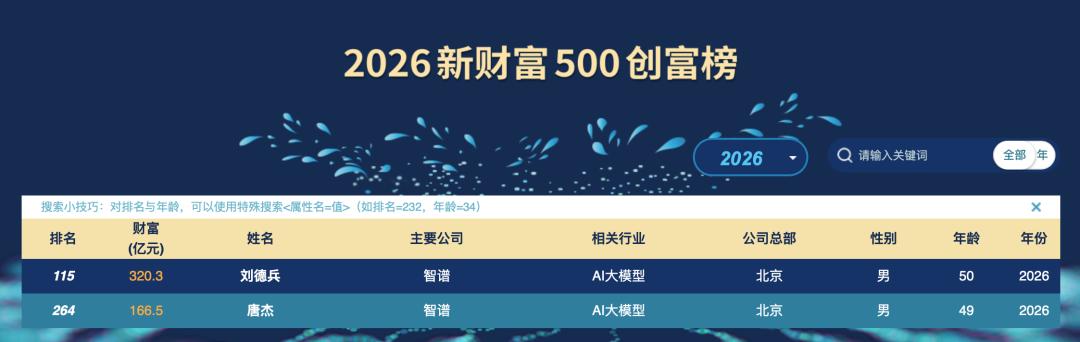
As Zhipu's market cap repeatedly hit new highs, the net worth of its two core founders, Liu Debing and Tang Jie, also skyrocketed. In the newly released "2026 New Fortune 500 Richest List," the duo made the list with holding values of RMB 32.03 billion and RMB 16.65 billion, respectively.
However, amid the soaring stock price, Zhipu remains in a persistent "money-burning" phase. Financial reports indicate that in 2025, Zhipu achieved revenue of RMB 724 million, up 131.85% year-on-year, but its net loss widened by nearly 60% to RMB 4.718 billion.
In response, Zhipu stated in its financial report that the increase in net loss was primarily due to sustained growth in R&D investment. In 2025, Zhipu's R&D expenses reached nearly RMB 3.2 billion, accounting for a staggering 439.09% of revenue.
Additionally, Leida Finance noted that Zhipu's "trillion-dollar market cap club" membership was short-lived. As of the market close on June 24, Zhipu's stock price stood at HK$2,174 per share, with a latest market cap of approximately HK$969.3 billion.
Zhipu's Brief Stint in the 'Trillion-Dollar Market Cap Club'
On June 22, Zhipu, hailed as the "first global large model stock," experienced a stock price surge, peaking at HK$2,980 per share during intraday trading, successfully joining the "trillion-dollar market cap club."
By the market close that day, Zhipu's stock price retreated to HK$2,410 per share, still up 15.09% from the previous trading day, maintaining its market cap at the trillion-dollar level.
However, Zhipu's trillion-dollar market cap could not be sustained. As of the market close on June 24, its stock price stood at HK$2,174 per share, with a latest market cap of approximately HK$969.3 billion, falling below the trillion-dollar threshold.
Despite the stock price retreat, Zhipu's latest market cap still surpasses those of established internet tech giants like Xiaomi, Meituan, JD.com, and Kuaishou.
According to Tianyancha information, Beijing Zhipu Huazhang Technology Co., Ltd. (referred to as "Zhipu") was registered and established in 2019. It is an AI enterprise focusing on the R&D and application of cognitive intelligence large models.
Zhipu's origins trace back to 2006 when Tsinghua University computer science professor Tang Jie developed AMiner, a tool to summarize patterns behind academic papers. His aim was to use AI to mine global scholars' papers and collaborations, constructing an academic map.
Although AMiner did not bring Tang significant wealth growth, its over-a-decade of technological accumulation laid the foundation for Zhipu's subsequent development. In 2019, Zhipu emerged from the technological achievements of Tsinghua University's Computer Science Department's Knowledge Engineering Laboratory (KEG).
In March 2021, Zhipu released its self-developed pre-training framework GLM, successfully breaking the bottleneck of BERT/GPT. The following September, Zhipu successfully developed China's first open-source hundred-billion-parameter base model, GLM-130B.
In 2023, Zhipu introduced China's first hundred-billion-parameter dialogue base model, ChatGLM. In early 2024, Zhipu released the new-generation base large model, GLM-4, taking the lead in benchmarking against GPT4 in China.
In the latter half of the same year, Zhipu successively released the multimodal model VideoCall, which aligns text/images/videos/sounds, the mobile agent AutoGLM, and the reasoning model GLM-Zero Preview.
Last December, Zhipu launched its new flagship model, GLM-4.7, which has been selected as the built-in model by numerous programming tools, once again stunning the industry.
Zhipu's continuous technological achievements have also attracted capital attention. Tianyancha shows that since its establishment, Zhipu has completed over ten rounds of financing, attracting numerous tech giants and renowned investment institutions, including Meituan, Ant Group, Tencent, Xiaomi Group, Hillhouse Capital, Shunwei Capital, and Sequoia China.
In December 2025, Zhipu officially submitted its prospectus to the Hong Kong Stock Exchange. The following month, Zhipu swiftly listed on the Hong Kong stock market, earning the title of "first global large model stock."
Five months after its listing on the Hong Kong Stock Exchange, Zhipu rapidly initiated the process of "returning to A-shares," planning to list on the Science and Technology Innovation Board with a proposed fundraising of RMB 15 billion.
Of this, RMB 12 billion will be used for artificial intelligence general-purpose base large models; RMB 2 billion for a large model MaaS one-stop service platform; and RMB 1 billion to supplement working capital.
Benefiting from the soaring stock price, Zhipu's two core founders successfully staged a "wealth myth." In the recently released "2026 New Fortune 500 Richest List," Liu Debing and Tang Jie made the list with holding values of RMB 32.03 billion and RMB 16.65 billion, respectively.
GLM-5.2 as Market Cap Catalyst, Founder Engages in Virtual 'Debate' with Musk
Analysts point out that the direct catalyst for Zhipu's recent stock price surge is the release and open-sourcing of its new flagship large model, GLM-5.2, on June 17.
Notably, this model is designed for long-term task capabilities, with core features including 1M lossless context, enhanced coding abilities, Day 0 adaptation to domestic computing platforms, and adoption of the MIT open-source license.
On the Artificial Analysis comprehensive leaderboard, GLM-5.2 scored an impressive 51 points, far surpassing domestic large models like MiniMax-M3 (44 points), DeepSeek V4 Pro (44 points), and Kimi K2.6 (43 points), ranking as the top open-source model SOTA and successfully joining the global large model first tier, forming a "new Big Three" pattern with Anthropic and OpenAI, the two global top large model companies.
Leida Finance noted that shortly before the release of GLM-5.2, overseas AI giant Anthropic's latest models, Fable5 and Mythos5, were subject to U.S. government export controls.
On June 12 (U.S. time), Anthropic issued a statement saying it received an urgent letter from the U.S. government at 5:21 PM that day.
Citing instructions from national security departments, the U.S. government issued an export control directive requiring Anthropic to immediately cut off access to its most advanced AI models, Claude Fable 5 and Mythos 5, for all foreign nationals (whether inside or outside the U.S., even including the company's own non-U.S. employees).
Anthropic stated that the U.S. government's move was based on a "serious misunderstanding" and warned that if the same standards were extended to the entire industry, all new deployments of cutting-edge models might effectively stall.
Shortly after the ban on top foreign models, Zhipu announced that GLM-5.2 would be fully open to all GLM Coding Plan users, covering Lite, Pro, Max, and team versions.
Zhipu explicitly stated: "At a time when some cutting-edge models have suddenly become unavailable, we choose to believe in another path: cutting-edge intelligence should not belong only to a few, nor should it be taken back at any time by a few rules. It should be open, available, buildable, and serve every developer."
Guolian Minsheng Securities pointed out that Zhipu's promotion of full GLM-5.2 access, API availability, and MIT open-sourcing is expected to meet the substitution demand of developers and enterprise clients for domestic cutting-edge models.
Notably, after GLM-5.2's launch, Zhipu's founder Tang Jie and Tesla/SpaceX founder Elon Musk engaged in a virtual "debate" over China's AI.
On June 18, a netizen asked on overseas social media, "When do you expect China's large models to reach Anthropic's Fable level?" Musk replied, "Probably Q1 2027." But Tang Jie retorted, "It won't take that long."
Musk then added, "Looking at various benchmark tests alone, that might be the case. But judging by practical, real-world value, even catching up by Q1 next year would be quite impressive."
At the same time, Musk emphasized that Anthropic focuses on refining intelligent capabilities with practical value, which cannot be reflected in benchmark rankings but can be tangibly converted into revenue.
Tang Jie replied, "Focus is the only thing we need, especially on what the essence of intelligence truly is..." Subsequently, Zhipu's official account also joined the discussion, posting three "taking notes" emojis.
Zhipu Yet to Cross Profitability Threshold Amid Stock Price 'Frenzy'
Despite reaching a new market cap high and surpassing the trillion-dollar mark, Zhipu is still in a continuous "money-burning" phase.
According to Zhipu's first annual report disclosed after its listing, in 2025, the company achieved full-year revenue of RMB 724 million, up 131.85% year-on-year; however, it has yet to cross the profitability threshold, recording a full-year net loss of RMB 4.718 billion, with the loss scale expanding by 59.5% from the previous year.
In terms of deployment methods, Zhipu's revenue mainly consists of two parts: cloud deployment and on-premises deployment.
Among them, on-premises deployment contributed RMB 534 million in revenue last year, up 102.3% year-on-year; cloud deployment contributed RMB 190 million, up 292.6% year-on-year.
Notably, starting in 2025, to more accurately reflect the company's strategic layout and business development essence, Zhipu has categorized its revenue into four segments based on business form and core product lines: open platform and API, enterprise-grade agents, enterprise-grade general large models, and technical services and others.
Specifically, in 2025, enterprise-grade general large models achieved revenue of RMB 366 million, up 70.5% year-on-year, accounting for 50.4% of revenue, clearly becoming the core engine of the company's revenue growth.
During the same period, Zhipu's open platform and API, enterprise-grade agents, and technical services and other segments contributed revenue of RMB 190 million, RMB 166 million, and RMB 2.544 million, respectively, up 292.6%, 248.8%, and 31.6% year-on-year.
However, in terms of profitability, due to the increased proportion of cloud deployment business and the periodic decline in gross margin of on-premises deployment business, Zhipu's overall gross margin decreased from 56.3% in 2024 to 41% in 2025.
Among them, affected by the phased increase in delivery costs due to diversified deployment demands, the gross margin of the company's enterprise-grade general large model business decreased from 69.6% in 2024 to 47% in 2025.
Additionally, the continuously growing R&D expenses are also eroding Zhipu's profits. Zhipu explicitly stated in its financial report that the increase in net loss was primarily due to sustained growth in R&D investment.
Data from Hithink RoyalFlush iFinD shows that from 2022 to 2025, Zhipu's R&D expenses were RMB 84 million, RMB 529 million, RMB 2.195 billion, and RMB 3.18 billion, respectively; accounting for a staggering 146.98%, 424.68%, 702.73%, and 439.09% of revenue.

During the same period, Zhipu's net losses were RMB 144 million, RMB 788 million, RMB 2.958 billion, and RMB 4.718 billion, respectively, with a cumulative loss scale exceeding RMB 8.6 billion over four years.
When will Zhipu, the beloved "domestic large model leader" among capital, achieve profitability? Leida Finance will continue to monitor.
-
![]()
NVIDIA-Backed AI Unicorn Secures $1.5 Billion Funding: Revenue Soars 2000%
-
![]()
Doubao Pro is Here: How Can Seed 2.1 Be Integrated into Real Processes?
-
"PCB Juice" Sees Four Consecutive Declines: Even Computing Power Material Suppliers Can't Lift This "Old Stock"
-
![]()
Potential 'Seismic Shift' in the U.S. TV Industry: Competition Shifts from Hardware Sales to Traffic Entry Points
-
![]()
Audi A6L's Defense in the Luxury C-Class Market: Following Huawei's Smart Driving Integration, Is Large-Battery HEV the Next Move?
-
![]()
Zhipu VS Minimax: A Chinese Reflection of Anthropic PK OpenAI
-
![]()
Dialogue with Trooly.AI: AI is Just the Pathway to Connect Authentic User Voices Directly to Brands
-
![]()
From January to May, New Energy Battery-Swap Heavy Truck Sales Surge 29% Year-on-Year, with Geely, XCMG, and Foton Daimler Leading the Pack