Industry and Information Tech Ministry Releases Crucial Notice on Power Battery and Vehicle Safety
 05/25 2026
 454
454
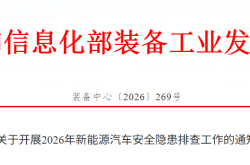
On May 21st, the Equipment Industry Development Center under the Ministry of Industry and Information Technology (MIIT) officially rolled out the Notice on Launching the 2026 Safety Hazard Investigation for New Energy Vehicles (Equipment Center [2026] No. 269). This notice sets the stage for a comprehensive annual safety hazard investigation in the new energy vehicle sector, with a particular emphasis on power battery and vehicle safety. 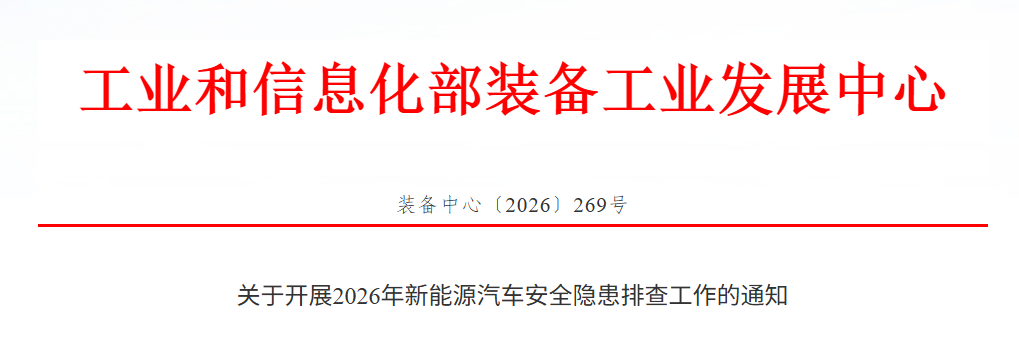 The investigation is guided by multiple regulatory frameworks, including the Measures for the Administration of Access of Road Motor Vehicle Manufacturers and Products, and is overseen by the MIIT's No.1 Equipment Industry Department. It encompasses five key areas: "product quality safety, operational monitoring safety, after-sales service safety, safety accident investigation, and self-assessment of safety system construction." Enterprises are mandated to complete the investigation and submit a detailed written report by August 1, 2026, thereby establishing a comprehensive, closed-loop safety management and control system that spans the entire supply chain and all relevant aspects.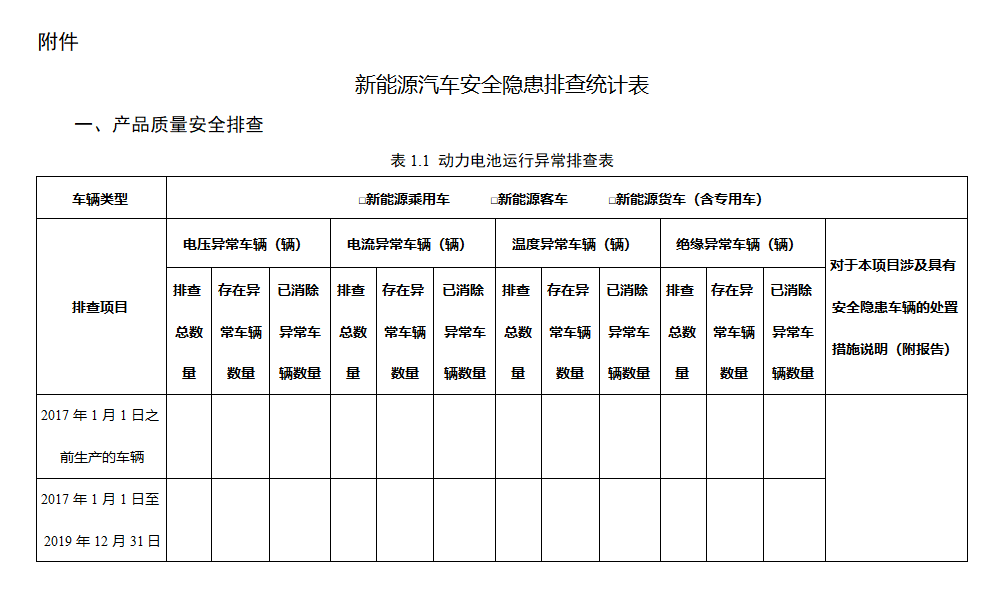
I. Power Battery Safety
The power battery stands as the cornerstone of new energy vehicle safety. This investigation mandates that enterprises work hand-in-hand with power battery manufacturers to conduct a thorough risk screening throughout the battery's lifecycle. The focus is on four primary abnormal conditions: Physical damage, such as battery casing damage resulting from collisions, deformation, or water exposure; Electrical anomalies, including potential hazards like excessive voltage, current, temperature, and reduced insulation performance; Degradation risks, involving the monitoring and risk assessment of batteries with high degradation rates; Extreme operating conditions, assessing the reliability of battery cooling and insulation systems under high-temperature, extreme cold, and high-humidity environments. The notice specifies that enterprises must devise specialized plans tailored to the actual usage scenarios of the batteries, promptly implement technical rectification measures for any issues uncovered during the investigation, ensure the safety and reliability of the power battery system, and mitigate the risk of accidents such as fires and electric leaks from the outset.
II. Vehicle Safety
The investigation into vehicle quality safety zeroes in on two critical areas: the safety of intelligent driving systems and adaptability to extreme operating conditions, aiming to comprehensively mitigate vehicle operational risks. Safety of intelligent driving assistance systems entails a thorough examination of faults in sensors, decision-making systems, and execution systems, with a particular focus on identifying system functional defects, performance shortcomings, and user misuse risks to avert safety accidents stemming from intelligent driving system failures or misuse. Operational safety in extreme scenarios involves investigating vehicle stability during startup and driving under special conditions like heavy rain, high temperatures, extreme cold, and high humidity, and reinforcing safety verification of key systems such as battery cooling and high-voltage insulation to guarantee safe vehicle operation in challenging environments. Simultaneously, for high-intensity operational vehicles such as trucks, taxis, and ride-hailing vehicles, enterprises are required to bolster operational monitoring of vehicles with extended cycles and high mileage, track safety status in real-time through technological means, and swiftly eliminate potential hazards.
III. Full-Chain Management and Control
Beyond core quality investigations, this notice further cements enterprises' full-chain safety management responsibilities and outlines multiple stringent requirements. Operational monitoring entails a rigorous examination of the completeness of vehicle access to enterprise monitoring platforms, with immediate special investigations and rectifications for vehicles that are offline for extended periods, frequently trigger level-three alarms, or are parked in large numbers in specific areas. After-sales service involves closed-loop disposal of fault alarm information and intensified user safety education, with a focus on organizing after-sales support for battery, motor, and electronic control suppliers whose cooperation has terminated to ensure the maintenance service quality of existing vehicles from merged or restructured enterprises. Accident management dictates that if three or more fire accidents occur in the same vehicle model, a special investigation must be launched, and rectification measures implemented; following an accident, basic information must be reported within 12/24 hours, a detailed report submitted within 5 days, and a technical analysis report uploaded within 15 days. Non-compliance will result in penalties such as interviews, notifications, suspension, or revocation of product announcements.
IV. Stringent Supervision and Robust Collaboration
This investigation represents a pivotal step by the MIIT to fulfill the requirement of "balancing development and safety" and serves as a specialized follow-up to the joint safety management deployment by three departments on May 14th. The notice clarifies that local industrial and information technology departments will collaborate with market supervision, fire rescue, and other units to forge a regulatory synergy. Enterprises found to conceal, omit, or provide false materials will face severe legal repercussions, compelling them to integrate safety management throughout the entire process of research and development, production, and use.
-
![]()
Commentary | The Second Fundamental Reason Behind the Sluggish Growth of China's AI Glasses Industry
-
![]()
Avita’s IPO Hits the Final Stretch: Examining 5 Key Questions Ahead of Its Listing Amid Changan’s Strategic Integration | Mingjing Pro
-
![]()
Industry and Information Tech Ministry Releases Crucial Notice on Power Battery and Vehicle Safety
-
![]()
OPPO Reno16 Pro Review: POP Camera is Fun and Performance is Finally Up to Par!
-
![]()
Weekly Stock Review | A-Shares Buck the Trend with a Plunge: Have You Been Caught in the Sell-Off?
-
![]()
Short Dramas Embark on Global Journey with Full Momentum: Who's Quietly Profiting Behind the Scenes?
-
![]()
Epic Restructuring of the Color TV Industry Set to Begin in 2026
-
![]()
AI Recruitment Accelerates Growth for Platforms like BOSS Zhipin