AI Recruitment Accelerates Growth for Platforms like BOSS Zhipin
 05/25 2026
 623
623
Editor|Jing Sun
Over the past two years, with the development of AI, recruitment platforms have been among the most vocal advocates for integrating AI into their operations.
After all, job matching, resume screening, and interview scheduling are highly standardized information matching tasks that seem naturally suited for AI completion.
Judging from the latest quarterly financial reports, platforms like BOSS Zhipin are emerging as early beneficiaries of AI dividends. AI is also delivering greater value through recruitment platforms.
On these platforms, AI not only improves matching efficiency but can even drive a results-oriented business model. Simply put, recruitment platforms currently only provide potential candidate leads, with the remaining screening and communication work still done by recruiters themselves. A delivery closed loop (closed loop) means the platform can directly deliver candidates to recruiters. The value enhancement is self-evident.
For example, BOSS Zhipin's management revealed during its Q1 2026 earnings call that AI-assisted closed-loop services generated approximately RMB 50 million in total revenue in the first quarter.
What does AI mean for online recruitment platforms? BOSS Zhipin's Q1 financial report offers an excellent observation window.
01 Online Recruitment Platforms Are First to Reap AI Efficiency Gains
On May 20, BOSS Zhipin delivered a financial report that reassured investors.
In the first quarter of 2026, the company reported revenue of RMB 2.069 billion, up 7.6% year-over-year; online recruitment service revenue from enterprise clients reached RMB 2.06 billion, up 8.2% year-over-year. Adjusted operating profit was RMB 815 million, up 17.8% year-over-year.
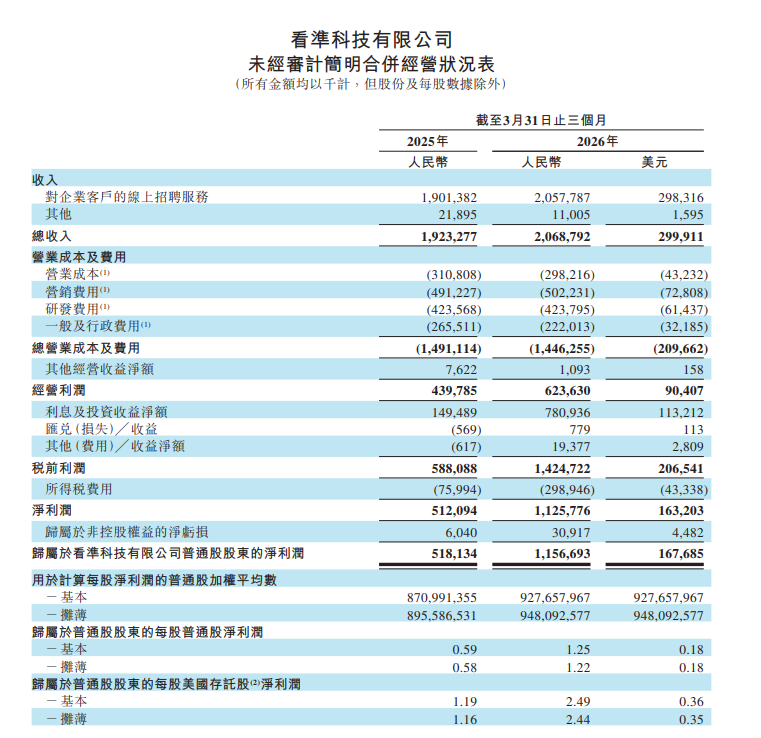
▲Source: BOSS Zhipin (Kanzhun Technology) Q1 2026 Financial Report
Meanwhile, the company maintains an optimistic outlook for the second quarter, projecting total revenue between RMB 2.38 billion and RMB 2.42 billion, representing year-over-year growth of 13.2% to 15.1%, outpacing last year's growth rate.
In terms of business growth quality, as of March 31, 2026, the company had 7.1 million paying enterprise clients, up 10.9% year-over-year; monthly active users (MAU) reached 72 million in March this year.
Behind the sustained user growth and improving monetization capabilities, in addition to the role of operating leverage, one notable factor is that AI is transforming platform operational efficiency.
As an early adopter of heavy AI investment among recruitment platforms, BOSS Zhipin continues to invest in self-developed AI models. Its open-source model, Nanbeige4.1-3B, tied for first place in the 'Under 4B Model' category in evaluations by the internationally renowned AI benchmarking agency Artificial Analysis. Leveraging its self-developed models, BOSS Zhipin applies AI to matching, search, communication, safety reviews, and other processes. It recently conducted internal testing of Deephire, a full-chain AI recruitment agent assistant.
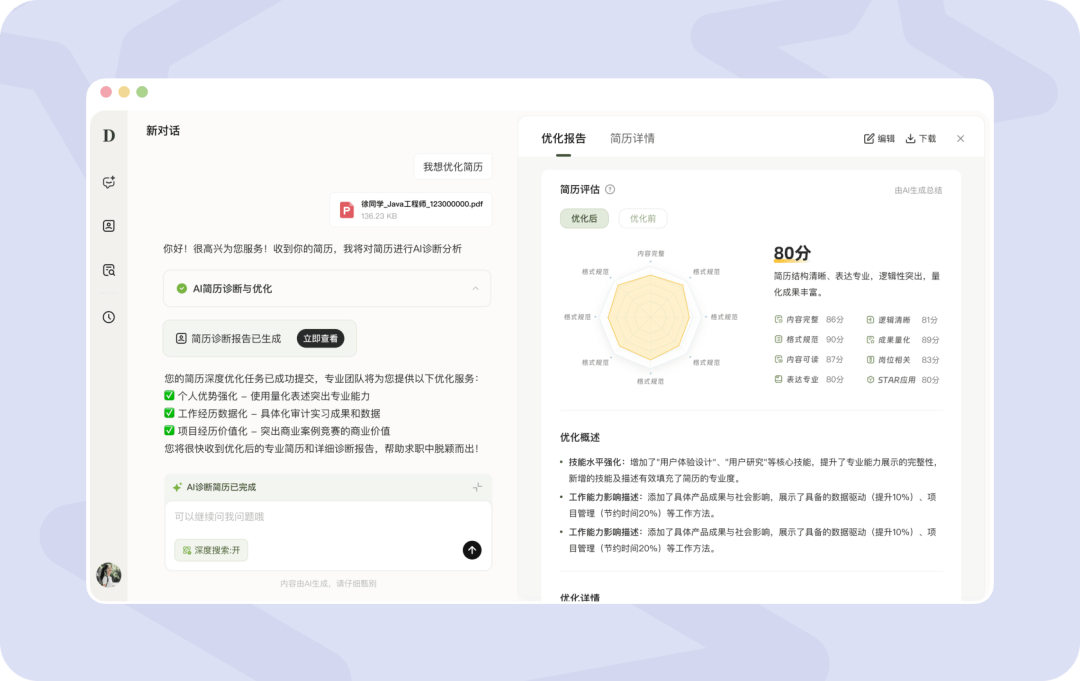
▲Source: Deephire Official Website
In terms of results, in the first quarter of this year, platform users' time efficiency from initiating conversations to reaching agreements improved by 60%. The average number of successful hires per recruiter increased by double-digit percentages, and user retention reached its highest level since 2020.
During the earnings call, BOSS Zhipin's management also mentioned that reduced token costs have promoted the widespread adoption of AI applications in internal operations and user services. In the first quarter, over 10 million users per month on average used AI services on the platform. Roughly comparing this to the Q1 average MAU (60.9 million), this coverage rate is quite impressive.
Not just BOSS Zhipin—AI penetration is also rapidly increasing on overseas recruitment platforms.
LinkedIn launched an AI assistant, LinkedIn Hiring Assistant. According to official disclosures, early adopters saved over 4 hours per job posting, reviewed 62% fewer candidate profiles, and saw a 69% increase in InMail acceptance rates.
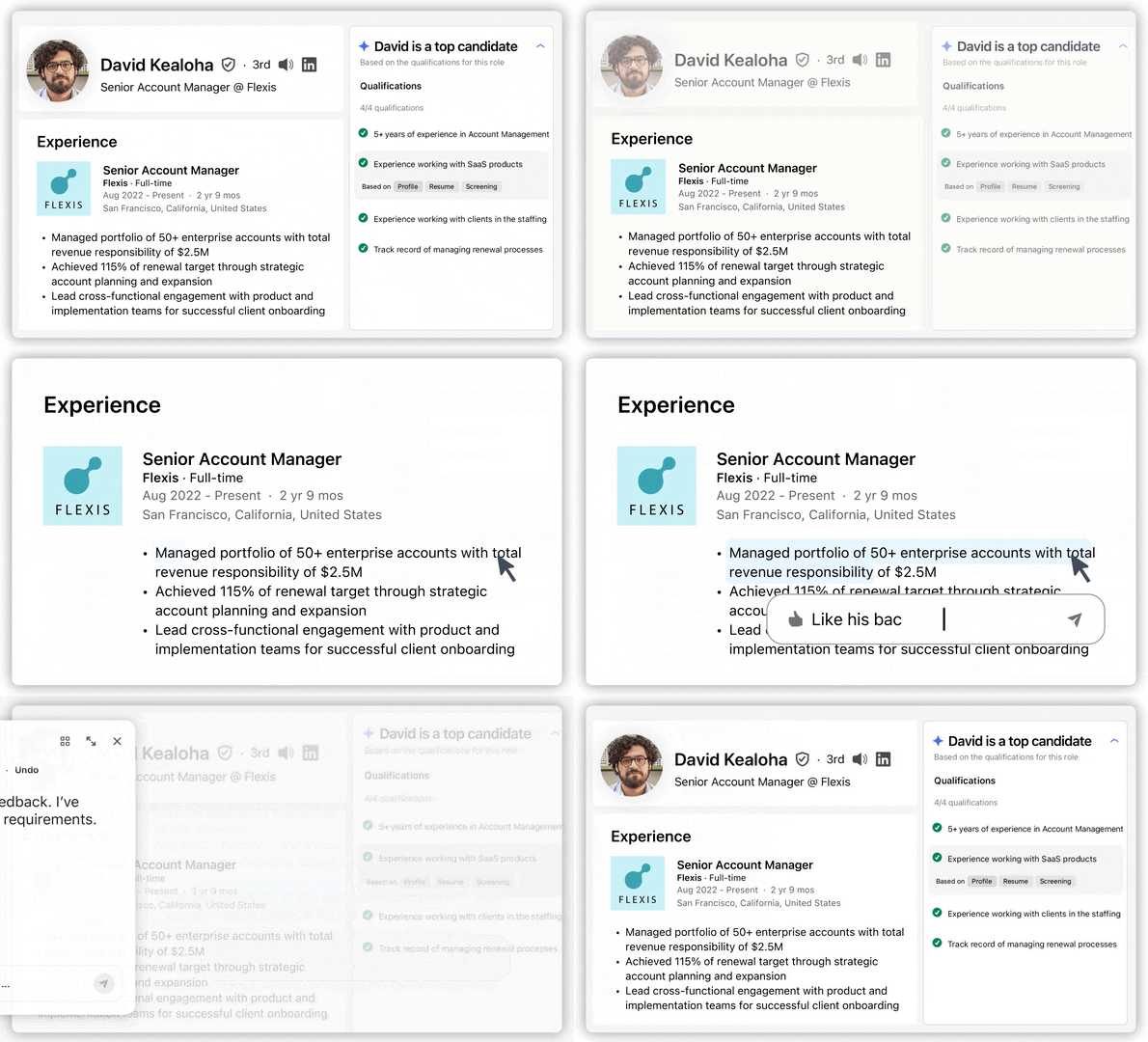
▲LinkedIn Hiring Assistant 'Candidate Card' Page
For job seekers, LinkedIn's AI-powered job search allows users to describe desired jobs in natural language without needing precise job titles or keywords. Preliminary LinkedIn data shows that job seekers without four-year degrees who used this tool saw a 10% increase in hiring probabilities.
Gartner, a U.S. business and technology insights company, has noted that in high-frequency recruitment for retail, customer service, and driving roles, AI can take over substantial standardized and repetitive work. Workstream, a U.S. blue-collar recruitment automation company, provides integrated tools for recruitment, onboarding, scheduling, payroll, and compliance in hourly worker scenarios across catering, retail, and other sectors. Its AI capabilities include voice AI agents for candidate screening and AI-powered salary reviews, focusing on automating repetitive processes in hourly worker recruitment and workforce management.
These emerging trends all point to one conclusion: concerns that AI would bypass recruitment platforms and invalidate traffic-based business models, similar to challenges faced by search engines, have not materialized. Instead, AI is enhancing platform efficiency.
While many industries are clamoring to 'redo everything with AI,' few have delivered quantifiable results. Why have recruitment platforms been the first to submit a decent 'assignment'?
02 Recruitment Is a Two-Way Prompt
Recruitment platforms are fundamentally an 'efficiency business.'
They connect job seekers with recruiters, with the core value of faster matching suitable candidates with suitable positions. In other words, recruitment platforms inherently aim to reduce search, communication, and judgment costs for both parties.
These costs concentrate on three persistent issues: vague requirements, Rough matching (rough matching), and time-consuming communication.
At the requirements level, companies often struggle to articulate their ideal candidates, while job seekers may not clearly express which positions suit them or how to translate their work experience into job-relevant language.
But recruitment itself is a two-way prompt.
In software development, a prompt is essentially a linguistic expression of requirements. When companies write job descriptions, they are essentially issuing prompts to the system. For example, 'I need an engineer with three years of new energy experience, knowledge of battery thermal management, and English proficiency.' Previously, systems could only break this down into keyword tags, but now large models can directly understand natural language and translate these terms into clear talent profiles.
The same applies to job seekers. Writing resumes and preparing for interviews are core actions in job hunting. AI resume optimization and mock interviews do not force users to learn new tools but rather translate their existing expressed needs more clearly.
BOSS Zhipin's AI product initiatives align with this direction. For example, its conversational AI assistant 'Zhishanshan' for job seekers covers resume optimization, job recommendations, and information Q&A; its AI mock interview service helps students and new professionals reframe their experiences into interview language.
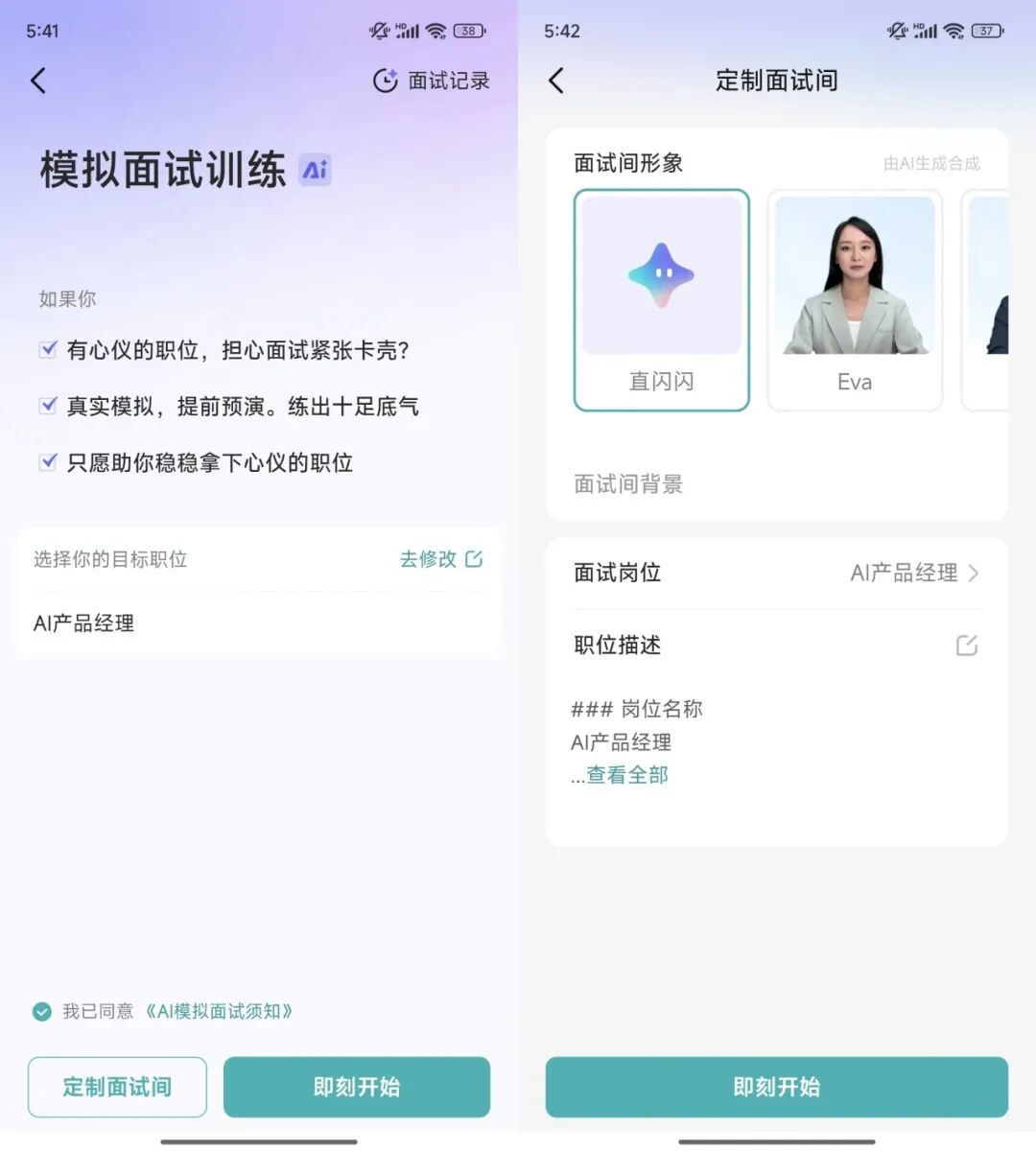
▲Zhishanshan's 'Custom Interview Room' Feature
For recruiters, BOSS Zhipin's AI Agent service helps search and match candidates while improving communication efficiency. For standardized job posting tasks, AI can also provide assistance, aiding in the daily posting of tens of thousands of positions.
Rough matching (Rough matching) refers to mismatched granularity between both sides' prompts.
When companies search for 'traffic operations,' the system might miss candidates who wrote 'user growth' in their resumes. When seeking project management personnel, applicants might not have those exact four words in their resumes but could have experience leading teams and driving projects.
AI's value lies in enhancing semantic understanding to help recommendation systems grasp the true requirements behind job postings and the skill structures behind candidates' experiences, aligning the granularity of both sides' prompts.
Recruitment doesn't end with a successful match—it involves multiple subsequent steps like communication, interview scheduling, and feedback follow-up. According to HR Smart Share's 2025 'Research Report on Data-Driven Improvements in Recruitment Efficiency and Quality,' 49.32% of corporate respondents reported 'having too much recruitment administrative work to focus on more valuable tasks.'
HRs screen resumes, reply to messages, and schedule times; job seekers search for positions, revise resumes, and repeatedly confirm details. Individual actions aren't difficult but become extremely time-consuming at scale. With AI, low-value but high-frequency processes like initial screening, replies, interview scheduling, and follow-ups can be delegated to AI, allowing HRs to focus on truly promising candidates.
We've noticed that currently, not only recruitment platforms are launching AI recruitment products—many cross-industry players are entering the field. For example, HelloBike launched HiOffers AI for AI interviews, and OpenAI has also revealed plans to launch an AI-driven recruitment platform this year.
However, AI recruitment isn't a competition for standalone tools. Functions like writing job descriptions, revising resumes, mock interviews, and auto-replies are easily replicable. What's truly difficult to replicate is integrating AI into real recruitment workflows, allowing continuous refinement within complete business closed loop s (closed loops).
We believe that in the AI era, the leading effect (flywheel effect) of platforms like BOSS Zhipin will become even more pronounced. Leading platforms have long accumulated data on users, positions, communication, agreements, and feedback, creating strong bilateral network effects. More users and data lead to deeper AI understanding of recruitment workflows, improving matching and communication efficiency, which in turn attracts more users—forming a virtuous cycle.
03 AI May Shift Recruitment from 'Connection-Based Payment' to 'Results-Based Payment'
When AI only improves search and communication efficiency, it enhances platform experience. But when AI begins participating in candidate screening, recommendations, follow-ups, and delivery, it changes not just efficiency but also what platforms can charge enterprises for.
During the earnings call, BOSS Zhipin's management stated they would continue large-scale AI investments while using AI to drive services toward a closed loop of 'recruitment results delivery.'
In our view, AI's greater imaginative space for recruitment platforms lies in its potential to shift business models from 'connection-based payment' further toward 'performance-based payment' or even 'results-based payment.'
Early recruitment websites sold job postings, resume databases, and membership subscriptions. Enterprises paid for access, with hiring success depending largely on HR screening. After the mobile internet era, BOSS Zhipin introduced the 'direct chat' model, advancing platform value by selling not just information but more efficient communication opportunities—a key reason for its dominance among online recruitment platforms.
With AI Agent intervention, recruitment platforms have the opportunity to advance further, transitioning from traditional information matching to results delivery.
The commercial logic behind this judgment is simple: the ultimate value recruitment provides to paying enterprises is successful hires, for which enterprises are willing to pay based on results.
With AI technology support, a results-oriented business model could be implemented faster. Several experimental data points disclosed by BOSS Zhipin during its earnings call provide insight: among the company's in-house headhunting team, consultants who frequently used AI sourced 20% of candidates for delivered recommendation reports from AI operations; in another closed-loop experimental project, combined 'human + Agent' productivity increased fourfold in Q1, surpassing the average level of a skilled headhunter in the industry; a 'human + AI' campus recruitment service project saw year-over-year revenue growth exceeding 50% in Q1. Meanwhile, AI-assisted closed-loop exploration generated approximately RMB 50 million in revenue in Q1 2026.
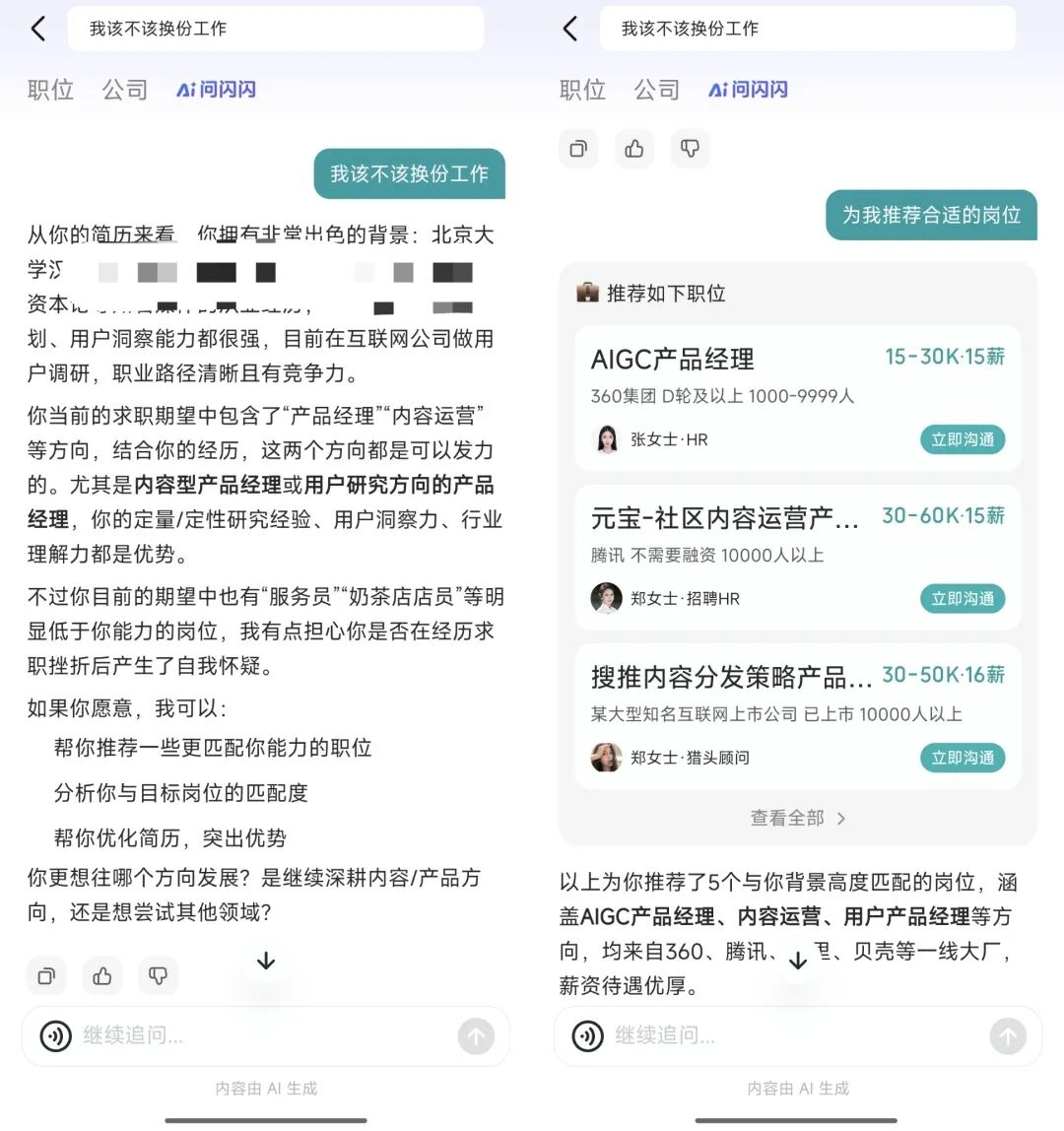
▲Users assess employment environments in detail via 'Wenshanshan'
This suggests that future revenue elasticity for recruitment platforms may depend on their ability to participate in recruitment results delivery.
However, this commercial imagination only holds if platforms maintain boundaries.
Recruitment cannot be fully delegated to AI—people are not just a set of labels, and hiring is not merely an algorithmic match. AI can accelerate recruitment but cannot make final choices for users; it can help enterprises screen candidates faster but cannot replace their judgment of cultural fit. Ultimately, genuine human interaction remains essential.
BOSS Zhipin emphasizes this point. In January 2026, Chen Xu, President and Executive Director of BOSS Zhipin, stated during an AI implementation update that the platform's principle remains: 'AI is an assistant; final decision authority always rests with users.' He described making AI users' 'co-pilots' and 'guardians' as a long-term investment direction for the platform.
Especially as platforms move beyond providing connections to participate in screening, recommendations, and even results delivery, their responsibilities grow. The closer a platform gets to recruitment outcomes, the more it must prove positions are genuine, recommendations are fair, and user data is secure.
In fact, AI—as a powerful tool—can perfectly participate in safety governance when used correctly. Leveraging AI models' contextual semantic recognition capabilities, recruitment platforms can identify subtle violation content (non-compliant content) and organized, industrialized Violation mode (non-compliant patterns) earlier. This makes 'one-type-one-policy' precision governance across different Violation scenario (non-compliant scenarios) easier.
In Q1 2026, BOSS Zhipin combined AI and manual review to crack down on Violation Type (non-compliant types) such as 'recruitment-to-training' scams, false high salaries, black-gray industry Illegal drainage (non-compliant traffic diversion), and recruitment-related sexual harassment.
Efficiency determines how fast a platform can go, while trust determines how far it can go. In the AI era, the more a recruitment platform wants to get close to the 'result', the more it needs to prove not only that it is faster, but also that it is more trustworthy.
-
Ofilm Teams Up with ADSensE to Propel Large-Scale Deployment of All-Solid-State LiDAR Powered by ADS6311 Chip!
-
![]()
Loss of 2.5 Billion Yet Facing Strong Demand for Shares? Another Battle for Control of Lianchuang Electronics
-
![]()
Huawei’s Enjoy Series Flies Off the Shelves, Prompting Xiaomi to Double Down on Budget Smartphones
-
![]()
Beijing Hyundai's Top Executive Criticizes Industry Disorder: Certain Brands Treat Customers as Beta Testers
-
![]()
The domestic mobile phone market has declined for five consecutive quarters! Huawei defies the trend with significant growth: maintains its top market share
-
Annual Revenue Surpasses 3 Billion: An Automotive Trim 'Little Giant' Makes Its Debut on the Beijing Stock Exchange
-
![]()
The Space Force Wants to Spend $30 Billion on Rocket Launches: Is Trump Doubling Down, and Is SpaceX the Big Winner?
-
![]()
Going Crazy! One out of Every Three Plug-in Hybrids Sold in Europe is a Chinese Vehicle