Short Dramas Embark on Global Journey with Full Momentum: Who's Quietly Profiting Behind the Scenes?
 05/25 2026
 624
624
Author/ Meng Huiyuan
Editor/ Li Wenjie
Layout/ Annalee
As many lament that "short dramas have achieved in one year what long dramas took a decade to accomplish," the post-short-drama era has witnessed global expansion becoming an essential pursuit for industry players.
DataEye's "2026 Overseas Micro-Drama Market Insights" reveals that 2025 marks the year of explosive growth for overseas micro-dramas, with the market size surpassing US$4 billion and projected to exceed US$5 billion (approximately RMB 35 billion) in 2026. Currently, the monthly active user base for overseas micro-dramas has reached 100 million, presenting tremendous growth potential compared to the global 1.8 billion short video users.
However, behind these soaring figures lies a fierce "money-burning race": COL is projected to incur a net loss ranging from RMB 580 million to 700 million in 2025; Crazy Maple Studio (the parent company of ReelShort) shifted from profit to loss in 2025, with a net loss exceeding RMB 85 million. Industry feedback indicates that 80% to 90% of overseas projects fail to recoup their costs.
Amid this content-side hemorrhage, a group of technology service providers have emerged as a rising force against the trend.
Hangzhou Xiaoying Technology has significantly reduced dubbing costs from RMB 1,500-3,000 per title to RMB 300-500 using AI, boosting monthly output from around 10 titles to over 1,000. Guangzhou Quwan Qianyin, leveraging its MaskGCT voice large model co-developed with The Chinese University of Hong Kong (Shenzhen), can mass-produce 3,000 minutes of dubbed content daily. Changsha Malanshan Dubbing Center utilizes self-developed AI algorithms to complete translation and dubbing for a 120-minute micro-drama in just 4-5 hours, achieving over 95% accuracy...
Clearly, amid the collective rush of short dramas going global, these "shovel sellers" are leveraging technological innovation and efficient services to become the most certain beneficiaries in this sector.
Precise Harvesting Through Efficiency and Cost Advantages
Undeniably, translation and localization remain persistent bottlenecks for content creators during rapid global expansion.
For instance, certain humorous segments popular in Asia may be completely incomprehensible or even offensive to Western audiences. Plot elements tied to specific cultural contexts, if not properly localized, leave overseas viewers confused and unable to emotionally connect.
While human translation ensures accuracy and cultural nuance to some extent, its high costs and lengthy cycles have become unbearable burdens for content creators. This is especially true when facing massive volumes of short drama content requiring rapid translation for international markets, where human translation's limitations become increasingly apparent.
Frankly speaking, human translation faces three major challenges: limited capacity, long cycles, high costs, and difficulty in scaling. AI's intervention is now dramatically reshaping this landscape.
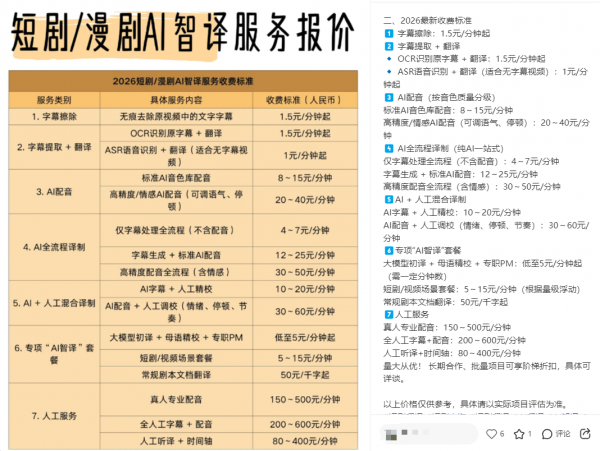
Source: Xiaohongshu
At this stage, players are adopting different strategies.
Xiaoying Technology has chosen a SaaS tool approach, providing "one-stop" creative support for overseas enterprises through AI dubbing, multilingual translation, highlight editing, and other toolchains. Its AI dubbing efficiency exceeds human capabilities by over 100 times, with monthly production capacity surpassing 1,000 titles. This effectively addresses content creators' most urgent need for rapid scaling.
When efficiency ceases to be an issue, "who pays the bill" becomes the core variable determining the sector's success. By June 2025, Stardust TV under Shanhai Xingchen had completed all translation work in-house, shifting from outsourcing to 100% internal processing, with monthly delivery exceeding 1,000 episodes. Production capacity increased over 500% compared to 2024, achieving translation and release within 2 hours at the fastest. This strategic move propelled it to the top of overseas short drama revenue rankings, securing an early advantage in fierce market competition.
Hangzhou Judian Network Technology Co., Ltd.'s practice demonstrates that even small and medium-sized players can quickly keep pace with AI. Its AI agent automates the entire process from subtitle extraction to video synthesis through "multimodal translation" technology, completing translation for a short drama in just seconds compared to 1-2 days previously.
With AI's significant advantages in efficient mass production emerging en masse on one side, and the production capacity gap in short drama globalization expanding at an alarming rate on the other, it's clear that technology service providers are naturally taking on this surging wave of rigid demand amid the subtle interplay of supply and demand rhythms.
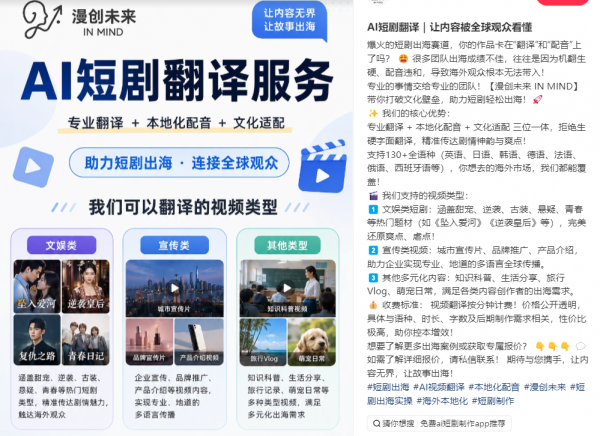
Source: Manchuang Weilai IN MIND
Unlike frontend content producers' fierce internal competition and uneven profitability, technology service providers, through lightweight and standardized product delivery strategies, not only effectively reduce costs and boost efficiency but also achieve relatively stable growth with scalable expansion capabilities.
Crucially, when leading short drama platforms like FlexTV adopt lightweight operation strategies combining "third-party procurement with AI-assisted translation" to cut costs and shed heavy asset operations, technology service providers' market demand and pricing power receive significant enhancement.
This closed loop—"the more intense industry competition becomes, the greater the need for cost reduction and efficiency gains, the more stable technology service providers' benefits"—makes AI translation service providers rare counter-cyclical growth players in the short drama globalization supply chain.
How They Became the 'Utilities' of Overseas Short Dramas
True industry maturity often hinges on key sectors achieving infrastructuralization—currently, AI translation service providers are undergoing such a profound transformation.
When technological capabilities, business models, and ecological niches perfectly converge and superimpose, a new industry standard quietly takes shape.
Technological moats form the foundation.
Quwan Qianyin, based on its MaskGCT voice large model co-developed with The Chinese University of Hong Kong (Shenzhen), achieved multi-dimensional decoupling editing of semantics-emotion-timbre-prosody. Finished dubbed content not only ensures linguistic accuracy but also conveys the original's emotional warmth, effectively breaking through early AI tools' "mechanical reading and emotional void" dilemma.
Meanwhile, the platform supports dubbing and generation in 40 languages, with daily capacity reaching 3,000 minutes of content. It has formed strategic partnerships with global leading short drama platforms like FlexTV, helping FlexTV achieve weekly multilingual localization adaptation for 400 short dramas, enabling true "global daily updates."
Malanshan Micro-Drama Intelligent Dubbing Center took a "public infrastructure" path. As an innovative platform jointly built by the government, research institutions, and content platforms, it integrates AI video algorithms including large language models, voice cloning, and subtitle recognition, supporting translation output in over 20 languages.
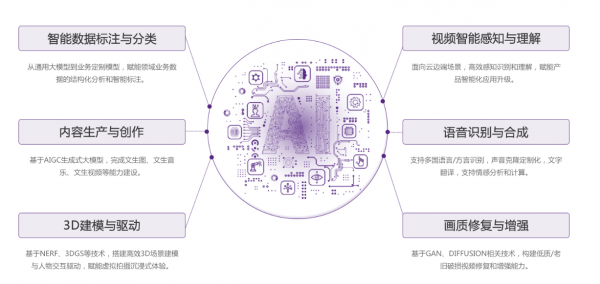
Source: Malanshan Audio-Visual Laboratory official website
Building on this, Malanshan further integrated full-process functions like pre-compliance review and automated transcoding, packaging all capabilities required for content globalization into one-stop services, significantly boosting compliance and distribution efficiency for SMEs. This model upgrade signifies that the "utilities" of the short drama globalization industry have evolved from mere technological tools into "review-dubbing-distribution" full-link integrated platforms.
Business model evolution drives single-service delivery toward scaled delivery.
Take Shanhai Xingchen as an example. Through a multilingual closed-loop process combining "AI collaboration + human refinement," it built its proprietary content production technology platform, pushing advertising consumption for dubbed dramas to nearly 50% of total spending, demonstrating stronger user retention and paid conversion across multiple regional markets.
Similarly, StoReel completely reshaped content production processes with AI avatar technology. By late March 2026, the platform had secured US$34 million in financing, comprising a US$9 million Seed round led by Play Ventures and a US$25 million user growth round from PVX Partners, becoming a capital-favored new force in the AI short drama sector.

Source: StoReel video channel
These cases powerfully demonstrate that technology service providers' roles have transcended traditional "backend tool" limitations, gradually marching toward the core areas of "frontend production" and deeply penetrating the entire lifecycle of overseas content from creation, dubbing, review to distribution.
Critically, the convergence and collaboration of multiple forces are driving profound changes in industrial division of labor, with a clearer pattern emerging: platforms focus on upstream IP and content procurement and downstream user operations, while technology service providers undertake key processes like AI production, multilingual localization, and compliance review.
When overseas platforms slash costs to 1/5 to 1/10 of human translation costs while boosting efficiency 5 to 20 times through AI translation technology, enabling resource focus on core links, the entire industry's competitive logic is quietly being reshaped.
The more platforms rely on third-party AI services or self-developed platforms for lightweight operations, the more significant technology service providers' voice becomes in setting technical standards, data pricing, and service rules.
Essentially, leading technology service providers can continuously accumulate three core data assets through sustained delivery: multilingual corpora, voice timbre libraries, and user preference models. These assets construct formidable barriers and first-mover advantages: even if new entrants possess basic AI capabilities, they cannot quickly accumulate industry-specific data and model adaptation experience on the same scale.
From this perspective, the short drama globalization field is exhibiting winner-takes-all characteristics with intensifying Matthew effects, and technology players with infrastructure-level service capabilities will undoubtedly become core winners anchoring long-term value.
-
Ofilm Teams Up with ADSensE to Propel Large-Scale Deployment of All-Solid-State LiDAR Powered by ADS6311 Chip!
-
![]()
Loss of 2.5 Billion Yet Facing Strong Demand for Shares? Another Battle for Control of Lianchuang Electronics
-
![]()
Huawei’s Enjoy Series Flies Off the Shelves, Prompting Xiaomi to Double Down on Budget Smartphones
-
![]()
Beijing Hyundai's Top Executive Criticizes Industry Disorder: Certain Brands Treat Customers as Beta Testers
-
![]()
The domestic mobile phone market has declined for five consecutive quarters! Huawei defies the trend with significant growth: maintains its top market share
-
Annual Revenue Surpasses 3 Billion: An Automotive Trim 'Little Giant' Makes Its Debut on the Beijing Stock Exchange
-
![]()
The Space Force Wants to Spend $30 Billion on Rocket Launches: Is Trump Doubling Down, and Is SpaceX the Big Winner?
-
![]()
Going Crazy! One out of Every Three Plug-in Hybrids Sold in Europe is a Chinese Vehicle