The Arrival of FSD: A Boon for Chinese Automakers
 05/26 2026
 426
426
Source | Bohu Finance (bohuFN)
After much anticipation, Tesla's FSD (Full Self-Driving, which literally translates to “完全自动驾驶” in Chinese) is finally set to enter the Chinese market.
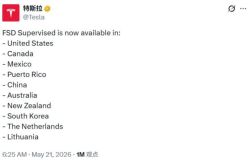
On May 21, Tesla's official X account announced that the FSD Supervised version is now available in 10 countries, including China.
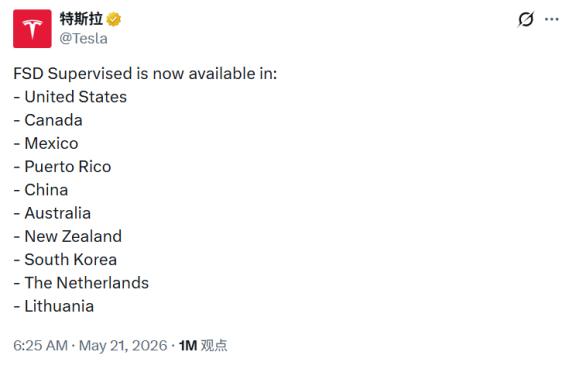
However, a review of Tesla's social media activity over the past year reveals that the official stance has consistently been that the "FSD Supervised version is available in China." Strictly speaking, this latest announcement does not bring entirely new information.
Nevertheless, Tesla's recent actions in China suggest a more proactive approach: the official launch of the Shanghai AI Training Center, a surge in recruitment for intelligent driving positions, and Elon Musk's visit to China—all these steps collectively indicate a clear strategic direction.
Of course, the intelligent driving capabilities of domestic new energy vehicles have significantly improved, and Tesla's FSD may no longer hold a decisive advantage.
However, beyond the competition in intelligent driving, FSD's entry into China carries another layer of significance: it could potentially open up a new market segment for domestic intelligent driving software services. As hardware competition reaches its limits, could software services become the new battleground in the new energy vehicle market?
01 A Prolonged Tug-of-War
The introduction of Tesla's FSD into China has become a "boy who cried wolf" scenario.
In 2019, Tesla China launched the FSD optional package on its official website, labeled as "coming soon," leaving customers waiting for seven years. During this period, Elon Musk repeatedly stated that "FSD will enter China soon," but it repeatedly failed to materialize.
It wasn't until February 2025 that Tesla China announced a limited-time free trial of FSD, which was suspended after just one week, primarily due to pending compliance approvals.
One notable detail is that after suspending FSD rollouts in China, Tesla promptly changed the description on its Chinese website from "FSD Intelligent Driving Assist" to simply "Intelligent Driving Assist."
The removal of "FSD" implies that FSD in China does not enable fully autonomous driving without human supervision but rather operates as an L2-level assisted driving system requiring driver oversight. This version is also known as the FSD Supervised version.
Subsequently, Tesla's intelligent driving capabilities have largely remained at the city-road Autopilot level, with only a few models equipped with HW4.0 hardware supporting the FSD Supervised version.
However, Tesla's official statements regarding FSD's entry into China have remained cautious.
For instance, the recent announcement used the phrase "available in," meaning the FSD Supervised version is "usable" in China. This is not a new claim by Tesla, as similar phrasing has been used in multiple tweets over the past year.
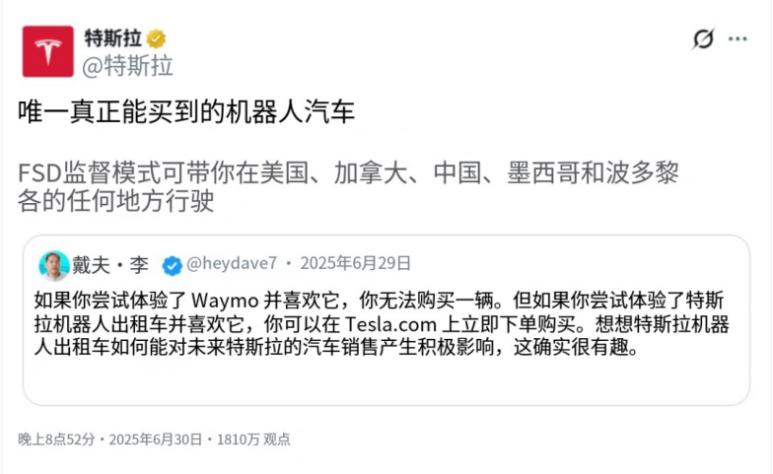
Yet, there is a difference between "being usable" and "being widely used," which is what Tesla has been striving for over the past year.
In February of this year, Tao Lin, Tesla's Vice President, stated that there was no specific timeline for the FSD Supervised version's launch in China, but efforts were progressing steadily. In April, Tesla's CFO publicly stated that they aimed for full approval by the third quarter.
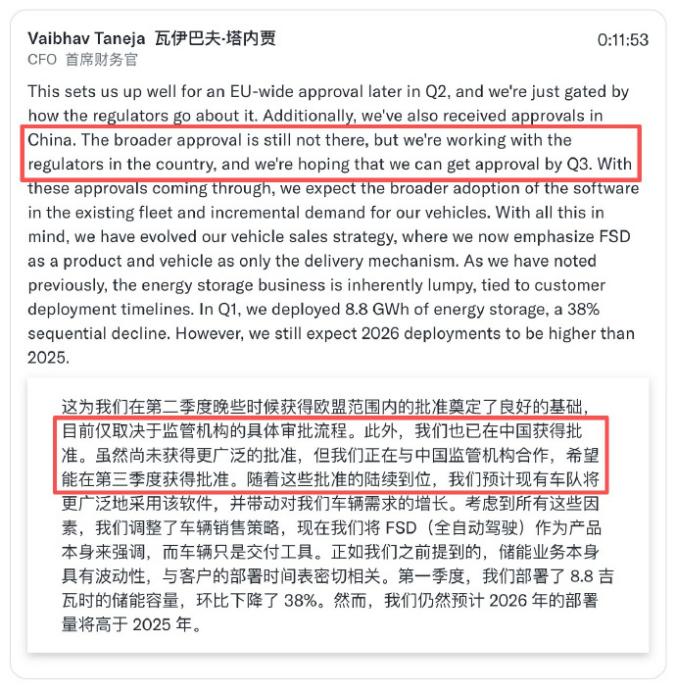
Thus, rather than saying FSD Supervised has already entered China, it would be more accurate to say it has been "present" in China, with ongoing approvals regarding its widespread rollout and the specific intelligent driving assist functions it will offer.
Nevertheless, various signs indicate that Tesla owners may not have to wait much longer.
Firstly, the data security issue has been resolved. In February of this year, Tesla's AI Training Center in Shanghai officially commenced operations, completing a localized model training closed loop. This is considered a core prerequisite for FSD's entry into China.
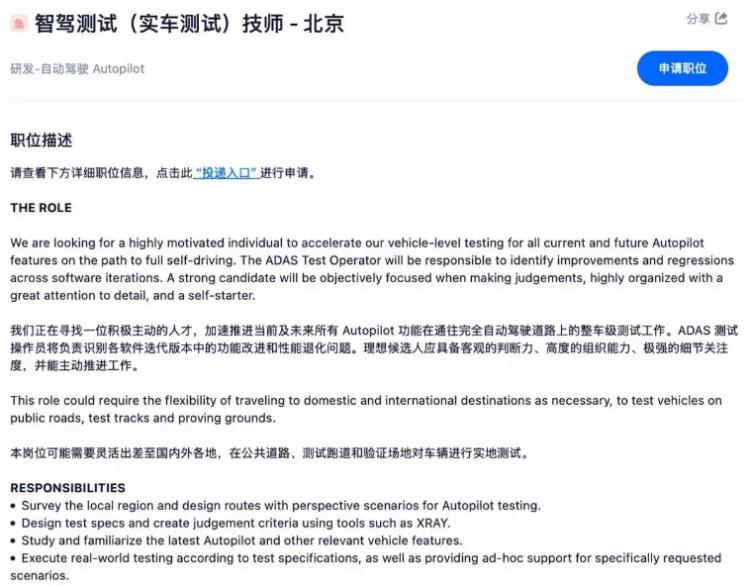
Secondly, FSD is accelerating its localization. Recently, Tesla has intensively opened multiple intelligent driving-related positions in China, including autonomous driving data annotators and on-road real-vehicle testing engineers in various cities.
These actions point toward a single goal: enabling FSD to truly operate in the Chinese market. Facing the more complex road conditions in China, accumulating sufficient local data is essential; otherwise, autonomous driving remains merely theoretical, regardless of how advanced the model is.
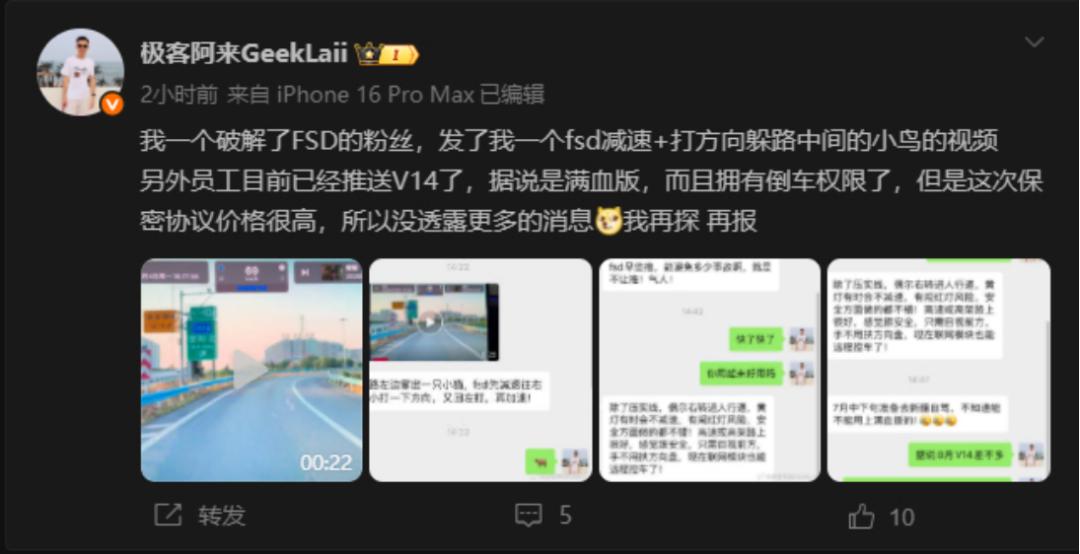
Additionally, there are whispers in the automotive circle that Tesla employees are internally testing the full-featured FSD Supervised version.
Behind this prolonged tug-of-war lies a multifaceted strategic maneuvering between China and the United States.
On the surface, the issues to be resolved are driving safety and system compliance, but in reality, this represents China's constraints on "data sovereignty" over core technologies such as artificial intelligence and autonomous driving in the AI era.
For Tesla to access China's intelligent driving market, it must make concessions on data sovereignty. In return, Musk has offered incentives such as domestic data training, increased infrastructure development, and job creation.
02 Why is Musk in a Hurry?
Almost simultaneously with SpaceX filing its prospectus, Musk is poised to become the world's first trillionaire.
For an entrepreneur who has been repeatedly reported by the media to have little interest in selling cars and instead seeks his place in the universe, does FSD's entry into China even matter?
One could say dreams are important, but bread is essential too.
Firstly, Tesla needs FSD.
In 2025, Tesla's total revenue was $94.827 billion, a 3% year-over-year decline—the company's first revenue drop. Net profit attributable to the parent company was $3.794 billion, a 46% decrease.
Tesla attributed the revenue decline primarily to "reduced vehicle deliveries" and "lower regulatory subsidy income." In 2025, automotive business revenue was $69.526 billion, a 10% year-over-year decrease, though it remained Tesla's primary revenue source.
In the first quarter of 2026, Tesla's overall automotive business revenue rebounded, growing 16% year-over-year, but its retail sales in China still declined by 16.2% year-over-year. This indicates that Tesla is not immune to the persistent weakness in the domestic automotive market.
In the first quarter of this year, total retail sales of narrowly defined passenger vehicles in China were 4.236 million units, a 17.4% year-over-year decrease. The phasing out of new energy vehicle purchase tax incentives and automakers' intentional slowdown of price wars have made consumers more cautious in their purchasing decisions.
In the short term, competition in China's new energy vehicle market will remain intense, but Tesla must continue to fund its AI, robotics, and other businesses. Goldman Sachs projects that Tesla's free cash flow will turn negative in 2026.
Therefore, Tesla urgently needs to address two issues: selling more cars and generating more revenue from car sales. FSD becomes crucial.
On one hand, selling FSD can boost revenue continuously.
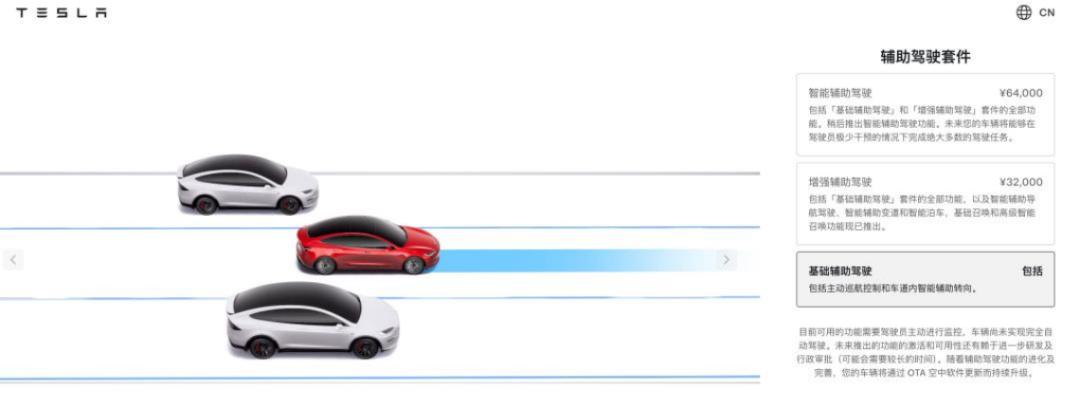
Currently, the monthly subscription price for FSD in the United States is $99 (approximately RMB 670), with the original buyout price at $8,000 (approximately RMB 58,000), though the one-time buyout option was discontinued in February this year.
In the Chinese market, according to last year's pricing, the one-time buyout price for FSD is RMB 64,000, with no monthly subscription pricing announced yet.
According to Tesla's data, in the first quarter of 2026, the number of active FSD subscribers reached 1.28 million, a 51% increase over the past year. At $99 per month, this generates approximately $380 million (approximately RMB 2.5 billion) in revenue per quarter.
From 2023 to 2025, Tesla's annual sales in China have hovered around 600,000 units, totaling nearly 2 million units. Even if only half of these owners opt for a monthly FSD subscription, it could bring in over RMB 8 billion in annual revenue.
On the other hand, FSD can help Tesla sell more cars.
A year ago, during FSD's limited trial in China, opinions were divided. Some owners reported issues such as FSD using bus lanes and ignoring traffic lights, while others believed Tesla's intelligent driving capabilities were superior.
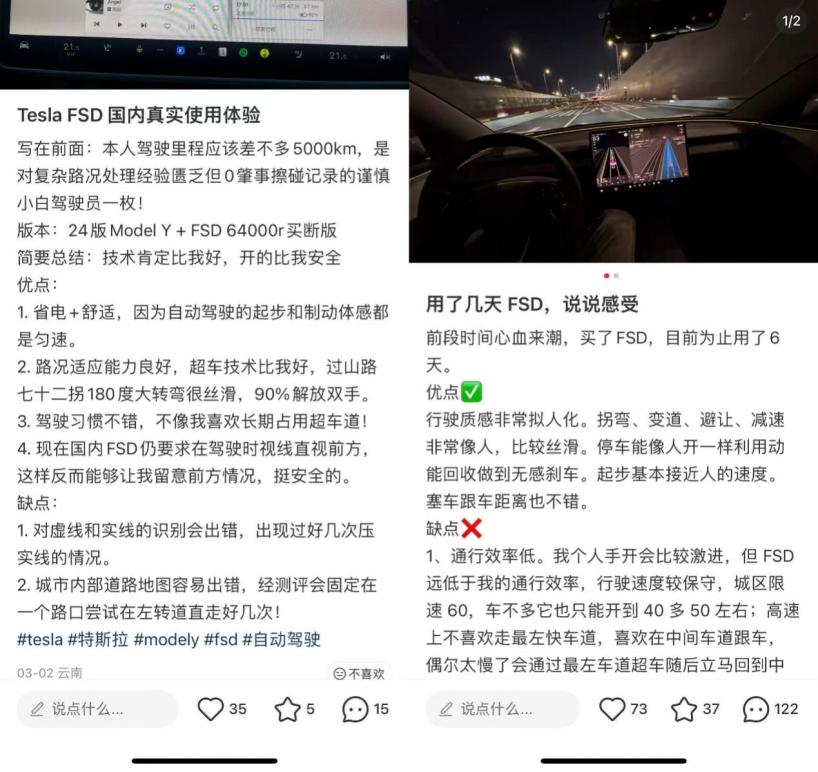
These contrasting views highlight one thing: users have expectations for FSD but are more concerned about its inability to understand Chinese roads. However, data must be collected in real-world scenarios to address this issue, necessitating FSD's initial launch in the Chinese market.
For FSD to compete head-to-head with Chinese automakers on the same track, it must prove its intelligent driving capabilities through tangible performance. Only then can it provide consumers with an additional reason to choose Tesla.
Meanwhile, Musk also needs FSD.
While Musk may not be solely focused on selling cars, intelligent vehicles serve as the carrier for his "tech dream."
Tesla's "Master Plan Part 4" mentions building an ecosystem centered on AI large model capabilities, spanning from autonomous driving to humanoid robots, energy networks, and space exploration plans. In this "vehicle-robot-AI" trinity business model, cars will serve as crucial intelligent terminal entry points.
As Musk mentioned earlier, FSD is Tesla's core product, with the car merely being the carrier. Expanding the hardware base first allows for software-based profitability—a strategy that is not unfamiliar.
03 Still a "Catfish" in Intelligent Driving?
However, after years of "wolf coming" warnings, how much of a splash can FSD, the "catfish," still make?
A year ago, He Xiaopeng, Chairman of XPeng Motors, traveled to the United States twice to test-drive FSD, giving it high praise as "L4 autonomous driving is within reach." A year later, Liu Xianming, Head of XPeng's General Intelligence Center, responded to FSD's entry into China by saying, "We hope to have a direct comparison with Tesla."
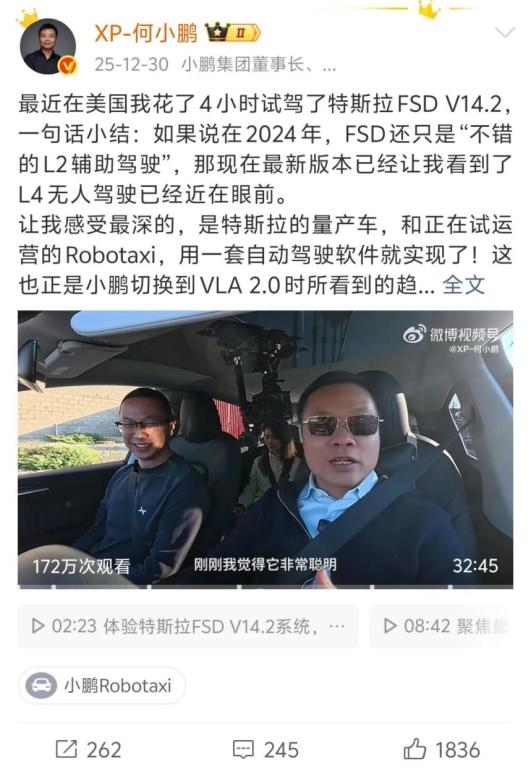
These two responses convey an intuitive sense that domestic automakers have gained confidence in intelligent driving. Currently, domestic automakers such as Huawei, XPeng, and Li Auto are advancing toward L3-level autonomous driving systems.
XPeng's second-generation VLA enables end-to-end generation from visual signals to action commands, aiming to bridge the gap from L2 to L4. Huawei's ADS 4.0, based on the WEWA dual-brain architecture, achieves nationwide mapless intelligent driving and highway L3-level autonomous driving functions.
Of course, Tesla's FSD is also evolving. It proposes using AI neural networks to handle the entire intelligent driving process. The latest V14.3 version increases the neural network's parameter count to approximately 10 times that of the previous version and incorporates spatiotemporal memory capabilities to better handle complex road conditions and low-visibility environments.
Who will prevail remains to be seen. However, if FSD no longer holds a technologically overwhelming lead, its true disruption to the domestic intelligent driving market will not be technological but rather in terms of industry business models and user mindset.
Historically, domestic users have shown little enthusiasm for "software subscription" models, especially in the fiercely competitive domestic new energy vehicle market, where automakers have already made "advanced intelligent driving" a standard feature.
Automakers like Li Auto and Leapmotor adhere to a free intelligent driving policy. Li Xiang, Founder of Li Auto, has publicly stated, "Intelligent driving systems are essential vehicle functions, and additional charges contradict users' basic understanding of intelligent vehicles."
However, an increasing number of automakers are beginning to adopt tiered pricing for advanced intelligent driving.
He Xiaopeng once said, "XPeng's core logic is to make intelligent driving and AI standard features," but at the launch event for the 2026 P7+, G7, G6, and G9 models, both the Ultra SE and Ultra versions required an additional RMB 12,000–20,000 for optional installation.
Huawei's ADS advanced feature package has always been subscription-based, with a current buyout price of RMB 12,000 and a monthly rate of RMB 359. NIO's Navigation on Pilot Plus (NOP+) also adheres to a subscription model, priced at RMB 380 per month.
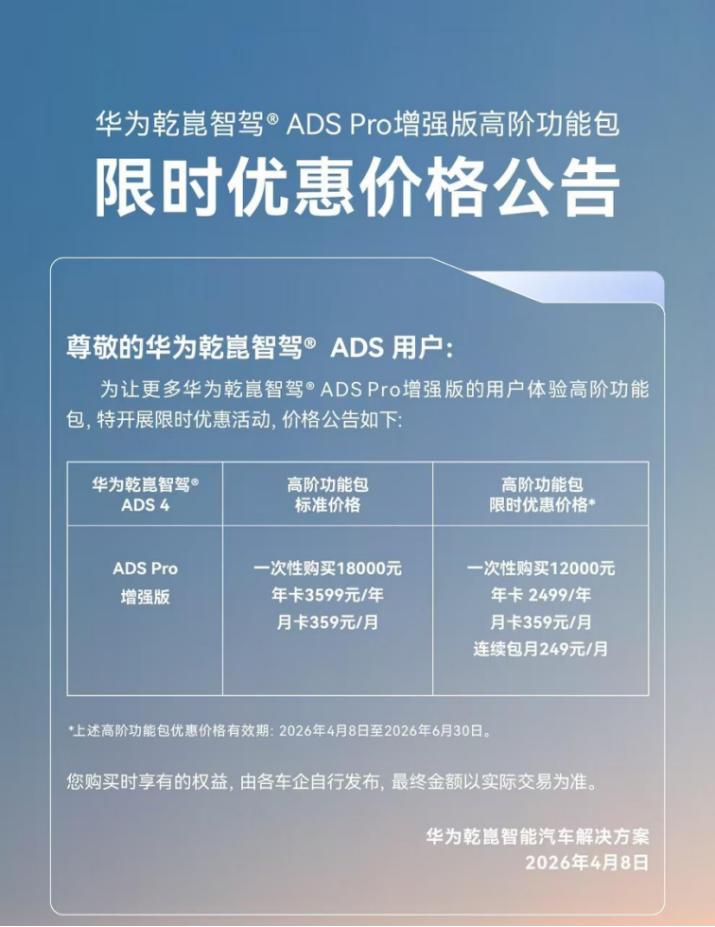
Automakers' attitudes toward "charging for intelligent driving" are diverging, but consumer willingness to pay remains low.
According to the "2024 McKinsey China Automotive Consumer Insights Report," 44.4% of users are willing to pay up to RMB 20,000 for intelligent driving, while 37.8% explicitly stated they "do not need optional installations."
Against this backdrop, FSD's explicit intention to charge for its services in China could potentially accelerate the industry's shift from "free to paid" models.
Of course, whether automakers choose to charge for intelligent driving systems depends on their cost calculations. The choice between "free for market share" and "technology for revenue" is not straightforward.
However, with FSD as the "catfish," the automotive circle might consider broader implications.
The price war in the new energy vehicle market has reached its limits, with increasingly transparent supply chain and component costs rendering the "specs and features arms race" unsustainable.
In stark contrast, the capabilities of intelligent driving present a challenge when it comes to quantification and pricing. Should users demonstrate a willingness to pay for these "increasingly valuable" features, it has the potential to shift hardware sales into a thriving, long-term software business model.
The competition in the hardware realm has reached its conclusion; however, the battle for software supremacy is only just unfolding. Certain automakers are already reaping the rewards with smiles on their faces.
The cover image and accompanying illustrations are the property of their respective copyright holders. Should the copyright owners believe that their works are not suitable for public viewing or free use, we kindly request that they reach out to us promptly. Our platform will take immediate action to rectify the situation.
-
![]()
NIO’s Q1 Revenue Surges 112% Year-on-Year, Notching Two Straight Quarters of Profitability
-
![]()
Can Token Packages from China’s Top Telecom Operators Unlock a New Revenue Frontier?
-
![]()
What If Computing Power Could Be Traded Like Futures?
-
![]()
Huawei’s Star Performer: Can AITO Sustain Its Market Dominance?
-
![]()
The Arrival of FSD: A Boon for Chinese Automakers
-
![]()
Japanese Automakers 'Hard Hit' by U.S. Policies
-
![]()
The Dishes of HaiDiLao Are Now Being Served by Autonomous Vehicles! Cold Chain Delivery Costs Plummet by 50%
-
![]()
The Game Changer in Embodied AI: More Important Than Being 'Number One in Evaluation' is Starting to Deliver