The Game Changer in Embodied AI: More Important Than Being 'Number One in Evaluation' is Starting to Deliver
 05/26 2026
 587
587

If you've been in the embodied AI circle long enough, you become immune to a certain scene: product launches, demo videos, 'world's first,' 'industry leader,' followed by a long silence.
This isn't about pointing fingers at any single company—it's an unspoken consensus across the entire industry over the past two years: make it sound good, but leave yourself an out.
So one question has lingered without an answer: When will robots truly enter our homes?
Figure AI has entered BMW's factories, but home deployment remains in pilot stages. 1X conducted employee home trials but stagnation at dozens of orders. Tesla Optimus still hasn't hit the market.
The domestic situation is more straightforward: for most companies, 'home scenarios' end at demo videos during product launches.
Behind this lies a stark difference: factories are structured environments where robots repeat the same actions on the same production line.
Homes are different: lighting changes, furniture moves, guests arrive today, kids scatter toys tomorrow. Every variable exponentially increases task complexity.
Entering factories and entering homes are widely recognized in the industry as two orders of magnitude apart in difficulty.
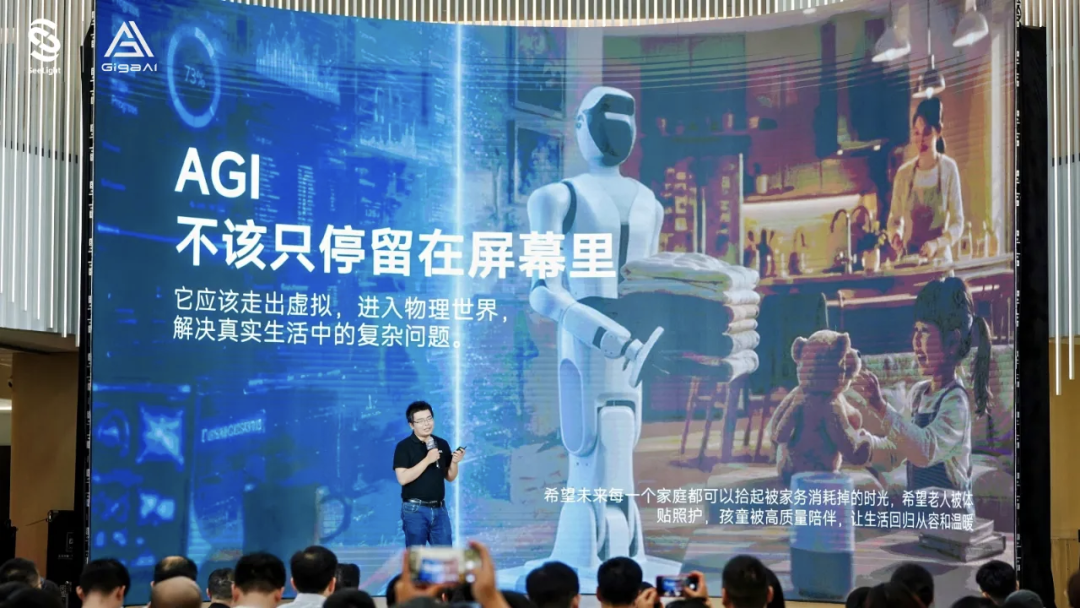
On May 20, in Wuhan Optics Valley, GigaAI held a product launch.
They announced that Shiguang S1 had secured 100 real home orders, with large-scale operations beginning in Q3 at Wuhan Optics Valley's residential community—a lived-in neighborhood, not a lab or showroom.
Based on publicly available information, this marks the first time in the general-purpose humanoid robot industry that a company has transformed demonstrations into contracts.
100 units may not sound like much, but no one had delivered on this front before.
The launch also revealed several other developments:
The world's first physical AGI 'Dual Pyramid' system, a home scenario sub-brand Shiguang SeeLight, the next-gen Shiguang S2 launching in Q3, and a 12-month roadmap for three generations of base models. Every announcement came with names and timelines—no 'soon,' no 'in planning.'
The information was substantial, but the core message was clear: in an industry accustomed to vague promises, GigaAI chose to make definitive commitments.

What Matters More Than 'Number One in Evaluation'
Let's first examine the technical achievements.
Over the past six months, GigaAI ranked first in three authoritative global benchmarks.
Its embodied world model GigaWorld-1 outperformed Google, NVIDIA, and others on WorldArena, becoming the first embodied world model to break 60 points in comprehensive scoring.
Its embodied base model GigaBrain-0 series surpassed Physical Intelligence's π0.5 in RoboChallenge, the world's largest real-robot benchmark, claiming the top spot.
Its world action model GigaWorld-Policy-0.1 defeated NVIDIA GR00T N1.5 and π0.5 on RoboCasa365, a global authority on home scenarios, reaching number one.
These three first-place finishes correspond to three core capabilities of physical AGI: world generation, real-robot operation, and home scenario generalization.
No other company in China's embodied AI sector has achieved this.
More importantly, what does 'three first-place finishes simultaneously' signify?
These 'firsts' represent three distinct capability paradigms: world modeling (cognition), real-robot operation (execution), and home scenario generalization (cross-scenario adaptation)—all breakthroughs at once.
Over the past two years, domestic embodied companies have typically focused on one area:
Zhiyuan emphasized real-robot data collection and hardware mass production; Yinhe General bet on synthetic data; Xingdong epoch focused on motion control; Zibianliang concentrated on end-to-end VLA.
Each path showed progress, but none formed a complete physical AGI system.
This becomes more interesting when viewed globally. For years, the industry has had an unspoken division of labor: Chinese teams excelled in hardware and supply chains, while U.S. teams led in base models and world models.
U.S. Players: Physical Intelligence (π series), Figure AI, 1X, Tesla Optimus, NVIDIA (GR00T series).
Chinese Players: GigaAI, Zhiyuan (AgiBot), Yinhe General, Zibianliang, Xingdong epoch , Unitree Technology, etc.
What GigaAI has now delivered marks the first time a Chinese team has comprehensively matched international leaders on the more challenging, AGI-essential path of 'world models + embodied base models.'
For the first time, a Chinese embodied AI company stands on equal footing with global leaders in model development.

Building the 'Dual Pyramid' in Three Years
If three evaluation firsts represent achievements, then the 'Dual Pyramid' is the methodology.
But before explaining this methodology, we must address a long-standing industry issue: everyone discusses Scaling Law, but nearly no one clarifies what physical AGI's Scaling Law should be built upon.
Where does data come from? How does algorithm iteration work? How do these form a closed loop (closed loop)? These questions have lingered for two years without standard answers.
At this launch, Ye Yun, GigaAI's Partner and VP of R&D, systematically disclosed the physical AGI methodology GigaAI has refined over three years: two pyramids—one for data, one for algorithms.
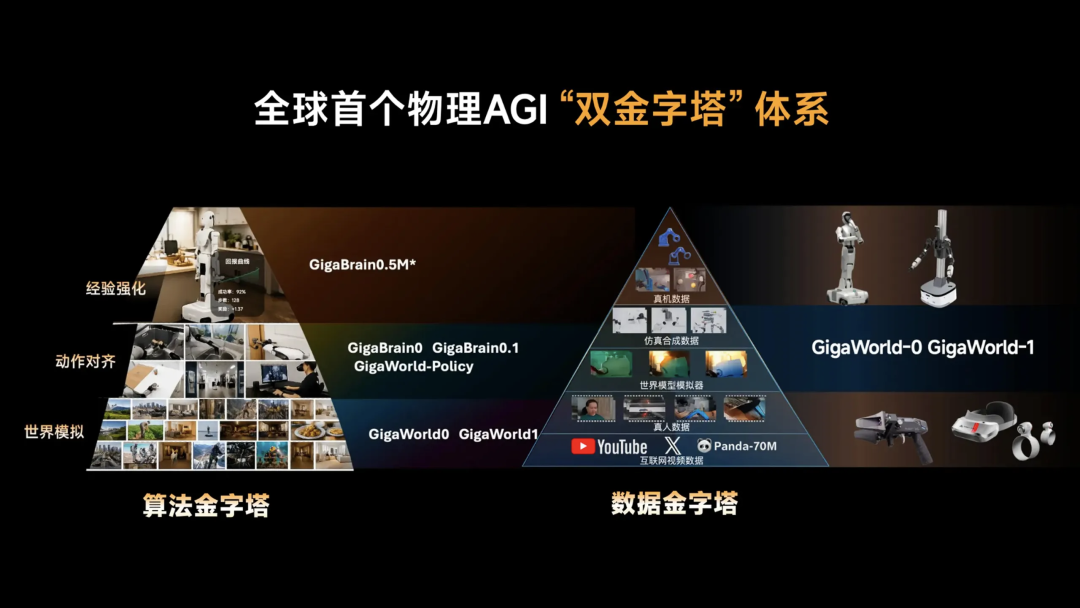
The data pyramid has five layers, from bottom to top: internet video data, human demonstration data, world model simulators, synthetic simulation data, and real-robot data.
The algorithm pyramid has three layers, from bottom to top: world simulation, action alignment, and experience reinforcement.
Each layer corresponds to specific engineering products:
Data collection: home wheel-arm robot Shiguang S1, low-cost real-robot data hardware Maker M01, low-cost handheld data hardware U-01, low-cost ego-centric data hardware E-01.
Data generation: self-developed embodied world model platform GigaWorld-0.
Model matrix: GigaWorld-1 (world simulation layer), GigaBrain-0 series and GigaWorld-Policy (action alignment layer), GigaBrain-0.5M* (experience reinforcement layer).
Among Chinese embodied companies, only GigaAI has systematically deployed both five-layer data and three-layer algorithm stacks in a full-stack manner.
The true significance of this system lies not in its layer count, but in how GigaAI organized data and algorithms into a self-sustaining closed loop:
Larger deployment scales generate more data, which strengthens model capabilities, which in turn supports even larger deployments.
Other companies either have data without complete algorithms or decent algorithms without data flywheels.
Only GigaAI has achieved both simultaneously in China.
One notable detail: before embodied AI, GigaAI had already run a similar path in autonomous driving. Their DriveDreamer series of world models also focused on environment generation, simulation, and data closures, now serving over 30 leading global automakers.
In a sense, they've validated this playbook once already.

2.5 Billion in Funding and 10 Billion Valuation: What Capital Sees
Building a technical system requires money.
In March and April 2026, GigaAI completed nearly 2.5 billion yuan in cumulative financing, becoming China's first world-model unicorn valued at over 10 billion yuan.
The investor lineup was stellar, including leading financial institutions, industrial capital, and national team funds.
In Q1 2026's valuation landscape for China's embodied AI sector:
Zhiyuan Robotics: Valued over 15 billion yuan, began mass production in late 2024, revenue exceeded 1 billion yuan in 2025.
Yinhe General: Valued over 20 billion yuan, pursuing synthetic data as primary with real-robot data as supplementary.
Xingdong epoch : Valued over 10 billion yuan, completed over 200 million USD in new financing in April 2026, incubated by Tsinghua University's Institute for Interdisciplinary Information Sciences.
Zibianliang Robotics: Valued over 10 billion yuan, focusing on end-to-end VLA, completed 1 billion yuan A++ round in early 2026.
GigaAI: Valued over 10 billion yuan, completed nearly 1.5 billion yuan B1 round in April 2026, China's first world-model unicorn.
GigaAI's upward trajectory stands out most in this valuation map.
GigaAI not only possesses a full-stack layout—developing both algorithms/models and native robot bodies—but also has begun mass production and delivery of its world model platform GigaWorld, embodied base model GigaBrain, and native robot body Maker H01. Combined with products like Shiguang S1, Maker M01, U-01, and E-01, they form a full-stack system integrating 'embodied base models + world models + native robot bodies + generalized scenarios.'
More critically, GigaAI leads in defining the endgame for world models and the dual-pyramid system of algorithms and data.
So why does the market believe GigaAI has industry-leading potential?
To answer this, we must first identify the current 'technological singularity' in embodied AI. GigaAI believes it's the physical AGI equivalent of GPT-3.
For large language models, GPT-3 marked the first emergence of scaling laws showing emergent capabilities—the critical point where models transitioned from 'usable' to 'impressive.'
Reviewing LLM development:
Before GPT-3, the NLP field had a similar landscape—big companies had data, compute, shipments, and revenue, with each building small models during the BERT era. After GPT-3, that old landscape reset instantly.
Physical AGI's development curve will theoretically undergo a similar reset. Whoever reaches that critical point first gains the initiative in the new landscape.
GigaAI currently leads the industry in systematic, comprehensive progress with clear timelines.
The 'Dual Pyramid' answers 'what scaling laws should be built upon'—a systemic methodology no other company has provided in equal completeness.
Three global first-place finishes (WorldArena/RoboChallenge/RoboCasa365) prove this system works—the only 'methodology + three global benchmark verifications' in the sector over the past two years.
Three generations of base models (GigaBrain-1/2/3) in 12 months—no other company has provided such definitive timelines.
100 real home deployments—the most critical data fuel for this timeline. The GPT-3 moment for physical AGI requires not factory data or synthetic data, but real-home, long-term, multi-variable, human-feedback real-robot usage data. Only GigaAI has begun accumulating this domestically.
Combining these four elements explains why top financial institutions, industrial capital, and national team funds invested.
They're not betting on Q2 2026 shipment volumes or past 12-month revenue figures, but on who will stand first when that critical point arrives in 12 months.
GigaAI is currently China's company closest to this moment with the most systematic layout. This underpins its 'latecomer advantage' and justifies its 10 billion yuan unicorn valuation.
The newly launched home scenario sub-brand 'Shiguang SeeLight' is positioned as 'China's first general-purpose home robot brand,' with GigaAI co-founder & Chief Scientist Dr. Zhu Zheng serving as brand CEO.
One side targets B-end (robots entering industrial/commercial scenarios, with DriveDreamer serving automakers for verifiable cash flow), while the other targets C-end (Shiguang SeeLight entering homes to close the data flywheel)—both lines converge on the same goal:
The physical AGI 'GPT-3 moment.'

100 robots enter real households.
For the first time in China, someone has submitted an answer sheet regarding embodied AI.
No matter how beautiful the capital narrative is, it ultimately boils down to one question: Can robots truly enter households?
Figure AI, 1X, and Tesla Optimus—none have truly achieved large-scale deployment in household settings.
Most domestic companies haven't even secured actionable orders yet.
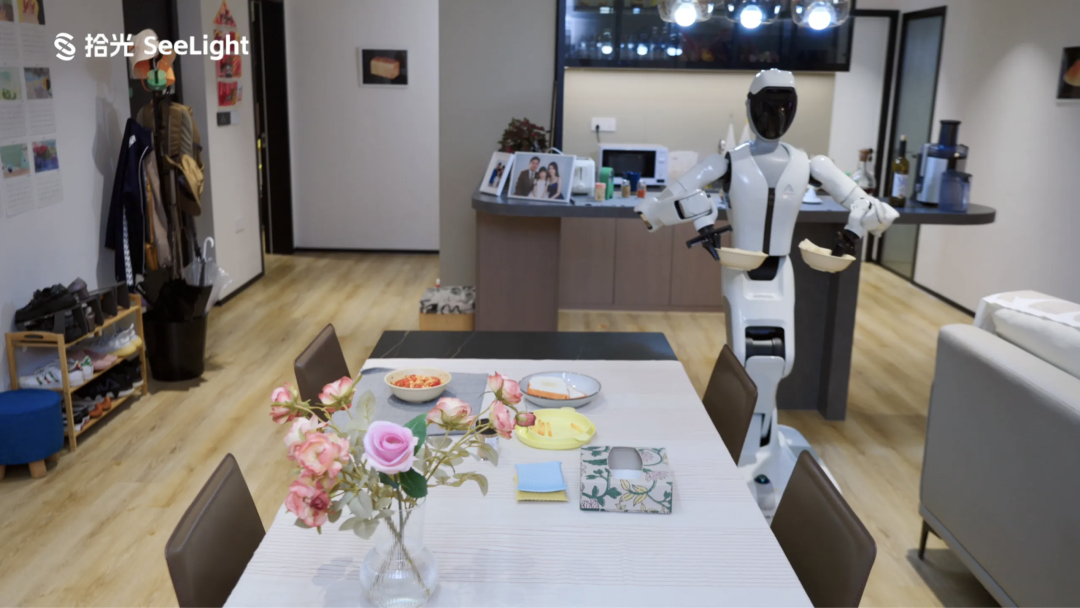
At the press conference, Vision Peak announced that the Shiguang S1 has secured orders for 100 units in real household settings and will be first deployed in the Guanggu Community in Wuhan—a residential neighborhood with actual occupants, with large-scale operations commencing in the third quarter of this year.
From publicly available information, this marks the first time globally that general-purpose humanoid robots have achieved a hundred-unit-scale deployment in real household settings.
The supporting timeline is also set:
May 31: The Shiguang Vision standard model home for household settings opens to the public for visits.
Third quarter: The Shiguang S2 is officially released, featuring a 60% reduction in chassis volume, a 70% increase in battery life, a 40% expansion in operational range, and support for tasks at heights up to 2.2 meters.
At that time, the pre-order channel for the Founder's Edition for real households will officially open, recruiting the first batch of seed users.
While 100 units may not seem like a large number, no one has ever submitted such an answer sheet in this regard before.
More importantly, the value behind this achievement: The industry's most scarce resource now is not algorithms, but real household usage data.
How long have robots been used in real households? How many times have they failed? What tasks do people prefer them to perform? These data points cannot be fabricated in a laboratory.
Once the hundred-unit deployment kicks off in the third quarter of this year, the long-cycle behavioral data, failure feedback data, and human preference data generated will be irreplaceable assets for companies without real-world deployments.
The training quality of subsequent generations of the GigaBrain model will also be built on this foundation.

12 months to turn the 'roadmap' into a 'timeline'
The final part of the press conference was a roadmap pointing to the future.
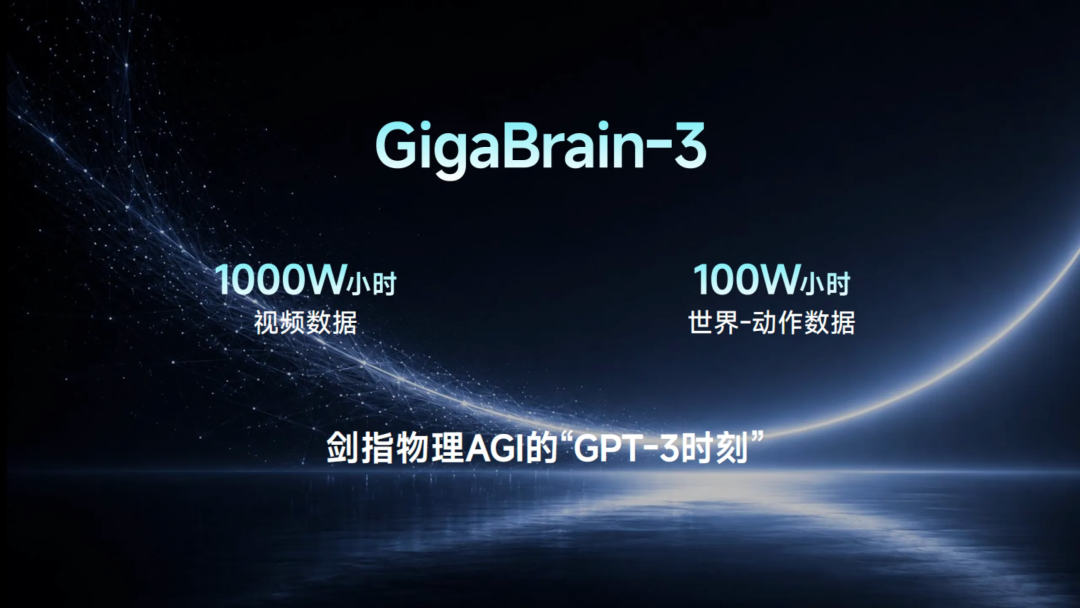
Vision Peak unveiled, for the first time, a 12-month roadmap for its foundational Physical AGI model: three consecutive generations of GigaBrain-1, GigaBrain-2, and GigaBrain-3.
GigaBrain-1: To be released in the third quarter of 2026, it will be the world's first foundational Physical AGI model built on the 'Dual Pyramid' system.
GigaBrain-2: Accelerated scaling, with technical details yet to be disclosed.
GigaBrain-3: Trained on 10 million hours of video data and 1 million hours of world-action data, aiming for the scaling inflection point in the field of physical intelligence—a milestone often described in the industry as the 'GPT-3 moment.'
This analogy deserves clarification:
GPT-3 marked the first point where the Scaling Law demonstrated emergent capabilities, representing the inflection point from mere functionality to astonishing performance.
ChatGPT's productization explosion came a full two years after GPT-3.
Vision Peak is targeting the former, the earlier and more foundational inflection point. Without GPT-3, there would have been no ChatGPT.
Over the past six months, when asked 'When will Physical AGI arrive?' most companies have responded with vague timelines like 'soon,' 'imminent,' or 'within five years.'
Vision Peak has chosen to break down this question into two specific technical propositions: What system is needed (Dual Pyramid) + When will it be achieved (12 months).
This is what truly sets this press conference apart from others of its kind.
The funding logic for embodied AI over the past two years has been quite straightforward: Goldman Sachs says that 60% of global robotics companies are valued at over 100 times their revenue. While doubts about a bubble persist, money continues to pour in.
Unitree and CloudMinds are pushing for IPOs, while Galaxy General and Stellar Atlas are preparing for Hong Kong listings, with leading companies collectively valued at over 10 billion yuan. What capital is waiting for is an answer: Who can first establish a viable commercial closed loop (closed loop)?
From this perspective, it's clear what Vision Peak is betting on with this press conference.
The hundred-unit household order is just the starting point; the real wager lies in the data generated once these orders are fulfilled.
Of course, the industry has seen too many gaps between words and actions.
Whether GigaBrain-1 can deliver in the third quarter of this year, whether the data flywheel can truly start spinning, and how far GigaBrain-3 will be from the scaling inflection point after 12 months—all these will be tested by time.
But one thing has already happened: In this industry, Vision Peak is the first to turn 'entering households' from a PPT slide into a contract.
Vision Peak has secured this position. The rest will be revealed in the third quarter of this year.
-
Ofilm Teams Up with ADSensE to Propel Large-Scale Deployment of All-Solid-State LiDAR Powered by ADS6311 Chip!
-
![]()
Loss of 2.5 Billion Yet Facing Strong Demand for Shares? Another Battle for Control of Lianchuang Electronics
-
![]()
Huawei’s Enjoy Series Flies Off the Shelves, Prompting Xiaomi to Double Down on Budget Smartphones
-
![]()
Beijing Hyundai's Top Executive Criticizes Industry Disorder: Certain Brands Treat Customers as Beta Testers
-
![]()
The domestic mobile phone market has declined for five consecutive quarters! Huawei defies the trend with significant growth: maintains its top market share
-
Annual Revenue Surpasses 3 Billion: An Automotive Trim 'Little Giant' Makes Its Debut on the Beijing Stock Exchange
-
![]()
The Space Force Wants to Spend $30 Billion on Rocket Launches: Is Trump Doubling Down, and Is SpaceX the Big Winner?
-
![]()
Going Crazy! One out of Every Three Plug-in Hybrids Sold in Europe is a Chinese Vehicle