Li Auto L9 Livis: Caught Between 'Daddy Car' and 'AI'
 05/26 2026
 397
397
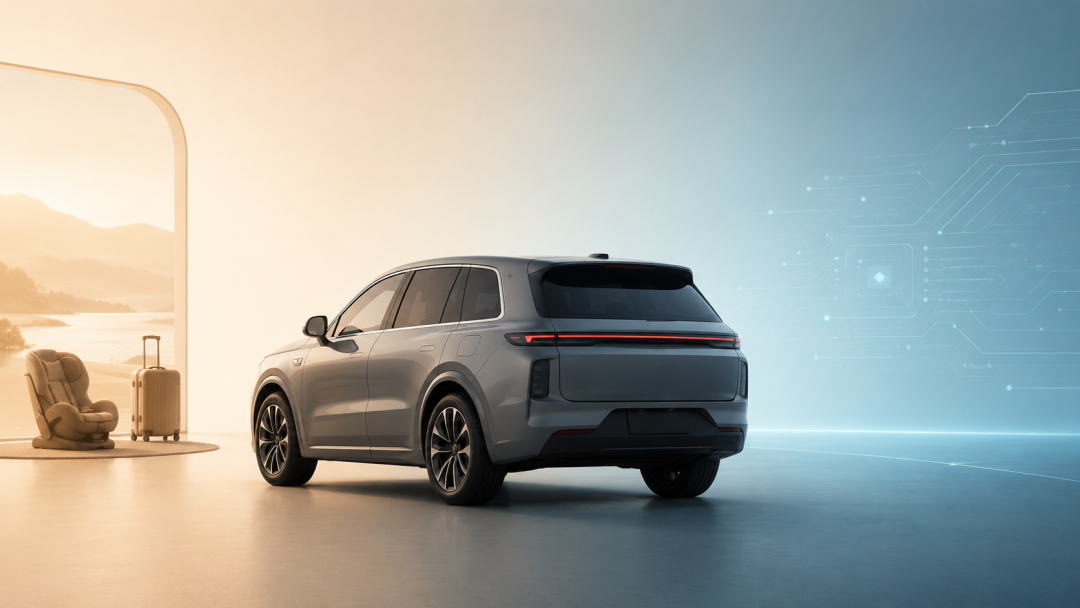
Too Far from AI, Not Close Enough to Family.
Author | Hua Yinglong Editor | Gu Nian
Li Auto's first step toward embodied intelligence seems to have faltered in the market.
On May 15, Li Auto launched its new-generation L9, which could be seen as a long-overdue arrival for both the market and the company.
On one hand, the initial L9, released in 2022, set the benchmark as the first 'extended-range large six-seater family SUV.' Four years have passed, and the market environment has undergone dramatic changes. Consumers and investors are waiting for Li Auto to respond with a new platform and design to the strong competition from rivals like Aito M9 and Zeekr 9X.
On the other hand, Li Auto shifted its strategic focus toward pure electric vehicles over the past two years, but the results fell short of expectations, causing it to lose its foothold in the extended-range market. Currently, it relies solely on one pure electric model, the I6, to support sales. Therefore, Li Auto desperately needs the new L9 to deliver a victory and boost sales of the L series.
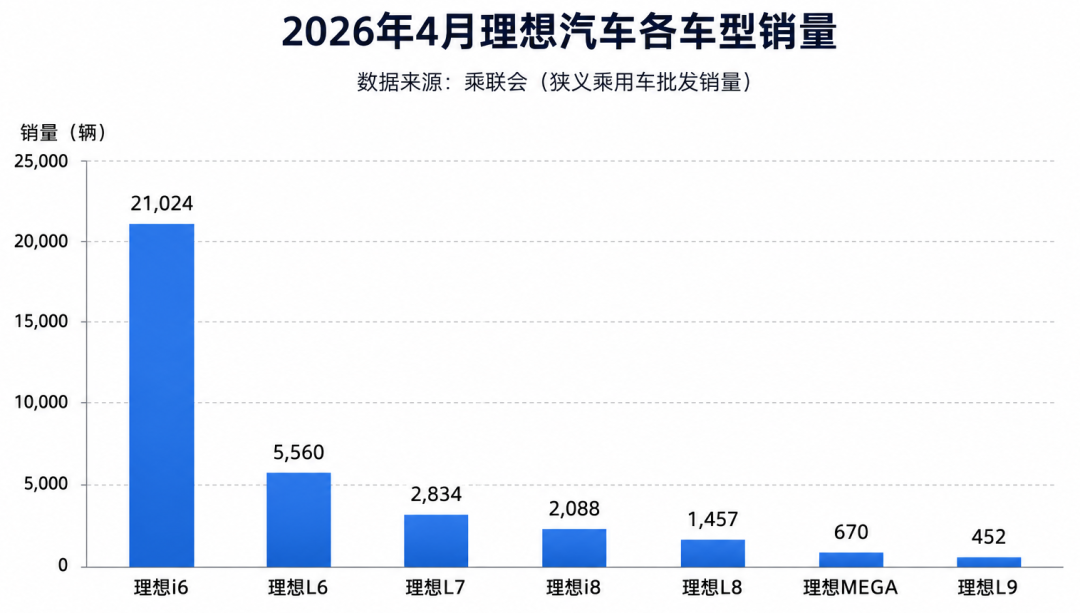
In promoting the new-generation L9, Li Auto has shifted its narrative focus. The core selling points of the initial L9 revolved entirely around family scenarios, with features like 'refrigerator, TV, and large sofa' essentially extensions and tangible expressions of family needs. However, in the new L9 era, despite Li Auto emphasizing its commitment to the family positioning (family-oriented positioning), both product design and promotional content have clearly tilted toward technical storytelling.
Take the optional two-tone body version of the L9 Livis as an example. Its design style has been criticized by many users as having a distinct 'executive elite' aesthetic, leaning more toward business professionals. Meanwhile, official promotions have gradually shifted toward technical labels such as the self-developed Mach M100 chip and 800V active suspension. The family-centric narrative that once occupied the core position has been somewhat sidelined this time.
To some extent, this represents Li Auto's proactive revision of its brand identity. In the past, Li Auto was long labeled a 'daddy car,' and the new L9 appears to be a counterattack (counterattack) to shed this ingrained perception.
However, from the results, more than a week after the new L9's release, its attempted reinforcement of AI technology narrative has not generated sufficiently noticeable market perception, and its breakthrough effect remains relatively limited. Amid a flurry of flagship model launches by automakers in late May, the new L9 made a brief splash but failed to stir up larger waves.

Has the New L9 Been Met with a Chill?
After the new L9's launch, the first signs of cooling were felt not in sales but in the capital markets.
On the first trading day after the release, Li Auto's stock price plummeted by 14.15%, continuing to decline over the next two trading days, with a cumulative drop of nearly 20% in three days. Compared to the high-profile technical narrative at the launch event, the secondary market offered a more cautious response.
Citi provided a relatively pessimistic sales forecast, projecting average monthly sales of around 5,000 units for the new L9, with approximately 1,000 units for the L9 Livis version and 4,000 units for the L9 Ultra version.
In Citi's view, although the final price of the L9 Livis was reduced by RMB 70,000 compared to the pre-sale price, appearing to show significant sincerity, this merely represented a 'return to competitive parity' rather than a true 'game-changer.' Based on this judgment, Citi maintained a 'neutral' rating on Li Auto.
However, third-party data suggests a slight deviation between the new L9's actual performance and institutional pessimistic forecasts.
According to data cited by 36Kr, the new L9 received over 6,500 nationwide orders within 48 hours of its launch. Meanwhile, Car Fans statistics showed that, within 72 hours of the launch, the average number of new orders per Li Auto store nationwide was approximately 20. With 511 retail centers across the country, total orders have surpassed 10,000 units.
To some extent, this figure may have just met Li Auto's internal passing grade.
Previous media reports indicated that Li Auto's internal monthly sales target for the entire L9 lineup was around 9,000 units, with suppliers preparing approximately 7,000 sets of inventory and factory production maintained at 'several thousand units' per month, while the annual sales expectation exceeded 100,000 units.
However, looking back four years, the new L9's performance clearly cannot replicate the phenomenal success of the initial L9. In June 2022, within 72 hours of the initial L9's launch, over 30,000 users paid a RMB 5,000 deposit, and first-month deliveries exceeded 10,000 units, making it one of the most representative hit models in the high-end new energy SUV market at the time.
Four years later, the new L9's order volume has struggled to reach those heights. Li Auto's internal team may have already anticipated this, as revealed during a small-scale investor communication earlier this year when a Li Auto executive stated, 'Our market share in the RMB 200,000+ segment will certainly not return to the 40%+ levels of 2022 and 2023. Our goal for 2026 is simply to regain a leading position.' This suggests that Li Auto's internal team has a relatively clear understanding of the changing competitive landscape in the industry.

The Elusive Balance Between Embodied Intelligence and Family
The new L9's relative cooling is, to some extent, linked to its high-profile buildup around embodied intelligence.
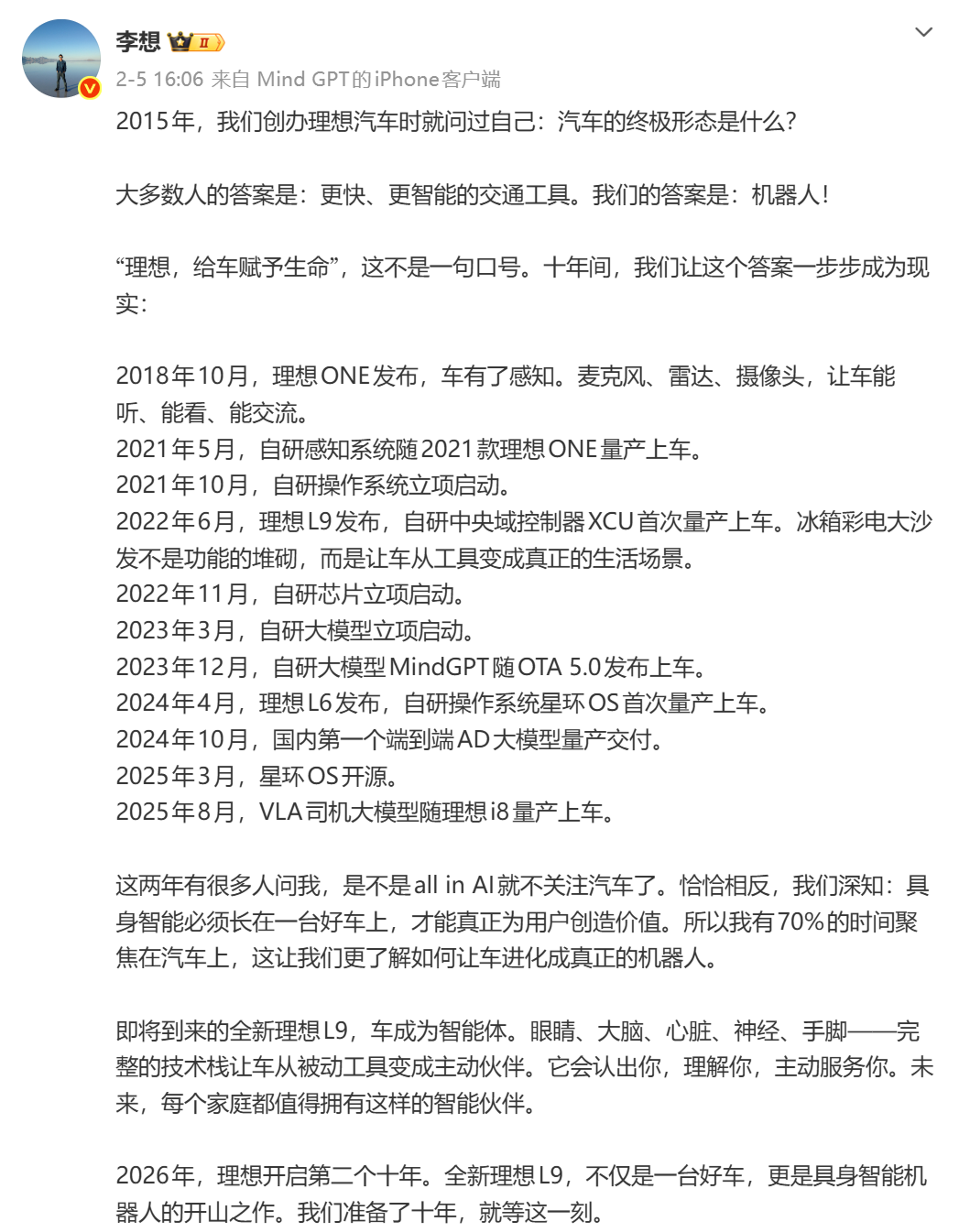
Over the past six months, Li Xiang has nearly defined the L9 Livis as an 'embodied intelligent robot.' Under this highly futuristic and even technically idealistic narrative, external expectations for the vehicle were rapidly heightened. However, during the actual launch, Li Auto did not deliver a more impactful scenario-based expression around embodied intelligence, and market perception of the concept remained weak.
The few features that truly left a lasting impression on consumers were voice-command parking: users can activate 'Li Auto Assistant' outside the vehicle, and the car can automatically complete steering, gear shifting, and braking to park independently. However, beyond this, Li Auto did not offer more experiences that would allow ordinary consumers to intuitively perceive embodied intelligence.
Instead, the heavily emphasized Mach M100 chip, 2560 TOPS computing power, four LiDAR sensors, and fully wire-controlled chassis were even questioned by some users as 'hardware redundancy.' In their view, Li Auto reduced embodied intelligence to a hardware parameter lesson without truly creating a generational gap in experience compared to competitors at the same level.
Nevertheless, the new L9 has not entirely failed to gain positive word of mouth (reputation). The 800V fully active suspension system has garnered some favorable evaluations. According to official claims, it delivers a smooth ride even on rough roads and maintains a more stable body posture during high-speed cornering.
However, comfort remains a highly subjective experience. One consumer who test-drove the vehicle stated, 'In reality, I didn't feel any 'imperceptible' difference when going over manhole covers or speed bumps compared to my L8. The difference is not significant.'
Li Auto's attempted storytelling around embodied intelligence has not fully translated into a clear experiential advantage for users. At the same time, its most adept storytelling around family scenarios seems to have fallen short as well.
Many users who test-drove the vehicle reported that the new L9's trunk space remains limited, especially when all six seats are occupied, leaving very little luggage room. One long-time owner stated, 'I'm satisfied with everything else, but I expected the trunk to be much larger. It's still just as small as before. Traveling long distances with two kids and my parents is impossible without a roof rack.'
This is actually a structural challenge commonly faced by large six-seater extended-range SUVs: the third-row seats, range extender, and fuel tank collectively occupy the rear depth space, making it difficult to further expand the trunk. This is already the result of a facelift optimization—the initial L9's trunk volume was only 242L, increasing to approximately 332L after the 2024 mid-cycle facelift. Even so, it remains a persistent pain point for six-seater family travel scenarios.
Another controversial detail is the removal of the steering wheel's small screen.
As one of the core highlights of the initial L9's five-screen interaction system, this small screen was a highly recognizable family design element for Li Auto and was seen by many users as part of the product's soul. However, the new L9 eliminated this design, sparking dissatisfaction among many existing owners.
Many users believe that 'without the steering wheel screen, the L9 lacks its past uniqueness.' Li Auto explained that with the maturity of HUD technology, the small screen's functions could be replaced. However, Li Auto overlooked one thing: its past success in creating hit products was not due to technological leadership but its ability to precisely meet consumers' most authentic and subtle needs.

The New L9 Under Immense Pressure
This year is a major product year for Li Auto, with facelifts for the new-generation L9, L8, L7, and L6 set to follow closely, and the flagship pure electric i9 scheduled to debut in the second half of the year.
For Li Auto, which is accustomed to a slow pace in product development, this update frequency is unusual. The reason is simple: in 2025, Li Auto delivered 406,000 vehicles, down 18.8% year-on-year, becoming the only major new energy vehicle (NEV) manufacturer among the head (leading) players to experience a decline. Its net profit also plummeted from RMB 8 billion the previous year to RMB 1.1 billion, a drop exceeding 85%.
During the Q2 2025 earnings call, Li Xiang admitted to falling behind, stating, 'Every time we make a move, our competitors make two. We've indeed slowed down.' Therefore, starting in the second half of last year, Li Auto began accelerating its pace.
Among these moves, the new L9 once again plays a pivotal role in bridging past and future strategies.
First, it carries the task of propelling Li Auto to new heights. Over the past few years, although Li Auto has achieved sales success, a lingering concern remains: its brand premium is not firmly established. Due to its extended-range technical route, family-oriented positioning, and pragmatic product language, Li Auto has managed to sell vehicles priced above RMB 400,000 but lacks true technological premium in luxury perception.
One of the meanings of the L9 Livis is to attempt to rebuild this premium capability. Whether through AI cockpits, embodied intelligence, intelligent interaction, or a more aggressive software-defined vehicle logic, the goal is to transition Li Auto from a 'family utility vehicle' to a 'tech-luxury brand.'
Second, it serves as an important testbed for Li Auto's AI strategy. Over the past year, Li Xiang has nearly staked everything on AI.
Li Auto's internal team is no longer satisfied with being positioned as a 'smart car company' but continuously emphasizes being an 'artificial intelligence enterprise.'
From organizational structure to R&D resources, AI has been given the highest priority. In a recent interview with Luo Yonghao, Li Xiang stated, 'Pursuing AI is not a risk; not pursuing AI is the risk.'
Li Xiang's thinking is forward-looking, but employees seem unable to keep pace with this rhythm. During a surprise all-hands meeting in January, he spent nearly two hours discussing foundational models, humanoid robots, and L4 autonomous driving, leaving employees bewildered. Comments like 'I didn't understand a word' and 'I don't know the purpose of this meeting' flooded internal chat groups.
When 'Shixiang' asked two sales representatives about 'where the embodied intelligence of the L9 Livis is reflected,' one directly quoted an AI response, while the other gave a vague answer: 'Embodied intelligence means it has a brain and heart like a human.' This suggests that Li Auto's 'All In AI' strategy has not yet achieved internal consensus, at least not among frontline sales teams.
Additionally, overseas expansion is another key focus for Li Auto this year.
Since the beginning of the year, newly launched Li Auto models have been adapted structurally and in terms of compatibility for overseas markets. As the flagship model, the L9 Livis is undoubtedly Li Auto's first business card (calling card) to establish recognition for Chinese smart luxury vehicles among overseas users. Its success or failure will determine whether Li Auto can tell a new story overseas that differs from the cost-effectiveness focus of other automakers.
Looking back, Li Auto seems to continue relying on a hit-making logic, with external evaluations suggesting that Li Auto likes to wage 'do-or-die' battles. From the Li ONE's success with the extended-range route during the new energy transition period to the initial L9's redefinition of family vehicles with the claim of being 'the best SUV under RMB 5 million,' and then to the MEGA's setback, which caused Li Auto to stumble in the pure electric segment, this hit-making logic has its benefits—once it hits, it becomes phenomenal—but also its drawbacks, with a very low error tolerance and no middle ground. It's either legendary or a flop. Ironically, Li Auto desperately needs such a hit model now to respond to external doubts.
The pressure is all on the L9 Livis.

-
![]()
Li Auto L9 Livis: Caught Between 'Daddy Car' and 'AI'
-
![]()
From 'Flying Machines' to 'Embodied Intelligent Agents': How Embodied Intelligence is Revolutionizing the Commercial Landscape of Low-Altitude Equipment
-
![]()
Launch of the Lynx S10: Why is DeepRobotics Developing a Small Wheeled-Legged Robot?
-
![]()
AI Accelerator: The Powerhouse Behind AI Algorithm Operations and Applications
-
![]()
Ferrari Luce Electric Debuts: Ferrari’s Essence Endures in the Electric Age | On-Site Report
-
Counter-trend Price Cuts: The Final Gamble in the High-End Smartphone Market?
-
![]()
Nine “Series 9” Flagship Models Debut in May, Intensifying the High-End Market Battle
-
![]()
The Era of Large Models in Edge AI Begins with Minwall Intelligence