Over 400 Mercedes-Benz EQC Owners Gear Up for Legal Action! ‘Battery Capacity Degradation’ Dispute Intensifies
 05/28 2026
 559
559
On May 25, reports surfaced indicating that the Mercedes-Benz EQC model has become embroiled in a controversy surrounding 'battery capacity degradation', sparked by a recall and subsequent upgrade of its battery management system software.
Numerous EQC owners have reported a significant drop in their vehicles' usable battery capacity and driving range, coupled with a marked decrease in charging power, following an official recall software upgrade conducted by Mercedes-Benz. Post-upgrade, the vehicles' maximum driving range has plummeted by approximately 100 kilometers, with battery capacity dwindling by 20%.

According to complaint data from Qichemen.com, as early as the first quarter of 2026, the Mercedes-Benz EQC faced a surge in owner complaints regarding reduced battery capacity and driving range attributed to the recall and upgrade, resulting in the 'battery capacity degradation' issue. Now, with the problem lingering unresolved for an extended period, over 400 owners have banded together to defend their rights, planning to safeguard their legitimate interests through complaints or legal avenues.
The controversy stems from a recall initiative launched by Mercedes-Benz in September 2025. As per the recall announcement, certain domestically produced EQC models harbored a design flaw in the battery management system software, potentially leading to uncontrolled heating of the high-voltage battery under extreme conditions, posing a fire risk to the vehicle. In response, Mercedes-Benz recalled the affected vehicles, totaling 13,447 EQC models.
Recently, several Mercedes-Benz EQC owners have lodged complaints with Qichemen.com. One owner recounted that during the recall upgrade of their EQC vehicle in September 2025, they were not pre-informed that the battery capacity and driving range would be compromised post-upgrade. Upon completion of the upgrade, the owner discovered that the vehicle's battery could not be fully charged, the driving range had significantly diminished, and the charging power had also noticeably decreased. The owner contends that Mercedes-Benz, citing battery hardware defects, unilaterally curtailed the driving range during the recall upgrade, thereby infringing upon the legitimate rights and interests of consumers.
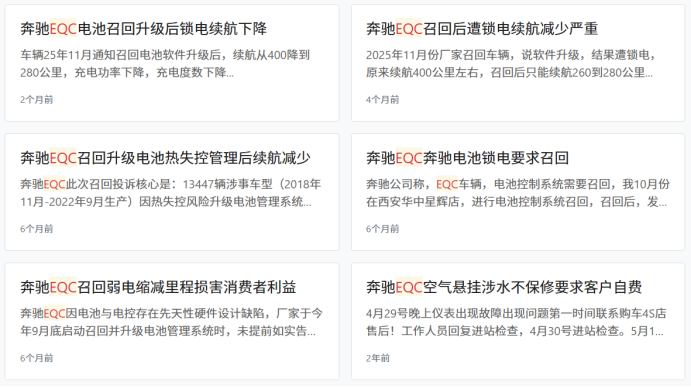
In fact, the owner who encountered a similar situation is not alone. Following the completion of the recall upgrade in 2025, owners across multiple regions have reported abnormal core data in their vehicles.
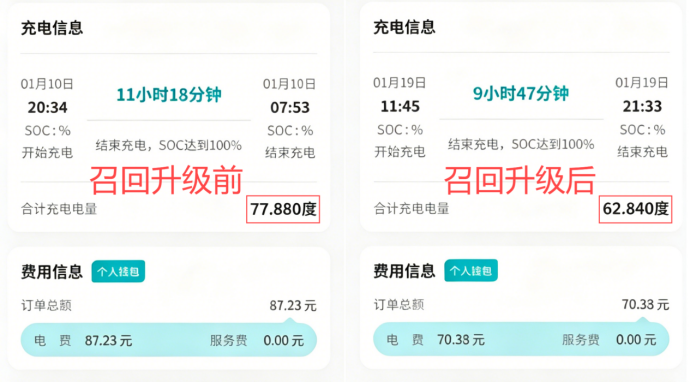
Based on actual test data provided by owners, the vehicle's full charge capacity remained stable at 77.88 kWh prior to the upgrade but plummeted to 62.84 kWh post-upgrade, a reduction of nearly 15 kWh. Consequently, the vehicle's full-charge driving range also decreased from approximately 340 kilometers to 270 kilometers, marking a substantial decrease in driving range.
Mercedes-Benz has not acknowledged 'battery capacity degradation' and has merely stated that a vehicle's actual driving range is influenced by multiple factors, including battery age, vehicle condition, ambient temperature, and charging power. Fluctuations in battery capacity and driving range following a software upgrade are deemed normal.
As of the end of May 2026, Mercedes-Benz has yet to provide a definitive solution. Over 400 owners have formed a rights protection group and collectively submitted complaints to the relevant regulatory authorities. They will decide whether to initiate a joint lawsuit based on the handling situation.
A lawyer analyzed that if the owners' evidence is substantiated, Mercedes-Benz's unilateral reduction of the vehicle's core performance through a software upgrade, which is suspected of (or allegedly) infringing upon consumers' right to information and fair trading, constitutes a breach of contract. Owners can legally seek financial compensation from Mercedes-Benz.
Previously, CCTV exposed the practice of some automakers 'reducing battery capacity' through OTA updates, and regulatory authorities have also made their stance clear. In March of this year, the Ministry of Industry and Information Technology, in collaboration with the State Administration for Market Regulation, issued a document explicitly prohibiting automakers from conducting 'silent forced upgrades' without user consent and from unilaterally reducing battery performance or driving range through software means.
Mercedes-Benz's sales in China have been on a downward trajectory, and its new energy vehicle product line is facing challenges. The brand's reputation in the electric vehicle sector is also under considerable strain. If the 'battery capacity degradation' controversy is not promptly and effectively resolved, it may not only exacerbate the erosion of trust among existing owners but also further tarnish Mercedes-Benz's brand image during its electric transformation process. Mercedes-Benz should promptly respond with a clear solution to quell the owners' controversy and prevent the continuous escalation of complaints.
(Image sourced from the internet, removed if infringing)
-
![]()
NIO's Profitability: A Testament to Long-Term Success
-
![]()
DeepSeek Raises the Query, Xiaomi Provides the Solution
-
![]()
The Story Behind Honor's IPO 'Difficulties': Lost Market Share and a Hanging Future
-
High R&D Investment ≠ High Barriers: Decoding Insta360's 'Technology Story'
-
![]()
Over 400 Mercedes-Benz EQC Owners Gear Up for Legal Action! ‘Battery Capacity Degradation’ Dispute Intensifies
-
![]()
The 'Enclosure Movement' in the AI Era: When Operators Start Selling Tokens
-
Domestic Mobile Phone Makers Navigate Challenging Times
-
![]()
NIO's Q1 2026 Performance: Has China's Most Hard-Pressed New Energy Vehicle (NEV) Manufacturer Finally Turned the Corner?