The Era of Station Wagons and Off-Road Vehicles: Beyond Traditional Travel and Off-Roading
 06/10 2026
 409
409
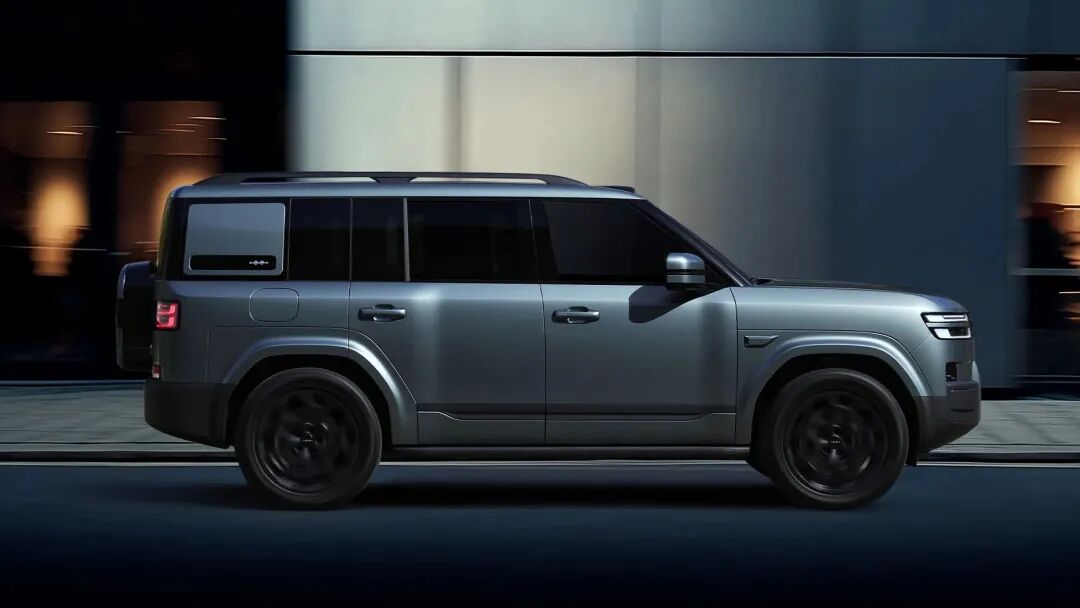
Lead
Introduction
It's not a compromise but a deliberate lifestyle choice.
In the era of fuel-powered vehicles, station wagons and off-road vehicles have consistently occupied niche positions within the automotive market.
Unlike mainstream family cars, these two categories boast inherent exclusivity and a strong sense of community.
Station wagons and off-road vehicles are not just symbols of high-end luxury; they are also the exclusive choices for automobile enthusiasts and seasoned drivers, serving as the primary vehicles for personalization in the era of fuel-powered vehicles.
Even as we transition into the new energy vehicle era, iconic models like the Audi RS6 Avant, Porsche Panamera Turbo S, Mercedes-Benz G-Class, and Land Rover Range Rover continue to enjoy robust consumer demand, thanks to their timeless product appeal and strong community following.
However, the new energy trend has fundamentally transformed these two classic niche segments—
The attributes of being 'niche luxury items,' once defined by large displacement, pure imports, and high pricing, are now being leveraged by automakers as personalized levers to elevate their brands.
It's clear that the adoption of new energy technologies has liberated station wagons and off-road vehicles from the scarcity constraints of the fuel-powered era, ushering in a new era of widespread accessibility and diversification.
Currently, the domestic new energy vehicle market has witnessed the emergence of numerous electrified station wagons and off-road vehicles; the personalized new energy segment is poised for explosive growth.
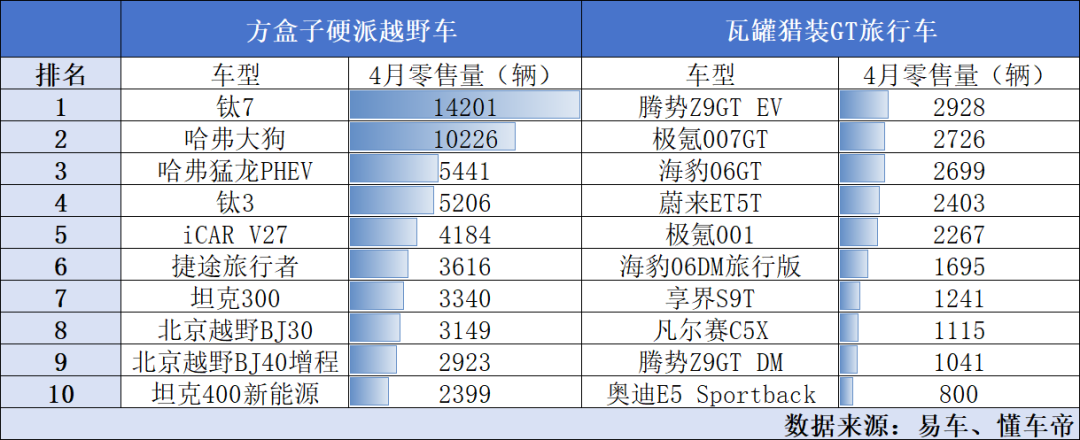
According to incomplete statistics, there are already 27 electrified off-road models with a boxy design from domestic brands, with brands like Tank, Fangchengbao, and Chery iCAR leading the charge and establishing a comprehensive off-road product lineup.
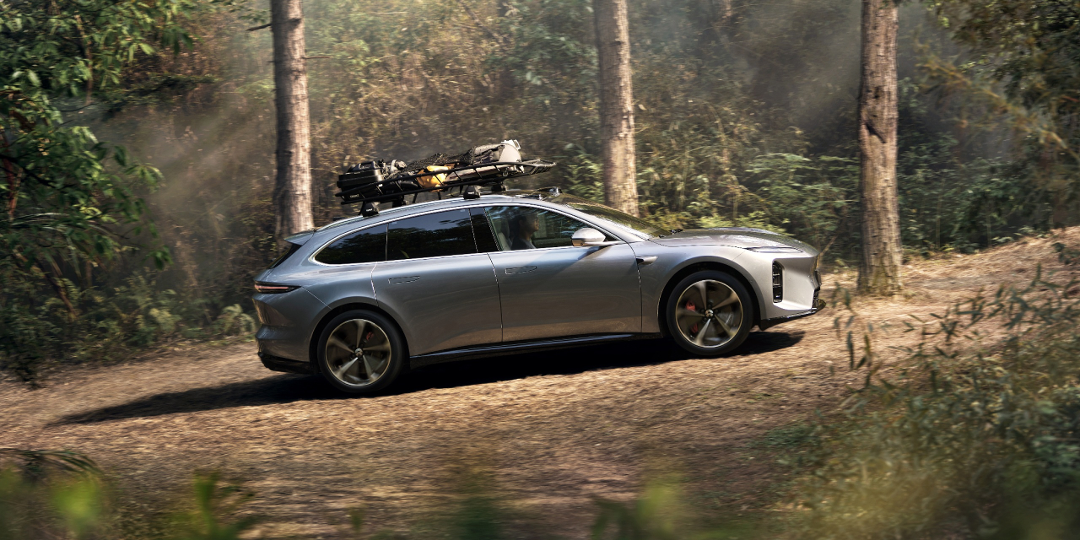
Meanwhile, over 10 electrified station wagon models have been introduced, including the NIO ET5T, Zeekr 001, Tengshi Z9GT, and Xiangjie S9T, many of which have become instant hits, precisely catering to the personalized needs of young consumers.
For automakers, possessing an iconic off-road model with a boxy design and a high-end GT station wagon has become a core strategy for entering the personalized market and establishing brand differentiation.
Moreover, with high-margin personalized models, automakers can further mitigate the challenge of 'increasing sales without increasing profits' amidst intense price competition.
However, Chinese automakers are known for their 'market flooding' tactics, and with a large number of domestic brands entering the fray, competition in the personalized new energy station wagon and off-road vehicle markets has become fierce, presenting inevitable challenges:
How can automakers create truly competitive, differentiated, and consumer-loved station wagons and off-road vehicles?
01 Rather Than Being More Professional, It's Better to Be More Urban-Oriented
It must be acknowledged that automotive market demand has been continuously declining this year. From January to May 2026, the Chinese automotive market saw cumulative retail sales of 7.15 million vehicles, a 19% year-on-year decrease.
Among them, fuel-powered passenger vehicles suffered significantly, with cumulative retail sales of approximately 3.42 million vehicles from January to May, a 36% year-on-year drop, and low-end fuel-powered commuter models experiencing over a 40% decline.
New energy passenger vehicles also faced challenges, with cumulative retail sales of approximately 3.73 million vehicles from January to May, a 14% year-on-year decrease, although their overall market penetration rate increased against the trend, demonstrating their relative resilience.
Under such market conditions, rather than making 'niche vehicles' like station wagons and off-road vehicles more professional and performance-oriented, it's wiser to proactively align with consumer demands and become more urban-oriented.
Automakers can certainly sell vehicles based on 'poetry and distant places,' but once users make a purchase, they will inevitably return to 'daily necessities.' This is not a compromise but a genuine decision based on people's living conditions.
Imagine a scenario where having a nine-to-five job becomes a luxury, and activities like traveling and off-roading seem like distant dreams.
For those fully engaged in work, the desire to buy a station wagon is not for traveling but for embracing a relaxed, elegant, and niche lifestyle.
Similarly, the urge to buy an off-road vehicle is not for playing in the sand and mud day and night or wandering the world but for appreciating a rugged, free, and unconstrained aura.
It's undeniable that there will always be a small group of people who continuously advocate for performance and emphasize off-road capabilities. There's nothing wrong with that, and automakers who create unparalleled vehicles deserve respect.
But times have changed. Nowadays, most of our driving scenarios are confined to urban roads, and even rural roads are paved.
Frequent red lights make acceleration within three seconds irrelevant; on smooth roads, discussing off-road and climbing capabilities becomes pointless compared to emphasizing comfort.
Moreover, looking at the sales data, the top-selling off-road vehicles are not all equipped with non-load-bearing bodies with large frames, and station wagons are not all performance-oriented.
Of course, this doesn't mean that these users don't value vehicle quality and only care about appearance. On the contrary, these users are more discerning, seeking:
More advanced intelligent technologies, more comfortable cabins, higher-quality materials and craftsmanship, more active communities, and more meticulous after-sales service... In short, they are not just buying a mode of transportation but a lifestyle companion that expresses their individuality.
02 Can 'Flavored' Vehicles Be Profitable?
From a consumer perspective, rather than being derogatory terms, 'flavored' Land Rovers or 'flavored' Porsches, 'flavored' off-road vehicles and 'flavored' station wagons are not negative concepts.
If we set aside the special functionalities and extreme performance of pure-blooded off-road vehicles and pure-blooded station wagons, it's incredibly easy for new energy automakers to create 'flavored' off-road vehicles and station wagons using existing supply chains.
Firstly, vehicle architectures are often universal; the same three-electric (battery, motor, controller) chassis can easily spawn three models: a regular SUV, a boxy off-road vehicle, and a station wagon.
Moreover, these different models can share components, further reducing production costs. In this way, only the exterior and interior details need to be changed without developing a new platform, ensuring high technical maturity and significantly reducing the risk of failure.
However, don't underestimate the difficulty of creating 'flavored' vehicles. A best-selling 'flavored' model is not just about copying an exterior design.
In short, in the new energy vehicle era, all best-selling models will follow the same rule: offering users more value at the same price.
In the past, we often used product strengths like durability, good handling, and solid chassis as metrics to evaluate a vehicle's value.
However, with highly developed industrial manufacturing capabilities today, creating a decent-quality vehicle is no longer a technical challenge but a matter of conscience. The real difficulty lies in providing users with more added value while ensuring quality.
Station wagons and boxy off-road vehicles inherently possess emotional value and are more likely to stand out.
Besides product quality, owners of station wagons and boxy off-road vehicles also tend to pay more attention to their respective communities, quality, and service.
Therefore, community operations, brand image, and distinctive services will become key factors for automakers to enhance premiums, retain users, and generate profits.
Selling cars in the new era is no longer a one-time transaction but a 'cultivation game' of mutual growth and companionship.
So, in my opinion, industry professionals should stop complaining about the market mismatch where station wagons don't travel and off-road vehicles don't off-road, as consumer demands have already changed.
Moreover, both the automotive market and consumers' daily lives are constantly evolving and reshaping with the changing times.
Editor-in-Chief: Cao Jiadong Editor: He Zengrong

THE END
-
![]()
Revenue Surges 50-Fold: Q1 Earnings Match Annual Profit, This Year's Hottest Business Revealed
-
![]()
Cook’s Gourd Holds No Magic Cure for Apple’s AI Woes
-
![]()
Stellantis Presents a Catalyst, Propelling Chinese Automobiles Towards Global Supremacy
-
![]()
The First AI Car! Seres + ByteDance, AIVA Targets the 200,000+ Market with Its First Vehicle Launching This Year | Mirror Pro
-
![]()
Most People Don't Understand Kimi's World Cup Prediction
-
![]()
Behind Saido: The Strategy of a Company Backed by CATL and ByteDance
-
![]()
Market Disparity: Domestic OLED TVs Hold Less Than 10% Share, with Two Korean Giants Leading the Pack
-
![]()
Seres Faces Six Months of Declining Sales: Challenges Coexist with Opportunities