Geely Auto's Li Shufu: Automotive Safety Is Paramount; Ignorance Leads to Incessant Problems
 06/17 2026
 425
425
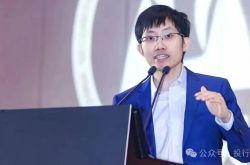
On June 13, at the 2026 China Automotive Chongqing Forum, Li Shufu, Chairman of Geely Holding Group, delivered a video speech entitled "Corporate Legacy and Value Orientation." Li Shufu emphasized:
For automotive products, which are intimately connected to human lives, it is crucial not only to understand the "what" but also the "why." One must not approach automobile manufacturing with a hasty and superficial mindset. Cars are durable consumer goods for which safety is the cornerstone; ignorance, masquerading as knowledge, leads to incessant problems. The development of any new automotive product must adhere to the objective laws of automotive R&D, rather than cutting corners on testing processes, compressing testing and validation times, or taking shortcuts.
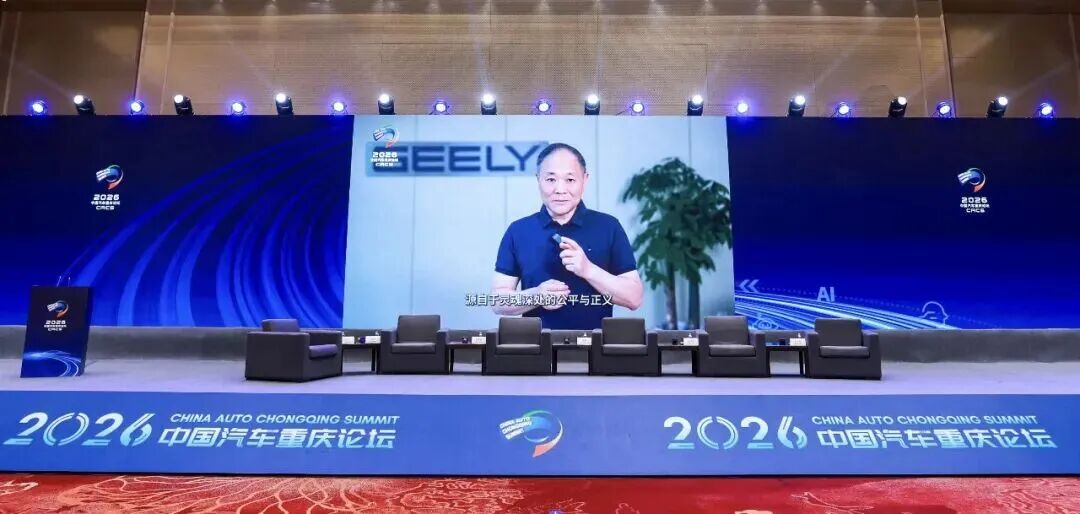
Li Shufu's remarks ignited significant discussion within the industry.
Coincidentally, on April 14 of the same year, BMW China posted a video on social media. The video initially depicted a scene of "simulator testing," seemingly shedding light on industry chaos. The so-called "simulator testing" showed a vehicle undergoing various tests, but as the scene shifted, it revealed someone using a spray bottle and a hairdryer to simulate testing on a computer screen, creating the illusion of testing the new vehicle under different conditions such as deserts, extreme cold, and high temperatures. Finally, BMW declared in the video: "At BMW, safety is not a feature; it is a baseline."
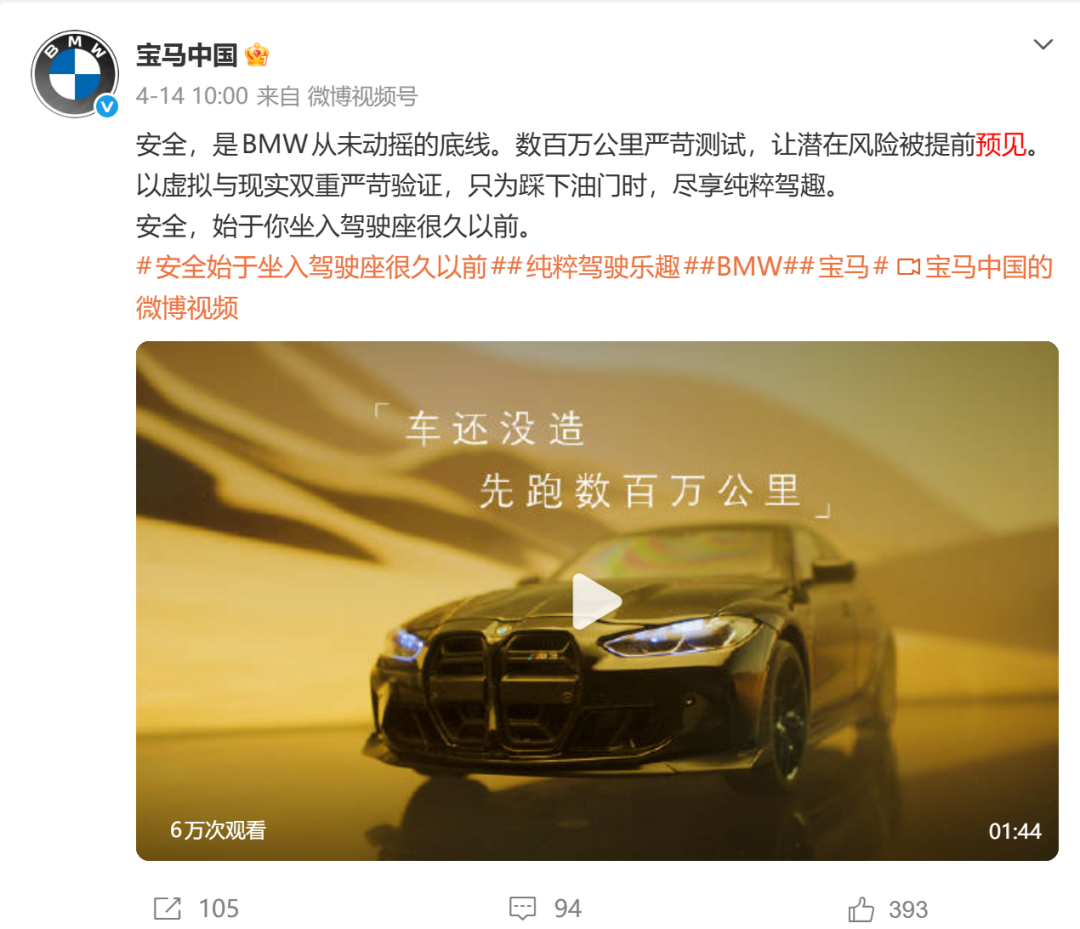
Upon its release, BMW's video immediately sparked widespread debate within the industry. Some directly pointed out that BMW was subtly ridiculing some new energy vehicle companies for compressing R&D cycles, overly relying on virtual simulations, skipping extensive real-vehicle validations, and launching immature, inadequately tested products into the market.
BMW's stance on safety, along with Li Shufu's assertion at the China Automotive Chongqing Forum that "the development of any new automotive product must adhere to the objective laws of automotive R&D, rather than cutting corners on testing processes, compressing testing and validation times, or taking shortcuts," clearly aligns in the same direction.
Coincidentally, in March of the same year, a video of a BMW female salesperson subtly mocking a certain Chinese new energy vehicle brand went viral on social media after being reposted by the media, triggering widespread dissemination. When asked about her opinion of a certain Chinese new energy brand during a live stream, the salesperson directly replied to consumers, "You can eat a chicken raised in 180 days, but I wouldn't dare drive a car made in 180 days."
Since the salesperson did not explicitly specify which brand she was referring to as the "chicken raised in 180 days," it remains ambiguous whether she was targeting a specific brand. However, the notion of the "chicken raised in 180 days," BMW's "simulator testing" in its advertisement video, and Geely's reference to "cutting corners on testing processes, compressing testing and validation times, or taking shortcuts" essentially point to the same issue.
Public information reveals that in recent years, it is an undeniable fact that Chinese automotive brands have been continuously accelerating their vehicle R&D speeds. On June 12, Nikkei News reported that Nissan Motor is preparing to learn from its Chinese counterparts by shortening its product R&D cycle from 55 months to two years.
The article highlighted that Chinese automakers generally have a new vehicle R&D cycle of about two years, with new models being launched consecutively. In China, Nissan has also leveraged its joint venture brand with Dongfeng Motor to absorb the partner's experience and technology, shortening the R&D cycle of its pure electric model, the N7, launched in April 2025, to two years. Moreover, Nissan plans to promote this efficient R&D model from the Chinese market globally.
However, this efficient R&D model is clearly distinct from the situation Li Shufu described as "cutting corners on testing processes, compressing testing and validation times, or taking shortcuts."
To achieve both efficient R&D cycles and eliminate opportunistic behavior, in Li Shufu's view, there are essentially two approaches. The first is for companies to establish correct values.
"A correct value orientation is the key variable ensuring the successful legacy of a company. The core content of corporate legacy is the inheritance of value orientation. Correct values are the core source ensuring the healthy development of a company," Li Shufu stated.
The second is to persist in providing users with "automotive products that withstand the test of time, are reliable, and trustworthy."
Li Shufu pointed out that to better and more sustainably develop Geely's automotive industry, Geely has successively acquired renowned companies such as Volvo and Lotus, taken stakes in century-old manufacturers like Mercedes-Benz, and deeply learned the essence of automotive technology, grasping automotive technology principles and details from the source, mastering them thoroughly and meticulously.
"We can fully seize the opportunity, collaborate, compete in accordance with the law, shoulder the responsibility for the sustainable development of China's automotive industry, and contribute to the great cause of national rejuvenation," Li Shufu further called for at the end of his speech.
-
![]()
In-depth | Survival Transformation of 38 Million Freight Drivers: How Platformization Defines the Next Decade?
-
![]()
Why Have ‘Computing Power Rental’ Companies Emerged as the Biggest Winners in the AI Era Amid Soaring Chip Prices?
-
![]()
DeepSeek's Financing Details Revealed! How Liang Wenfeng Secured Control
-
![]()
Valued at 210 Billion Yuan, Generating 42 Billion Yuan in Annual Revenue, Xiaohongshu May Proceed with IPO
-
![]()
Three Straight Months of Growth in Heavy Truck Sales: Both New and Veteran Players Are on the Same Wavelength!
-
![]()
AI Rewrites the Logic of Going Global: Cross-border E-commerce Reaches a New Turning Point
-
![]()
DeepSeek Secures Over 50 Billion Yuan in Initial Funding Round: Tencent and CATL Among Investors
-
![]()
Trillionaire Musk