In-depth Report on the 2026 Hong Kong Auto Expo | China's Auto Industry Upgrading Systemic Competition in Global Expansion: How Can Hong Kong Empower It?
 06/22 2026
 447
447
China's auto industry global expansion has evolved from product exports to systemic competition. Leveraging its highly internationalized professional services, Hong Kong has become a vital platform for mainland automakers to expand their global footprint and mitigate cross-border operational risks.
As the global industrial landscape undergoes profound reshaping, the automotive industry, a cornerstone of manufacturing, is embracing historic opportunities for global development. China's auto industry has made steady progress, with brands continuously enhancing their strength and confidently stepping onto the international stage. Global expansion has become an inevitable trend for high-quality industry development. With its internationally recognized status as a hub, a comprehensive financial ecosystem, a mature legal framework, and unique geographical advantages, Hong Kong serves as a golden bridge and strategic highland for mainland automotive enterprises to connect globally and establish overseas presence.
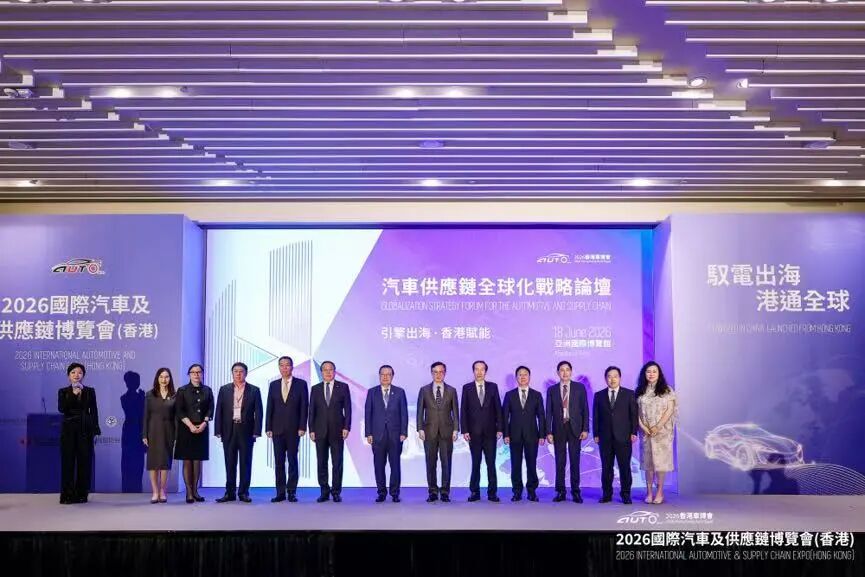
To align with industry trends, foster consensus, and address challenges in global expansion, the 2026 International Automotive and Supply Chain Expo (Hong Kong) hosted the "Global Engine, Hong Kong Empowerment" Automotive Supply Chain Globalization Strategy Forum on the afternoon of June 18. The forum gathered government authorities, leading automotive enterprises, top investment banks, and experts in cross-border legal compliance to discuss topics including supply chain globalization restructuring, global expansion strategies for automakers, international brand operations, and cross-border finance and compliance risk management.
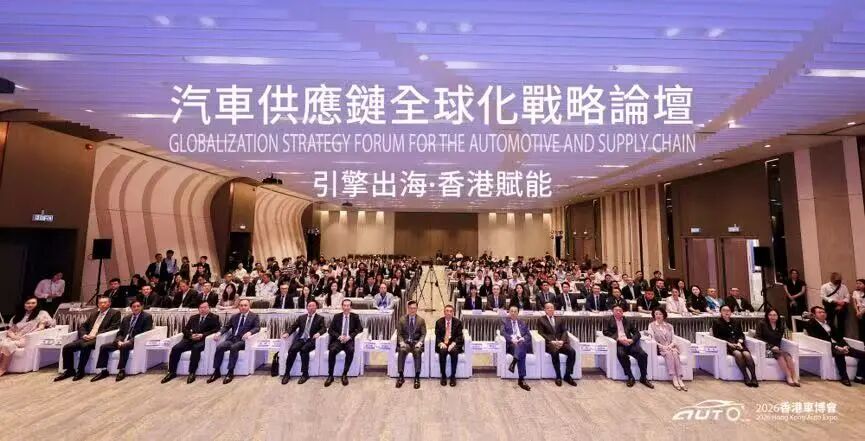
Key attendees included Zhang Guojun, Deputy Secretary for Justice of the Hong Kong Special Administrative Region Government; Xu Niansha, President of the China Machinery Industry Federation; Lo Man-tuen, Vice Chairman of the 10th All-China Federation of Returned Overseas Chinese, President of the China Hong Kong, Macao, Taiwan and Overseas Chinese Peaceful Development Association, and Honorary Chairman of the Hong Kong Auto Expo Organizing Committee; Tam Yiu-chung, Secretary-General of the Hong Kong Alliance for Relaunching China's Rejuvenation and Vice President of the Chinese Association of Hong Kong and Macao Studies; Fu Bingfeng, Chairman of the Hong Kong Auto Expo Organizing Committee and Executive Vice President and Secretary-General of the China Association of Automobile Manufacturers; Yu Xiao, Chairman of the Hong Kong Auto Expo Organizing Committee and Vice President and CEO of the Hong Kong China Enterprises Association; Luo Xianping, Chairman of the Hong Kong Auto Expo Organizing Committee and Executive President of the China Hong Kong, Macao, Taiwan and Overseas Chinese Peaceful Development Association; Ge Ming, Industrial Commissioner of the Hong Kong Special Administrative Region Government's Innovation, Technology and Industry Bureau; Tam Wan-chi, Senior Counsel, Independent International Arbitrator, and Professional Advisory Committee Member of the Hong Kong Trade Development Council; Liu Min, Chairman of BOC International Holdings Limited; Liu Yan, Deputy Secretary-General of the China Association of Automobile Manufacturers; Wei Haigang, General Manager of GAC International; Li Lingde, Deputy Head of KPMG China's Greater Bay Area Strategy and Development Center; Shi Miao, Senior Partner at Fenxun Baker McKenzie; and Zheng Haizhu, Representative of PetroChina International.
Global Expansion Enters Systemic Capability Competition
To understand why Hong Kong is becoming a pivotal support for Chinese automakers' globalization, one must first grasp the fundamental shift in China's auto industry global expansion.
The technological wave of electrification and intelligence has disrupted the global automotive industry's competitive landscape, which had remained stable for decades. Xu Niansha stated in his forum speech that this transformation brings not only opportunities but also unprecedented systemic pressures: traditional automotive powers' strategic foresight has been disrupted, while supply chain security and stability have become focal points across the industry.
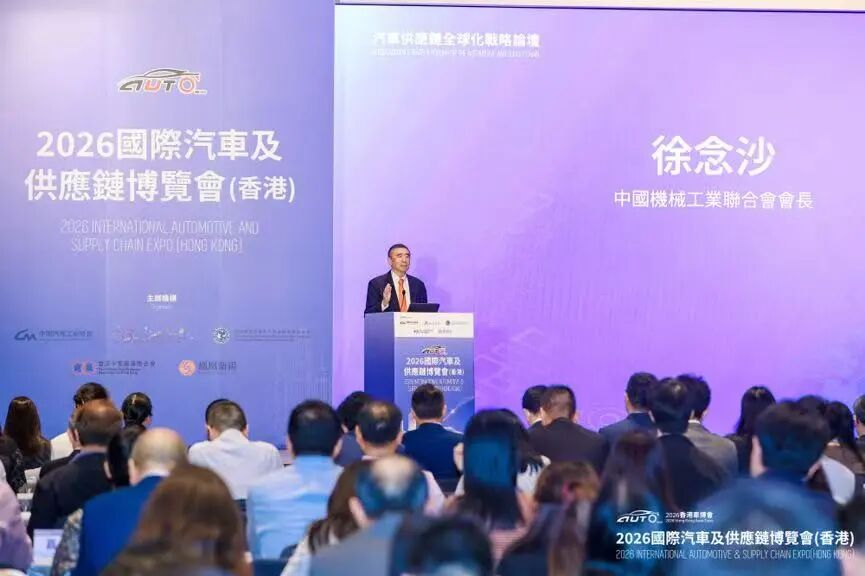
Xu Niansha, President of the China Machinery Industry Federation
From the evolution of global expansion paths, Li Lingde proposed an upgrading trajectory: testing markets through complete vehicle exports, sharing tariff costs with local partners via component assembly, and deeply embedding into target markets through fully localized production. The evolution of component exports follows a clear trajectory: starting with exterior trim parts leveraging cost advantages to enter global supply chains, gradually extending to battery systems and thermal management, and then to higher-barrier areas like intelligent driving and smart cockpits. The latter, involving highly sensitive intellectual property, often advances through technology licensing or joint ventures rather than simple product exports.
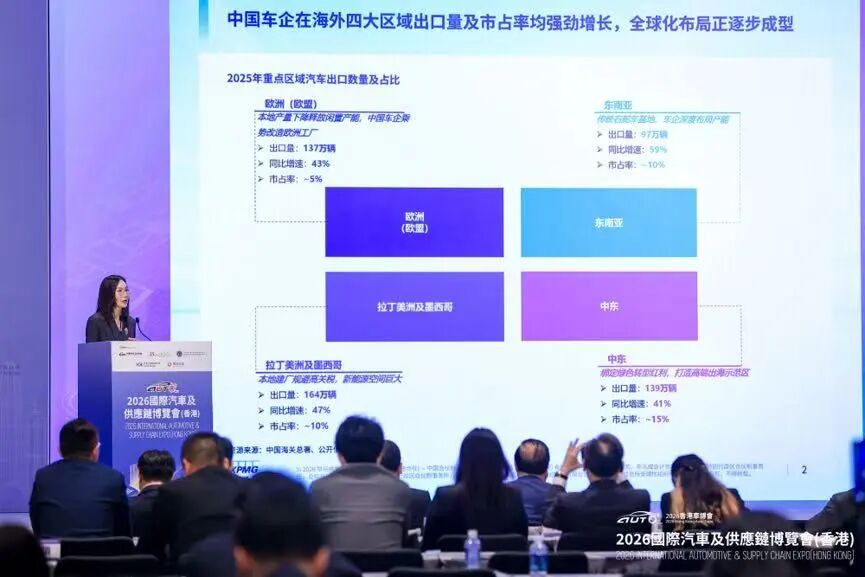
Li Lingde, Deputy Head of KPMG China's Greater Bay Area Strategy and Development Center
However, this upgrading path faces increasingly complex external resistance. Liu Min outlined a "risk checklist": trade barriers have become diversified and normalization (normalized), with tariffs, anti-subsidy investigations, carbon tariffs, and data compliance reviews overlapping. Some countries continue strengthening regulatory requirements in areas like intelligent driving and data security, further complicating the global layout of China's automotive supply chain.
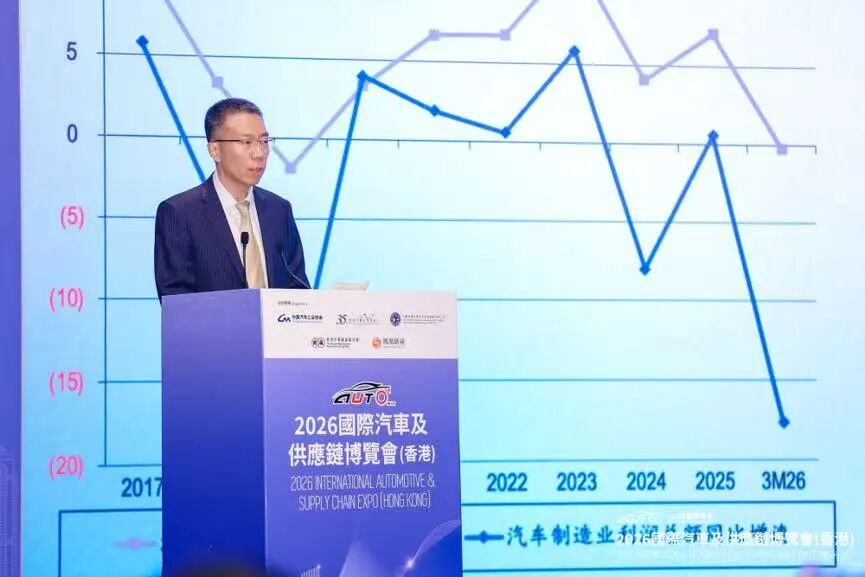
Liu Min, Chairman of BOC International Holdings Limited
Meanwhile, data security has emerged as a new core battleground for regulation. Zhang Guojun noted that over 140 countries and regions have enacted data and information protection laws, with intelligent electric vehicles becoming focal points due to their handling of highly sensitive information like geolocation and personnel imagery. Different countries impose varying requirements on data storage methods and cross-border flow paths, with regulatory violations carrying severe consequences. Zhang characterized this trend as "not a temporary risk but a long-term new normal."
Additionally, exchange rate fluctuations are quietly eroding overseas profitability. Liu cited first-quarter data showing that weakening major foreign currencies against the RMB had significantly impacted profits for several mainstream overseas automakers, becoming a major concern for capital markets. Meanwhile, compliance risks in overseas labor, commercial, and antitrust areas are drawing increasing attention from expanding enterprises.
Li added another layer of challenge: compliance has become a core threshold for "staying power" rather than a post-hoc remedy. The EU's GDPR on data privacy, green standards for battery lifecycle management, local labor laws, and union power—violating these requirements triggers not just fines but systemic threats to overall investment security.
Combining these challenges points to a single trend: Chinese automakers' focus in global expansion is shifting from market entry to long-term operational capability building. Addressing this requires not isolated breakthroughs but comprehensive systemic restructuring across capital, compliance, legal, supply chain, and digital operations.
How Hong Kong Becomes a "Super Connector"
Facing these systemic challenges, Hong Kong's role is far more complex and critical than commonly perceived. It serves not merely as a financing intermediary or legal services platform but as a strategic pivot connecting capital, regulations, and markets simultaneously.
Zhang presented the institutional landscape of Hong Kong's evolving professional services ecosystem from the government perspective. The Hong Kong Department of Justice recently released a professional services directory listing over 70 legal service providers, categorizing their expertise into 12 fields including corporate finance, IP protection, data compliance, and dispute resolution for precise matching with overseas enterprises' needs. Yu Xiao, Vice President of the Hong Kong China Enterprises Association, added (added) that under joint deployment by five national ministries, Hong Kong is accelerating the establishment of overseas integrated service stations, connecting with the Hong Kong Trade Development Council's "Global Go" platform and various professional resources to provide mainland enterprises with full-process one-stop services.
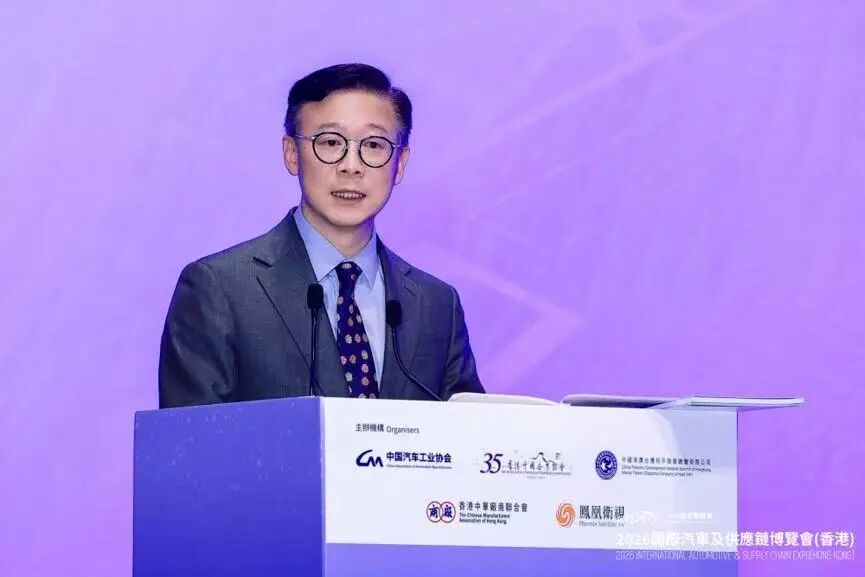
Zhang Guojun, Deputy Secretary for Justice of the Hong Kong Special Administrative Region Government
This reflects Hong Kong's framework for empowering enterprises' global expansion: connecting global capital through its financial system, international rules through legal and arbitration services, and global markets through its international network.
First is connecting global capital from financing windows to full-cycle financial ecosystems. This forms the foundational base for capital-intensive, long-cycle automotive globalization. Liu cited data showing that over 30 projects including IPOs and placements for major automakers and power battery companies in Hong Kong raised over HK$300 billion in the past 12 months, primarily for overseas R&D, factory construction, M&A, and channel development.
But Hong Kong's capital market value extends far beyond listing financing. Liu argued that as large automakers deepen their global strategies, one-time IPOs cannot meet expanding funding needs. What's required is a full-cycle capital support system spanning equity financing, bond issuance, M&A financing, operational funding, green finance, and FX hedging tools—a system he summarized as "long-term, fast, and stable": providing full-cycle services through product combinations of investment, loans, bonds, and FX, using blockchain for simultaneous FX hedging upon dealer orders, and locking in FX risks at source through RMB cross-border funding pools.
Shi further endorsed this capital advantage from a legal perspective. Citing Chery's HK$9.1 billion IPO, CATL's US$5 billion fundraising, and BYD's US$5.6 billion refinancing, she emphasized that while HKEX remains the most convenient hub for China's auto industry to access international capital, "gaining admission is no easy feat." Path selection, domestic regulatory coordination, structural design, governance upgrades, and fundraising usage planning—all these hurdles must be cleared, with only truly compliant enterprises able to seize capital market opportunities.
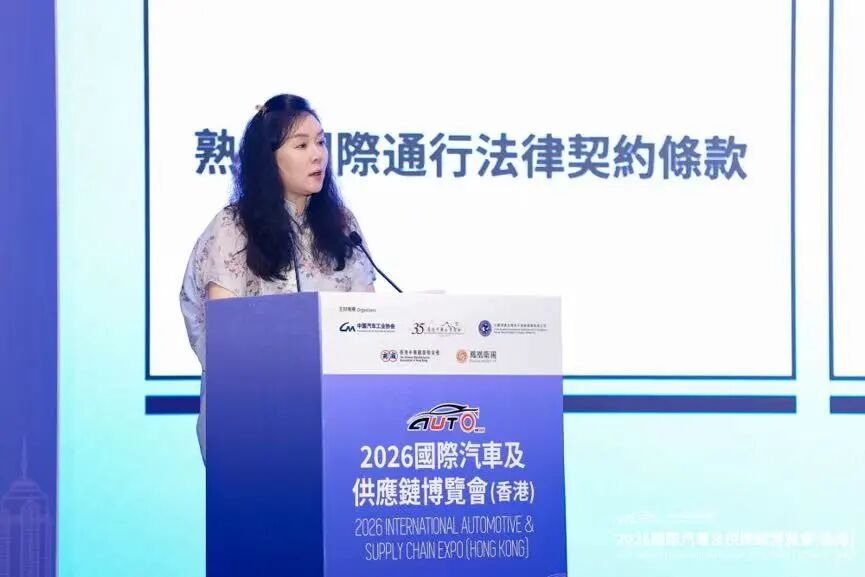
Shi Miao, Senior Partner at Fenxun Baker McKenzie
Meanwhile, Hong Kong's ability to connect global rules is becoming crucial for enterprises' global expansion.
If capital fuels global expansion, then regulatory compliance stabilizes the journey. Hong Kong's value in this dimension transcends being a mere legal services provider, evolving into a professional services ecosystem covering law, arbitration, and data compliance—an institutional infrastructure for building global compliance systems.
Shi positioned Hong Kong's role at this level as a "system converter" rather than a simple "geographic springboard": amid today's complex international environment, mainland automakers bringing capital overseas for M&A often face national security reviews or antitrust investigations before negotiations begin. Establishing investment structures through Hong Kong and engaging global regulators and joint venture partners using common law commercial norms can effectively mitigate geopolitical biases, providing enterprises with "compliance confidence for a global identity."
The core carrier of this institutional value is Hong Kong's arbitration mechanism. In Shi's view, Hong Kong arbitration awards are enforceable in over 170 New York Convention member states; uniquely, mainland China and Hong Kong have established comprehensive judicial mutual assistance mechanisms, enabling enterprises to apply for property preservation in the mainland while enforcing overseas assets in Hong Kong—truly "grasping both hands firmly."
Beyond capital and regulations, Hong Kong serves as a commercial hub helping mainland automakers access diverse global markets.
Yu cited a compelling statistic: over 60% of China's outward investment lands in or flows overseas via Hong Kong. The city hosts China's largest and strongest offshore Chinese enterprise cluster—pioneers in global expansion with rich international operational experience forming an active resource network. Yu revealed that the association is establishing an "Overseas Service Alliance" to efficiently connect member enterprises' global professional capabilities across 12 fields including law, finance, IP, and inspection with mainland expanding enterprises, enabling coordinated global expansion of Chinese products, services, and brands.
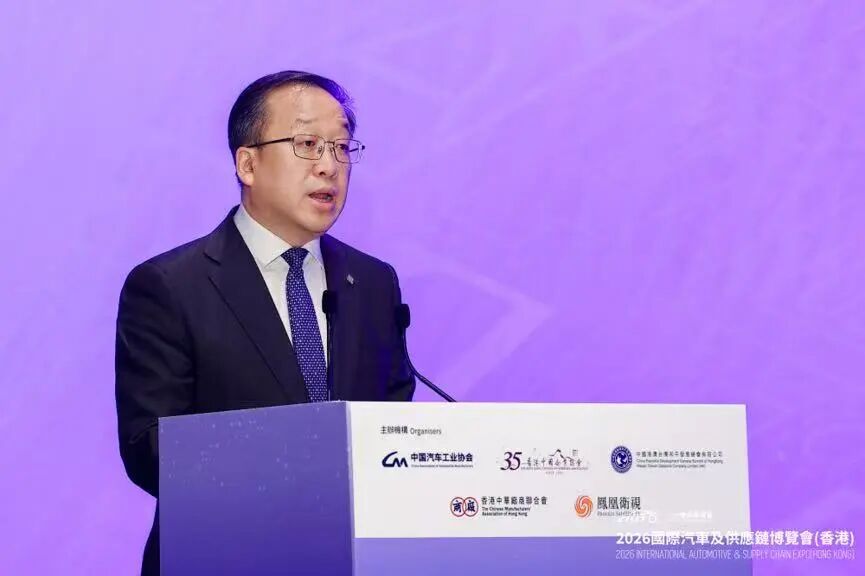
Yu Xiao, Chairman of the Hong Kong Auto Expo Organizing Committee and Vice President and CEO of the Hong Kong China Enterprises Association
Xu added from an industry organization perspective that Hong Kong's recent outreach activities in Kazakhstan, Uzbekistan, the UAE, and Abu Dhabi are materializing this hub value—Hong Kong's service capabilities and international networks can serve as vital support for mainland industries entering emerging markets.
The China Machinery Industry Federation has built 11 business platform systems for supply chain security, covering expert think tanks, data information, international cooperation, legal services, technology, and member services. These platforms provide decision consulting, operational data, cross-border matching, compliance guidance, technology transfer, and resource coordination functions, forming a support system covering the entire overseas layout chain. These platform capabilities can effectively empower Hong Kong's service industry and international networks to drive mainland industries into emerging markets via Hong Kong's hub, effectively mitigating transnational operational risks.
Liu added a frequently overlooked market logic: over 70 countries and regions use right-hand drive standards, with annual new vehicle demand exceeding 13 million units, covering mature markets like the UK and Australia. Hong Kong itself is a right-hand drive market with highly compatible regulatory standards and driving habits with these regions. Increasingly, Chinese new energy brands use Hong Kong as an important testing platform for entering right-hand drive markets. In his view, though small, Hong Kong's right-hand drive market attributes and international regulatory environment provide crucial references for enterprises expanding into related overseas markets.
From capital to law, from channels to talent, Hong Kong is becoming a "super connector" in the globalization process of China's automotive industry, evolving into a systematic capability platform that gradually covers the entire overseas expansion chain.
From service platform to rule-based platform,
Hong Kong's new role is taking shape.
Understanding Hong Kong's existing value is only half of the equation. What deserves greater attention is the historic opportunity Hong Kong faces in the reconfiguration of the future global industrial order.
When Chinese automakers embark on their globalization journey, they face not just market competition but also clashes of institutional systems. Shi Miao, from a legal perspective, described this dilemma: thick and heavy (Note: This Chinese term is left as is in the original context, likely referring to "cumbersome" or "complex") foreign-language contracts, unfamiliar union negotiation cultures, stringent data privacy frameworks like GDPR, and other institutional "cultural shocks" that are often more difficult to overcome than technological gaps.
Shi Miao believes that establishing an Asia-Pacific regional management platform in Hong Kong can enable centralized management of businesses in Southeast Asia, the Middle East, and South Asia. By adopting a common law contract logic for global alignment, an arbitration mechanism for handling cross-border disputes, and a judicial mutual assistance mechanism for safeguarding asset security, these "cultural shocks" can be gradually transformed into "seamless integration." This function as an "institutional converter" also constitutes Hong Kong's significant advantage in corporate globalization strategies.
However, deeper challenges are brewing.
At the forum, Shi Miao put forth a judgment: Today's leading automakers will soon no longer be identified solely as "automobile manufacturers." With flying cars, humanoid robots, and AI terminal services advancing toward commercial reality at an unprecedented pace, this cross-border integration is giving rise to a series of global regulatory gaps: How should low-altitude airspace be managed? Where do the ethical boundaries of robots lie? What frameworks should govern the storage and flow of cross-border data?... To date, these questions lack clear answers globally.
Shi Miao characterized this regulatory vacuum as "regulatory hegemony," where countries and regions that take the initiative in rule-making may gain first-mover advantages in related fields, thereby raising the barriers for latecomers in international market competition. She thus concluded: Future global competition will no longer be solely about product technology and capital scale but also about competitive influence in rule-making. Whoever takes the lead in establishing universally applicable rules will hold the power to define the future.
Against this backdrop, Shi Miao believes Hong Kong has encountered a historic strategic window and has proposed a clear "three-step" pathway: Step 1: Establish a regulatory sandbox. In cutting-edge fields like flying cars and embodied AI, the absence of rules does not mean innovation should wait. Hong Kong can leverage its flexible regulatory mechanisms to create a regulatory sandbox, allowing companies to experiment and accumulate real-world data on regulatory needs, accelerating technology deployment and business model validation. Step 2: Define a rule framework. On global challenges such as data ownership, liability boundaries, and algorithmic ethics, Hong Kong should rely on its common law precedent tradition to take the lead (Note: This Chinese term means "take the lead" or "be the first to") construct a clear, actionable rule framework that balances China's industrial interests with internationally accepted logic. Step 3: Export standards. Leveraging its institutional status as an international arbitration and financial center, Hong Kong should radiate these rules globally through transaction compliance clauses and arbitration agreements, gradually transforming "Hong Kong standards" into "international standards."
Zhang Guojun echoed this direction in his keynote speech. He stated that the national 15th Five-Year Plan explicitly supports Hong Kong in deepening its development as an international legal and dispute resolution service center, and the profound significance of this deployment lies in providing an institutional fulcrum for China's participation in constructing global industrial rules.
China's automotive globalization is seeking new fulcrums.
Over the past decade, China's automotive overseas expansion has focused on products: the ability to manufacture competitive vehicles and enter markets at lower prices.
Today, product strength is a threshold rather than a barrier; overseas expansion now hinges on systems: whether capital is sufficient, compliance is comprehensive, supply chains are resilient, brands can take root in foreign cultures, and management can transcend institutional boundaries. Liu Min summarized this phase of competition as "globalization is not merely about relocating supply chains but requires a complete system of capital coordination and cross-border risk control as a foundation"; Xu Niansha, from an industry organization perspective, emphasized that platform and location advantages must ultimately be translated into real competitiveness through corporate implementation.
In the foreseeable future, as competition in the global automotive industrial system escalates, it will increasingly become a contest of rule-making participation capabilities. From product exports to system exports to rule participation... China's automotive globalization is progressively deepening. Hong Kong, meanwhile, is emerging as a crucial fulcrum connecting these processes.

Photo: Hong Kong Auto Expo
Article: Auto Review
Layout: Auto Review
-
![]()
Enflame Technology Clears IPO Hurdle: A Daring Venture into CUDA-Incompatible Realm
-
![]()
Significant Shifts in Home Appliance Market Trends During This Year’s 618 Shopping Festival
-
![]()
Insta360 Fights Back! Standing Up to Black PR Operations", "Insta360 Innovation, Black PR Operations, Patent Litigation, Market Competition, Financial Performance", "Insta360 Innovation, targeted by b
-
![]()
Home Appliance Enterprises: Shifting Focus from Traffic Acquisition to User Retention
-
![]()
Re-imported Cars Dilemma Unveils the Fallacy of Japanese 'Craftsmanship Spirit'
-
![]()
Stepping onto a New Path, Yet Hongqi Faces Familiar Challenges
-
![]()
Should Honda Offer Toshiaki Mibu a Second Chance?
-
![]()
The Qualification Remains, But Where Does Zotye’s Future Lie?