Over the Past Three Years, Air Conditioner Powder Spraying Has Become a Widespread Issue Among Over a Dozen Automakers and Numerous Models! Is Cost-Cutting the Culprit?
 06/24 2026
 506
506
Three years ago, when BYD's Dolphin first drew attention to the issue of "air conditioner powder spraying," the outside world joked about "antacid spraying." However, no one anticipated that "air conditioner powder spraying" would soon become a buzzword within the industry.
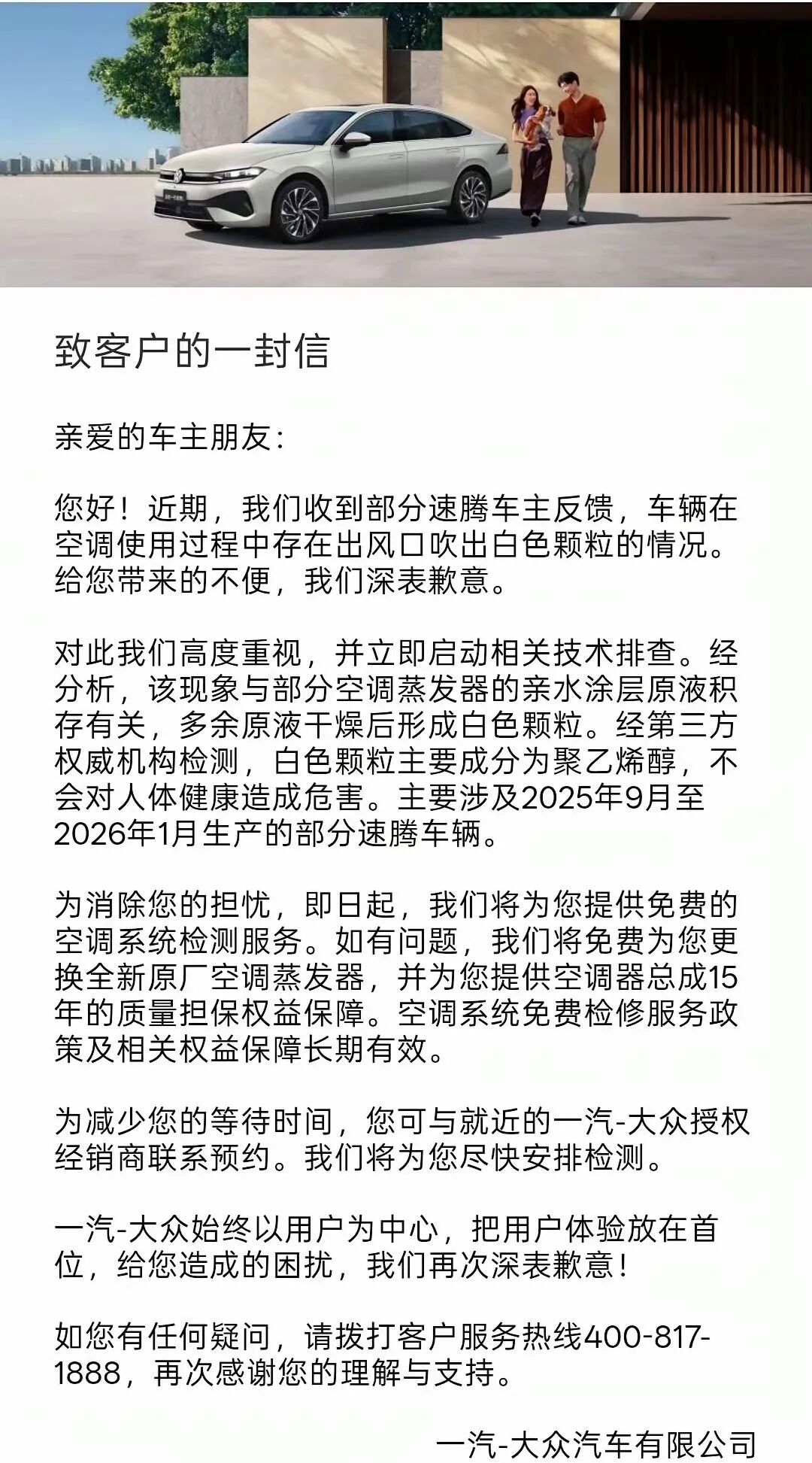
Recently, both FAW-Volkswagen and Changan Qiyuan have been reported by the media for air conditioner powder spraying. In early June, FAW-Volkswagen issued "A Letter to Customers" to vehicle owners, offering a solution: "If there are issues with the air conditioning system, a brand-new original factory air conditioner evaporator will be replaced free of charge, along with a 15-year quality warranty for the air conditioning assembly." This can be seen as a relatively satisfactory resolution to the air conditioner powder spraying incident. Meanwhile, Changan Qiyuan has also recently faced complaints from vehicle owners regarding air conditioner powder spraying. According to public reports, the issue primarily involves the A07 model, with a few cases also reported in the A05 and other models.
Based on incomplete public data, air conditioner powder spraying has surfaced in over a dozen brands in the past three years, affecting numerous models. These brands include BYD (Dynasty, Ocean series), Qiyuan, Shenlan, Volkswagen, Zeekr, IM Motors, Arcfox, Exeed, Hongqi, BMW, Smart, Jetta, Tesla, and others. The problem predominantly affects new energy vehicles equipped with heat pump systems, while gasoline vehicles are mainly impacted in new production batches after September 2025. Complaints primarily come from platforms such as Chezhinet, Heimao Complaints, Autohome, and Dongchedi Car Owner Circles, with the common issue being the peeling of the hydrophilic coating on the evaporator.
Among these, BYD has had a relatively large number of affected products, with the issue mainly concentrated in 2023-2024. Affected models include the Dolphin, Seagull, and Yuan PLUS, with the powder primarily consisting of aluminum hydroxide. The phenomenon is most noticeable when using winter heating or when the air conditioner is turned on for the first time after long-term parking. However, after August 2025, BYD improved the evaporator design and installed it in vehicles, leading to a significant decline in complaints, although a few complaints about 2024 inventory vehicles still persist.
Complaints about this issue within the Changan group increased in the second half of 2025. Specifically, the Qiyuan A07 has received numerous reports of aluminum powder spraying from the air conditioner since the end of 2025, with multiple owners reporting recurrence within 1-2 months after evaporator replacement. After-sales service often attributes this to "normal wear and tear." The Shenlan S07 and S05 have experienced issues with evaporator solder joint detachment and coating powder overflow in the past year, with concentrated exposure on Chezhinet and forums. Additionally, the Oushang Z6 new energy vehicle (ZhiDian iDD) has received complaints since the end of 2025, with owners stating that 4S stores initially often misdiagnosed the issue as a filter problem when it was actually due to evaporator coating peeling.
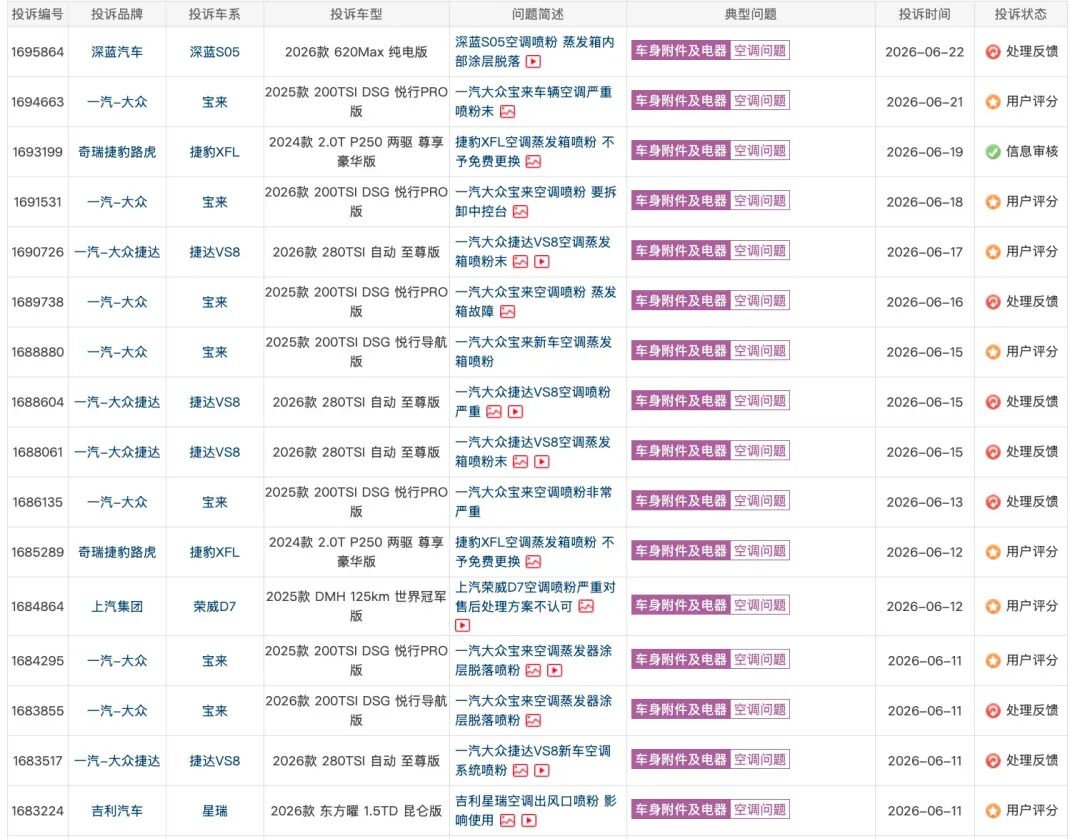
Volkswagen and its subsidiary brands began experiencing such issues in 2026, affecting models such as the Sagitar, Bora PRO, and Jetta VS8. These problems have largely been resolved through after-sales service. Additionally, Zeekr, IM Motors, Arcfox, Toyota, Exeed, Smart, and others have received sporadic but persistent complaints. However, among them, multiple brands such as IM Motors, Zeekr, and Toyota have seen a sharp decline in complaints after improving evaporator production or switching evaporator suppliers. Nevertheless, the issue has a very broad scope, effectively becoming an industry-wide problem. It has even been reported in overseas markets.
So, why has the previously unheard-of issue of air conditioner powder spraying emerged and become concentrated in the past two years? This is believed to be caused by cost-cutting measures.
An automotive blogger analyzed that the main reasons for air conditioner powder spraying are substandard surface coating processes on aluminum evaporators, insufficient adhesion, and corrosion from condensation water, leading to coating peeling and powder formation. Some suppliers, in an effort to cut costs, reduce coating processes or omit them entirely, failing to perform hydrophilic passivation treatment, allowing aluminum oxides to be directly blown into the air duct by the blower. The blogger suggested that this may not be an issue specific to a single automaker but rather a result of shrinking profit margins being passed on to suppliers, who are then forced to cut costs in certain processes as a last resort. Suppliers face their own challenges.
An industry insider pointedly noted that the "quality" of powder spraying is increasing across the entire industry, and in the end, consumers are the ones who suffer from cost-cutting and efficiency improvements. Some people still believe that the current significant price reductions in vehicles are a good thing. Earlier, another blogger pointed out that the concentrated emergence of air conditioner powder spraying in the past two years may be related to the compact layout of electric vehicles, which has altered the surface design of evaporators, potentially introducing micro-voltages on the evaporator surface. Additionally, price wars were not as intense in the past. Regardless of the perspective, cost compression appears to be a significant contributing factor.
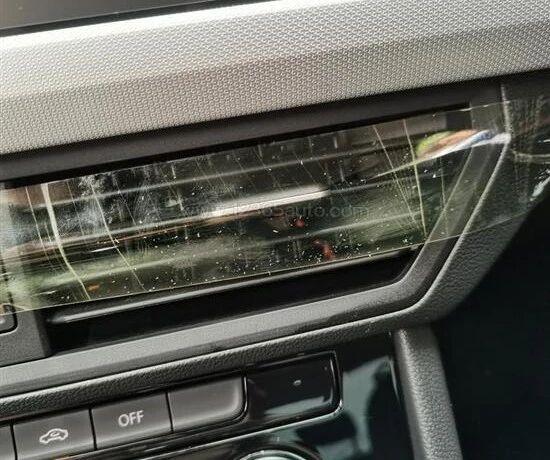
Therefore, in summary, the emergence of powder spraying can be attributed to both technical and cost-related factors. From a technical standpoint, air conditioner evaporators are made of aluminum and require a hydrophilic anti-corrosion coating (primarily aluminum hydroxide, polyvinyl alcohol, and potassium fluoroaluminate) on their surface to accelerate condensation water drainage and prevent aluminum foil corrosion. There are three direct causes of coating peeling:
1. Extreme temperature fluctuations (unique to new energy vehicles): The air conditioning systems in new energy vehicles use heat pump technology, requiring year-round temperature control for the cabin and cooling for the battery/motor. The compressor operates for 1,000-2,000 hours annually, three to four times longer than in gasoline vehicles (300-600 hours). The evaporator frequently switches between 0-10°C (cooling) and 50-60°C (heating), with temperature differences exceeding 50°C. The differing expansion coefficients of the coating and aluminum foil lead to repeated stretching and contraction, causing the coating to crack and peel.
2. Humid and corrosive environment: The evaporator continuously generates slightly acidic condensation water during operation. Over time, coatings with insufficient adhesion are easily corroded and peeled. Once the aluminum foil is exposed, it further oxidizes to form aluminum hydroxide powder, creating a vicious cycle of "coating peeling → aluminum foil corrosion → increased powder."
3. Process defects: If the coating is applied too thinly, dried incompletely, cured unevenly, or if residual flux remains during production, adhesion will be insufficient, leading to premature peeling after leaving the factory.
The cost-related reasons stem from the intense price wars in the automotive industry in recent years. To control costs, automakers have simplified coating processes, used low-cost coating materials, shortened durability testing cycles, and even reduced coating thickness, directly resulting in substandard coating quality. This often leads to batch occurrences and concentrated outbreaks. In the industry's view, air conditioner powder spraying in vehicles is not simply a "minor fault" but an inevitable consequence of the combined effects of new energy technology characteristics, industry price wars, and supply chain quality control failures. It exposes deep-seated issues such as quality control lagging behind scale growth, technical standards not adapting to new energy upgrades, and a lack of corporate responsibility consciousness during rapid industry expansion.
It can be said that the powder spraying incidents directly demonstrate that in the end, there are no winners in a price war.
-
【Insight】NPO (Near Package Optics) as a Transitional Solution for CPO, Industry Development Embraces Opportunities
-
![]()
Charging Industry Shifts from Quantity to User Experience as New Benchmark
-
![]()
Qianli Technology Aims for Autonomy from Geely's Sphere: Why Does BAIC Initiate the Alliance First?
-
![]()
Three Major New Policies Come into Force on the Same Day, Revolutionizing the Growth Dynamics of China's Auto Market
-
![]()
The Complete Blueprint of Tsinghua-Affiliated Embodied AI 'Startup Dream Team': 7 Companies, 25 Billion in Funding, and the Dawn of an Era
-
![]()
The Ministry of Industry and Information Technology Forces Auto Companies to 'Self-Examine and Rectify,' Banning Unsafe Old Electric Vehicles from the Roads
-
![]()
Trump Hits the Brakes: America's Pure Electric Vehicle Race Crashes into a Wall
-
![]()
New 'Traffic Rules' for Unmanned Logistics Vehicles: No Nighttime Driving, Black Boxes Now Mandatory