Dreame's 'Automotive Aspirations' Hit Turbulence: Genuine Car-Building or Mere Posturing Following Key Executive's Exit?", "Dreame, automotive sector, Chen Longdong, strategic shift, vehicle developme
 06/25 2026
 533
533
In a mere span of 12 months, the much-debated Dreame and its foray into the automotive realm have been consistently embroiled in upheaval.
The company promptly addressed recent speculation surrounding the departure of Chen Longdong, the CEO of Dreame Automotive.
On June 23, Stellar Future (Suzhou) Automotive Technology Co., Ltd., a subsidiary of Dreame, released a statement clarifying that Chen Longdong joined Dreame Technology's original Stellar Future business unit (BU) in June 2025 as its leader. His actual responsibilities diverged from the online monikers of 'Dreame Automotive CEO' or 'Dreame executive.' In May 2026, Chen Longdong exited Stellar Future, marking a routine organizational and personnel transition within the firm.
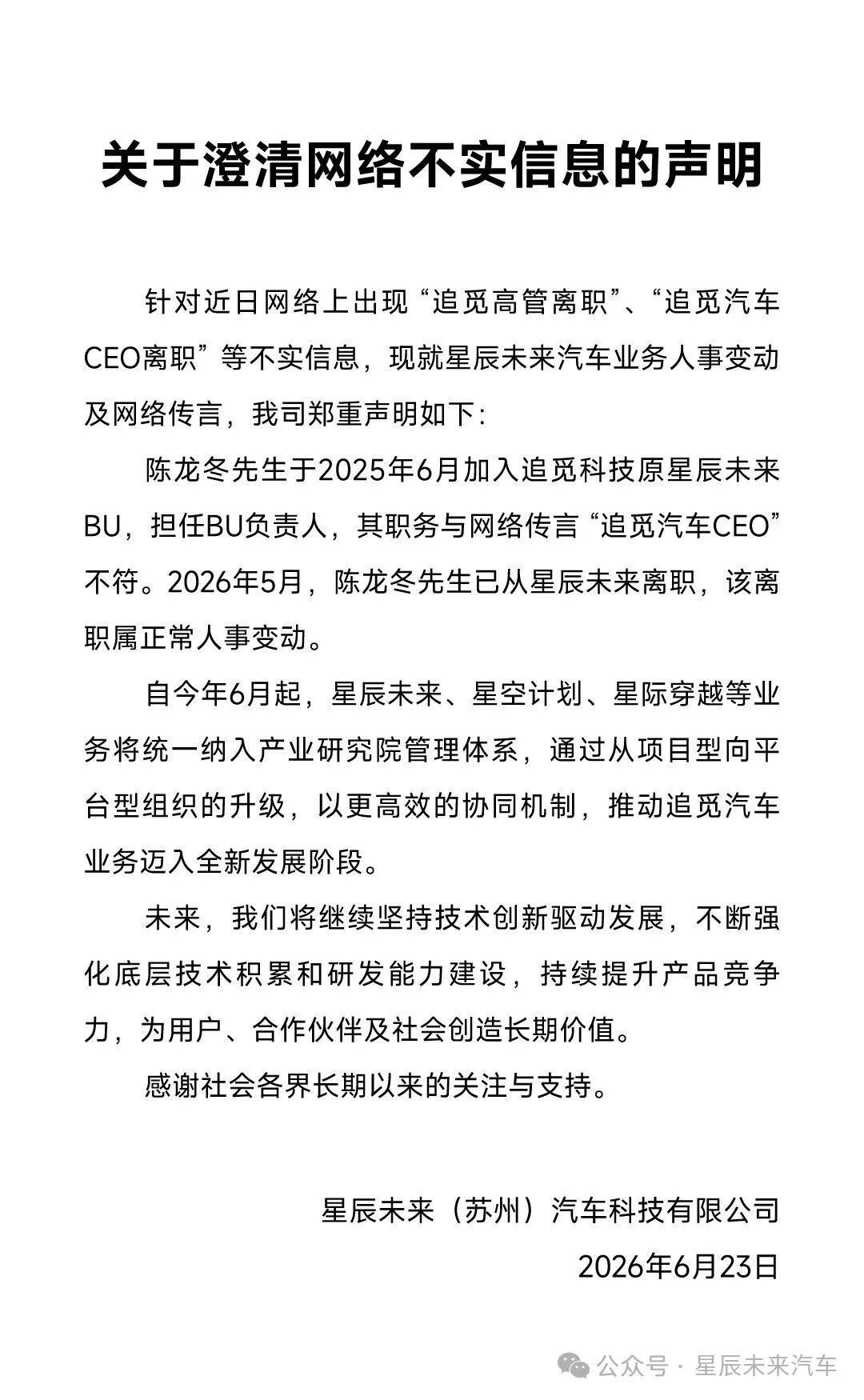
Stellar Future also announced that, commencing in June of this year, entities such as Stellar Future, Stellar Plan, and Interstellar Travel will be consolidated under the Industrial Research Institute's management framework. The company aims to enhance internal synergy and propel Dreame's automotive endeavors into a fresh phase of growth by transitioning from a project-centric to a platform-centric organizational model.
Just days prior, on June 18, Dreame unveiled a strategic pivot, pledging to concentrate fully on four core domains: smart home, outdoor living, intelligent mobility, and embodied intelligence. Non-core businesses will undergo integration, merger, or transformation, while certain BUs lacking substantive operations or personnel will be dissolved outright. Previously market-centric ventures like automotive and mobile phones will progress under the Industrial Research Institute's aegis, primarily focusing on technological R&D and industry-academia-research collaboration.
1. Chen Longdong Retains Legal Representation for Multiple Dreame Entities, Participated in 'Career Direct' Prior to Departure
In essence, amidst internal reshuffling within Dreame's automotive and mobile phone divisions, Chen Longdong, a pivotal figure in the automotive landscape, also exited simultaneously.
Regarding his specific role, whether Chen Longdong was dubbed the CEO of the automotive business or the BU head, the distinction lies solely in nomenclature. Since his integration into Dreame, his initial significance to the automotive venture cannot be overstated.
According to public records, Chen Longdong joined Dreame Technology in June 2025 and established Stellar Future (Suzhou) Automotive Technology Co., Ltd., serving as its legal representative and BU head. This wholly-owned subsidiary of Dreame Technology, operating in the intelligent mobility sector, is headquartered in Suzhou, Jiangsu Province, and focuses on R&D and manufacturing of high-end intelligent electric vehicles, with a registered capital of 50 million RMB.
Notably, the Stellar Future company issuing the statement to debunk misinformation is the parent entity of Stellar Future Technology, with only a slight variation in their names. Tianyancha data reveals that as of June 24, Chen Longdong remains the legal representative of both entities. In other words, his legal representative status has not been updated promptly since his departure in May.
Furthermore, Tianyancha indicates that Chen Longdong currently also holds the position of legal representative for Dreame-affiliated companies such as Starlink Everything (Shenzhen) Automotive Technology Co., Ltd., Shenzhen Stellar Fanmai Technology Co., Ltd., Spark Origin (Guangzhou) Automotive Technology Co., Ltd., and Stellar Leads Media (Hangzhou) Co., Ltd. The first three entities were established in November and December 2025, while Stellar Leads was founded in March of this year.
In Dreame's grand commercial vision, its lofty automotive ambitions initially targeted the high-end market, with Chen Longdong undoubtedly serving as a linchpin. However, a closer examination of Chen's professional background reveals no prior automotive industry experience.
Chen Longdong graduated from Jilin University with a degree in electromechanical robotics. He commenced his career as a hardware engineer at Huawei, later ascending to the roles of CTO and Chief Strategy Scientist at Boya Gongdao.
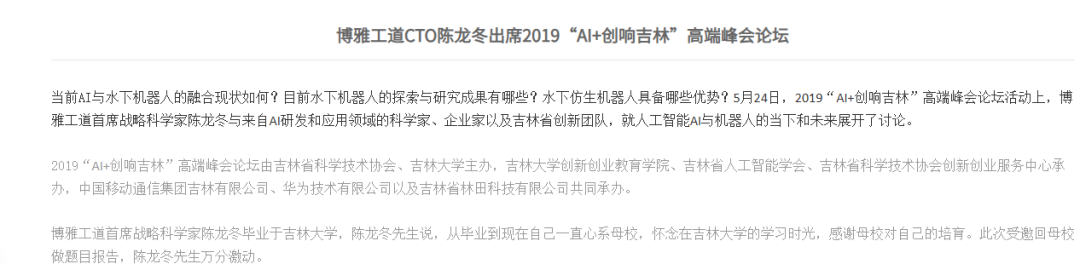
Public records indicate that in 2015, Peking University Ph.D. holder Xiong Minglei founded Boya Gongdao, targeting the untapped global market for consumer-grade underwater robots. At the time, the underwater equipment industry had stagnated technically for decades, with foreign devices dominating, civilian products scarce, and a dual shortage of talent and capital—a quintessential niche, high-tech sector. Chen Longdong, optimistic about the long-term potential of underwater intelligent equipment, left his stable position at Huawei to join full-time as a partner, CTO, and Chief Strategy Scientist, becoming the team's core technical leader, fully responsible for the full-stack R&D of bionic algorithms, underwater propulsion, and visual navigation, as well as the architect of the company's technological framework.
Under Chen Longdong's guidance, the team embarked on relentless efforts, abandoning conventional spiral structures to independently develop a bionic fin propulsion system, addressing underwater silence and high-maneuverability challenges. Simultaneously, they constructed a comprehensive algorithm control platform, enabling autonomous obstacle avoidance and deep-water high-definition filming for robotic fish. During the most arduous phase, the team trimmed costs and relied on a 12 million RMB Pre-A round funding from a government industrial fund to sustain operations and prevent R&D disruptions.
Under Chen Longdong's stewardship, the team introduced China's inaugural consumer-grade bionic robotic fish, BIKI, and the bionic shark underwater vehicle, ROBO-SHARK, securing over 60 core patents and filling gaps in domestic underwater robot localization.
Just a month or two prior to his departure, on March 14, 2026, Chen Longdong participated in the variety show 'Career Direct 2026' as the president of Stellar Future Automotive.
2. The Automotive Aspiration Initially Targeted Multi-Million-Dollar Bugatti Veyrons
A visionary company with boundless automotive dreams selected a research-oriented talent with no automotive background as its leader, attempting to forge a new path.
In today's fiercely competitive global automotive landscape, this was an uphill battle from the outset.
Recalling Dreame's automotive aspirations, the company claimed to have harbored car-building plans since 2013. On August 28, 2025, Dreame officially announced its entry into car manufacturing, adopting a China-research, Germany-manufacturing model, with brand positioning rivaling Bugatti Veyron and Rolls-Royce. It reportedly secured its initial funding round on September 12 of the same year and commenced production base construction near Berlin, Germany, with a planned area 1.2 times that of Tesla's Berlin factory, adjacent to Tesla's Berlin Gigafactory and in collaboration with BNP Paribas for factory construction.
On January 6, 2026, the Stellar Plan made its debut at the International Consumer Electronics Show (CES), unveiling the concept car Nebula Next 01 Concept. On February 4, 2026, Dreame first revealed the names and appearances of three SUV models: Interstellar T08, Interstellar T08L, and Interstellar D09. The brand name for these three models was set as STAR MOTOR Interstellar Travel.
Dreame Technology once declared that its ambition was not to follow but to establish a new order in the ultra-luxury market as a 'Chinese brand.'""The Bugatti Veyron, which Dreame's inaugural model aims to rival, is the flagship sports car of Bugatti, an ultra-luxury brand under the German Volkswagen Group, launched in 2005. This vehicle starts at 25 million RMB in the domestic market, with high-performance versions reaching 43 million RMB.
Dreame's automotive dreams were globally top-tier from the inception.
On April 28 (U.S. time) this year, Dreame Technology hosted a launch event in San Francisco, USA, officially unveiling the pure electric supercar concept car—Nebula NEXT 01 JET Edition.
Dreame introduced that this propulsion system boasts a response time as low as 150 milliseconds and a maximum thrust of 100 kilonewtons. The vehicle accelerates from 0 to 100 km/h in just 0.9 seconds, significantly surpassing the physical grip limits of existing tires.
3. Genuine Car-Building or Mere Posturing? Does It Possess the Right Timing, Location, and Talent?
The promotional materials always exude positivity. However, debates also swirl around Dreame Automotive's true capabilities—is it a concept car, a PPT car, or just an empty shell?
In the view of Bo Wenxi, Vice Chairman of the China Enterprise Capital Union, Dreame announced its car-building plans in August 2025 and had its automotive business taken over by the Industrial Research Institute by June 2026, taking less than a year. Chen Longdong, a 'layman' with a background as a Huawei hardware engineer and entrepreneur in underwater bionic robots, was elevated to CEO of the entire vehicle division, exposing the hastiness of Dreame's car-building decision. Car manufacturing transcends mere hardware integration; it entails an intricate system engineering of supply chain management, safety certifications, channel networks, and after-sales systems.
Bo Wenxi cited Xiaomi's car-building endeavor as an illustration: it necessitated three years, over 10 billion RMB in investment, and personal leadership by Lei Jun, yet it still encountered significant hurdles. Dreame, employing a person lacking automotive industry experience, aimed to launch a top-tier luxury car rivaling Bugatti within a year—this appears more akin to a capital narrative than an industrial blueprint. More critically, media on-site inspections revealed that the planned plot 'had no sign of a factory,' indicating that mass production never truly commenced in a substantive manner.
According to Dreame Automotive's plans, the official mass production of its inaugural luxury coupe is slated for 2027.
Zhang Xiang, an automotive industry analyst and researcher at the Automobile Industry Innovation Research Center of North China University of Technology, commented, “It’s possible that Dreame doesn’t truly intend to manufacture cars. Instead, its primary goal might be to raise funds through advertising and marketing efforts. With the capital secured, it can pursue car manufacturing; otherwise, it can still leverage the promotional activities to enhance the company’s profile, thereby boosting sales of other products. The cost of producing the several concept cars that Dreame has unveiled is relatively low, as creating prototype vehicles has become more affordable these days. Hence, producing prototypes doesn’t necessarily demonstrate true strength, as these models don’t need to be operational; they simply require an appealing exterior design without bearing responsibility for the vehicle’s overall quality and reliability, including potential defects, recalls, or customer complaints.”
“Zhang Xiang believes that Dreame’s recent decision to reintegrate its automotive business into the research institute may reflect a recognition that car manufacturing is more complex and demanding than initially anticipated. From the perspective of the automotive industry, after several rounds of market consolidation, the barriers to entry have risen significantly. In today’s climate, where the ‘tide has receded,’ revealing the true capabilities of companies, unlike the earlier period when over a hundred firms were venturing into car manufacturing with varying degrees of success—many resorting to mere PPT presentations—even previously successful players like WM Motor have been forced out. Other automakers are facing even tougher challenges. Moreover, investors now have a clearer understanding of the new energy vehicle sector, and achieving short-term profitability presents substantial hurdles. Sales of new energy vehicles have surpassed those of fuel-powered cars, and evaluation criteria now extend beyond funding and company valuation to include sales performance and profitability; otherwise, valuations cannot sustain growth.”
“Furthermore, Chen Longdong of Dreame lacks experience in the automotive industry and cannot demonstrate the same level of commitment as Lei Jun. Relying on the early strategies employed by new automotive entrants, such as hosting press conferences and engaging in fan-based marketing, is also challenging. Additionally, there are no policy incentives or subsidies available. Overall, Dreame lacks the favorable timing, location, and talent required for successful car manufacturing and must rely solely on its own capabilities. Without acquisitions, it must undertake its own research and development, yet translating R&D outcomes into market success is extremely difficult, as top talent and technological resources are currently concentrated within established automakers.”
“Regarding Dreame’s strategic shift, Bo Wenxi stated that the essence of the Dreame phenomenon epitomizes the typical predicament of the ‘narrative-driven’ model prevalent in Chinese tech entrepreneurship: founders excel at crafting grand narratives, establishing over 200 business units spanning diverse sectors such as automotive, mobile phones, aviation, and the low-altitude economy, and utilizing ‘ecosystem’ concepts to attract capital attention. However, they often lack a deep respect for industrial laws. When faced with Pre-IPO valuation pressures, regulatory tightening, and a capital market downturn, this ‘scattered’ approach inevitably collapses. Dreame’s experience serves as a reminder that technological similarity does not equate to commercial viability; just because a company excels in high-speed motors doesn’t mean it can successfully build entire vehicles; similarly, just because robotic vacuum cleaners achieve global sales leadership doesn’t mean the brand can support high-end luxury cars. True strategic determination lies not in ‘chasing trends’ but in ‘mastering areas of expertise.’ Dreame’s current retreat is less about embracing long-termism and more about rectifying last year’s aggressive expansion—fortunately, it’s not too late.”
“Bo Wenxi also cautioned that, on the surface, Dreame’s main business witnessed an 80% year-on-year growth from January to May 2026, with robotic vacuum cleaners ranking first globally in both sales volume and value, giving the impression that the company is ‘not short of money.’ However, the deeper implications of this retreat cannot be overlooked: founder Yu Hao’s Weibo account was suspended, a location in Jiangsu requested statistics on cooperation with Dreame, over 200 business units were consolidated, and approximately 12% of the staff was laid off—these signs indicate that Dreame’s ‘scattergun’ expansion model has reached its organizational limits. The downgrading of capital-intensive businesses like automotive and mobile phones from independent business units to a research institute is essentially using the dignified term ‘technology reserve’ to mask the reality of commercialization failure. Dreame is not ‘proactively streamlining during a period of high main business growth’ but is compelled to cut losses before the financial drain of non-core businesses adversely affects its core operations. (Produced by Harbour Finance)”
-
![]()
Can Computers, Despite Daily Price Hikes, Still Be a Viable Purchase?
-
![]()
January-June Auto Stocks' 'Resilience Ranking': Geely Alone Posts Gains, Six Plummet Over 40%, One Tumbles 54.5% | Mirror Pro
-
![]()
China’s Public Charging Market: Didi Charging, Teld, and Yunkuai Take the Lead
-
![]()
The First Year of AI-Native Mid-Year Shopping Festival: Technology Reconstructs Human-Product Matching for 618
-
![]()
Micron has released its financial report, showing revenues of $41.5 billion, a 74% increase quarter-over-quarter, with a gross margin of 84.6%. The company provided both short-term and long-term guida
-
![]()
Expert Interpretation of New Policy Combination: Activating the Trillion-Dollar Automotive Aftermarket
-
![]()
Doubao Goes 'Professional', Volcano Rolls the Snowball
-
AI: No Sign of a Bubble!