High-End Market Slips Away: Li Auto Grapples with Declining Performance and Stock Price, Trillion-Dollar Market Cap Dream Seems Elusive Amid 'Golden Handcuffs'
 06/25 2026
 552
552
On June 23, the brand-new Li L8 made its official debut and commenced deliveries, quickening the pace of the Li Auto-W's (02015.HK, hereinafter referred to as 'Li Auto') L series refresh. This new energy vehicle (NEV) maker, once the first among its peers to turn a profit, is now deeply entangled in operational challenges. In 2025, it witnessed across-the-board declines in deliveries, revenue, and net profit, and swung from profit to loss in the first quarter of 2026. The company's sales volume is predominantly propped up by models in the 200,000-yuan price bracket, while high-end models have suffered a significant slump, leading to a substantial shrinkage in vehicle gross profit margins.
Securities Star observed that, under the pressure of performance, Li Auto has rolled out two equity incentive plans totaling over HK$2.3 billion. Among these, the equity incentives for three key executives are tied to market cap with five-tier unlocking conditions, ranging from HK$200 billion to HK$1 trillion. However, Li Auto's current total market cap stands at just over HK$100 billion, with the first-phase target requiring nearly a doubling of the current market cap, and the long-term trillion-dollar market cap goal looming more than nine times the current total market cap. Whether this incentive mechanism can reverse Li Auto's current dual pressures of operations and valuation remains highly uncertain.
01. Q1 Swing from Profit to Loss, Auto Manufacturing Gross Profit Margin Takes a Dive
In 2025, the penetration rate of new energy passenger vehicles surpassed 50%, and the industry entered a phase of inventory competition in 2026, amplifying performance pressures for Li Auto. Throughout 2025, Li Auto delivered 406,300 new vehicles, a year-on-year decrease of 18.8%; revenue reached RMB 112.313 billion, down 22.3% year-on-year; and net profit was a mere RMB 1.139 billion, a sharp year-on-year decline of 85.8%.
In the first quarter of 2026, Li Auto delivered 95,100 vehicles, a year-on-year increase of 2.45%. However, this growth in deliveries did not translate into revenue expansion, with company income reaching RMB 22.983 billion, a year-on-year decrease of 11.4%; and a net profit loss of RMB 2.276 billion, swinging from a profit of RMB 647 million in the same period of 2025.
Delving into the business structure, vehicle sales revenue in the first quarter of 2026 was RMB 21.533 billion, a year-on-year decrease of 12.7%. Li Auto stated that the year-on-year drop in vehicle sales revenue was primarily due to a lower average selling price resulting from a different product mix. Consequently, the company's vehicle gross profit margin plummeted to 6.1%, a year-on-year and quarter-on-quarter decrease of 13.7 and 10.7 percentage points, respectively.
During the first-quarter 2026 earnings call, Li Auto's Chief Financial Officer, Li Tie, mentioned that the company's first-quarter gross profit margin was impacted by a confluence of factors, including model facelifts and renewals, an increase in the sales share of the Li i6 and Li L6, and the Li i6 purchase tax subsidy.
Securities Star noted that the dividends from the extended-range vehicle segment are gradually fading, with Li Auto's original core advantages continuously narrowing, and pure electric models emerging as a crucial source of incremental growth in the first quarter. According to data from Chezhuzhijia, in the first quarter of 2026, sales of the Li i6 reached approximately 57,100 units, accounting for 60% of total sales. As of May, the Li i6 had surpassed 20,000 deliveries for three consecutive months, becoming the brand's top sales pillar. However, the Li i6 is priced at RMB 249,800, making it the brand's lowest-priced model. The second-best-selling model, the Li L6, had sales of approximately 18,100 units in the first quarter, accounting for about 19% of sales, with a price range of only RMB 249,800-279,800. The overall shift in the company's product mix towards lower-priced models in the 200,000-yuan range has directly lowered the average selling price per vehicle.
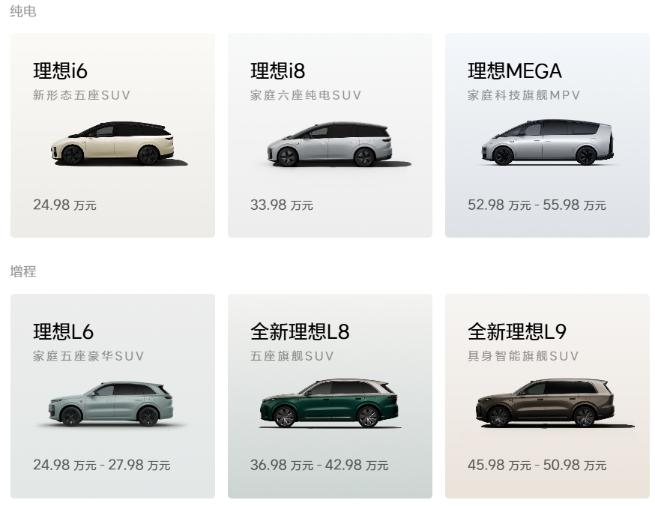
In the first quarter of 2026, except for the Li L6, sales of the other main models in the L series fell by around 70%. In April and May, the sales slump in the L series persisted, with the sales base still relying on low-priced models. Li Auto's current predicament is partly attributable to the growing pains during the transition period between old and new products. To expedite the transition to the new generation of products, the company proactively halted production of the old L series models in March this year, cutting off some short-term delivery sources, which also led to weak sales of high-end, high-gross-profit-margin models.
In May, deliveries of the all-new Li L9 commenced, marking the start of the full renewal of the Li L series, with prices starting at RMB 459,800. On June 23, the all-new Li L8 was also officially launched and delivered, priced at RMB 369,800 and RMB 429,800, respectively. However, the question facing Li Auto is whether consumers are still willing to pay a premium for the higher-positioned L series, given that the Li i6 has already pushed cost-effectiveness to the extreme. Additionally, how long can the sales boost from the new models sustain?
It is worth mentioning that Li Auto has adopted a cautious stance in its performance guidance for the second quarter of 2026, expecting deliveries to range from 95,000 to 100,000 units, a year-on-year decrease of 14.5% to 10%; and total revenue to range from RMB 24.1 billion to RMB 25.4 billion, a year-on-year decrease of 20.2% to 16%.
02. Stock Price Hits Rock Bottom, Trillion-Dollar Market Cap Goal Clashes with Reality
Amid performance and sales pressures, Li Auto has splurged over HK$2.3 billion on equity incentives, which are tied to a trillion-dollar market cap goal.
On June 15, Li Auto granted a total of 35 million share options to Li Tie, President Ma Donghui, and Chief Technology Officer Xie Yan under the 2020 plan. These share options represent 17.5 million American Depositary Shares (ADS), equivalent to 35 million Class A ordinary shares, accounting for 1.62% of the company's total share capital. Specifically, Ma Donghui was granted 15 million options, while Li Tie and Xie Yan were each granted 10 million options.
The exercise price of the share options is US$14.38 per ADS, requiring a total payment of approximately US$252 million for full exercise. The exercise period for the share options is 10 years from the date of grant, i.e., until June 15, 2036. Li Auto has set a market cap-linked unlocking mechanism, requiring the average market cap in Hong Kong to meet targets over 30 consecutive trading days for vesting to occur in batches. The market cap assessment thresholds correspond to five stages: HK$200 billion, HK$400 billion, HK$600 billion, HK$800 billion, and HK$1 trillion, with 20% unlocking at each stage.
Based on the share price of HK$56.85 per share on the grant date (June 15), the total value of the aforementioned shares is approximately HK$1.99 billion. However, the secondary market is not optimistic, with Li Auto's stock price hitting a historic low of HK$47.9 per share on June 23. Currently, the company's market cap is approximately HK$104.9 billion. Over the long term, Li Auto's peak market cap occurred in August 2023, when the stock price reached HK$185.5 per share, and the total market cap exceeded HK$350 billion. The current total market cap has fallen by about 70% from its historic peak.
Securities Star noted that Li Auto launched a share repurchase plan worth up to US$1 billion in March this year, attempting to regain market confidence with real money. However, since the announcement of the repurchase plan, the stock price has still retreated by about 24%. Based on the current stock price trend, to reach the first-phase unlocking threshold of HK$200 billion, the company's market cap needs to grow by about 91% from its current level, and the long-term trillion-dollar market cap goal is more than nine times the current market cap.
Li Auto stated in the announcement that the company is adjusting the long-term incentive arrangements for its core management members, shifting from fixed time-based vesting to an incentive structure that better aligns the interests of core management members with shareholder interests and the group's long-term performance. Core management members will only benefit when the company's stock price rises, relevant market cap performance targets are met, and shareholder value is truly enhanced.
Against the backdrop of intensifying competition in the NEV market and a swing from profit to loss in performance, whether Li Auto's hefty incentive plan will serve as a long-term bond to unite the team or remain a capital narrative that is difficult to materialize remains to be seen over time.
It is worth mentioning that the orientation of this incentive binding was already reflected in the 2025 compensation structure. Ma Donghui's total compensation in 2025 was RMB 36.289 million, with share-based compensation expenses accounting for RMB 33.033 million, or 91.03% of his total compensation; Li Tie's total compensation was RMB 23.291 million, with share-based compensation expenses accounting for RMB 20.225 million, or 86.84% of his total compensation.
The announcement also disclosed a second equity incentive plan, under which Li Auto granted 5.5572 million restricted shares worth approximately HK$316 million to Ma Donghui and 99 employees under the 2019 plan. The assessment criteria for the second equity incentive plan are primarily linked to performance evaluations, including but not limited to work quality, efficiency, collaboration, and management. The total value of the aforementioned two equity incentive plans is as high as HK$2.306 billion. (This article was first published by Securities Star, Author: Lu Wenyan)
- End -
-
![]()
Can Computers, Despite Daily Price Hikes, Still Be a Viable Purchase?
-
![]()
January-June Auto Stocks' 'Resilience Ranking': Geely Alone Posts Gains, Six Plummet Over 40%, One Tumbles 54.5% | Mirror Pro
-
![]()
China’s Public Charging Market: Didi Charging, Teld, and Yunkuai Take the Lead
-
![]()
The First Year of AI-Native Mid-Year Shopping Festival: Technology Reconstructs Human-Product Matching for 618
-
![]()
Micron has released its financial report, showing revenues of $41.5 billion, a 74% increase quarter-over-quarter, with a gross margin of 84.6%. The company provided both short-term and long-term guida
-
![]()
Expert Interpretation of New Policy Combination: Activating the Trillion-Dollar Automotive Aftermarket
-
![]()
Doubao Goes 'Professional', Volcano Rolls the Snowball
-
AI: No Sign of a Bubble!