Car Manufacturing Paused, Yet Dreame’s Automotive Dream Marches On
 06/29 2026
 369
369
Recently, news about Chen Longdong stepping down as CEO of Xingchen Future Automobile—a subsidiary of Dreame—spread quickly online. This was widely seen as a major indicator of Dreame's strategic pullback in the automotive sector. In response, Xingchen Future issued a statement on June 23rd to set the record straight. According to the statement, Chen Longdong joined Dreame Technology's original Xingchen Future Business Unit (BU) in June 2025 as its head. This role was different from the online reports of him being the "CEO of Dreame Automobile." His departure from Xingchen Future is considered a routine personnel change.
At the same time, the statement revealed that starting in June of this year, businesses like Xingchen Future, Xingkong Plan, and Xingji Chuangyue would be integrated under the management of the Industrial Research Institute. By upgrading from a project-based to a platform-based organizational structure, Dreame aims to take its automotive business to a new level of development. Moreover, Dreame made it clear that automotive R&D is still moving forward steadily, with a focus shifting towards overseas markets in the future. The previously announced timeline for mass production of new vehicles by the end of 2027 remains unchanged.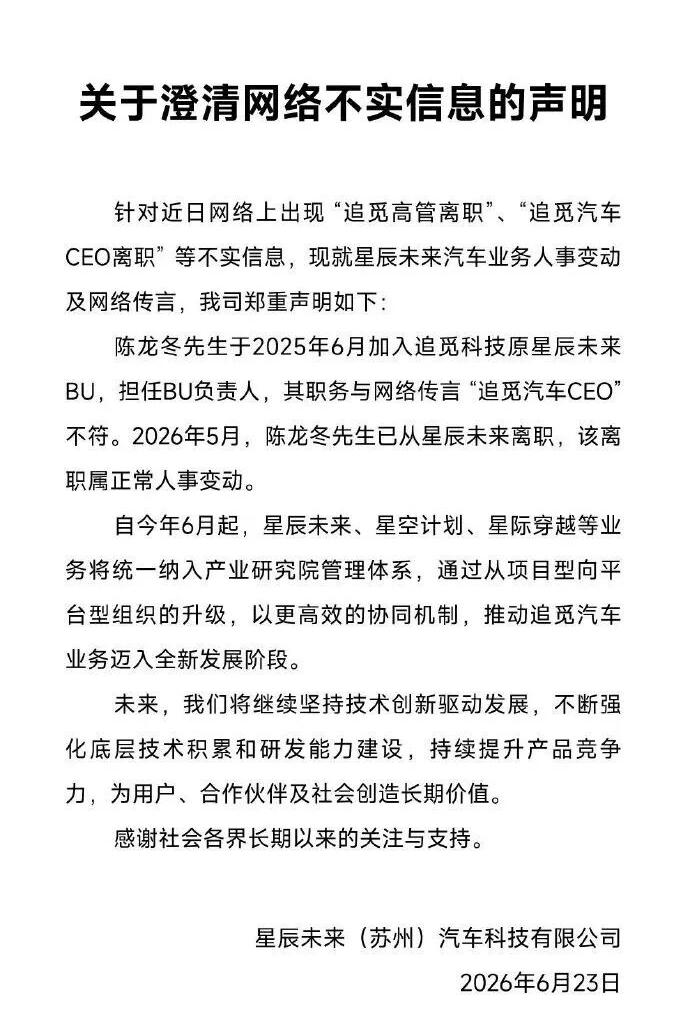
From its official announcement of entering the car-making business to a significant strategic retrenchment, Dreame has gone through this transition in just ten months. In January 2025, Dreame's main car-making entity, "Xingkong Plan (Shanghai) Automotive Technology Co., Ltd.," was officially established with a registered capital of 1 billion yuan. Founder Yu Hao indirectly holds 96.7% of the shares through a multi-tiered shareholding structure.
In August 2025, Dreame made a splashy announcement about its car-making plans. Its first product was positioned to compete with the Bugatti Veyron, with mass production slated for 2027. The company also set up an independent car-making entity, assembled a team of nearly a thousand people, selected a site in Germany, and even chose a location near Tesla's Berlin factory.
Dreame's high-profile entry into the automotive sector immediately caught the industry's attention. In the first half of 2026, Dreame unveiled several concept cars. However, some rendering images were criticized for showing obvious signs of being AI-generated, sparking ongoing discussions about "PPT car-making" (a term referring to making grand announcements without substantial progress).
In fact, earlier this June, media outlets visited Dreame's planned car-making site but found no construction activity at the factory. This revealed a significant gap between the company's promotional plans and its actual progress, fueling further industry skepticism. It's widely recognized that developing a car from scratch to mass production and delivery typically takes three to five years and requires hundreds of billions of yuan in investment.
Certainly, Dreame CEO Yu Hao expressed confidence in early public interviews, stating that the company had sufficient cash reserves. But where did this confidence stem from? The reality is that most of the funds came from local state-owned capital.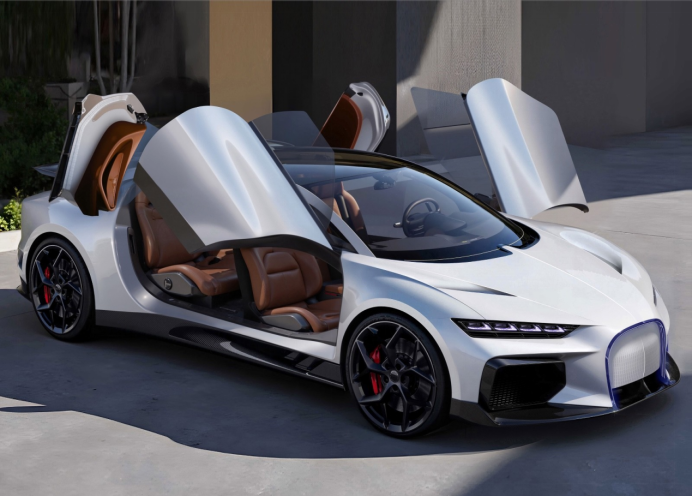
In March 2025, Yu Hao introduced the concept of "Born Without Boundaries" and outlined an ecosystem encompassing "people, vehicles, homes, the sky, the earth, and chips." This involved splitting the company into over 200 independent business units (BUs) under ten incubators. The model featured incubators coordinating efforts while BUs operated autonomously, resulting in nearly 300 affiliated business entities. At the same time, Dreame established industrial funds totaling over 40 billion yuan, with actual contributions exceeding 20 billion yuan. The funding model involved Dreame contributing 20% and local state-owned capital providing 80% to support various businesses.
Some public opinions have suggested that Dreame might not have a genuine intention to manufacture cars. Instead, it could be using car-making as a tool for brand marketing and fundraising. If funds were secured, mass production would proceed; if fundraising fell short, the related publicity would still boost the company's overall brand and other product lines.
However, by 2026, Dreame was facing mounting internal and external pressures. On the one hand, on June 5th, the State Council's Document No. 54 explicitly stated that "districts and counties should, in principle, not establish new government investment funds," significantly narrowing the company's state-owned capital fundraising channels. Additionally, reports indicated that Dreame Group began tightening its capital supply in March. Internal BU borrowing was halved in April, reduced to 25% in May, and completely stopped in June. BUs that couldn't generate profits or repay group debts entered liquidation processes.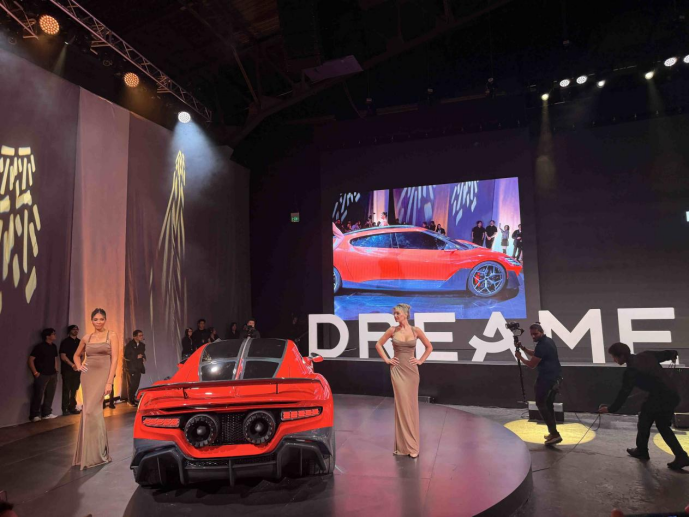
In the latest adjustments made in June of this year, Dreame has consolidated over 200 business units into four core sectors. The automotive and mobile phone businesses are no longer independently pursuing mass production but are now unified under the Industrial Research Institute, retaining only technical R&D functions. Downgraded from business divisions to laboratories, and shifting from a "mass production in 2027" goal to "no specific timeline," this ten-month automotive venture has taken a step back.
Meanwhile, Dreame has optimized about 12% of its workforce, excluding factory positions. This affected around 2,400 employees out of approximately 20,000. Optimized employees received compensation ranging from 0.5N to N+1 based on their business lines and tenure. These signs indicate that Dreame's "scattergun" expansion model has reached its organizational limits.
Some viewpoints suggest that downgrading capital-intensive businesses like Dreame Automobile and mobile phones from independent BUs to research institutes is essentially using the dignified term "technical reserves" to mask the reality of commercialization failure.
Anyone can unveil concept cars or hold press conferences, but car manufacturing has never been sustainable through PPTs and hype alone. When the car-making craze subsides, only then will it become clear who was swimming naked. Dreame's "strategic retreat" might just be the right move in this era of rationality. (Image sourced from the internet; removal upon infringement claim)
-
![]()
Can Chinese Automakers Pose Such Fierce Competition? Mercedes-Benz Cancels Year-End Bonuses for 90,000 Staff, Volkswagen to Lay Off 100,000 Employees...
-
![]()
Anhui and Zhejiang Vie for the Crown in New Energy Vehicle Dominance: Who Will Prevail?
-
![]()
Tmall 618 Rankings Unveil Trends Transforming the Home Appliance Industry
-
![]()
This Week in Home Appliances: Overseas Boom! Midea, TCL, Dreame Break Through; Casarte, Fotile, Gree, Hisense, Ronshen Lay Foundations
-
![]()
Aiming to Be the Alphard of the Electric Era! After D99's Launch, Leapmotor Will Release All-New Technologies to Pave the Way for a High-End Brand | Mirrormedia Pro
-
![]()
Over 5,200 Orders Placed on First Day: Can the Qijing GT7, Priced from 209,900 Yuan, Compete with the Z7 and SU7? | Mingjing Pro
-
![]()
AI Predicting the World Cup? It’s Time to Stop Insulting AI
-
![]()
iPhone 18 Pro Memory Costs Soar Threefold! Apple Seeks Trump Administration Approval for CXMT Memory Chips