Weekly Stock Review | Li Bin Sounds Alarm on 'Toughest' Year, Casting a Shadow Over Lei Jun's Noodle Moment
 06/29 2026
 427
427
Weekly Auto Stock Review: Diverse Trends in the Auto Market Unveiled
Panic is starting to permeate the atmosphere. This term has become a recurring theme in global stock markets as of late.
On June 26th, within just half an hour of the market opening, stocks took a nosedive, breaching the 4010-point threshold. Nearly nine out of ten stocks suffered losses, with the ratio of declining stocks vastly outweighing those that rose.
The A-share market isn't the only one feeling the pinch; the global tech sector is also under considerable strain, with panic spreading like wildfire across markets. Tech giants overseas, previously at the forefront of the global AI market rally, have seen their stocks decline en masse. This has prompted the market to reassess the growth prospects of the AI industry chain, thereby dampening previously bullish expectations for the tech sector.
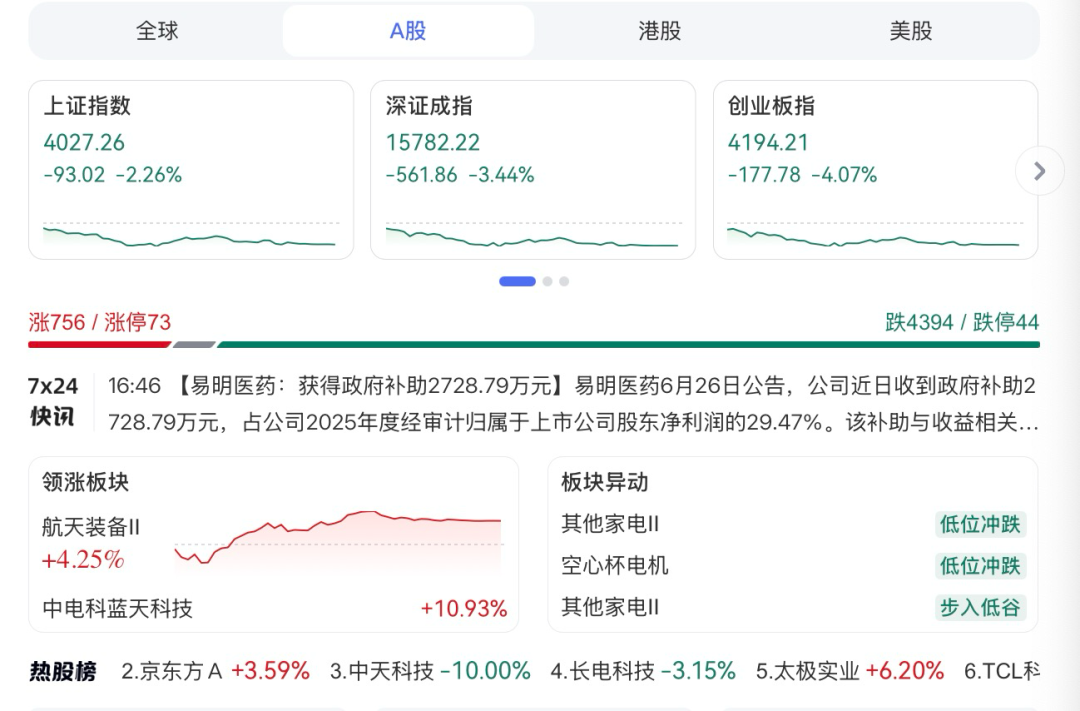
Despite the temporary lull in the tech sector, capital continues to flow into growth areas such as semiconductors and rare metals. However, the automobile manufacturing sector is facing relentless pressure.
Take June 25th's data, for instance. Most major A-share auto stocks closed in the red, with BYD finishing at 82.2 yuan, down 1.32%. Great Wall Motors ended at 15.67 yuan, a 2.18% decline. GAC Group closed at 5.28 yuan, down 0.75%, while SAIC Motor and BAIC BluePark experienced slight dips. Upstream auto parts and lithium battery equipment sectors followed suit, displaying notable weakness across the board.
This is because the auto industry is grappling with a scenario of 'increased revenue without corresponding profit growth.' Profit pressures are primarily stemming from the sustained impact of price wars on the industry chain's profitability. In the first quarter of 2026, the overall profit margin of the domestic auto industry stood at a mere 3.2%, well below the historical average of 6% for the manufacturing sector. The situation is akin to 'selling cars at a loss.'
Of course, the auto sector's woes aren't confined to the A-share market; the Hong Kong stock market is also feeling the heat.
In Hong Kong, the three core indices weakened throughout the day. Capital outflows from new automotive forces were evident, with Li Auto closing at HK$47.4, down 4.13%, marking the sector's biggest loser. XPeng Group finished at HK$47.9, a 2.52% decline, while NIO closed at HK$38.62, down slightly by 1.18%.

Moreover, Xiaomi's stock price decline has cast a shadow over Lei Jun's noodle-eating moment. Xiaomi Group closed at HK$22.3, down 2.87%, with multiple intraday dips hitting new lows, barely clinging to a market value of HK$500 billion, having plummeted nearly two-thirds from its peak. Persistent expectations of losses in its automotive business continue to weigh on its valuation. Just this year, Xiaomi's stock price has plummeted by over 40%.
The glory days of a year ago seem like a distant memory. On June 27th, 2025, with the high-profile launch of the Xiaomi Yu7, Xiaomi Group's stock price in the Hong Kong stock market soared to a historic high of HK$61.45, reaching a market value of HK$1.59 trillion. Lei Jun beamed as he accepted cheers, with analysts纷纷 (a Chinese term meaning 'one after another' or 'in succession') raising their target prices.
A year later, even Lei Jun's down-to-earth breakfast couldn't revive Xiaomi's stock price. On June 15th, Lei Jun attended the World Youth Development Forum in Wuhan. That morning, he indulged in the 'three essentials for breakfast' in Wuhan: hot dry noodles, dough fritters, and three-delicacy bean skin.
Unsurprisingly, Lei Jun became a trending topic on social media.
However, this time, the public's attention was drawn to a comment from a passing child: 'Why are so many people taking photos when you're just having breakfast?' Netizens speculated that Lei Jun was imitating someone. Later, Lei Jun responded, 'Such a simple matter has trended for days; I'm also puzzled.'
From a capital perspective, Lei Jun's breakfast has no bearing on Xiaomi's stock price, but it does suggest that Xiaomi may be running out of tricks. Wang Wen, founder of Rido Investment, bluntly stated, 'I even doubt if Xiaomi has a long-term plan; it seems to jump into whatever is trending.'
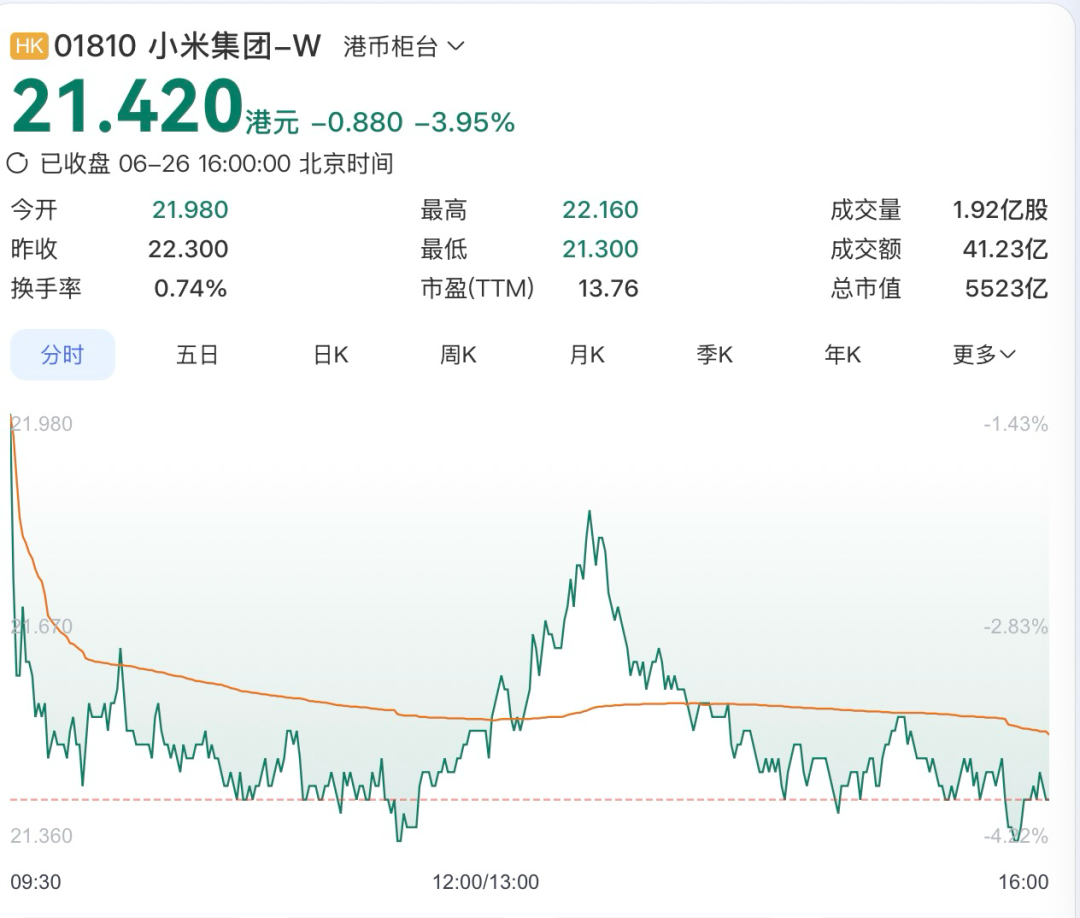
Nevertheless, the primary reason for the market value reduction lies in Xiaomi's revenue decline. In the first quarter of this year, Xiaomi Group reported revenue of 99.1 billion yuan, down 10.9% year-on-year. Net profit was 4.7 billion yuan, a 56.5% decrease year-on-year.
Xiaomi acknowledged that in the first quarter, geopolitical uncertainties disrupted the global economy, while significant price hikes in core components, including memory and commodities, coupled with intensified industry competition, continued to pose challenges, leading to performance pressures.
Seres, which had been favored by the capital market, also showed signs of weakness in its A-share performance, falling to 66.46 yuan in early June, down more than 60% from its high, with its A-share market value evaporating by over 150 billion yuan.
The market value reductions of Xiaomi and Seres have directly shattered market expectations for high growth in the smart electric vehicle sector. The pure electric vehicle market in 2026 is not facing a comprehensive downturn but rather entering a phase of structural differentiation and high-barrier elimination.
'The auto industry is like a marathon on a muddy road; there are no quick victories or shortcuts,' remarked Li Bin. He noted that the overall market environment is exceptionally challenging this year.

According to data from the China Passenger Car Association, domestic retail sales fell 19.5% year-on-year from January to May, with a 21% year-on-year decline in May and a more than 22% drop in the first half of June. Li Bin predicted that domestic retail sales for the year might fall by 15% to 20% year-on-year.
He offered some insights: 'Technology is entering a convergence phase, with products becoming increasingly homogenized.' Li Bin judged that core routes such as electric motors, 800V/900V high-voltage architectures, and electronic electrical architectures are unlikely to witness 'groundbreaking innovations,' with brand loyalty once again becoming a core decision-making factor for consumers.
Besides technological homogenization, the auto market also faces challenges from both upstream and downstream sectors, simultaneously piercing the auto industry's heart. Firstly, in early 2026, raw material prices across all upstream categories surged, eroding cost advantages and making price hikes inevitable.
Lu Weibing, President of Xiaomi Group, responded at a March earnings call, 'I can fully understand their difficulties because everyone is struggling. We'll try to hold on first, but if we can't, we'll have to raise prices too.'
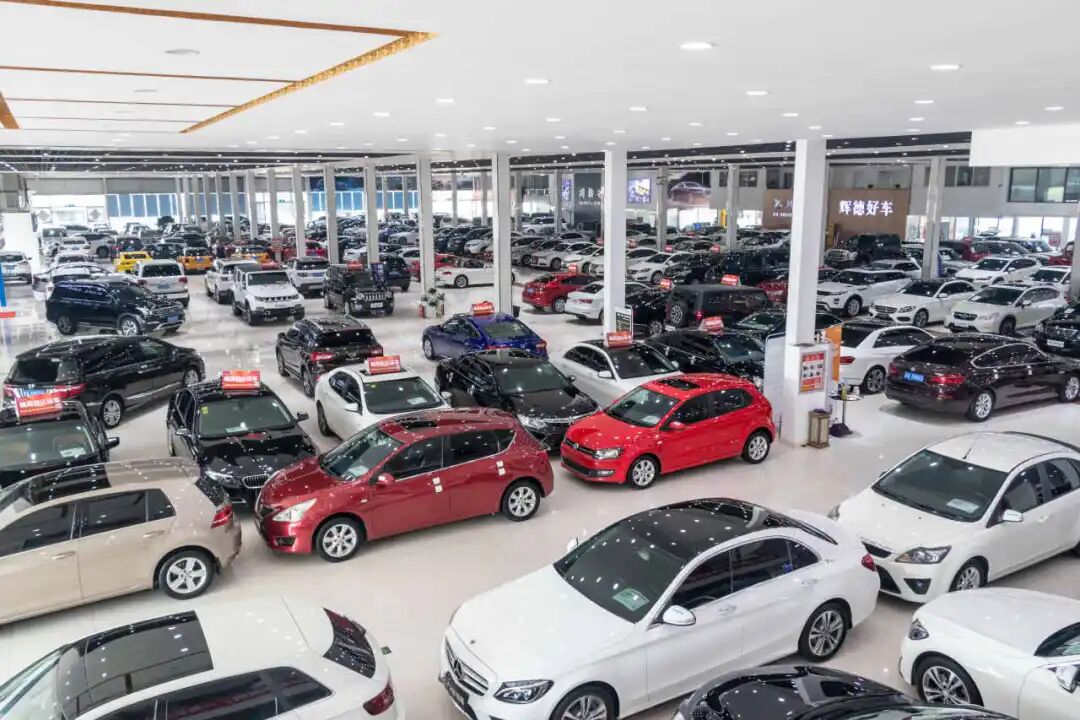
Additionally, the dealer system is on the brink of collapse. In the first quarter of 2026, the gross profit margin for new car sales was -21.5%, with over 80% of dealers experiencing price inversions and more than 55% of 4S stores nationwide incurring losses.
Furthermore, the EU is set to impose anti-subsidy tariffs on plug-in hybrid vehicles, and Southeast Asian countries are raising entry barriers for electric vehicles, obstructing the growth logic for overseas complete vehicle sales. Hong Kong-listed automakers, highly reliant on overseas markets, have seen more pronounced stock price declines.
Indeed, as Li Bin said, this year is tough. He predicted that domestic auto retail sales would not buck the trend and grow in the second half of the year, and the entire industry should brace for a year-on-year sales decline of 15% to 20%.
'After being in the auto industry for so many years, this year is truly the toughest yet.'
Note: Some images are sourced from the internet. If there is any infringement, please contact us for removal.
-END-

-
![]()
Can Chinese Automakers Pose Such Fierce Competition? Mercedes-Benz Cancels Year-End Bonuses for 90,000 Staff, Volkswagen to Lay Off 100,000 Employees...
-
![]()
Anhui and Zhejiang Vie for the Crown in New Energy Vehicle Dominance: Who Will Prevail?
-
![]()
Tmall 618 Rankings Unveil Trends Transforming the Home Appliance Industry
-
![]()
This Week in Home Appliances: Overseas Boom! Midea, TCL, Dreame Break Through; Casarte, Fotile, Gree, Hisense, Ronshen Lay Foundations
-
![]()
Aiming to Be the Alphard of the Electric Era! After D99's Launch, Leapmotor Will Release All-New Technologies to Pave the Way for a High-End Brand | Mirrormedia Pro
-
![]()
Over 5,200 Orders Placed on First Day: Can the Qijing GT7, Priced from 209,900 Yuan, Compete with the Z7 and SU7? | Mingjing Pro
-
![]()
AI Predicting the World Cup? It’s Time to Stop Insulting AI
-
![]()
iPhone 18 Pro Memory Costs Soar Threefold! Apple Seeks Trump Administration Approval for CXMT Memory Chips