4 Million Tesla Drivers Celebrate! FSD V14 Rolls Out Overnight with All Key Features
 07/01 2026
 333
333
Older Tesla Models Get Their Moment to Shine
Author|Wang Lei
Editor|Qin Zhangyong
This time around, Musk has kept his promise.
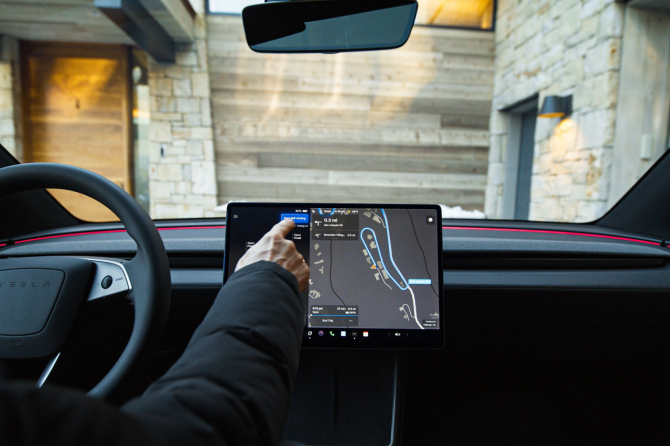
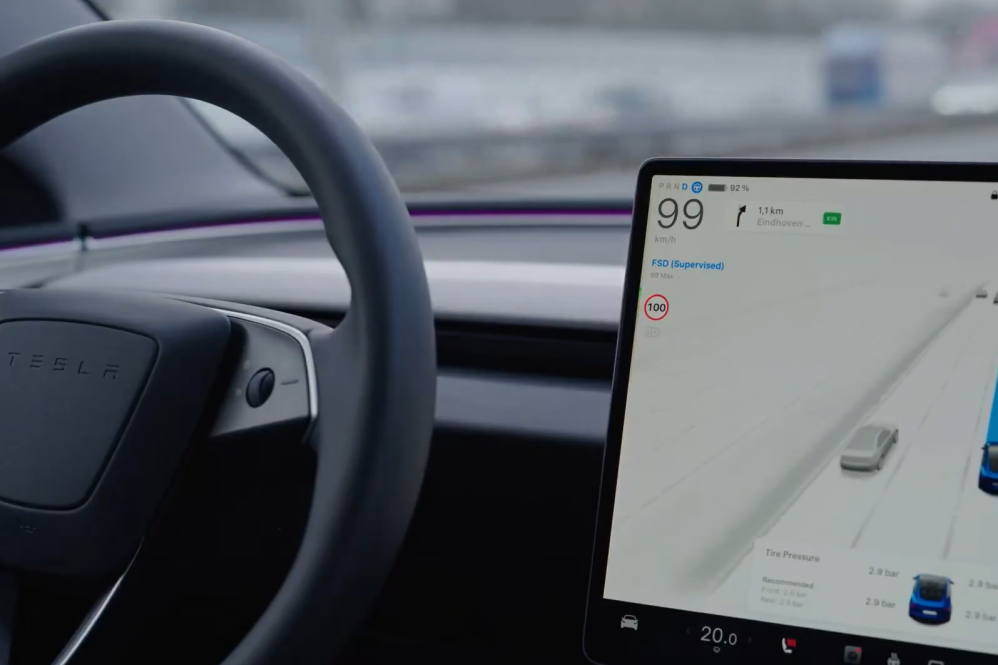
Just yesterday, Tesla officially started deploying the FSD V14 Lite version—a streamlined edition of V14—to Tesla drivers using Hardware 3 (HW3).
Despite being a simplified version, HW3 owners who have installed the update are thrilled with the experience, expressing their collective gratitude to Musk on the X platform.
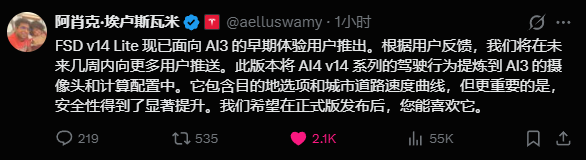
After all, Tesla vehicles with HW3 have been stuck on FSD version V12.6 for a full 16 months, from mid-2024 up until now.
Over the past two years, owners of vehicles on the HW4 platform have enjoyed multiple major updates, including FSD V13, V14, V14.3, as well as new features like Auto Reverse, Auto Parking, and Speed Modes.
HW3 owners could only watch from the sidelines—until now, when they’re finally getting a taste of the latest advancements.
However, the rollout is currently limited to select users in the U.S., but according to Musk, it will eventually expand globally. This means that HW3.0 platform owners—who make up the vast majority of Tesla drivers in China—will also get access.
And there are indeed a lot of drivers with older vehicles. Public statistics show that the global installed base of Tesla vehicles on the HW3.0 platform is nearly 4 million units, accounting for close to half of Tesla’s total sales to date.
01 "Absolutely Explosive"
Leaping directly from FSD V12.6 to V14 Lite might seem like skipping just two versions, but the hardware gap is significant.
Musk has publicly stated that HW3’s memory bandwidth is only 15% of that of the new HW4 (AI4). The AI chip computing power of HW4 is approximately 3-5 times greater than HW3, and it also supports higher-resolution cameras.
Moreover, FSD V14 utilizes a one-stage end-to-end Transformer neural network—a model highly dependent on data transmission speed. Even ignoring the sheer computing power difference, memory read and write speeds struggle to keep up. As a result, Tesla couldn’t simply port the full V14 model to HW3 and instead had to create a quantized, compressed version.
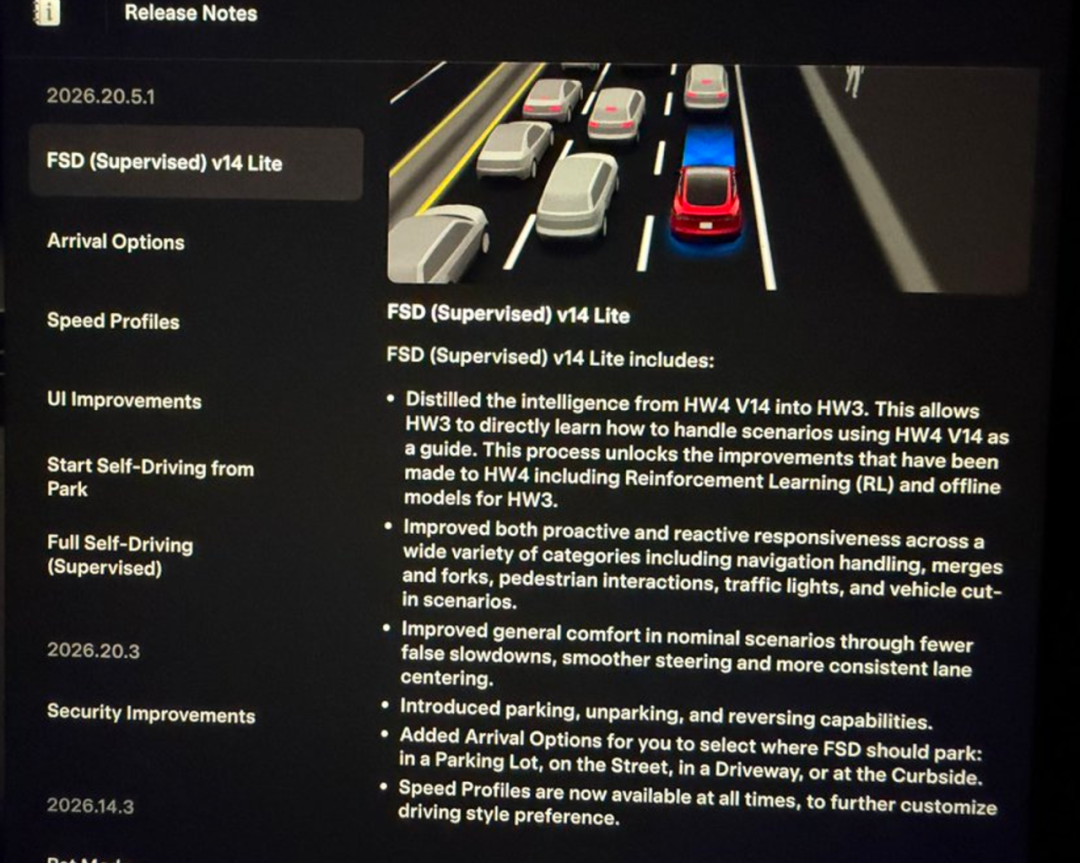
Despite being scaled down, Tesla has confirmed that all core functionalities remain intact, including the complete feature set of FSD V14—just with a reduced model scale. In practical use, there may be slight differences compared to the HW4 version in terms of response speed or handling of extreme scenarios.
Let’s dive into the specifics. According to the official rollout, the biggest change is an architectural upgrade. V14 Lite synchronously upgrades the entire driving stack to an ultra-large end-to-end neural network, eliminating disjointed experiences across different scenarios while unlocking Reinforcement Learning (RL) and offline models.
New capabilities include Auto Parking + Exit, allowing FSD to be activated directly from Park (P) gear. The vehicle automatically shifts into reverse, exits the parking spot, and then switches to Drive (D) gear to continue. On V12.6, users had to manually shift gears to public roads, and FSD could only be activated while driving.
Additionally, Arrival Options have been introduced, letting users choose where to park—whether in a parking lot, on the street, in a lane, or at the curb—delivering a Robotaxi-like drop-off experience, with preferences saved persistently for each destination.
Surprisingly, the Speed Modes from HW4 have also been included. Previously, FSD only offered a single "Maximum Speed" setting, but now there are four modes: Cautious, Relaxed, Standard, and Assertive. While a new Sloth cautious driving mode has been added, the most aggressive "Mad Max" mode has been removed.
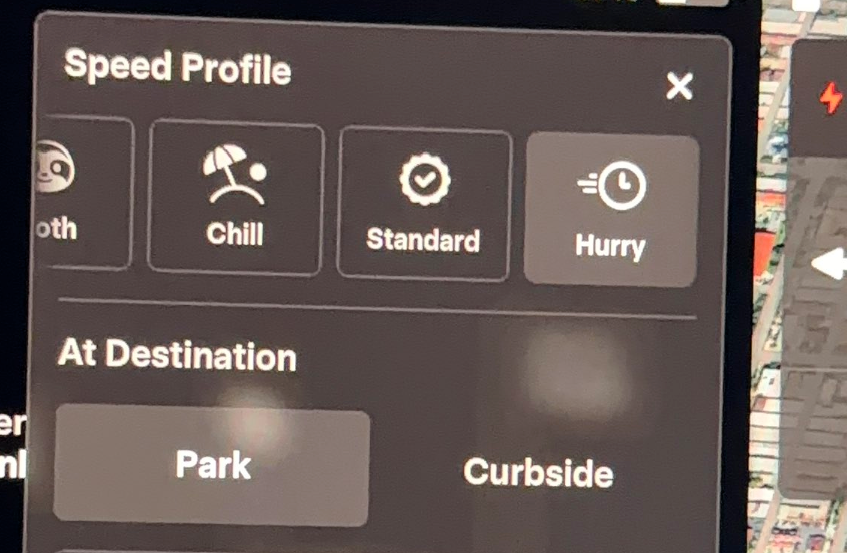
Furthermore, proactive and passive responsiveness has been enhanced, covering scenarios such as navigation handling, merging and diverging, pedestrian interaction, traffic lights, and cut-ins. Daily driving comfort has also improved, thanks to reduced false decelerations, smoother steering, and more stable lane centering.
As for real-world performance overseas, one user conducted a single-take test and shared it online, driving from Culver City to Hollywood with zero FSD disengagements, parking in a charging spot at Tesla Diner at night, and successfully executing three unplanned roadside stops.
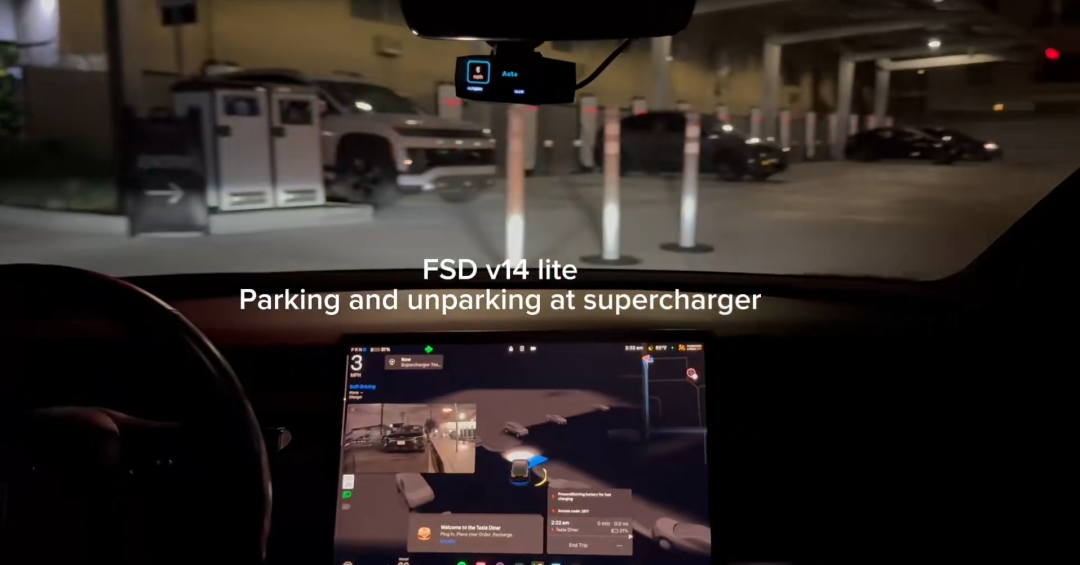
Summing up his experience, he used the trendy Chinese phrase "absolutely explosive," even earning a like and retweet from Musk himself.
Another testimonial came from a 2020 Model 3 Performance owner, who said after testing the update for an hour on highways, community roads, and country lanes: "It made my 7-year-old car feel brand new again."
02 The Upper Limit Has Been Reached
As Musk mentioned, the memory bandwidth of the HW3 chip is only 15% of that of the new HW4 (AI4), meaning its performance ceiling is 85% lower. Despite this massive gap, Tesla’s AI team has managed to push the solution to its limits.
They didn’t rely on any cutting-edge technology but instead used classic model distillation techniques from the AI field.
It’s important to note that FSD versions after V12 began relying on a one-stage end-to-end Transformer neural network, with parameter counts increasing by tens to hundreds of billions, making this architecture extremely memory-intensive and requiring higher bandwidth.
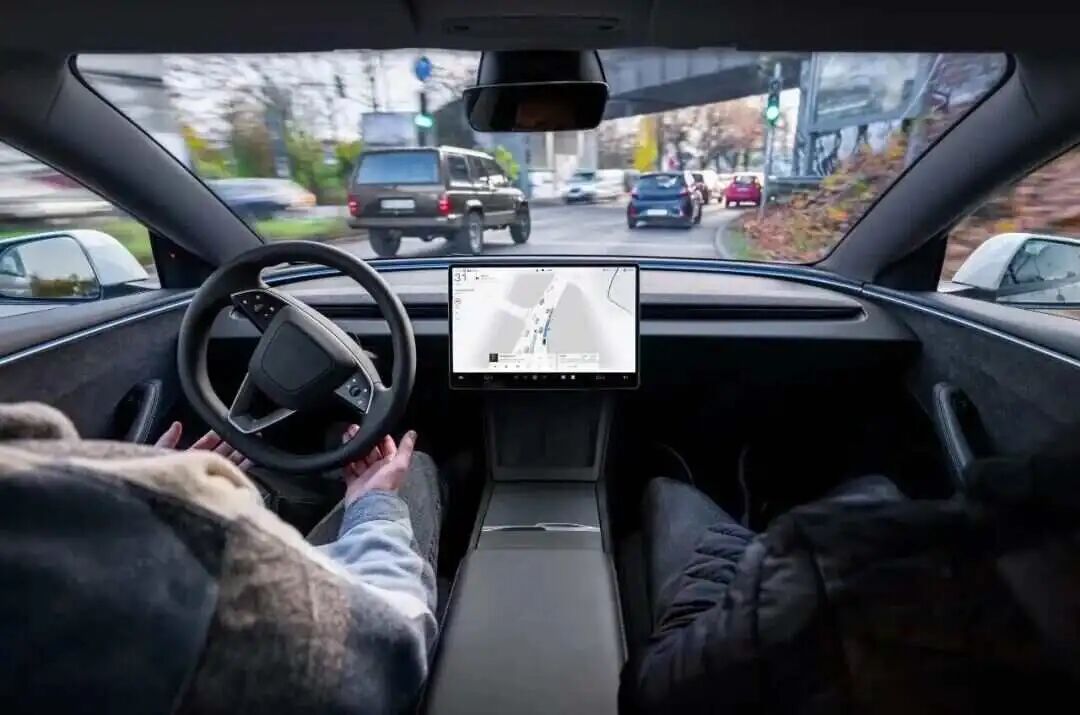
Many mistakenly believe that AI performance depends solely on chip computing power (TOPS), but today, the bottleneck in autonomous driving is no longer computational speed but data transfer speed.
Vehicle cameras continuously capture massive amounts of visual data, while neural networks require vast amounts of weight parameters to be rapidly transported from memory to the computing core. If the transmission speed can’t keep up, even the most powerful computing capabilities will idle while waiting for data.
For example, HW4 is equipped with high-speed GDDR6 memory, capable of processing hundreds of GB of data per second—sufficient to feed the parameter-heavy full V14 model in real-time. In contrast, HW3 uses LPDDR4 memory, whose data transfer speed falls short. Running the original, uncompressed V14 neural network directly on HW3 would result in unacceptable latency and even pose safety hazards.
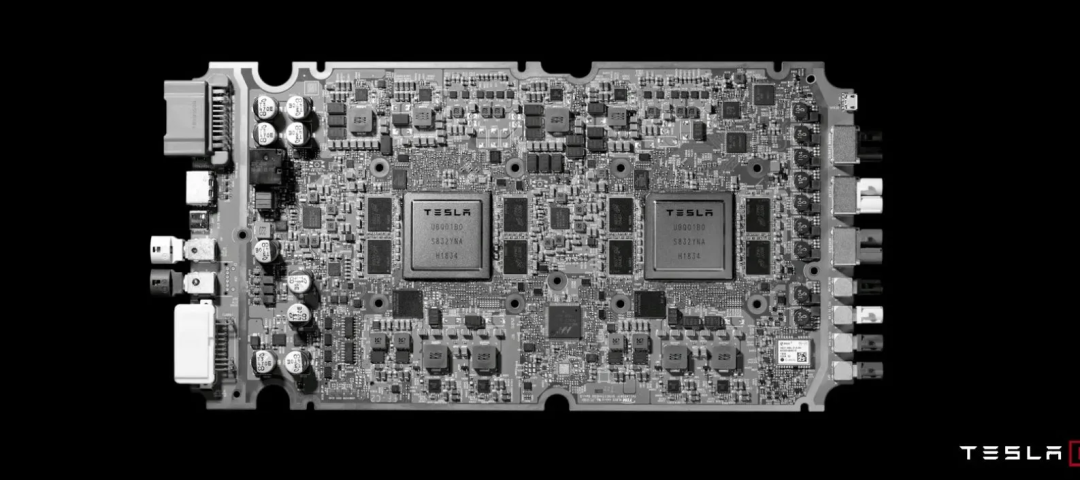
Therefore, to maximize FSD V14’s compatibility with the HW3 platform, extreme compression and distillation were necessary.
This can be understood through a teacher-student analogy: the teacher extracts key and refined knowledge from massive textbooks before teaching it to the student.
The full HW4 V14 serves as the "teacher," compressing and refining the entire set of mature driving logic and road decision-making before feeding it to the "student" HW3, paired with quantized and streamlined parameters to fit the massive model into the narrow bandwidth channel.
This involves two core processes: "quantization compression" and "parameter pruning"—reducing the computational precision of neural network weights while eliminating redundant and ineffective parameters, retaining only the core weights that affect driving safety and smoothness.
After this dual screening, a lightweight model with fewer parameters can complete real-time computations within HW3’s limited bandwidth, outputting stable and reliable vehicle control instructions.
For the 4 million HW3 owners, this represents a significant leap in experience, but distillation is still distillation—some capabilities cannot simply be transferred through this process.
For example, the Advanced Smart Summon feature from V14 is absent in V14 Lite, and after selecting a parking method, the map pin does not automatically jump to the corresponding location.
Additionally, the harsh reality is that V14 Lite is destined to be the "ultimate upper limit version" for HW3 owners.
In other words, no matter how much OTA updating is done in the future, it will essentially be squeezing out every last bit of potential from the old chip. Tesla has officially confirmed that V15 will only support the AI4 and future AI5 platforms, which will again see a model upgrade with 10 times the parameter scale.
It must be acknowledged that no matter how advanced the software algorithms are, they cannot overcome the inherent physical limitations of the hardware. The physical ceiling for HW3 has been reached—its memory bandwidth is insufficient to support larger, more complex models.
In other words, to achieve unsupervised FSD with no disengagements, the only path is to upgrade to the latest hardware.
Believe it or not, there might actually be hope. Musk previously promised to replace the infotainment chips for HW3 owners who purchased FSD for free—but only "after fully achieving unsupervised FSD."
At the current pace, it’s unclear which year that will happen...
-
![]()
Big Company HR Departments Are Overwhelmed: Young Job Seekers Harness Agents, AI-Assisted Interviews Spark Controversy
-
![]()
SAIC MG General Manager Overwhelmed by Online Backlash, Ends Livestream Prematurely: A Blend of Unfairness and Fairness
-
![]()
Hong Kong Stock IPO丨Recon Technology: The First Embodied Visual Intelligence Stock in Hong Kong Stock Market Launches Offering Without Cornerstones or Green Shoe Option
-
![]()
Avita Reapplies for Listing: Reports 25.6 Billion Yuan in Revenue and 3.49 Billion Yuan in Net Loss for the Previous Year, with 182 Million Yuan in Dividends from Yinwang | MIRROR Pro
-
![]()
DataStory's Controversial Hong Kong IPO: 5 Billion Valuation Hangs in the Balance Amid 866 Million Debt Pressure
-
![]()
Apple’s Prices Skyrocket Up to 3,500 Yuan! Who Empowered Cook to Hike Prices?
-
![]()
ByteDance Executives Go Viral!
-
![]()
ByteDance Executives Dominate Headlines!