Nostalgia for Ghosn Won't Save Nissan
 07/02 2026
 516
516
On June 25, in Beirut, Lebanon, Reuters interviewed 72-year-old Carlos Ghosn, the former Nissan CEO and 'fugitive.' When asked if he would return to Nissan as a management consultant under objective conditions, Ghosn firmly refused, displaying his trademark toughness: 'Merely offering advice and suggestions is far from enough. The only way to save this company is to take the CEO role. It must be someone who can truly make decisions and take control of the overall situation.'

After a long silence, Ghosn suddenly spoke out about Nissan with full force, responding to the earlier turbulence at Nissan's annual shareholder meeting.
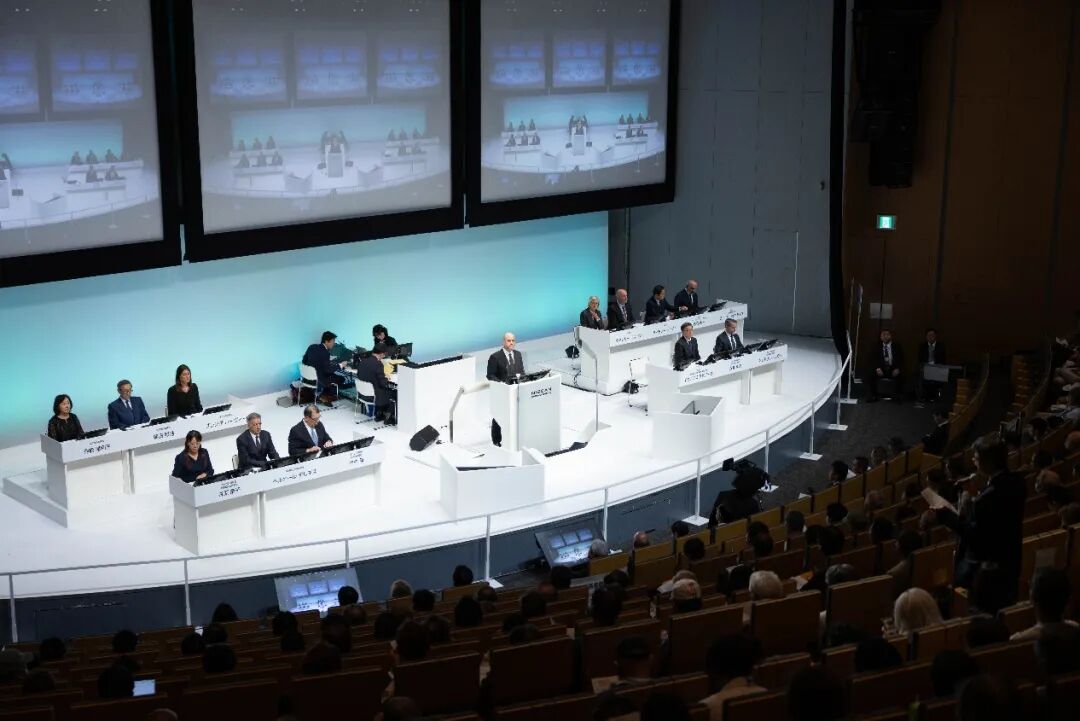
On June 23, Nissan's current CEO, Ivan Espinosa, was on stage at the shareholder meeting, earnestly explaining the 'Re:Nissan' restructuring plan as tensions ran high in the venue. It was reported that some minority shareholders, angered by the recent poor performance and sluggish stock price, publicly proposed 're-hiring Ghosn as CEO to save the company' at the meeting. However, the proposal was overwhelmingly rejected by the board and majority shareholders.
Ghosn stated that the shareholders' proposal at the meeting was an 'inevitable reaction' to Nissan's failed transformation over the years. He believes Nissan is now in a more perilous situation than in 1999, before he took over to save and restructure the company, 'and back then there was hope; now there's even less.'
On one side is the former CEO who once staged an 'escape,' and on the other, a group of angry minority shareholders. This echo across distances reflects the dilemma Nissan is currently facing and reveals the capital market's habitual backward-looking stance when confronted with the unknown.
Why Some Nostalgic for Ghosn
The most superficial layer of the 'nostalgia for Ghosn' group consists of 'injured' retail investors from the Tokyo Stock Exchange.
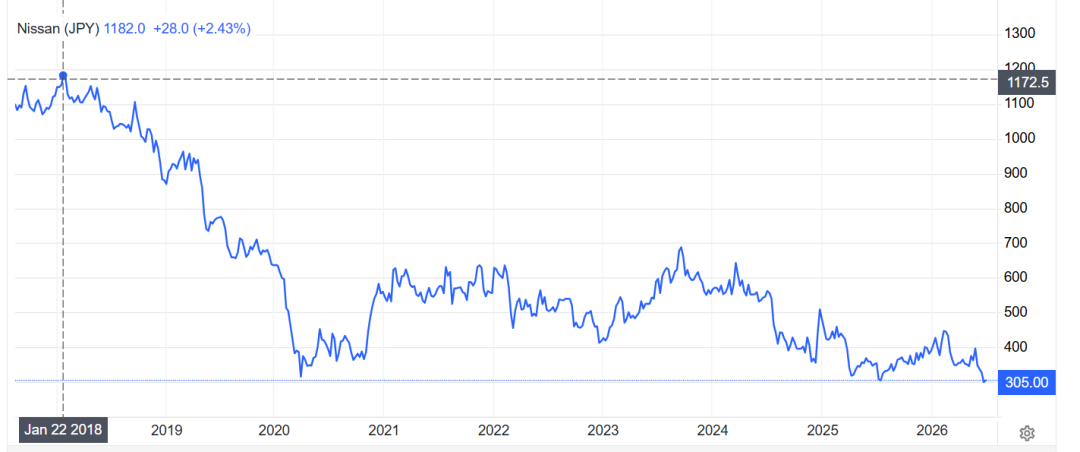
Since Ghosn's dismissal in 2018, Nissan's stock price has shrunk by nearly 80%. Global annual sales have plummeted from over 5 million vehicles at Ghosn's peak to 3.15 million in FY2025. What chills shareholders even more is that Nissan has seen three CEO changes in seven years, with each successive leader prescribing various restructuring 'remedies,' yet none truly effective until the recent financial report barely showed a slight operating profit recovery. Perhaps in the eyes of retail investors, the Ghosn era represented a genuine golden age. He took over a nearly bankrupt Nissan and, with his decisive 'Nissan Revival Plan' (NRP), turned the company around within two years, earning it a reputation as one of the most successful corporate turnarounds in automotive history. Under this 'V-shaped recovery' narrative, Ghosn has become a symbol of 'strongman leadership' for many investors.
The second group consists of middle-level employees frustrated by sluggish internal decision-making.
Ghosn's model in 1999 was essentially a highly centralized management approach. He bypassed traditional hierarchical decision-making mechanisms, empowering cross-functional teams to directly drive reforms and pushing through cost-cutting and organizational adjustments with strong execution. In contrast, by 2026, the complexity of interest coordination in Nissan's internal restructuring has become incomparable. Some middle-level employees or external partners accustomed to Ghosn's swift and decisive style now view his past approach through rose-tinted glasses amid the current 'slow-boiling frog' style of gradual reform.
James Hong, an analyst at Macquarie Securities, commented: 'They're just nostalgic for Nissan's glory days. This proposal holds little economic significance and is nearly unfeasible in reality.' This remark strikes at the essence of the 'nostalgia for Ghosn' phenomenon: it's less about Ghosn himself and more about longing for a more predictable Nissan.
Why the 'Ghosn Model' No Longer Applies
As a former business titan, any one-sided analysis of Ghosn would fail to consider the full context of the challenges he faced at the time. His model worked during Nissan's 1999 crisis, but today, its applicability has fundamentally changed.
The core pillar of Ghosn's model was a financially driven 'cost-cutting and scale' dual-track strategy.
On one hand, he overhauled Nissan's traditional 'keiretsu' supplier network, mandating a 20% price reduction from suppliers and severing many inefficient equity ties within the group. In the era of internal combustion engine vehicles, when standardization of automotive components was high and core systems like engines and transmissions were mature, automakers held absolute bargaining power over suppliers. This 'scale as leverage' pricing logic was effective at the time.
On the other hand, he later launched the 'Power 88' plan, aiming for an 8% global market share and an 8% operating profit margin. However, to achieve scale, Nissan relied heavily on deep discounts and fleet sales in key markets like the U.S., eroding brand premium.
These two foundations have now completely collapsed in the 2026 landscape.
First, consider supplier relationships. Today, the core competitiveness of automobiles no longer lies in steel and rubber but in batteries, high-performance chips, and intelligent cockpit software. In this new ecosystem, top suppliers like CATL, Qualcomm, and NVIDIA hold genuine scarcity power. The relationship between automakers and suppliers is no longer about 'pressure' but 'symbiosis' or even 'solicitation.' Using high-pressure tactics to squeeze partners capable of providing advanced autonomous driving chips or next-generation battery cells would amount to self-exclusion from the technological ecosystem.
Next, consider R&D investment. Ghosn's 'financial surgery' naturally favored cutting long-term projects with no short-term returns. Yet, in automotive intelligence, the key differentiators often lie precisely in those long-term R&D efforts with no immediate payoff. Take Tesla, for example: its R&D spending as a percentage of revenue has consistently exceeded 5%. BYD's total R&D investment in 2024 surpassed 50 billion yuan, surpassing most traditional automakers. In contrast, under recent 'cost-cutting' pressures, Nissan's R&D investment ratio has Continuous pressure (chixu chengya, 'remained under pressure'). This gap cannot be bridged through cost compression alone but requires sustained R&D investment and long-term strategic support.
Ghosn himself has, to some extent, recognized this management misalignment. In his Reuters interview, he admitted that he might have stepped down after accomplishing the Renault-Nissan alliance mission, stating, 'My real mistake was accepting Renault's second term in 2018.' At least from this statement, Ghosn acknowledges that some of his later judgments warrant re-examination.
Objectively, Ghosn remains one of the most representative corporate restructurers in the global automotive industry. He resolved financial crises and operational inefficiencies, successfully helping Nissan achieve a phased recovery. However, today's industrial environment has changed. With diminishing globalization dividends and accelerated smart electric competition, Nissan's real challenge is not whether it needs another Ghosn but how to survive under new competitive rules.
The Missed Seven-Year Transformation Window
The 'hidden illnesses' left by the Ghosn model are undeniable but insufficient to explain all of Nissan's current dilemmas. In the seven years since his 'escape,' Nissan has seemingly invested resources in solving yesterday's problems, thus missing critical opportunities during this key technological transformation window.
These seven years have also witnessed a rapid reshaping of the global automotive competitive landscape. Tesla has transitioned from an upstart brand to a global mainstream electric vehicle player. Chinese new energy automakers have continuously advanced intelligence and software-defined vehicles. Meanwhile, Nissan has long been mired in internal governance and restructuring.
In a sense, during this period, Nissan never truly had a CEO capable of formulating next-generation industrial strategies. After Ghosn's arrest, the baton passed to his protégé, then-CEO Hiroto Saikawa. However, Saikawa resigned after just one year amid allegations of improper stock compensation, exposing governance issues left over from the Ghosn era. Nissan's senior leadership was effectively leaderless during this time, with any strategic investments requiring long-term vision suppressed by immediate crisis management.
By late 2019, Makoto Uchida took the helm. He prioritized rebuilding corporate governance and repairing alliance relationships. This was reasonable at the time: Nissan faced deep management trust crises, unresolved equity disputes with Renault, and internal controversies that consumed significant decision-making resources. However, the cost of 'stability first' was continuous strategic drift.
The most fatal mistake during this phase occurred in the hybrid electric vehicle (HEV) segment. At the time, U.S. consumer demand for hybrid models was surging. Toyota firmly captured the market with its Prius and Camry hybrids, while Honda built considerable reputation with its Accord Hybrid. In North America, Nissan had little to offer beyond the Leaf and relatively niche e-POWER models. When the U.S. market truly entered the electrification transition phase, consumers chose hybrids over pure EVs first. Nissan bet on the future but lost the transition stage.
Even more worthy of scrutiny is the product trajectory of the Leaf. In 2010, Nissan launched the Leaf as the world's first mass-produced pure electric passenger vehicle, winning World Car of the Year and dominating global EV sales for several years. This was a highly valuable technological pioneer ticket. However, over a decade of iterations, the Leaf remained a 'good-enough commuter tool,' failing to evolve a competitive fast-charging standard (relying on Nissan's promoted CHAdeMO protocol, which diverged from the mainstream CCS standard) or establish a deep battery supply chain layout. By the time the Tesla Model 3 emerged, the Leaf's first-mover advantage vanished almost overnight. By Q3 2024, the Leaf's U.S. EV market share had shrunk to less than 1%. This was not merely a product failure but represented a wasted brand opportunity during a precious technological window.
Toward the end of Uchida's tenure, an even riskier gamble unfolded. From late 2024 to early 2025, Nissan and Honda engaged in intensive merger discussions, raising hopes for a Japanese automotive giant with a market cap exceeding $60 billion capable of countering China's new energy wave. However, negotiations collapsed after Honda proposed making Nissan a subsidiary, a red line for Nissan's board. 'At that point, the negotiation focus had shifted unacceptably,' Uchida later stated.
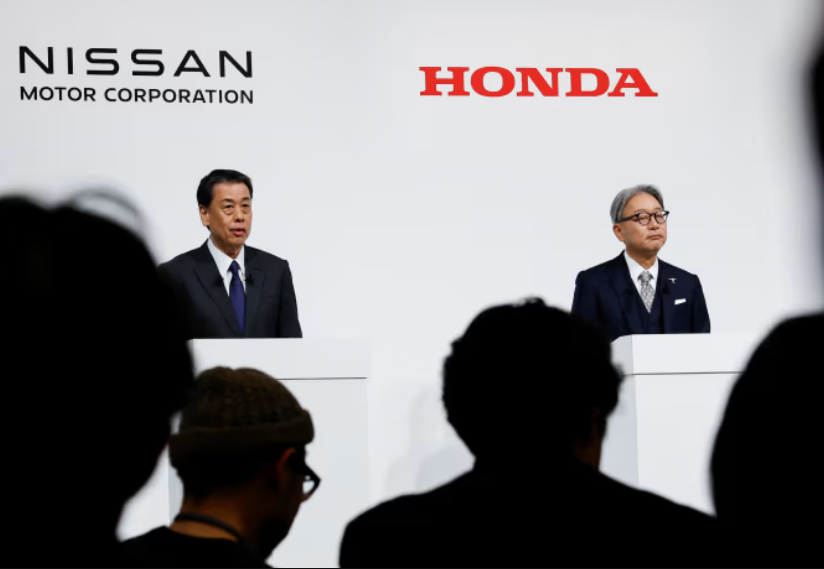
After the merger failed, Uchida formally resigned, leaving a handover statement filled with regret: 'I deeply regret having to pass the baton under these circumstances.' This statement, to some extent, summarizes Nissan's management dilemmas over the past seven years.
From Saikawa's scandal-ridden resignation to Uchida's steady conservatism, and finally to the dramatic collapse of merger talks, Nissan's leadership has constantly oscillated between 'firefighting' and 'future planning.' Strategic resources were eroded by internal friction, and technological investments were suppressed by crises, ultimately leaving Nissan at a crossroads: it lacks both the financial leverage inherited from Ghosn and the technological accumulation needed for the intelligent era. Looking back, Nissan's reforms over these seven years were not absent. Management adjusted continuously, organizational structures reorganized repeatedly, and layoffs, cost-cutting, alliance repairs, and partner searches never ceased. However, these reforms always revolved around 'how to solve yesterday's problems,' while industry competition had shifted to 'how to define tomorrow's automobiles.'
Nissan's Reconstruction Amid New Competitive Dynamics
Ghosn's warning that Nissan might become a 'small appendage of a large corporation' was dismissed by some as emotional rhetoric, but the industrial judgment behind it is not hollow. The problem is that automotive competition in 2026 is no longer a one-dimensional enterprise management issue.
It involves at least two layers of structural change. First is the technological competition Refactoring (chonggou, 'restructuring') brought by software-defined vehicles (SDVs).
Leading Chinese new energy automakers have established rapid iteration capabilities in operating systems, large models in vehicles, and end-to-end autonomous driving. Volkswagen is aggressively promoting its CEA electronic architecture in Europe to secure software sovereignty. Mainstream players are investing tens to hundreds of billions in long-term R&D for this race, focusing on engineering teams, codebases, and algorithm iterations with little short-term financial return. Any 'cost-cutting' strategy would first slash such investments, but the cost of halting them would far exceed any savings.
The second layer involves geopolitics and supply chain localization.
The 'Renault-Nissan-Mitsubishi Alliance,' which underpinned Ghosn's era, relied on a premise of global market freedom and platform synergy. A single platform could serve multiple regional markets, and supply chains optimized costs globally, with scale itself being the efficiency source. However, in 2026, tariff barriers abound. U.S. tariff policies have shifted multiple times, pressuring Japanese automakers. New localization rules under the USMCA reshaped North American supply chains. European and U.S. anti-dumping and countervailing measures against Chinese EVs continue to escalate. The old 'one-design-for-all' model is failing, replaced by the need for Nissan to simultaneously build high-intensity localization capabilities in North America, China, Europe, and other core markets. This means exponential capital consumption and the invalidation of traditional 'global platform efficiency models.'
The alliance once led by Ghosn increasingly resembles a legacy structure with diminishing support today, while what Nissan needs is a new connection method to reorient itself amidst geopolitical uncertainties. Under these dual pressures, Nissan has begun reorganizing its response system, making “Re:Nissan” a directional redefinition rather than merely a cost-control plan.
Its core transformation first occurs in strategic orientation. Unlike Ghosn-era's logic of "scale first," Re:Nissan attempts to shift towards "profitability quality first," rebuilding unit profit structures through scale contraction, resource concentration, and enhanced local capabilities, rather than solely pursuing sales expansion.
This logic is first reflected in the compression of global production and organizational structures. Nissan plans to reduce its global production bases from 17 to 10 and implement layoffs of approximately 20,000 employees, while reducing new model development cycles and costs through modular manufacturing systems. The core of this adjustment is not merely "reduction" but an attempt to leverage fewer platforms to accommodate greater market adaptability.
Simultaneously, supply chain strategies have undergone directional changes. The past model of relying on decentralized competition to drive down prices is being replaced by "centralized orders + deep collaboration." Nissan is concentrating more business among a select few core suppliers to gain joint R&D capabilities in critical areas such as batteries and chips.
The product system has also been adjusted accordingly. Nissan's model lineup has been compressed from 56 to 45 models, with low-profit models systematically eliminated. Products are reclassified into high-performance "heart-stopping products," stable cash flow "core products," growth-oriented new energy and SUV products, and "co-created products" advanced through alliance collaboration.
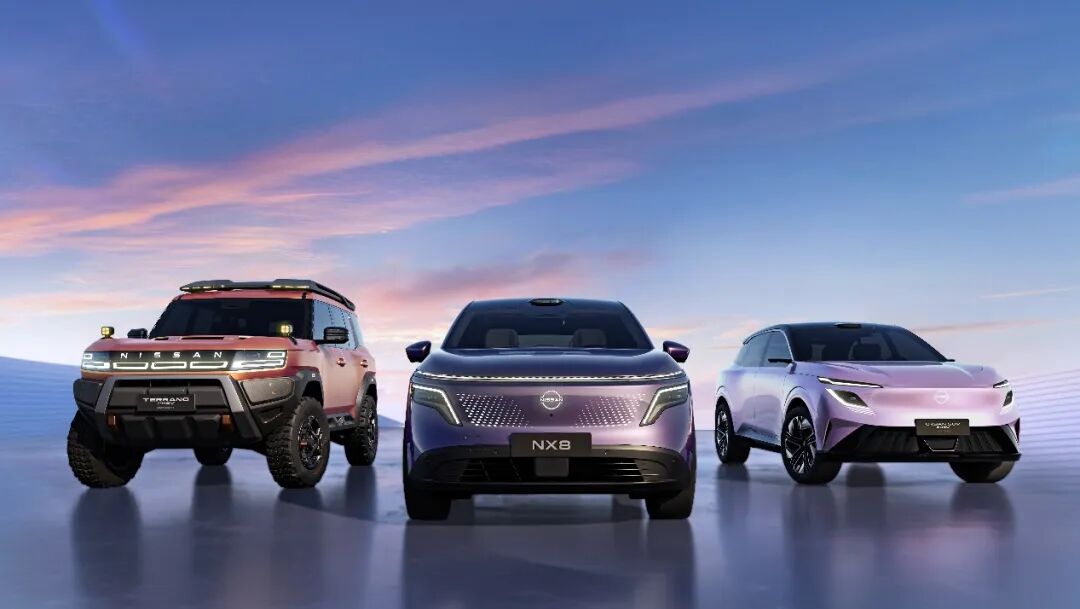
Among these, the most strategically significant step is the redefinition of China's role. Nissan no longer views China as a mere sales terminal but transforms it into a dual node for local R&D and global output. Under the Dongfeng Nissan system, models like N7, N6, and NX8 are no longer simple global facelifts but products reconstructed based on local intelligent electric supply chains, further exported to Southeast Asian, Middle Eastern, and Latin American markets. China has begun to serve as a crucial node for Nissan's global product and technology exports.
At a deeper level of industrial collaboration, Nissan's cooperation with Honda and Mitsubishi in SDV and electrification is strengthening, including joint battery procurement, co-research on electronic and electrical architectures, and AI systems to share the high trial-and-error costs of the software and electrification era. Compared to the past collaboration model centered on global alliances, this cooperation centered around Japanese domestic enterprises better aligns with the current industrial environment of supply chain localization and parallel R&D collaboration.
From a results perspective, these adjustments have not yet altered the competitive landscape but have begun to reflect in financial performance. In FY2025 (ending March 2026), Nissan achieved an operating profit of ¥58 billion, with an operating profit margin of 0.5%; a net loss of ¥533.1 billion, primarily from factory consolidation and asset impairments; and automotive business free cash flow turning positive at ¥112 billion, with liquidity maintained at ¥3.6 trillion.
These figures do not signify a completed recovery but at least indicate that restructuring is beginning to yield tangible feedback. This series of adjustments may not be sufficient to restore Nissan to the top tier, but they at least signify that the company is starting to answer the question it has failed to address for the past seven years: Where does Nissan's new competitiveness lie after the waning of scale expansion and globalization dividends?
Image: Sourced from the Internet
Article: Auto Review
Layout: Auto Review
-
![]()
Behind the Release of Its First Self-Developed Chip, Is OpenAI's Full-Stack Ambition on Display?
-
![]()
Has Anthropic Targeted Chinese Users? Is a New Era of AI-Driven Racial Discrimination Emerging?
-
![]()
MathWorks: Generative AI Holds Great Potential, Yet a Trusted Toolchain is Essential for Flawless Operation
-
![]()
Small Earphones, Big Business
-
![]()
Volkswagen Slashes 100,000 Jobs, Mercedes-Benz Axes Year-End Bonuses: What’s Ailing German Auto Titans?
-
![]()
Doubao Can No Longer Offer Free Services to 345 Million Users: China's Era of Free AI Is Drawing to a Close
-
![]()
How Can Chinese Small Home Appliances Conquer Southeast Asia Through 'Dimensional Competition'?
-
![]()
Why are top intelligent driving players betting on reinforcement learning?