Auto Market Undergoes Major Shake-Up: Winners and Losers Revealed
 07/13 2026
 344
344
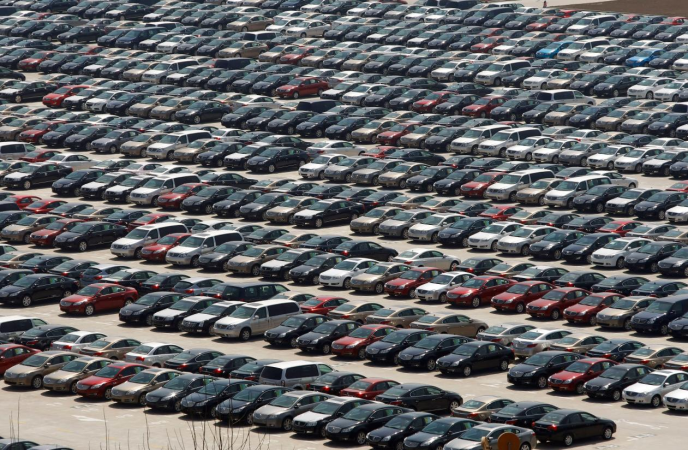
According to the latest data from the China Passenger Car Association (CPCA), retail sales of passenger vehicles in China reached 1.602 million units in June this year, marking a 23.2% year-on-year decrease but a 6.1% month-on-month increase. Among these, conventional fuel vehicle retail sales stood at just 600,000 units, experiencing a sharp 39% year-on-year decline and seeing their market share shrink to 37.2%. The downturn in domestic fuel vehicle sales was the primary contributor to the overall passenger vehicle sales slump, accounting for 78% of the total decrease and emerging as the key factor dragging down the domestic market. However, not all segments within the fuel vehicle sector are struggling; conventional hybrid models have shown remarkable resilience, with retail sales only dipping by 7% year-on-year while surging by 24% month-on-month, making them a rare bright spot in the fuel vehicle landscape.
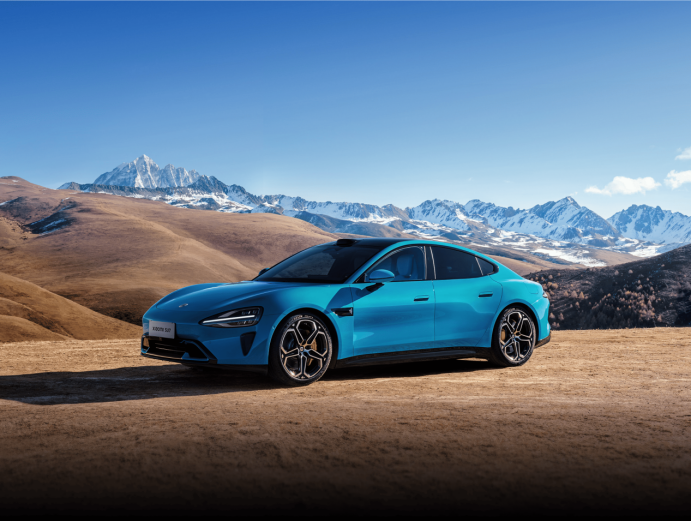
In stark contrast, new energy vehicles (NEVs) witnessed their retail penetration rate soar to a record 62.8% in June, with retail sales of passenger NEVs hitting 1.007 million units, representing a 9.4% year-on-year decrease but a 6.0% month-on-month increase. The new energy market has transitioned beyond broad-based growth, with internal structural differentiation becoming increasingly pronounced. Mid-to-high-end electric vehicles priced above 200,000 yuan continue to surge, with wholesale sales of B-class pure electric vehicles jumping by 37% year-on-year. High-end models such as the Xiaomi SU7, Model Y, and BYD vehicles remain in high demand. Conversely, entry-level micro electric vehicles in the A00 and A0 segments are under significant pressure, with A00 wholesale sales plummeting by 50% year-on-year as low-end consumer demand in rural and county-level areas continues to wane. In terms of powertrains, battery electric vehicles (BEVs) and plug-in hybrid electric vehicles (PHEVs) maintain their growth momentum, while extended-range electric vehicles (EREVs) saw sales decline by 25.2% year-on-year, with their market share continuing to contract.
Indeed, the overall market trend is mirrored in the performance of major automotive brands.
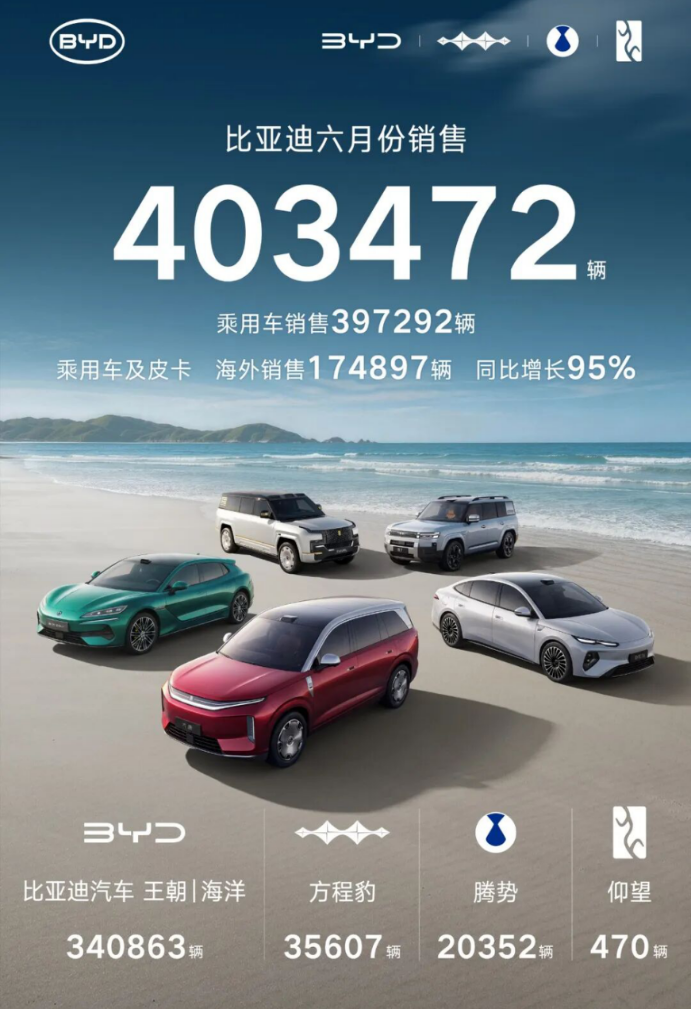
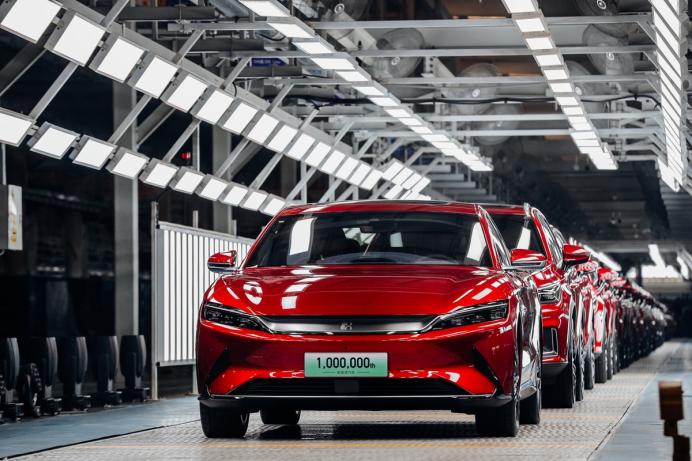
In June this year, domestic brands achieved retail sales of 1.1 million units, a decrease of 18% year-on-year but an increase of 6% month-on-month, capturing a retail market share of 68.6%, up 4.5 percentage points year-on-year. Among them, BYD stood out with monthly sales of 403,000 units, showcasing a significant lead. Other domestic brands like Geely and Chery also achieved steady market growth by adopting a dual strategy of deepening their presence in the domestic new energy market and expanding overseas.
Mainstream joint-venture brands, however, are grappling with the challenges of electrification transformation, with their market performance under continuous pressure. In June, mainstream joint-venture brands recorded retail sales of 330,000 units, a 34% year-on-year decrease but an 8% month-on-month increase, with both German and Japanese brands seeing their market shares decline. Although NEV sales by joint-venture brands increased by 45% year-on-year, the base was too small to offset the loss of market share in the fuel vehicle segment. Traditional strongholds in the family fuel vehicle market are being rapidly eroded by domestic brands. Joint-venture brands lacking competitive NEV products continue to see their market shares decline. The luxury vehicle market has not been spared either, with retail sales declining by 30% year-on-year as the momentum of consumption upgrading weakens under macroeconomic pressures.
According to CPCA data, from January to June 2026, cumulative retail sales of passenger vehicles in China reached 8.701 million units, a 20.2% year-on-year decrease, reflecting persistent weakness in domestic terminal consumption and sluggish growth in domestic demand. Against this backdrop, overseas markets have emerged as a new growth area for automakers, with auto exports becoming a core force in offsetting downward pressure in the domestic market and supporting overall industry development.
The latest data from the China Association of Automobile Manufacturers (CAAM) reveals that from January to June this year, China exported 5.096 million vehicles, a 65.3% year-on-year increase; among them, new energy vehicle exports reached 2.355 million units, doubling year-on-year. In June, passenger vehicle exports reached 877,000 units, an 82.3% year-on-year increase and an 11.5% month-on-month increase, with NEVs accounting for 56.9% of total exports, up 15.9 percentage points year-on-year. A00+A0-class pure electric vehicles, the core focus, accounted for 53.8% of pure electric exports. Meanwhile, fuel vehicle exports also maintained robust growth of 33%, showcasing China's exceptional performance in overseas expansion with both fuel and electric vehicles.
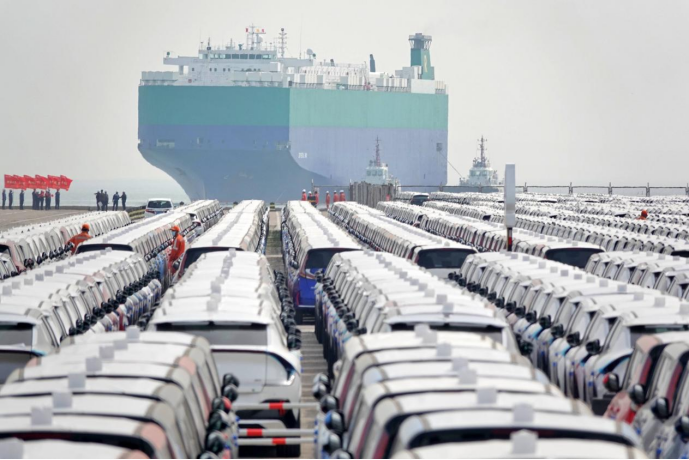
As China's new energy vehicles demonstrate their scale advantages and expansion needs, more and more Chinese-made new energy brand products are going global, with their recognition overseas continuing to rise.
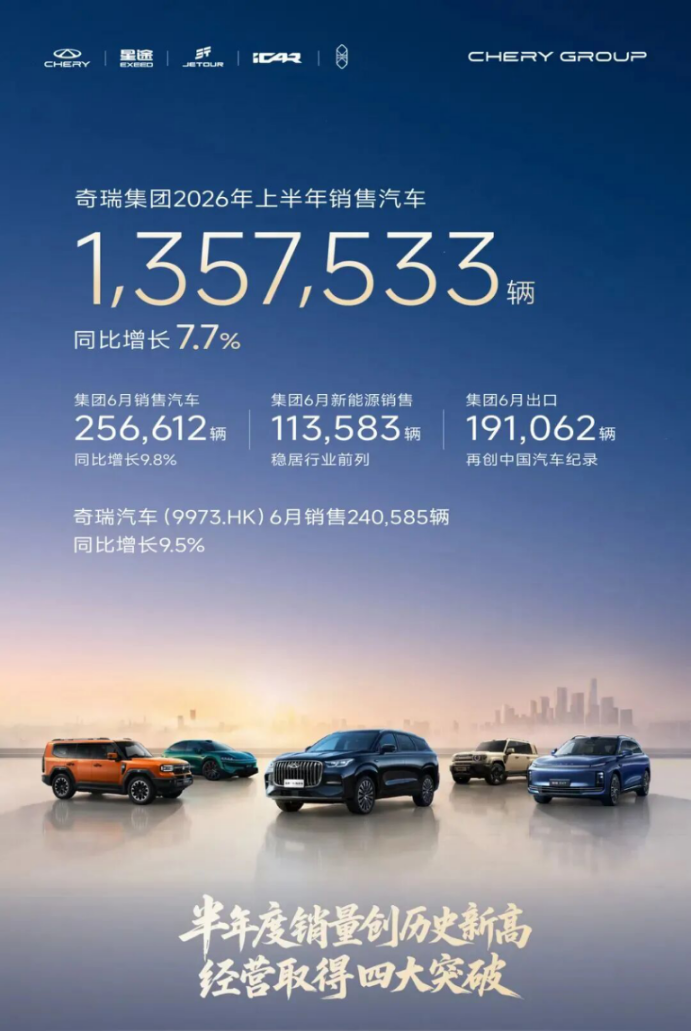
Specifically, Chery's exports reached 191,000 units in June, a 79.7% year-on-year increase, marking the first time its single-month exports exceeded 190,000 units and setting a new record for China's auto exports. BYD exported over 170,000 vehicles overseas in June, a 94.7% year-on-year increase, with overseas sales accounting for nearly 43% of its total sales. It achieved a 78% market share in Brazil's pure electric vehicle market and secured multiple consecutive months of new energy sales championships in Thailand, Australia, and other countries. Moreover, the average price of its overseas models is higher than in the domestic market, achieving growth in both volume and profit. Geely exported 102,900 vehicles overseas in June, a 157% year-on-year increase, marking six consecutive months of year-on-year and month-on-month growth, with its total exports in the first half of the year surpassing last year's annual total. SAIC Group achieved overseas sales of 735,000 units in the first half of the year, with overseas markets accounting for one-third of its total sales.
In fact, the phenomenon of a 'cold domestic market and hot overseas market' with structural differentiation in June's auto market can be attributed to multiple factors.
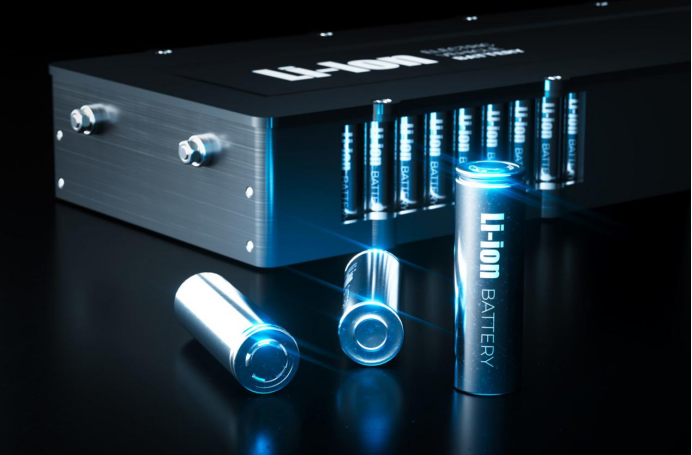
On one hand, persistently high fuel prices this year continue to impact the fuel vehicle market, significantly raising vehicle usage costs. Coupled with evolving consumer demands, younger consumers increasingly prioritize vehicle intelligence, comfort, and cost-effectiveness, trends that new energy vehicles precisely align with. Meanwhile, continuous advancements in the three core technologies of new energy vehicles—batteries, electric motors, and electronics—have amplified the cost advantages of PHEVs and BEVs, accelerating the industry's transition from fuel to electric vehicles.
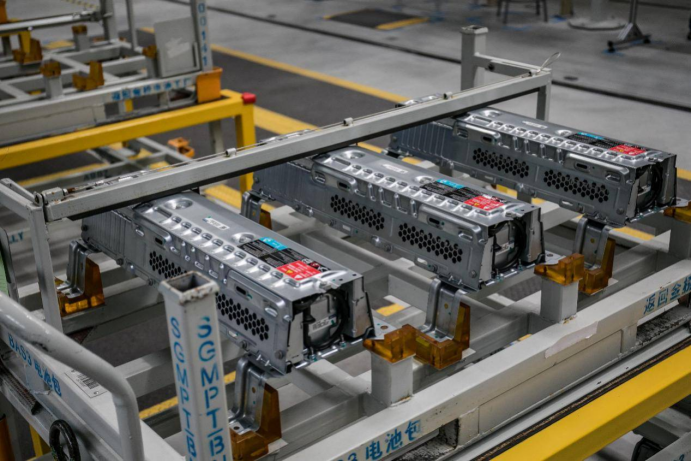
On the other hand, sustained policy support, including new energy subsidies and purchase tax exemptions, has provided strong impetus for growth in the new energy vehicle market. Simultaneously, the continuous upgrading of fuel vehicle emission standards has prompted automakers to accelerate their electrification transformation. Additionally, the implementation of new national safety standards for new energy vehicles in July led some consumers to adopt a wait-and-see attitude, temporarily affecting vehicle purchase demand in June.
In the tug-of-war between price and configuration, simple price reductions are no longer sufficient to drive market growth. From January to May this year, the automotive industry's profit margin stood at just 3.4%. Rising prices of upstream raw materials and core components, such as lithium carbonate and automotive chips, have continuously increased production costs for automakers, making large-scale price wars unsustainable. The industry has thus shifted towards competing in areas such as intelligence and safety technologies.
However, consumers are becoming desensitized to the tactic of 'piling on configurations.' The market-pulling effect of new vehicle launches has significantly shortened, with a model's popularity often fading just months after its debut. The era of relying solely on a long list of features is over, as users now focus more on actual driving experience and long-term vehicle value.
The rapid iteration of vehicle models has also brought new market issues and consumer conflicts. The current iteration cycle for new energy vehicle models has compressed to 1-2 years, far faster than the 5-6-year cycle for traditional fuel vehicles. Frequent model updates have left existing owners facing situations where new models are priced lower or come with upgraded configurations, leading to a surge in consumer disputes and eroding brand trust. Persistent iteration disputes not only damage user experience but also foster a wait-and-see mentality among potential consumers worried about vehicle depreciation risks, further suppressing short-term terminal consumption demand.
Additionally, some brands and dealers have faced issues such as mismatches between pre-sale promotions and actual vehicles, unfulfilled promises of subsidies and maintenance services, leading to rapid dissemination of negative public opinion and harming brand reputation. Coupled with widespread dealer losses and immense pressure to de-stock passively, terminal service quality has declined, creating a vicious cycle in market consumption.
Furthermore, domestic brands have steadily enhanced their market competitiveness by leveraging a complete industrial chain layout, mature cost-control capabilities, and continuous technological innovation. In contrast, joint-venture brands have been slow in their electrification transformation and lagging in product iteration, failing to adapt to changes in domestic market consumption, resulting in a continuous weakening of their overall market competitiveness.
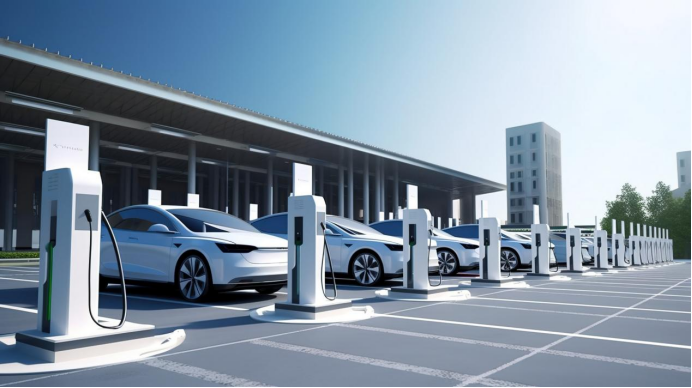
The auto market performance in June this year is a true microcosm of China's automotive industry in the midst of profound transformation, concentrately reflecting the ongoing contraction of the fuel vehicle market, structural optimization of new energy vehicles, pressure on the domestic demand market, and expansion of overseas markets. Future industry competition will shift from price-based internal competition to a contest of comprehensive strength in technology, branding, and globalization. Domestic brands, leveraging their product and overseas expansion advantages, will continue to expand their global market share, and the process of China's automotive industry 'overtaking on a new track' will continue to deepen.
(Image source: Internet, removed if infringing)
-
![]()
Weekly Stock Review | Who Dominates the Market: Hedge Funds, Quant Traders, Institutions, or Hot Money?
-
![]()
Sales Slump Again: Why Are Affluent Buyers No Longer Exclusively Opting for Porsche?
-
![]()
Xiaomi’s New Auto Brand Launch Sparks Stock Rebound: Is a Trend Reversal on the Horizon?
-
![]()
Seres Mid-Year Report Catastrophe: Projected Losses Surpass 1.5 Billion Yuan!
-
![]()
"Fruit Chain Brother No.1" Plummets Below Issue Price on Debut Trading Day! Chaoshan's Wealthiest Woman Stakes HK$24 Billion on AI
-
![]()
Auto Market Undergoes Major Shake-Up: Winners and Losers Revealed
-
![]()
The Successful Recovery of the First Stage of the Long March 10B: What Does It Mean for China's Commercial Space Industry?
-
![]()
Xiaomi Pengcheng: Crafting the Future of Mobility