Xiaomi’s New Auto Brand Launch Sparks Stock Rebound: Is a Trend Reversal on the Horizon?
 07/13 2026
 477
477
As of July 11, Beijing Time, Xiaomi Group (01810.HK), listed on the Hong Kong Stock Exchange, closed up 3.36% at HK$25.84 yesterday, marking a significant rebound of over 21.31% from the low of HK$21.30 reached on June 26 amidst the current downturn.
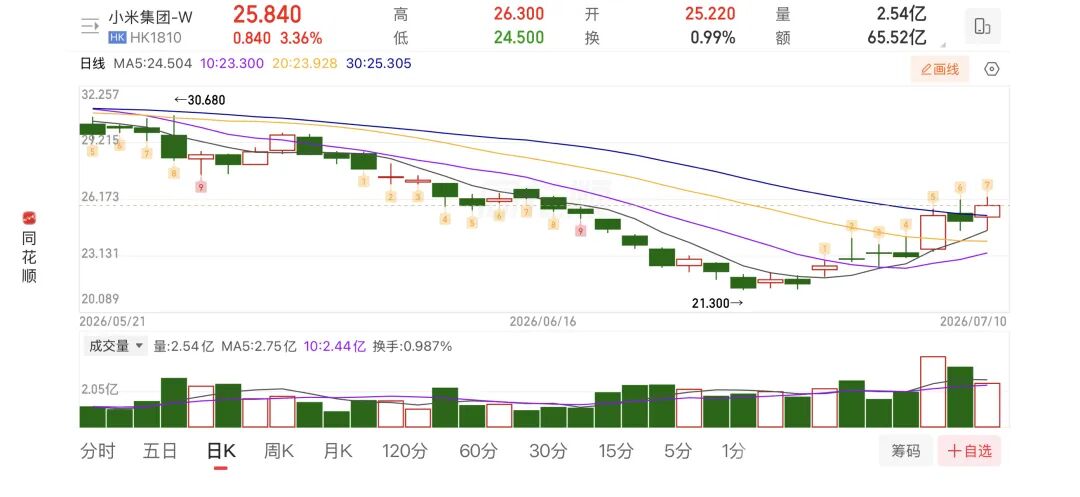
From a technical analysis standpoint, Xiaomi's stock price precisely retraced to the five-day moving average of HK$24.504 yesterday (with an intraday low of HK$24.500), and the closing price of HK$25.84 also surpassed the 30-day moving average of HK$25.305.
For Xiaomi's investors or potential investors, does this signify that Xiaomi Group's stock price has emerged from a year-long downturn (reaching a historical high of HK$61.45 on June 27, 2025)?
Timing-wise, after exactly one year and a stock price decline exceeding 65.34%, a rebound of over 21% has occurred.
Let's revisit the several waves of declines and rebounds in Xiaomi's stock price over the past year.
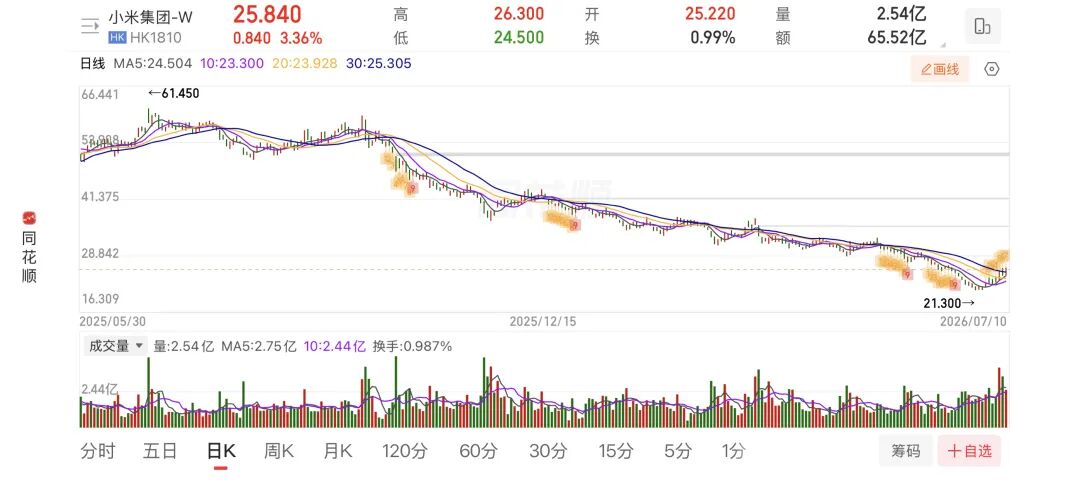
First Wave of Decline: From the historical high of HK$61.45 on June 27, 2025, to HK$50.10 on August 12, 2025, marking an 18.47% decline.
First Wave of Rebound: From HK$50.10 on August 12, 2025, to HK$59.90 on September 25, 2025, a rebound of 19.56%.
In hindsight, both the first wave of decline and rebound were typical market fluctuations. The first rebound even attempted to reach a new high but ultimately fell short.
On September 26, 2025, Xiaomi closed down 8.07% at HK$54.65, with trading volume reaching HK$23.347 billion, approximately 20% higher than the HK$19.308 billion traded on the previous trading day at the peak of the current rebound, erasing the gains from the previous two days. The next trading day, September 29, Xiaomi closed down 2.01% with trading volume of HK$17.883 billion.
Subsequently, Xiaomi's stock price rebounded by 0.84% and 3.33% on September 30 and October 2, respectively, before initiating a new wave of decline.
Second Wave of Decline: Starting from September 26, 2025, Xiaomi's stock price plummeted to HK$36.62 on November 21, 2025. This decline lasted about two months, with a 38.86% drop from HK$59.90 and a 40.40% decline from the historical high of HK$61.45, firmly pushing Xiaomi into a bear market.
In Q4 2025, Xiaomi Group's core smartphone business faced significant pressure. Financial reports later revealed that Xiaomi's smartphone business revenue for the quarter was RMB 44.33 billion, a year-on-year decline of 13.6%, with shipments down 11.6% year-on-year, including an 18% decline in the domestic market. The gross margin was only 8.3%, a significant month-on-month decline of 2.8 percentage points, nearing the hardware breakeven line.
Three main factors contributed to this: rising prices of memory chips DRAM and NAND, increased costs of upstream components, and elevated hardware costs; the complete withdrawal of domestic mobile phone consumption subsidies and increased terminal promotion discounts; intense competition in the global mobile phone industry, with Apple's pricing of the iPhone 17 basic model suppressing Xiaomi's high-end aspirations, along with the strong return of Huawei's high-end models.
However, Xiaomi's auto business experienced high growth. In Q4 2025, Xiaomi's auto business segment generated overall revenue of RMB 37.2 billion, a year-on-year increase of 123.4%. In Q4, 145,100 vehicles were delivered, a year-on-year increase of 108.2%, accounting for about 35% of the annual delivery volume. The average selling price (ASP) per vehicle was RMB 249,800, with a slight month-on-month decline. The segment's gross margin was 22.7%, a year-on-year increase of 2.3 percentage points and a month-on-month decline of 2.8 percentage points.
Notably, Xiaomi Auto's liquid level gauge achieved quarterly operating income of RMB 1.1 billion, achieving positive profitability for two consecutive quarters.
Second Wave of Rebound: Xiaomi experienced a small rebound from November 21, 2025, to December 8, 2025 (12 trading days), with the stock price rebounding from HK$36.62 to HK$43.64, a rebound of 19.17%.
Subsequently, Xiaomi initiated a third wave of decline.
Third Wave of Decline: From the high of HK$43.60 on December 12, 2025 (failing to break through the high on December 8) to HK$31.20 on March 4, 2026, this wave of decline was 28.44%.
Third Wave of Rebound: From HK$31.20 on March 4, 2026, to HK$37.18 on March 19, 2026 (11 trading days of rebound), a rebound of 19.17%.
Fourth Wave of Decline: From HK$37.18 on March 19, 2026, to HK$21.30 on June 26, 2026, this wave of decline reached 42.71%.
Fourth Wave of Rebound: From HK$21.30 on June 26, 2026, to HK$26.30 on July 10, 2026 (currently 9 trading days of rebound), a rebound of 23.47%.
Over the past year, Xiaomi's stock price has generally experienced four waves of declines and four waves of rebounds.
Historically, the duration of declines has always exceeded that of rebounds, and the magnitude of declines has always been greater than that of rebounds. Moreover, starting from the second wave of rebound, the duration of rebounds has generally been around 10 trading days.
So, how long can the duration of the fourth wave of rebound last for Xiaomi?
From a macro perspective, the Hang Seng Tech Index has also rebounded by over 10% from its lows in this rebound.
From Xiaomi's own business perspective, due to the continuous rise in memory prices, there should be no improvement in the smartphone business, and it will continue to deteriorate. The latest news is that Apple has cut one-third of its iPhone 17 production lines due to rising memory prices.
The CEO of SK Hynix stated in an exclusive interview on July 10, the day of its Nasdaq listing, that 2027 will be the year with the tightest supply and the greatest pressure for price increases in the history of memory.
Apple has already raised the prices of Macs and iPads in June. Smartphones are Apple's core business, and Apple is struggling to maintain profitability, but it has also fallen below the profit margin red line. This has led Apple to cut production capacity for its smartphones. The iPhone 17 will not raise prices, but the iPhone 18 will definitely raise prices, which will also suppress demand.
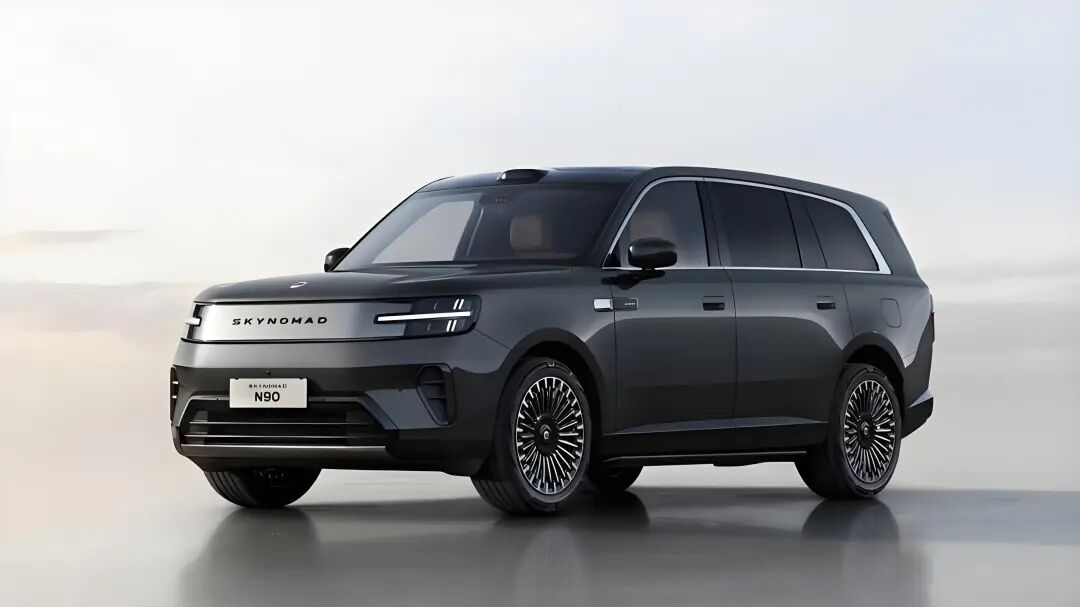
As for Xiaomi's auto business, this wave of rebound for Xiaomi is highly correlated with news about Xiaomi Auto's new brand and models. On July 8, it surged over 10% in a single day because Xiaomi officially announced its all-new extended-range SUV, SkyNomad (Peng Cheng), leading the market to raise its full-year delivery and revenue expectations.
In terms of sales, Xiaomi Auto's sales stabilized at 30,000 units in May and June, with June deliveries reaching a new high for the year, and overseas export orders also increasing.
However, two points cannot be ignored: the overall auto market is sluggish, with a decline of over 20% in the first half of the year. Rising memory prices have also affected the auto industry, with Li Bin stating that rising memory prices have increased the cost per vehicle by RMB 20,000.
For Xiaomi, its auto business only completed 33.65% of its full-year delivery target in the first half of the year. The extended-range brand and models, which hold high hopes, face intense competition in the current extended-range market and the overall market decline of extended-range models. Extended-range has become the only negative-growth segment in the new energy vehicle market, with a total wholesale volume of 504,000 units in the first half of the year, a year-on-year decline of 13.1%.
Even for Li Auto, its main model is now the i6 (accounting for over 60%).
In May 2026, extended-range models accounted for 7% of total new energy vehicle sales, a contraction of 3.3 percentage points from 10.3% last year. In June, only one extended-range model made it to the top ten list of new energy vehicle retail sales.
Therefore, it is very challenging for Xiaomi's extended-range vehicles to achieve strong sales. The greater the hope, the greater the potential disappointment.
So, how long can this wave of rebound in Xiaomi's stock price last? Can it reverse the trend? The market and time will tell.
Will Xiaomi's stock price bottom out this year, in 2027, or not until 2028?
-
![]()
Why Has Continental Evolved into a Pure Tire Company Post-'Downsizing'?
-
![]()
Zhipu’s Valuation Soars, MiniMax Faces Challenges
-
![]()
Weekly Stock Review | Who Dominates the Market: Hedge Funds, Quant Traders, Institutions, or Hot Money?
-
![]()
Sales Slump Again: Why Are Affluent Buyers No Longer Exclusively Opting for Porsche?
-
![]()
Xiaomi’s New Auto Brand Launch Sparks Stock Rebound: Is a Trend Reversal on the Horizon?
-
![]()
Seres Mid-Year Report Catastrophe: Projected Losses Surpass 1.5 Billion Yuan!
-
![]()
"Fruit Chain Brother No.1" Plummets Below Issue Price on Debut Trading Day! Chaoshan's Wealthiest Woman Stakes HK$24 Billion on AI
-
![]()
Auto Market Undergoes Major Shake-Up: Winners and Losers Revealed