Avita’s Second Stab at IPO: Over 10 Billion Yuan in Losses Over Three Years, Backed by Industry Titans Yet Sales Plummet, Crafting a Premium Narrative Proves Daunting
 07/20 2026
 484
484
More than a month after its initial prospectus expired, Avita Technology (Chongqing) Co., Ltd. (hereinafter referred to as 'Avita') swiftly refreshed its prospectus and relaunched its Hong Kong IPO bid. This premium new energy vehicle brand, which enjoys the backing of three industry giants—Changan Automobile (000625.SZ), Huawei, and CATL (300750.SZ)—has been grappling with losses since it commenced vehicle deliveries, racking up approximately 11.2 billion yuan in losses from 2023 to 2025 (hereinafter referred to as the 'reporting period').
Despite nearly doubling its delivery volume in 2025, Avita's sales took a nosedive, halving in the first half of 2026, as economies of scale failed to materialize in a timely manner. Concurrently, facing relentless industry price wars, Avita was compelled to slash its model prices, making it arduous to penetrate the premium market.
Securities Star observed that Avita poured 11.5 billion yuan into acquiring a stake in Yinwang Intelligent Technology Co., Ltd. (hereinafter referred to as 'Yinwang') to forge deeper ties with Huawei. However, this move significantly drained its cash reserves, with the asset-liability ratio soaring to 80.3% in 2025. It's worth noting that Huawei's expanding automotive ecosystem has engulfed Avita with a plethora of competing products from the same stable, steadily eroding its exclusive technological edge. Amid intensifying industry shakeouts and a long way from achieving self-sufficiency, Avita's listing appears all the more pressing.
01. Persistent Losses, Supply Chain Deeply Intertwined with Three Giants
Avita is a premium intelligent new energy passenger vehicle brand co-created by Changan Automobile, Huawei, and CATL. Changan Automobile handles vehicle manufacturing, CATL supplies power batteries, and Huawei provides intelligent solutions. Changan Automobile, as Avita's controlling shareholder, holds approximately 41.57% of the shares directly and indirectly, while CATL is the second-largest shareholder with a 9.17% stake.
Leveraging the endorsement of these three titans, Avita adopts an asset-light operational model. During the reporting period, Avita recorded revenues of approximately 5.645 billion yuan, 15.195 billion yuan, and 25.631 billion yuan, respectively, with year-on-year growth of 169.16% in 2024 and 68.68% in 2025.
However, this rapid revenue growth failed to translate into positive profits. Avita's annual losses for each period were 3.693 billion yuan, 4.018 billion yuan, and 3.489 billion yuan, respectively, culminating in cumulative losses of approximately 11.199 billion yuan over three years. Although the loss scale decreased by 13.17% year-on-year in 2025, the pace of loss reduction lagged behind revenue growth.
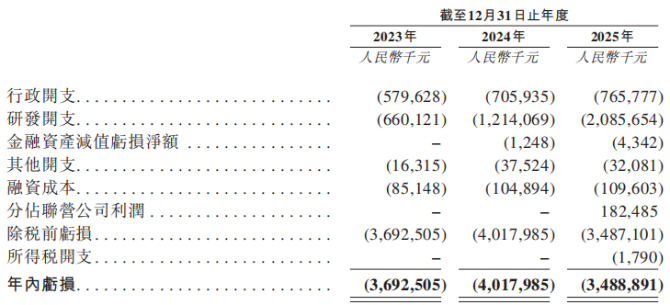
Regarding these sustained losses, Avita attributed them primarily to the early stages of commercialization and growth. Since vehicle deliveries only commenced at the end of December 2022, Avita incurred substantial upfront investments in product development, sales and marketing, channel expansion, and organizational structure building before economies of scale kicked in.
To build brand awareness and support its vehicle series launches, Avita's sales and marketing expenses during the reporting period were 2.304 billion yuan, 3.036 billion yuan, and 3.281 billion yuan, respectively. Brand and marketing expenses accounted for over 40% of the total sales and marketing expenses in the same period, reflecting its determination to spend its way to market share. Research and development also maintained high-intensity investment, with the company's R&D expenses surging from 660 million yuan in 2023 to 2.086 billion yuan in 2025.
Avita conceded that its profitability might still face pressure in the near term. To alleviate cost pressures, in April 2026, Changan Group strategically merged its Avita and Shenlan brands, expecting to slash public costs by 20% to 30% by integrating mid- and back-end resources such as technology, supply chain, and manufacturing.
Securities Star noted that the flip side of the asset-light model is Avita's heavy reliance on the three giants in its supply chain. During the reporting period, Changan Automobile, CATL, and Huawei were all among Avita's top three suppliers, with the total procurement amounts from them accounting for 82.4%, 58.8%, and 48.8% of the total procurement amount, respectively. Although these proportions declined, the absolute scale remained significant, reaching 11.184 billion yuan in 2025. During the reporting period, CATL and Huawei generated revenues of 10.113 billion yuan and 6.929 billion yuan from Avita, respectively.
02. Economies of Scale Remain Elusive, Delivery Volume Stalls After 'Triple Jump'
According to the prospectus, Avita has currently rolled out four main mass-produced models: the Avita 06 series, Avita 07, Avita 11, and Avita 12, covering the premium and luxury segments of China's new energy passenger vehicle market, with prices ranging from 200,000 yuan to 700,000 yuan.
Since deliveries began in December 2022, Avita's delivery volume has witnessed a 'triple jump': 20,021 units in 2023, a significant leap to 61,588 units in 2024, and a further climb to 122,702 units in 2025, with monthly sales consistently exceeding 10,000 units.
Securities Star observed that the sales surge in 2025 was fueled by a combination of intensive product launches and terminal discounts. At that time, the upgraded and refurbished series of Avita 11, Avita 12, and Avita 07 were successively launched, along with the new Avita 06 model. Terminal discounts and promotions collectively drove a significant uptick in annual sales.
However, Avita's delivery volume has yet to achieve economies of scale. During the reporting period, Avita's sales costs accounted for 103%, 93.7%, and 90.6% of its revenue, respectively, indicating that its cost structure has not yet fully benefited from economies of scale in the early commercialization stage. Further analysis reveals that raw material costs and production expenses combined accounted for over 90% of the total sales costs in the same period.
Avita stated that its relatively modest procurement volume limits its bargaining power with component suppliers, while manufacturing-related costs are allocated to a relatively low delivery volume during the growth stage, adversely affecting gross margin and overall profitability.
However, entering 2026, Avita's sales growth came to an abrupt halt. According to the prospectus, total sales from January to May 2026 were 20,160 units, with an average monthly sales volume of approximately 4,032 units. Its delivery volume in June was 7,459 units, a 26.53% decline from 10,153 units in the same period in 2025. Based on this calculation, Avita's delivery volume in the first half of the year was 27,619 units.
According to the previous prospectus, Avita's delivery volume in the first six months of 2025 was 56,729 units, a year-on-year increase of approximately 151.1%. In contrast, Avita's delivery volume in the first half of this year decreased by 51.31% year-on-year.
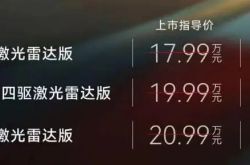
More severe is the intensifying industry price competition, making it increasingly challenging for Avita to maintain its premium positioning. The initial price range of the first mass-produced flagship model, Avita 11, was 349,900 yuan to 409,900 yuan. After continuous upgrades and refurbishments, the current official website price ranges from 289,900 yuan to 429,900 yuan, with the lowest price starting at 279,900 yuan after rights and benefits deductions, significantly lower than the initial threshold.
From an overall product layout perspective, the later-launched Avita 06 and Avita 07 have significantly lower prices than the first two models. The currently available 2026 model of Avita 07 starts at 219,900 yuan, with prices as low as 204,900 yuan after benefit deductions; the Avita 06T, launched in April 2026, starts at 219,900 yuan.
Relying on price reductions to boost sales has drawn Avita into the fiercely competitive red ocean of the 200,000 yuan segment, blurring its premium positioning and highlighting the growing contradiction between its aspiration for brand elevation and the reality of market downscaling. According to the plan, Avita intends to launch multiple new models through a joint co-creation model from the fourth quarter of 2026 to 2027, with subsequent new models expected to be positioned in even higher-end segments. How to establish a foothold in the premium market with new models may become a significant challenge for Avita.
03. Investing 10 Billion Yuan in Huawei Yinwang, Ensnared in Financial and Ecological Competition Dilemmas
Intelligent driving capability is one of the key factors influencing the premium pricing of vehicles. As a core strategic partner in Huawei's intelligent automotive ecosystem, Avita deepened its cooperation with Huawei in December 2024 to create a joint co-creation model characterized by joint product definition, joint development, and joint marketing plans. In February 2025, Avita acquired a 10% stake in Yinwang for 11.5 billion yuan, and the two parties will jointly develop refurbished and next-generation Avita models through the joint co-creation model.
In 2025, this investment generated a profit of 182 million yuan but also significantly drained Avita's cash reserves, with cash and cash equivalents plummeting from 19.323 billion yuan in 2024 to 9.687 billion yuan in 2025. As of April 2026, the company's cash and cash equivalents further shrank to 6.249 billion yuan.
The significant depletion of cash has led to a comprehensive deterioration of debt repayment indicators. Affected by the dual impact of large equity investments and rising working capital needs, Avita's current ratio declined from 1.3 to 0.6, and its quick ratio declined from 1.1 to 0.5 in 2024 and 2025. As of the end of 2025, the company's asset-liability ratio reached as high as 80.3%.

Meanwhile, the company's net current assets turned from 4.712 billion yuan in 2024 to a net liability of 8.285 billion yuan in 2025, primarily due to the significant reduction in cash and cash equivalents resulting from the acquisition of Yinwang. As of April 2026, the net current liability still stood at 5.18 billion yuan.
A deeper concern is that the strategic investment of 11.5 billion yuan in Yinwang, intended to be a key move for Avita to deeply bind Huawei's technology, has seen its exclusive technological advantage continuously diluted as Huawei's intelligent automotive solution 'circle of friends' expands. According to data released at the 2026 Huawei Qiankun Technology Conference, Huawei Qiankun has collaborated with over 25 vehicle brands and over 50 models. The total number of vehicles equipped with Huawei Qiankun intelligent driving has exceeded 1.7 million units.
Hongmeng Zhixing's 'Five Realms' and other mass-produced models equipped with Huawei Qiankun intelligent driving are competing with Avita to varying degrees. Competitors within the same ecosystem divert customer and technological resources, and Huawei's technology is rapidly transforming from a 'scarce' label to a 'standard' one, continuously weakening the premium brand appeal that Avita relies on through Huawei's intelligent driving. How to build exclusive differentiated competitive barriers within Huawei's ecosystem is a core challenge that Avita urgently needs to address. (This article was first published by Securities Star, Author | Lu Wenyan)
- End -
-
![]()
Personnel Shuffle: Independent Director Mi Xuming Steps Down from OFILM
-
![]()
Net Profit Anticipated to Skyrocket by 103%: What Gives This Optical Company a Competitive Edge?
-
In Just One Year, China Unveils Unicorns Valued at 10 Trillion Yuan!
-
![]()
6 Park Companies Shine at WAIC: How Hong Kong Science Park Bridges AI from Research to Industry
-
![]()
Wang Wenjing’s Third Act: Can Yonyou Reinvent Itself in the AI Era?
-
![]()
Performance Coupe Entry Threshold Reduced to 170,000 Yuan: Assessing the 2027 Exeed ES's Prospects
-
![]()
Battery "Crisis" for 4 Million New Energy Commercial Vehicles
-
【Focus】Fluorinated Photosensitive Polyimide (FPSPI): A High-End Subdivision of PSPI with Great Potential in High-Tech Industries