Sales Generally Decline in the First Half of 2026, Luxury Brands Still in a 'Cold Winter'
 07/20 2026
 383
383
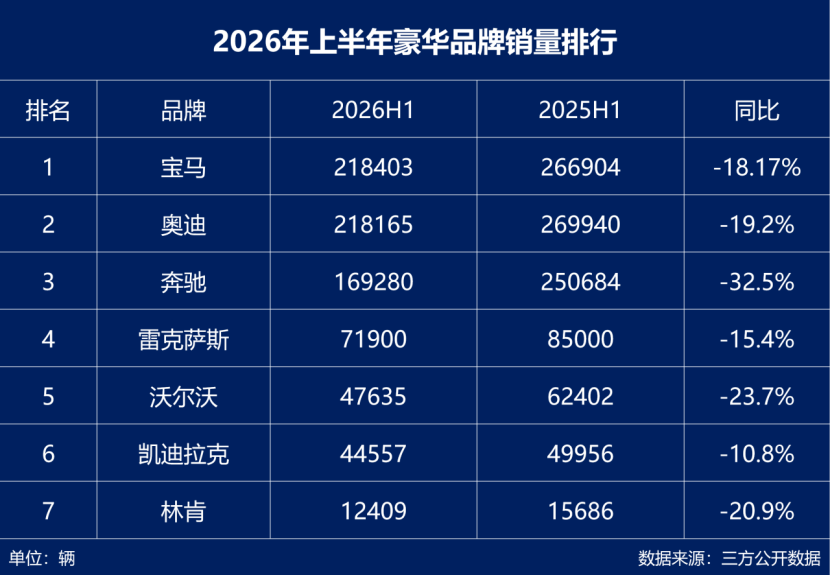
In the first half of 2026, as the automotive market structure continues to change, the market share of fuel-powered vehicles continues to decline, while the penetration rate of new energy vehicles continues to rise, accelerating the reshaping of the industry's competitive landscape. Against this backdrop, competition in the luxury car market has further intensified, with traditional luxury brands generally experiencing sales declines. Data shows that brands such as BMW, Audi, and Mercedes-Benz, although still ranking in the top three in sales, have all seen year-on-year declines; at the same time, second-tier luxury brands like Lexus, Volvo, Cadillac, and Lincoln have also experienced varying degrees of sales declines.
BMW: 220,972 units
Publicly disclosed data from media shows that in the first half of 2026, BMW's cumulative sales in China reached 220,972 units, ranking first among luxury brands, but down 17.2% year-on-year. As a brand that has long dominated the luxury market, BMW's current sales mainly come from models such as the 3 Series, 5 Series, X3, and X5, with the 3 Series and 5 Series contributing a combined 113,489 units, down 18.51% year-on-year.
As competition in the new energy market intensifies, BMW's advantage in traditional fuel-powered vehicles is gradually weakening, and the market competitive landscape continues to adjust, further increasing BMW's market pressure. To address the challenges of transformation, BMW is accelerating its new energy layout. BMW will successively launch multiple pure electric models based on the "Neue Klasse" platform, including the new generation iX3 long-wheelbase version, i3 long-wheelbase version, pure electric iX4, and iX7, covering multiple segments such as sedans and SUVs.
At the same time, BMW is also strengthening cooperation with Chinese companies such as Momenta and Huawei in areas such as intelligent driving and vehicle connectivity to enhance the competitiveness of BMW's new energy products. In the future, whether BMW can rely on new energy products to reopen growth space will be key to its sales recovery.
Audi: 218,165 units
Publicly disclosed data from media shows that in the first half of 2026, Audi's cumulative sales were 218,165 units, ranking second among luxury brands, down 19.2% year-on-year. From a sales structure perspective, classic fuel models such as the Audi A6L, Q5L, A3, and A5L are the pillars of Audi's sales. Among them, the A6L and Q5L contributed a combined 110,616 units in the first half of the year, down 27.08% year-on-year.
Currently, the penetration rate of domestic new energy models has exceeded 63%, and the market space for traditional fuel-powered vehicles continues to narrow, putting significant pressure on luxury brands that rely on traditional fuel-powered vehicles for sales. In this environment, Audi is accelerating its new energy product layout.
In the future, Audi will launch multiple new energy models based on the PPE and MEB pure electric platforms. Among them, models such as the Q6L e-tron and A6L e-tron built on the PPE platform will be successively launched; the facelifted Q4 e-tron based on the MEB platform will also be launched in the second half of the year. In addition, Audi plans to launch the Concept C pure electric sports car built on the PPE platform in 2027 to further improve (wán shàn, improve) its pure electric product matrix.
At the same time, Audi is also leveraging Chinese technology to enhance the competitiveness of its new energy products. FAW-Audi has collaborated with Huawei in the field of intelligent driving, with models such as the all-new Audi Q5 offering optional installation of relevant intelligent driving technologies; SAIC-Audi's AUDI brand models adopt CATL's battery solutions, enhancing the intelligence and electrification levels of new energy products through localized cooperation.
Mercedes-Benz: 169,280 units
Publicly disclosed data from media shows that in the first half of 2026, Mercedes-Benz's cumulative sales in China were 169,280 units, ranking third among luxury brands, down 32.5% year-on-year. Among the three major German luxury brands, Mercedes-Benz's sales decline is relatively significant. From a sales structure perspective, models such as the Mercedes-Benz E-Class, GLC, and C-Class remain the main sources of the brand's sales, with the three models contributing a combined 154,775 units, down 24.78% year-on-year, but still accounting for more than 90% of Mercedes-Benz's total sales, with fuel models still occupying a core position.
As competition in the domestic new energy market continues to intensify, the market space for traditional fuel-powered vehicles continues to shrink, and local high-end new energy models are increasingly favored by consumers. Models such as the Li Auto L series, NIO ET9, and XPeng X9 are diverting some users from traditional luxury brands with their advantages in intelligence and electrification.
Facing this trend, Mercedes-Benz is also accelerating its electrification layout, with new models built on platforms such as MMA, MB.EA, and VAN.EA to be successively launched. Among them, the all-new GLA will be the first to launch a pure electric version based on the MMA platform; the C-Class pure electric version will be built on the MB.EA platform; the MPV model VLE will be developed based on the VAN.EA platform.
In addition, Mercedes-Benz is also strengthening localized technical adaptation to enhance the competitiveness of its intelligent products. Mercedes-Benz is strengthening cooperation with Chinese companies such as ByteDance, Tencent, and Momenta in areas such as intelligent cockpits and assisted driving. Among them, the intelligent driving technology jointly developed by Mercedes-Benz and Momenta has been applied to models such as the pure electric GLC, next-generation S-Class sedan, and Maybach S-Class, and will also be equipped on the long-wheelbase GLE SUV model, planned to be launched in the second half of this year. Through product updates and intelligent upgrades, Mercedes-Benz's product competitiveness is expected to improve, but future sales performance still needs market verification.
Lexus: 71,900 units
Publicly available data from third-party platforms shows that in the first half of 2026, Lexus's cumulative sales were 71,900 units, down 15.4% year-on-year. From a sales structure perspective, models such as the ES, RX, and NX remain the main contributors to Lexus's sales, with Lexus's hybrid models still possessing certain appeal in the segment market due to their long-established brand recognition and hybrid technology advantages.
However, against the backdrop of rapid development in the new energy market, consumers' attention to intelligent and electrified products continues to rise, and the advantages of traditional hybrid technology are being weakened, putting pressure on Lexus to accelerate its electrification transformation. In 2025, its pure electric SUV RZ450e model sold only slightly more than 10,000 units annually in China, still showing a significant gap compared to traditional fuel and hybrid models.
To accelerate its new energy product layout, Lexus will subsequently launch multiple electrified models, including the pure electric ES 350e built on the e-TNGA platform, the all-new IS offering both hybrid and pure electric versions, and the all-new pure electric SUV TZ built on an improved TNGA-K platform.
In addition to its new energy model layout, Lexus is also strengthening its localized and intelligent layout (bù jú, strategy), proposing the "with China, for China" strategy to further increase Chinese R&D participation and jointly developing intelligent driving assistance systems with Momenta. For Lexus, whether it can transform its hybrid technology advantages into new energy product competitiveness and gain market recognition still requires time to test.
Volvo: 47,635 units
Publicly available data from third-party platforms shows that in the first half of 2026, Volvo's cumulative sales were 47,635 units, down 23.7% year-on-year. From a sales structure perspective, Volvo's current sales mainly rely on models such as the XC70 plug-in hybrid, XC60, and S60, with the three models contributing a combined 40,653 units, with the XC60 and S60 models down 61.16% year-on-year. At the same time, Volvo's pure electric models have relatively limited market performance.
The domestic new energy market is fiercely competitive, with traditional fuel-powered vehicles' market share being continuously encroached upon, while Chinese new energy brands continue to break through into the high-end market, putting sales pressure on first-tier luxury brands such as BBA. Second-tier luxury brands like Volvo are under even more pronounced competitive pressure.
Facing market changes, Volvo is seeking breakthroughs through its new energy product layout. According to plans, Volvo will develop next-generation models based on the SPA3 native pure electric architecture, expected to debut after 2027. The new products will further enhance technologies such as intelligent driving, 800V ultra-fast charging, and sustainable cockpits to strengthen the competitiveness of new energy products.
Next, whether Volvo can improve its sales performance depends on whether its new energy products can open up the market and bring new growth momentum.
Cadillac: 44,557 units
Publicly available data from third-party platforms shows that in the first half of 2026, Cadillac's cumulative sales were 44,557 units, down 10.8% year-on-year. From a sales structure perspective, fuel models such as the XT5 and CT5 remain the main sources of the brand's sales, with the two models contributing a combined sales volume of approximately 37,049 units in the first half of the year, down 9.86% year-on-year. In contrast, Cadillac's new energy models have a low market presence, with models such as the IQ Lyriq and IQ Ostria contributing only 1,143 units in combined sales, accounting for less than 3%.
Against the backdrop of the deepening new energy trend in the domestic automotive market, local high-end new energy models are gaining more consumer attention with their advantages in intelligence and electrification, continuously squeezing the market space for traditional fuel-powered vehicles. For Cadillac, which still relies mainly on fuel models for sales, the problem of insufficient competitiveness in new energy products is more prominent.
To address this, Cadillac is adjusting its product layout to further improve (wán shàn, improve) its electrified product matrix. Next, Cadillac will launch models such as the Optiq-V (high-performance version) and XT5 PHEV. Among them, the Optiq-V (high-performance version) is built on the mid-size pure electric SUV IQ Ostria (Optiq); the XT5 PHEV is Cadillac's first plug-in hybrid SUV launched in the Chinese market, specifically developed for the Chinese market based on SAIC-GM's localized "Xiaoyao Architecture," and is expected to be launched in the third quarter of this year.
Lincoln: 12,409 units
Publicly available data from third-party platforms shows that in the first half of 2026, Lincoln's cumulative sales were 12,409 units, down 20.9% year-on-year. Currently, the Lincoln Z and Nautilus models are the main sources of Lincoln's sales, with the two models contributing a combined sales volume of 10,488 units, down 11.31% year-on-year.
In the past, Lincoln gained certain market recognition with its American luxury design and comfort, but with the major transformations in the domestic automotive market, increasingly fierce competition among luxury brands, the rapid rise of new energy brands, and the narrowing market space for traditional fuel-powered vehicles, Lincoln is facing greater pressure in terms of product structure and market competitiveness. Currently, Lincoln's sales still mainly rely on fuel models for support. Compared to Cadillac, which has already launched pure electric models based on the Ultium platform and is accelerating its intelligent layout, Lincoln still needs to catch up in terms of new energy products and intelligence.
Subsequently, Lincoln will enhance its product competitiveness through model updates and intelligent upgrades. Among them, the 2027 Nautilus is expected to be launched in the fourth quarter of this year, mainly featuring optimized and upgraded configurations. At the same time, Lincoln will also further enhance the intelligent cockpit and assisted driving experience. Compared to other luxury brands that have accelerated their new energy transformation, Lincoln still needs to further improve (wán shàn, improve) its new energy product matrix and intelligent technologies. Next, whether Lincoln can rely on new energy products to open up new growth space remains to be seen.
Summary:
Overall, the luxury brand market is under pressure in the first half of 2026. BMW, Audi, and Mercedes-Benz still rank in the top three in sales, but all three German luxury brands have experienced declines, with Mercedes-Benz seeing a particularly significant year-on-year drop of 32.5%, indicating more pronounced market pressure. At the same time, second-tier luxury brands such as Lexus, Volvo, Cadillac, and Lincoln are also facing sales decline pressures.
Against the backdrop of rapid development in the new energy market, Chinese local brands are accelerating their breakthroughs into the high-end market, and traditional luxury brands are facing challenges from multiple aspects such as products, intelligence, and brand competitiveness. In the second half of the year, brands will continue to accelerate their new energy product layouts and intelligent technology upgrades, and the competitive landscape in the luxury market will continue to adjust accordingly.
(Images sourced from the internet, removed if infringing)
-
![]()
Personnel Shuffle: Independent Director Mi Xuming Steps Down from OFILM
-
![]()
Net Profit Anticipated to Skyrocket by 103%: What Gives This Optical Company a Competitive Edge?
-
In Just One Year, China Unveils Unicorns Valued at 10 Trillion Yuan!
-
![]()
6 Park Companies Shine at WAIC: How Hong Kong Science Park Bridges AI from Research to Industry
-
![]()
Wang Wenjing’s Third Act: Can Yonyou Reinvent Itself in the AI Era?
-
![]()
Performance Coupe Entry Threshold Reduced to 170,000 Yuan: Assessing the 2027 Exeed ES's Prospects
-
![]()
Battery "Crisis" for 4 Million New Energy Commercial Vehicles
-
【Focus】Fluorinated Photosensitive Polyimide (FPSPI): A High-End Subdivision of PSPI with Great Potential in High-Tech Industries