Boasting is against the law.
 07/22 2026
 392
392
Mandatory Standards for Driver Assistance Take Effect
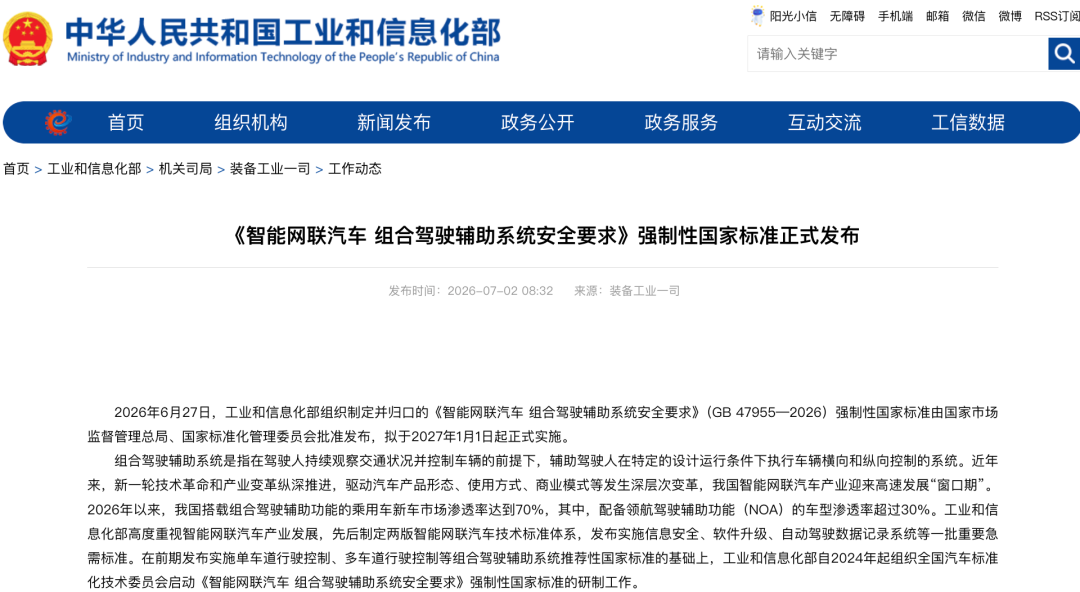
Recently, China's first mandatory national standard for L2-level combined driver assistance, GB 47955—2026 (hereinafter referred to as the "New National Standard"), was officially released, with implementation scheduled for January 1, 2027. Developed jointly by nearly 40 automotive and technology leaders, including Huawei, Xiaomi, BYD, and Tesla, this standard represents the first binding regulation for L2-level driver assistance products. Meanwhile, another significant mandatory national standard for driver assistance, GB 39901—2025, is set to take effect on January 1, 2028.
The implementation of these two national mandatory standards signifies that China's intelligent driver assistance sector will officially bid farewell to unregulated growth and enter a new phase of high-quality development, with safety compliance as the sole entry threshold. He Xiaopeng, Chairman and CEO of XPENG Group, told China Newsweek, "China's intelligent driver assistance leads the world in both corporate effectiveness and regulatory development."
Unregulated Growth Amid High Penetration
Data from the Ministry of Industry and Information Technology shows that 70% of new domestic vehicles now feature L2-level intelligent driver assistance systems, while over 30% offer higher-level navigation assistance (NOA) functions. This means that out of every 10 new vehicles sold, 7 are equipped with combined driver assistance, and 1 in 3 supports urban or highway navigation.
Liu Fawang, Deputy Director of the Equipment Industry Development Center under the Ministry of Industry and Information Technology, noted that the rapid development of intelligent connected vehicle technologies has accelerated the integration of combined driver assistance functions, which have evolved from premium value-added (value-added) configurations to standard features in vehicles priced around RMB 100,000. While enhancing the driving experience, this trend has also exposed issues such as inadequate system performance in some models and improper use by drivers. In response, the Ministry has formulated this mandatory national standard to better regulate industry development and ensure safety.
Amid intense market competition and traffic anxiety, some automakers have created differentiated selling points using non-standard classifications like L2.5 and L2.999, blurring the lines between "driver assistance" and "autonomous driving" while downplaying system limitations in scenarios such as rain, snow, fog, or unmarked roads.
Marketing wordplay has led to user misconceptions. Some drivers mistakenly treat L2 systems as fully autonomous, disengaging from the steering wheel for extended periods, browsing short videos, resting, or even neglecting road conditions on highways.
Previously, China's intelligent driving sector lacked mandatory standards, relying solely on corporate self-discipline for promotional claims, hardware configurations, and OTA updates. This resulted in some low-end models claiming L2 capability but failing to meet performance standards, posing risks in emergency scenarios due to ineffective braking or lane-keeping.
Establishing Regulatory Boundaries
As a mandatory standard, the New National Standard incorporates product development, hardware configurations, promotional claims, and data retention into its approval system. Exaggerated marketing is no longer just an ethical issue but a regulatory violation.
The standard establishes safety boundaries across four dimensions:
First, "word games" in automotive marketing are prohibited. L2-level driver assistance is clearly classified into three levels: basic single-lane, basic multi-lane, and navigation assistance (NOA). Basic single-lane supports only ACC with lane-keeping, prohibiting automatic lane changes; multi-lane systems require driver-initiated lane changes via stalk activation; even NOA must operate within specified design domains, adhering strictly to lane-change rules and traffic markings. Marketing terms like L2.5 and L2.999 are no longer permitted.
Second, to address long-standing issues of hands-off and eyes-off misuse, the standard mandates driver monitoring systems as standard equipment, featuring tiered warnings and penalties. To prevent workarounds like using a water bottle to trick the steering wheel sensor, new vehicles must include irremovable hand and eye monitoring systems that operate simultaneously and cannot be manually disabled. At speeds above 10 km/h, the system continuously monitors the driver: a 5-second hand-off triggers audible and visual alerts, escalating to emergency warnings after 10 seconds; prolonged eye-off-road behavior triggers simultaneous return prompts. Repeated distracted or hands-off behavior results in a 30-minute lockout of assistance functions, preventing "hands-free driving" at the hardware level.
Third, strict safety thresholds are set. The standard establishes a multi-tier testing system including track tests, road tests, and document inspections. At 80 km/h, the system must identify stationary obstacles 120 meters ahead and execute smooth deceleration; in curves, passenger vehicles must not exceed 3 m/s² lateral acceleration. Vehicles must pass 46 extreme hazard scenarios in closed testing and complete at least 72 hours of effective real-world road testing.
Fourth, mandatory "black box" data recorders are required. The system must have complete, tamper-proof data recording capabilities. In accidents, core data such as vehicle operation, system decisions, and warnings are preserved for liability determination.
The regulations also strictly govern OTA updates, prohibiting automakers from silently expanding system operating ranges. Each update must disclose operational boundaries and performance changes in advance, preventing unauthorized expansion of assistance permissions through software updates.
From a long-term industry perspective, regulating L2-level assistance is a prerequisite for commercializing higher-level autonomous driving (L3 and above). Unregulated L2 systems causing severe accidents would erode consumer trust in autonomous technologies, hindering industry progress. The New National Standard clarifies liability boundaries during human-machine co-driving and eliminates market chaos, protecting road users while providing crucial data and institutional experience for future higher-level intelligent transportation regulations, insurance claims, and liability divisions.
From "Follower" to "Rule-Maker"
The implementation of these two mandatory standards transcends domestic market regulation, positioning China as a global rule-maker in automotive regulations.
Sun Hang, Chief Engineer at the China Automotive Technology & Research Center Standards Institute, noted that China has transitioned from "selective participation" to "comprehensive engagement" in global automotive standardization. Within the UN/WP.29 framework, China chairs or co-chairs multiple working groups on autonomous driving and new energy vehicles, with participation expanding from a few enterprises to mainstream automakers, solution providers, and testing agencies, forming a new ecosystem of full-industry-chain collaboration.
XPENG Motors deeply participated in the 2026 UN autonomous driving regulations workshop and presented China's high-level intelligent driving solutions at the February offline meeting, providing critical practical support for global unified regulations. He Xiaopeng stated that only China and the US have achieved large-scale L2 deployment, while most EU regions have yet to fully enable related functions. China's unified, compliant intelligent driving regulations will facilitate standardized, global implementation of intelligent assistance technologies for Chinese and international automakers, benefiting companies like XPENG that are expanding overseas and participating in international regulatory development.
Notably, He Xiaopeng proposed at the National People's Congress that China accelerate intelligent driver assistance development by skipping L3 and moving directly to L4/L5. "We're pleased to see both China and the UN making significant progress in high-level autonomous driving regulations," he said. "I believe L4 and even L5 will be realized in three to five years, faster than we imagine."
With the New National Standard, the intelligent vehicle industry will shift from concept-driven, specification-stacked growth to safety-compliant, high-quality development. Strict adherence to technological boundaries and traffic safety will become non-negotiable for all automakers and supply chain enterprises. The era of competing on gimmicky features and exaggerated claims is ending; future competition will focus on safety redundancy, human-machine control, and comprehensive testing capabilities, marking a new phase of high-quality, compliant development for China's combined driver assistance sector. This transformation will not only reshape domestic industry patterns but also export Chinese standards and expertise to the global intelligent driving safety system.
-
When Cost-Effectiveness Falters, Mobile Phone Sub-brands Engage in a Survival Showdown
-
![]()
Automotive-Grade Fragrance Generator: Safety as the Foundation, Pleasant Aroma as the Norm
-
![]()
Tengjing Technology’s Revenue Projected to Soar by Over 50% in First Half of 2026!
-
![]()
Insta360 Ramps Up 'Bundling' with Upstream Optical Supply Chain with 110 Million Yuan in Related Procurement
-
![]()
Following NIO and CATL’s Footsteps, Guangzhou Nurtures Another Billion-Dollar Unicorn
-
![]()
No Choice for Mobile Phone Companies | Waves
-
![]()
From Jiyue to Li Auto and Saido: The Expedition of AI Cars Has Just Begun | Business Wave
-
![]()
Why Chinese Domestic Brands Are Embracing the Supercar Race Despite Its Unprofitable Nature