Jiefeng Power Secures IPO Registration: A Critical Turning Point for an Exhaust System Supplier’s Evolution
 07/23 2026
 556
556
Source: Xiaocaimi
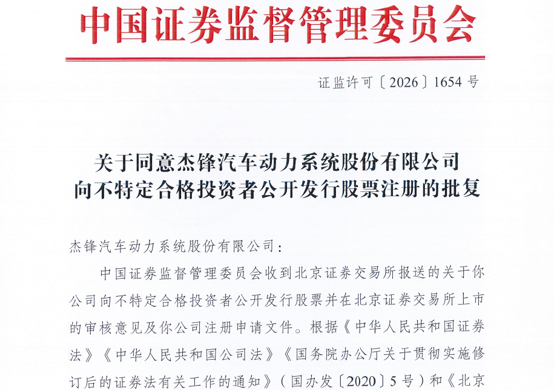
On July 8, 2026, the China Securities Regulatory Commission (CSRC) issued Document No. CSRC License [2026] 1654, formally approving Jiefeng Automotive Power System Co., Ltd.’s application to issue shares publicly to qualified investors. Based in Wuhu, Anhui, this automotive components company has successfully navigated a series of key milestones since submitting its prospectus to the Beijing Stock Exchange in December 2025. These include exchange review and inquiry, deliberation and approval by the listing committee, and submission for registration, culminating in its entry into the capital market.
Established in August 2005, Jiefeng Power is a Sino-foreign joint venture with a registered capital of 40.61 million yuan, headquartered in the Jiujiang Economic Development Zone, Wuhu City, Anhui Province. The company specializes in the research, development, design, production, and sales of key automotive components, with a focus on automotive exhaust systems and power systems. As a Tier 1 supplier, it directly serves vehicle manufacturers. Its core product lineup includes mufflers and three-way catalytic converters for exhaust systems, phasers and OCV solenoid valves for engines, and accumulators and solenoid valves for transmissions. In recent years, Jiefeng Power has expanded into emerging areas such as hydrogen fuel cell components and intelligent suspension components, with some products achieving significant mass production and sales volumes.
Financially, Jiefeng Power reported revenues of 1.707 billion yuan, 2.1 billion yuan, and 2.373 billion yuan for the years 2023 to 2025, respectively, with year-on-year growth rates of 23.01% in 2024 and 12.98% in 2025. Net profit attributable to shareholders of the parent company stood at 131 million yuan, 145 million yuan, and 147 million yuan for the same periods, while non-recurring profit and loss net profit was 127 million yuan, 129 million yuan, and 142 million yuan. While revenue has shown consistent growth, the net profit growth rate has lagged significantly, with a cumulative increase of approximately 12% over two years—far below the nearly 39% expansion in revenue. This phenomenon of “revenue growth without proportional profit growth” is not uncommon in the automotive components sector, as annual price reduction demands from vehicle manufacturers are passed up the supply chain.
One of Jiefeng Power’s most prominent financial characteristics is its high customer concentration. During each reporting period, Chery Automobile has been the company’s largest customer, accounting for 71.65%, 71.83%, and 65.80% of sales revenue, respectively. Moreover, Chery Automobile indirectly holds a 15.34% stake in Jiefeng Power through its wholly-owned subsidiary, Wuhu Chery Technology Co., Ltd. This deeply intertwined relationship, where Chery is both a major customer and a shareholder, became a focal point during the deliberation meeting of the Beijing Stock Exchange’s listing committee. The committee requested clarification on the discrepancy between the growth rate of Jiefeng Power’s revenue from selling exhaust system components to Chery Automobile and the growth rate of Chery’s vehicle sales. According to the inquiry response document, from 2022 to 2025, Chery Automobile’s vehicle sales increased from 1.2327 million units to 2.8064 million units, while Jiefeng Power’s revenue from selling exhaust system components to Chery rose from 578 million yuan to 1.412 billion yuan during the same period.
The automotive exhaust system represents Jiefeng Power’s core business segment. This system is responsible for guiding and discharging engine combustion exhaust, reducing noise, controlling vibration, and working in conjunction with the exhaust after-treatment system to minimize pollutant emissions. Exhaust systems are indispensable for traditional fuel vehicles and remain essential for hybrid electric vehicles, which still incorporate internal combustion engines. However, pure electric vehicles no longer require traditional engine exhaust systems.
This shift highlights the industry transformation that Jiefeng Power is navigating. In the first half of 2026, China’s automotive production and sales reached 14.993 million and 15.017 million units, respectively, down 4% and 4.1% year-on-year. While the overall market volume is declining, the market structure is undergoing a dramatic reconfiguration. During the same period, new energy vehicle production and sales reached 7.438 million and 7.446 million units, respectively, up 6.7% and 7.3% year-on-year, with an overall penetration rate of 49.6%. In June alone, the new energy penetration rate climbed to a high of 58.5%. Data from the China Passenger Car Association reveals that retail sales in the first half of the year totaled 8.701 million units, down 20.2% year-on-year, while the new energy retail penetration rate exceeded 60% from April and remained at this historic high for three consecutive months. The market share of fuel vehicles fell below 40% for the first time.
These figures carry dual implications for exhaust system suppliers. On one hand, a penetration rate approaching 50% means that new vehicle sales of traditional fuel vehicles—the largest source of demand for exhaust systems—are rapidly diminishing. On the other hand, new energy vehicles other than pure electric models—plug-in hybrids and extended-range electric vehicles—still retain internal combustion engines and thus still require exhaust systems. In the first half of 2026, production and sales of plug-in hybrid electric vehicles reached 499,000 and 500,000 units, respectively, while wholesale volumes of non-rechargeable hybrid electric vehicles reached 392,000 units from January to May, up 4.5% year-on-year. Hybrid electric vehicles provide transitional demand support for traditional exhaust system component manufacturers.
Changes in emission regulations represent another significant variable. The current National VI emission standards already impose stringent requirements on pollutant emission limits. The upcoming National VII emission standards, expected to focus on “collaborative control of pollutants and greenhouse gases,” will be even stricter. Industry insiders anticipate that the National VII standards will be released for public comment in 2026, piloted in key regions in 2027, and rolled out nationwide in 2028. Stricter emission standards mean that exhaust systems and after-treatment systems will require higher technological sophistication and more precise catalytic conversion and filtration devices. This presents an opportunity for product upgrades for suppliers with technical capabilities, while posing a risk of obsolescence for those lacking such capabilities. Given the progress of the Euro VII standards, which were officially implemented in November 2026, the global trend toward stricter emission regulations is clear.
From a global perspective, the automotive exhaust system market continues to experience modest growth. Data from third-party research institutions indicates that the global automotive exhaust system market size was approximately between $32.6 billion and $39.7 billion in 2025 and is projected to grow to between $51 billion and $67.8 billion by 2032. China, as the world’s largest automotive market, had an exhaust system market size of approximately between 89.6 billion and 119.4 billion yuan in 2025. However, this growth forecast assumes the continuation of traditional vehicle ownership structures and new demand, and the rising penetration rates of new energy vehicles may necessitate revisions to this forecast.
The technological evolution of power systems represents a deeper industry challenge. Traditional internal combustion engines continue to enhance their potential by improving thermal efficiency, optimizing combustion control, and reducing friction losses. Hybrid power systems seek synergy between internal combustion engines and electric motors—where the engine operates in efficient ranges and the electric motor plays a role at low speeds and during start-stop phases—relying on precise control systems and thermal management solutions. Pure electric drive systems are evolving toward 800-volt high-voltage platforms, silicon carbide power devices, and high-power fast charging, with integration, lightweighting, and high efficiency of electric drive systems becoming focal points of competition. Hydrogen fuel cells remain in the early stages of commercialization, with system cost, durability, and infrastructure being the main bottlenecks restricting their large-scale adoption.
For traditional automotive component manufacturers like Jiefeng Power, the diversification of power systems means pressure to extend their product lines. The company’s current primary revenue still comes from exhaust systems and traditional power system components, both of which are closely tied to the fate of internal combustion engines. The company has disclosed in its prospectus its expansion into new fields such as hydrogen fuel cell components and intelligent suspension components, but the revenue contribution of these new products during the reporting period does not yet constitute the main body of its core business. The transition from a single-product supplier to a system solutions provider requires time, R&D investment, and customer certification—three elements that are not easily obtained in the automotive industry chain.
In this IPO, Jiefeng Power plans to raise 400 million yuan, all of which will be allocated to the “Industrialization Project of Automotive Exhaust Systems and Intelligent Suspension Components.” The project, with a planned investment of 498 million yuan, aims to expand and upgrade the existing production lines for exhaust system products by purchasing land, factory buildings, and introducing automated and intelligent production equipment, while also expanding the production capacity of related products in the intelligent suspension field. Upon completion, the project is expected to have an annual production capacity of 4.35 million automotive exhaust system components and 3.96 million intelligent suspension components. Market analysis suggests that once the project is fully operational, it is expected to achieve an average annual new sales revenue of 1.63 billion yuan, with an estimated average product price of approximately 196 yuan per unit—significantly higher than the company’s current actual sales price of about 70 yuan per unit for exhaust system components. Whether the profit forecast for the funded project is overly optimistic and whether there is a risk of insufficient orders after capacity expansion are issues that warrant ongoing observation.
The automotive components industry is facing “dual pressures” in 2026—downstream vehicle manufacturers’ price wars continue to pass annual price reduction pressures to suppliers, while upstream raw materials such as copper, rubber, and automotive-grade chips are simultaneously increasing in price. In the first quarter of 2026, the automotive components sector reported revenue of 255.14 billion yuan, up 2.1% year-on-year, but traditional components were more directly affected by the slowdown in vehicle demand. As of mid-July 2026, 71 companies in the A-share automotive components sector had disclosed their semi-annual performance forecasts, revealing significant industry performance divergence.
Jiefeng Power also faces some company-specific risks. In addition to its high customer concentration on Chery Automobile, the company’s asset-liability ratio is disclosed to be higher than that of comparable companies in the same industry. The company also distributed large cash dividends before its application. In October 2025, the company, along with its chairman Fan Li, CFO Tao Guorong, and board secretary Wang Jingyu, received administrative regulatory measures from the CSRC in the form of a warning letter for information disclosure violations. Discrepancies between the data in the prospectus and the public transfer Instruction Manual have also raised market questions about the accuracy of information disclosure.
The acquisition of registration approval marks a milestone in Jiefeng Power’s development journey, not an endpoint. From approval for registration to completion of the offering and then to official listing, there are still procedures to be fulfilled. The transition from traditional exhaust systems to new energy vehicle components, from single-customer dependence to diversified customer expansion, and from a component supplier to a system solutions provider—each transformation direction is filled with uncertainty. China’s automotive industry is at a historical juncture of accelerating the transition from old to new growth drivers, with the market share of fuel vehicles falling below 40% for the first time in the first half of 2026. This figure itself serves as a reminder to all traditional automotive component manufacturers: transformation is not a distant matter but is already underway.
Whether Jiefeng Power can secure its position in this transformation depends on how it balances the maintenance of its traditional business base with the exploration of new business growth in the coming period, how it addresses the bargaining pressure brought about by customer concentration, and how it converts the registration approval into real development momentum. These questions have no ready-made answers, and every enterprise in the automotive industry chain is searching for its own solutions.
-
Annual Revenue Surpasses 3 Billion: An Automotive Trim 'Little Giant' Makes Its Debut on the Beijing Stock Exchange
-
![]()
The Space Force Wants to Spend $30 Billion on Rocket Launches: Is Trump Doubling Down, and Is SpaceX the Big Winner?
-
![]()
Going Crazy! One out of Every Three Plug-in Hybrids Sold in Europe is a Chinese Vehicle
-
![]()
Gemini Falls Out of Global Top 10: Where Is Google's AI Empire Headed?
-
![]()
Jiefeng Power Secures IPO Registration: A Critical Turning Point for an Exhaust System Supplier’s Evolution
-
![]()
Gemini Slips From Global Top 10: What Lies Ahead for Google's AI Dominion?
-
![]()
Exclusive | Interview with Wu Yongjian, Vice President of Tencent Cloud: The Intelligent Agent Market Has Yet to Enter a Bubble Phase, Though Some Sectors Are Becoming Saturated
-
![]()
Profits Plunge by 57%: China’s Auto Price War Takes a Toll on Tesla