The Space Force Wants to Spend $30 Billion on Rocket Launches: Is Trump Doubling Down, and Is SpaceX the Big Winner?
 07/23 2026
 479
479
Trump Demands More from the Space Force: Launch Contract Cap Tripled to $17 Billion, Combined Total Exceeds $30 Billion—Are There Enough Rockets?
The Trump administration is requiring the Space Force to take on an increasing number of missions, which means one thing: more rocket launches are needed. On Friday, the U.S. Space Force announced that it would triple the maximum value of contracts for Lane 1 of Phase 3 of the National Security Space Launch (NSSL) program, from the original $5.6 billion to $17 billion. While this may seem like just a number change, it reflects the Pentagon's rapidly rising demand for military satellite launches.
The NSSL program, operated by the Space Systems Command, maintains a pool of launch service providers, selecting suppliers for each specific mission to send military satellites into orbit. The program is divided into two tracks: Lane 1 is for missions with a "higher tolerance for risk," such as medium-lift launches carrying experimental payloads or rideshare launches for reconnaissance and relay constellations; Lane 2 is for high-priority strategic missions—the government's largest and most expensive spy satellites or radiation-hardened communication satellites designed to withstand nuclear war.
$5.6 Billion Not Enough: Tripled to $17 Billion
Lane 1 is more open to commercial launch providers and does not require lengthy certification and oversight by the Space Force. This portion has now been authorized to spend up to $17 billion. Lane 2, however, has extremely high barriers to entry: only rockets that have passed the military's lengthy certification process are eligible. Currently, only SpaceX's Falcon 9 and Falcon Heavy, as well as United Launch Alliance's (ULA) Vulcan rocket, have been approved.
Multiple companies are eligible to compete for Lane 1 contracts. In 2024, the Space Systems Command initially selected SpaceX, ULA, and Blue Origin; subsequently, Rocket Lab and Stoke Space joined the pool, and more recently, Relativity Space and Impulse Space have entered the competition. The Space Force annually solicits bids for several Lane 1 missions and issues fixed-price "task orders" to the winners. To date, SpaceX has secured the vast majority of Lane 1 orders, with Blue Origin winning its first contract earlier this year.
Surge in Demand Outpaces Contracts 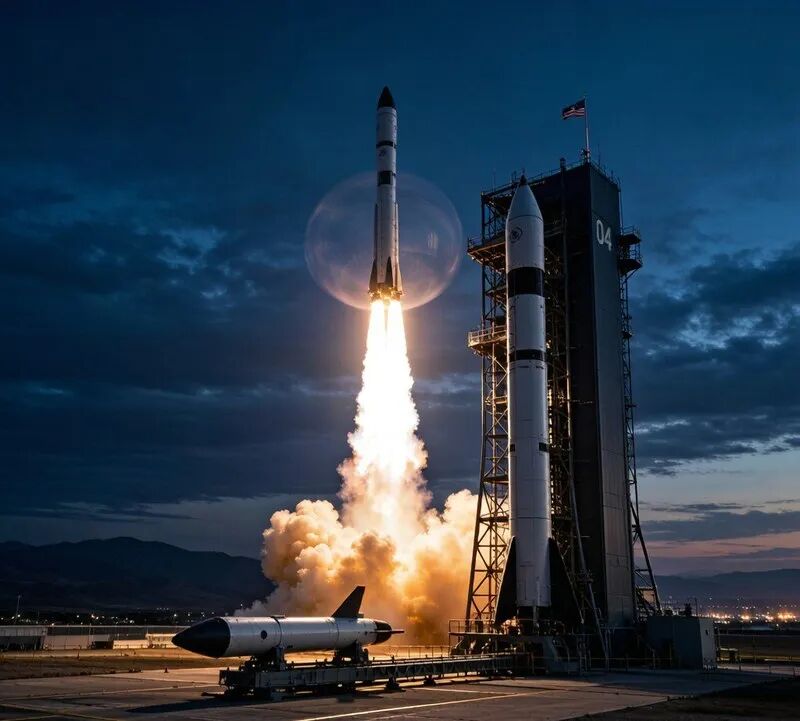
Image Source: Ars Technica
The Space Force originally expected Lane 1 providers to compete for at least 30 task orders over five years, setting a cap of $5.6 billion. Lane 2 reached a ceiling of $13.7 billion last year, with officials believing it would be sufficient to cover the projected 54 launches through 2029. But reality has outpaced budgets: in April, the Space Systems Command announced 25 additional Lane 2 missions beyond the original 54. Now, with the Lane 1 cap tripled, the combined total has surpassed $30 billion, and the figure is likely to keep rising.
What's Driving the Demand? Several projects stand out. One is the recent multi-billion-dollar contract awarded to SpaceX by the Space Force to deploy the Department of Defense's Space Data Network (SDN) and Airborne Moving Target Indicator (AMTI) satellite constellations, providing global connectivity and strike guidance for the U.S. military. Another is the "Golden Dome"—a missile defense shield proposed by the Trump administration, expected to be filled with an unspecified number of space-based early warning sensors and interceptors.
Budget Doubles: The Space Force Becomes a Money Pit
Funding is expanding accordingly. The Trump administration has requested a $71.1 billion budget for the Space Force in fiscal year 2027, up from about $40 billion in fiscal year 2026. However, the House Appropriations Committee draft only allocates $55.5 billion, below the White House's request; the Senate's defense budget bill has not yet been released. Regardless of the final figure, one trend is clear: as satellites become the nervous system of modern warfare, rocket launches have shifted from "occasional feats" to "ongoing consumption," with the cost borne by an ever-thickening defense budget.
Today's Insight
"As warfare increasingly relies on satellites in the sky, rocket launches have transformed from one-time marvels into everyday consumables—the $30 billion contract isn't buying a single launch but a standing space transportation force ready at a moment's notice."
Follow 【De Gaoxing Zhiqinglang】 for three minutes a day to understand how rockets and satellites are reshaping modern warfare.
-
![]()
Beijing Hyundai's Top Executive Criticizes Industry Disorder: Certain Brands Treat Customers as Beta Testers
-
![]()
The domestic mobile phone market has declined for five consecutive quarters! Huawei defies the trend with significant growth: maintains its top market share
-
Annual Revenue Surpasses 3 Billion: An Automotive Trim 'Little Giant' Makes Its Debut on the Beijing Stock Exchange
-
![]()
The Space Force Wants to Spend $30 Billion on Rocket Launches: Is Trump Doubling Down, and Is SpaceX the Big Winner?
-
![]()
Going Crazy! One out of Every Three Plug-in Hybrids Sold in Europe is a Chinese Vehicle
-
![]()
Gemini Falls Out of Global Top 10: Where Is Google's AI Empire Headed?
-
![]()
Jiefeng Power Secures IPO Registration: A Critical Turning Point for an Exhaust System Supplier’s Evolution
-
![]()
Gemini Slips From Global Top 10: What Lies Ahead for Google's AI Dominion?