"Hastily Assembled Vehicles" Face Halt: New Energy Vehicle Standards Must Match Those of Fuel-Powered Cars
 08/05 2026
 345
345

Lead-in
Introduction
The 30,000-kilometer testing threshold is merely the starting point for safeguarding automotive safety standards.
As times evolve and industries progress, the automotive sector undergoes constant transformation.
Particularly with the rapid emergence of new energy vehicles (NEVs), the automotive market is advancing at an unprecedented pace. In this context, the frequency of new car launches accelerates, with "three new models a year" becoming the norm, breaking away from the traditional consensus of the fuel-powered vehicle era, which adhered to "minor updates every three years and a new generation every five years."
However, beneath this rapid pace, risks related to product quality are gradually surfacing, with "hastily assembled vehicles" becoming an inevitable issue in the industry's development.
At the 2026 China Auto Forum, Li Fenggang, General Manager of Beijing Hyundai Motor Co., Ltd., openly addressed this industry pain point. He pointed out that some automakers, in a rush to seize market opportunities and expedite product launches, deliberately skip necessary testing processes, turning consumers into de facto "test drivers" and posing significant safety risks on the road.
These remarks have shed light on the overlooked quality concerns amidst industry competition and sparked reflections across the sector regarding the balance between "speed and quality."
We all understand that as market competition intensifies, the drawbacks of solely pursuing speed become more apparent, and the industry urgently requires guidance and regulation at the policy level.
At this critical juncture, the National Technical Committee for Auto Standardization publicly solicited opinions on three NEV prototyping test procedures, proposing to increase the total reliability driving test mileage for NEV models to 30,000 kilometers, aligning them with traditional fuel-powered vehicle standards. This move directly addresses the chaos of "hastily assembled vehicles" and sets a quality benchmark for the industry's development.
01 From "Steady Progress" to "Rushed Launches"
Although we are in the era of rapid NEV development, we still vividly recall that during the fuel-powered vehicle era, product updates were relatively slow, and players generally adhered to a rigorous industry pace.
Classic models like the Japanese Accord and German Passat consistently followed the pattern of "minor updates every three years and a major overhaul every five years," steadily refining their products.
Launching a new car required comprehensive extreme testing, including cold, hot, high-altitude, collision, and durability tests, with every step from design verification to mass production verification meticulously checked and without omission. This "steady progress" approach not only ensured high reliability during the fuel-powered vehicle era but also solidified consumer trust in automotive products and set a quality benchmark for the industry.
Today, the explosive growth of the NEV market has disrupted this traditional rhythm.
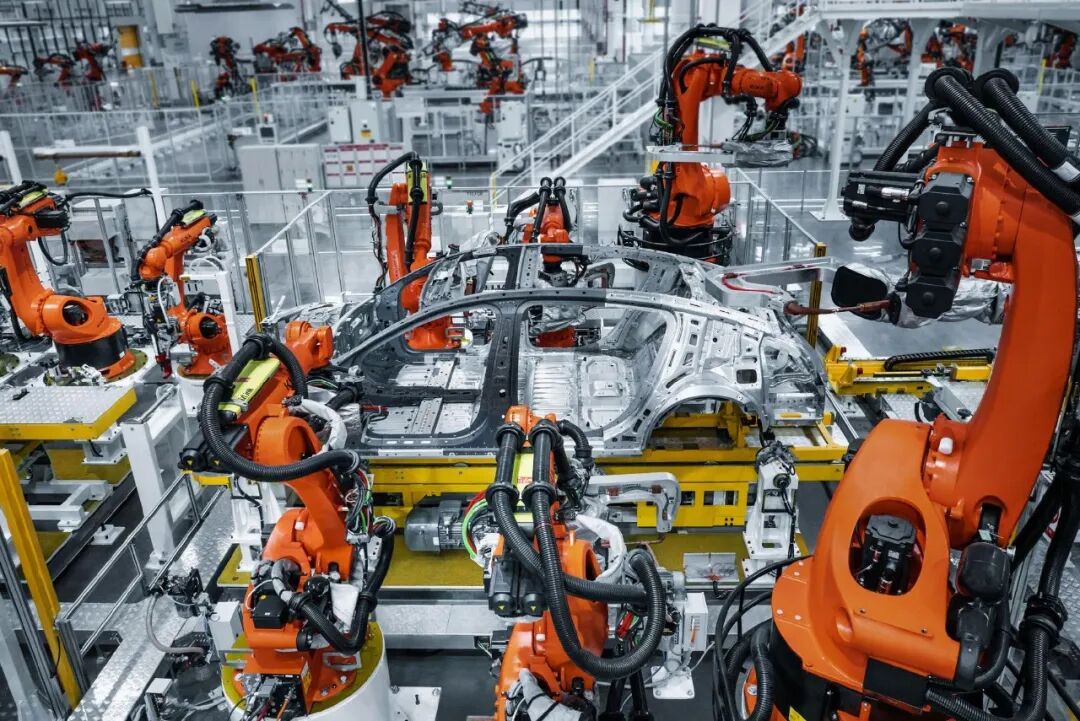
The pace of new car iterations has become increasingly frenetic, primarily driven by the continuous compression of the vehicle development cycle. According to industry reports, many brands have reduced their research and development cycles from over 36 months in the fuel-powered vehicle era to around 18 months, nearly halving the time.
Moreover, according to incomplete statistics, about 700 new models were launched in the domestic market in the first half of 2026, with a total of 768 models having terminal sales records, covering all segments and price ranges. This translates to an average of 3.8 new models per day in the first half of the year; excluding January, which saw no new launches, the daily average from February to June surged to 4.7 new models, with multiple new products flooding the market almost every day.
This intense new product rollout has left auto executives exclaiming, "This is crazy—it's cars we're talking about!"
Fu Yuwu, Honorary Chairman of the Chinese Society of Automotive Engineers and Deputy Director of the China Automotive Industry Consultative Committee, pointed out that the shortened research and development cycles are closely related to technological advancements.
"The application of technologies such as simulation, platform-based development, and modular design has indeed improved development efficiency and reduced costs. Some automakers have significantly shortened their research and development cycles by building modular platforms that accommodate various powertrains, including fuel-powered, pure electric, and hybrid vehicles," he said. However, he also directly questioned, "Have all these models gone through the complete systematic development process?"
An industry insider revealed that a complete process for a fuel-powered vehicle project used to take several years, but now, a new energy project is expected to be completed within six months from initiation to conclusion, leaving no room for meticulous refinement amid intense market competition.
Li Fenggang further explained that vehicle development consists of two core stages: design verification (DV) and production verification (PV). DV focuses on verifying the feasibility of the design scheme, while PV focuses on verifying the stable production capacity of mass production molds and assembly lines. Cutting corners in either stage leads to poor production consistency and significant quality fluctuations.
However, if a company rushes to meet deadlines and only conducts verification in a single stage, it inevitably leaves behind irreparable quality risks.
The hazards of the "hastily assembled vehicle" phenomenon are gradually becoming apparent, even triggering a market trust crisis.
Recently, some NEVs experienced widespread breakdowns during hot weather, leading owners to question whether extreme heat testing had been conducted before launch. Additionally, batteries in some commercial vehicles have experienced concentrated failures, with industry insiders speculating that manufacturers, in a rush to capture the market, hastily assembled the vehicles and drastically shortened verification testing times.
More critically, the "rushed market" approach has not led to sustainable growth but has instead trapped the industry in a vicious cycle. A new car model requires an investment of over 1 billion yuan and a development cycle of more than two years, yet its market popularity often fails to last beyond three months.
According to statistics, the automotive industry's profit in the first half of this year was 195.4 billion yuan, down 20% year-on-year, with an industry profit margin of only 3.8%. Among the 768 models on sale, only 40 achieved average monthly sales of over 10,000 units, accounting for just 5.2%. Less than one-tenth of the models shouldered the majority of the industry's sales, while most "hastily assembled vehicles" ended up as market casualties, exacerbating industry resource waste.
02 30,000 Kilometers: Just the Safety Baseline
Fortunately, in response to the persistent spread of the "hastily assembled vehicle" phenomenon, regulators have taken decisive action, using standards to set a quality benchmark for the industry.
The National Technical Committee for Auto Standardization recently publicly solicited opinions on three NEV prototyping test procedures, proposing to uniformly increase the total reliability driving test mileage for NEV models to no less than 30,000 kilometers, fully aligning them with traditional fuel-powered vehicle standards.
Specifically, the total reliability driving test mileage for electric vehicles should be no less than 30,000 kilometers, with direct current charging-related driving mileage accounting for at least 90% of the total reliability mileage (i.e., 27,000 kilometers). Hybrid vehicles should have a total test mileage of no less than 30,000 kilometers, while plug-in hybrid vehicles must complete no less than 10,000 kilometers of reliability testing in pure electric mode. Each requirement directly targets the core of quality improvement.
Meanwhile, the National Technical Committee for Auto Standardization pointed out in its explanatory document that some previous national standards no longer met the needs of technological development, and this revision increases the reliability mileage for market access verification of pure electric vehicles, favoring the industry's stable and healthy development.
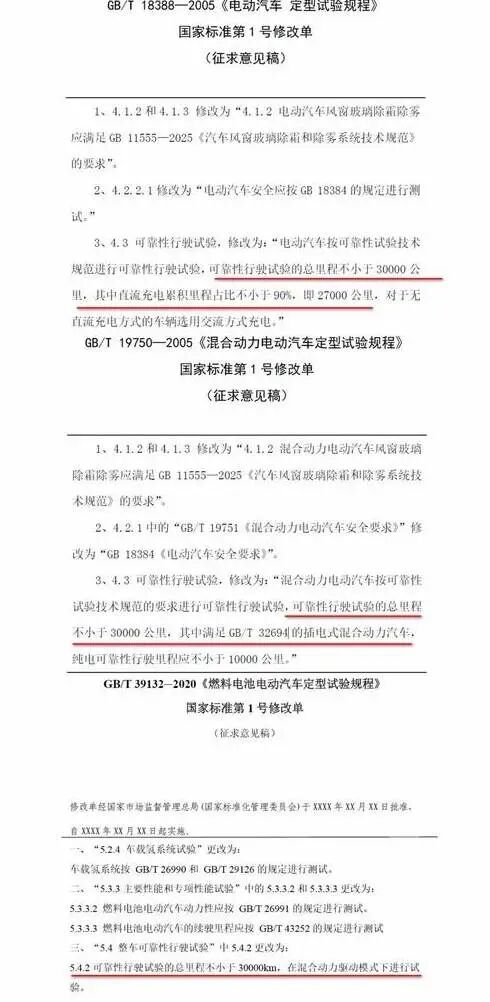
In fact, earlier this year, the 2026 Announcement No. 1 by the Ministry of Industry and Information Technology, titled "Requirements for Access Review of Road Motor Vehicle Production Enterprises," already explicitly increased the reliability testing requirements for automotive products, mandating that traditional vehicles undergo reliability verification testing of no less than 30,000 kilometers. The revision of standards for NEV models is a concrete implementation of this requirement.
"There must be a bottom line when compressing cycles," Fu Yuwu said. He emphasized that the essence of the automotive industry is to provide safe and reliable products, and the transition to electrification and intelligence should not undermine this fundamental principle. Technological advancements cannot replace real-world road testing, and extreme tests in cold, hot, and high-altitude conditions are essential for ensuring safety.
It is important to note that the 30,000-kilometer regulation is just the beginning, and regulators are taking a more intensive and stringent approach to combat "hastily assembled vehicles."
Recently, the No. 1 Department of Equipment Industry of the Ministry of Industry and Information Technology conducted special supervision and inspections at some automakers, focusing on verifying the safety assurance capabilities, design and development capabilities, production capabilities, and production consistency assurance capabilities of intelligent connected vehicles. Random samples of vehicles and power batteries were taken on-site. The No. 1 Department of Equipment Industry also made it clear that it would continue to organize supervision and inspections, seriously handle problematic enterprises in accordance with laws and regulations, and resolutely uphold the safety baseline of automotive products.
If this series of measures can be successfully implemented, making standard upgrades a normalized part of supervision, the industry is expected to gradually move away from a sole focus on speed and return to a focus on quality. As Fu Yuwu said, "Only by adhering to the quality baseline and regulating market order can the automotive industry break free from the vicious cycle of 'more competition, more losses; more losses, more competition' and achieve long-term and stable development."
-
![]()
Unveiling Yin Tongyue's 'No Involution' Stance: Chery's Strategic Maneuvers
-
STO Express Faces Scrutiny: Franchise Model’s Safety Gaps Under the Microscope
-
![]()
The Richest Woman is Going Public Again! Valued at 22.5 Billion, Building an 'Optical Empire' with Her Brother
-
![]()
Buying More GPUs is No Longer Enough: Divergence in Monetization Progress Among the Top Four Cloud Providers
-
![]()
Leapmotor Exceeds 100,000 Units, Li Auto Faces Three Straight Months of Decline: China’s Auto Market Competition Intensifies in the Second Half
-
![]()
Can NASA Discover Extraterrestrial Life? UK Invests £3 Million, but First Must Block Out Stars
-
![]()
Huawei Expands Computing Power Business into the Pig Farming Sector
-
![]()
Asian Dragon Receives a 'Makeover': Is FAW Toyota Using the 'Crown' as a Substitute Strategy?