Tesla’s Open Source Strategy: A Blueprint for Struggling New Energy Automakers
 08/05 2026
 420
420
What should be opened up even more than open source is the avenue for third-party repairs.
In late July, a debate surrounding open sourcing took center stage in the AI model arena. NVIDIA CEO Jensen Huang even created a social media account to champion the open sourcing of AI models, opposing the so-called safety constraints imposed by closed-source model companies such as OpenAI and Anthropic.
Under the leadership of AI advocate Jensen Huang, the CEOs of Microsoft, Tesla, Meta, and Google swiftly voiced their support for AI open sourcing. Eventually, even the founders of OpenAI and Anthropic had to align with this widespread call for justice across the internet and endorse the open sourcing of AI models.
Musk, who was particularly enthusiastic about this open sourcing movement, even expanded its scope to encompass his entire business empire. In addition to advocating for the open sourcing of AI models, Tesla has consistently chosen to open source technologies in the electric vehicle sector to spur the advancement of new energy vehicles.
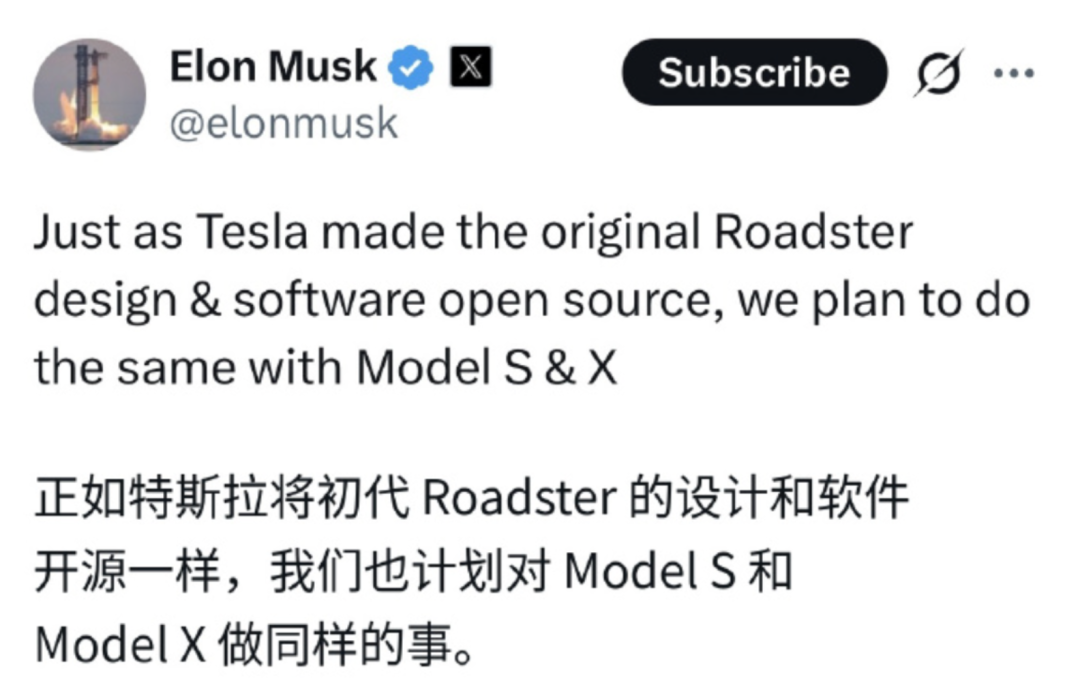
Just prior to this AI open sourcing controversy, Tesla CEO Elon Musk announced on social media that the company would fully open source all design materials and supporting software systems for its flagship models, the Model S and Model X.
Then, on August 4th, Tesla Vice President Tao Lin posted on domestic social media, delving further into Tesla's open sourcing plans and stating, 'Technological leadership is never achieved by hoarding patents; it is attained through rapid and continuous innovation.'
From an external viewpoint, Tesla's open sourcing, akin to the aforementioned AI model open sourcing, appears to benefit the industry. However, if you perceive it that way, you may have misconstrued Tesla's 'open sourcing.'
The Business Strategy Behind Openness
On June 12, 2014, Musk published an article titled 'All Our Patents Are Belong To You' on the official blog, declaring that Tesla would make all its patents available.
This move swiftly caused a stir. At that time, the penetration rate and ownership of new energy vehicles were not at their current levels, and the new energy vehicles launched by major manufacturers appeared rudimentary by today's standards.
That same year, Tesla officially entered the Chinese market. However, constrained by the era and product limitations, Tesla's inaugural year in the Chinese market was challenging, with only around 3,500 new vehicles sold throughout the year, falling short of its annual target of 5,000 vehicles and struggling to establish a foothold in the Chinese market.
The timing of these events has led to a persistent narrative on the internet suggesting that Tesla's open sourcing propelled new energy vehicles to prominence, with some netizens even sarcastically remarking that other automakers continue to utilize Tesla's patents to this day.
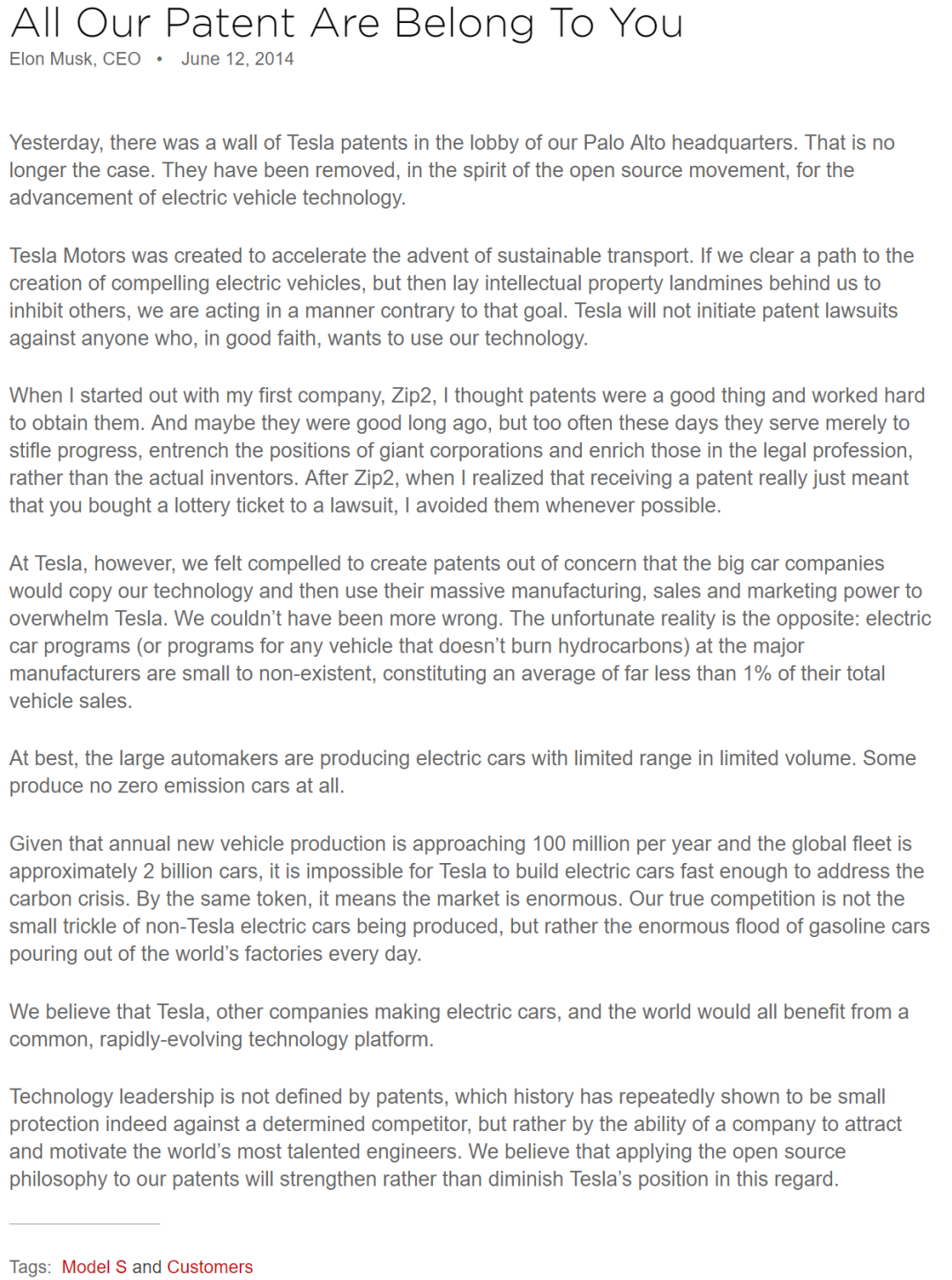
However, the reality is that Tesla's open sourcing at the time pertained solely to patents and came with stringent legal restrictions, known as the 'good faith clause.'
In essence, the 'good faith clause' means you can utilize my technology for free, but you cannot sue me with your technology, nor can you attempt to invalidate my patents. Simultaneously, any enhancements you make to the technology must also be shared.
Under such constraints, no traditional automaker was genuinely willing to employ Tesla's patents. After all, doing so would mean that all subsequent R&D investments in that patent could be freely utilized by Tesla, effectively rendering them free improvements for Tesla.
Nevertheless, this did not prevent Tesla from garnering a favorable reputation. Under Musk's image of openness and inclusivity, Tesla attracted a plethora of top engineers and, strategically, successfully positioned itself as an industry leader.
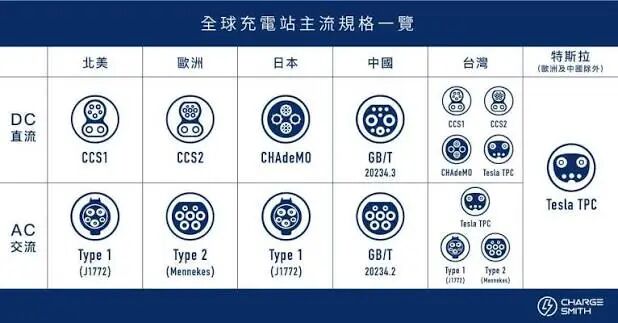
Regarding Tesla's subsequent open sourcing endeavors, they were predominantly considered from a business perspective. For instance, in 2021, Tesla opened up the NACS North American charging interface standard, enabling other brands' vehicles to utilize its Supercharger network.
This was because there was no unified charging interface standard in the North American market, and other new energy automakers had to construct their own charging infrastructure to ensure users could charge in public places. Tesla's open charging standard was actually a means to expand its charging network's profit model.
By opening up the NACS charging interface standard, Tesla could diversify the profitability of its charging network, transforming it from a cost center to a profit center.
According to statistics, by the second quarter of 2026, Tesla boasted more than 82,000 Superchargers worldwide, with quarterly charging volume reaching 2.0 terawatt-hours, generating substantial revenue for Tesla.
However, in the Chinese market, Tesla Superchargers were not accessible to all new energy vehicle owners until May 6, 2026. Nonetheless, according to national standards, Tesla could have technically opened up its charging network since the implementation of the 2015 national standard DC charging protocol.
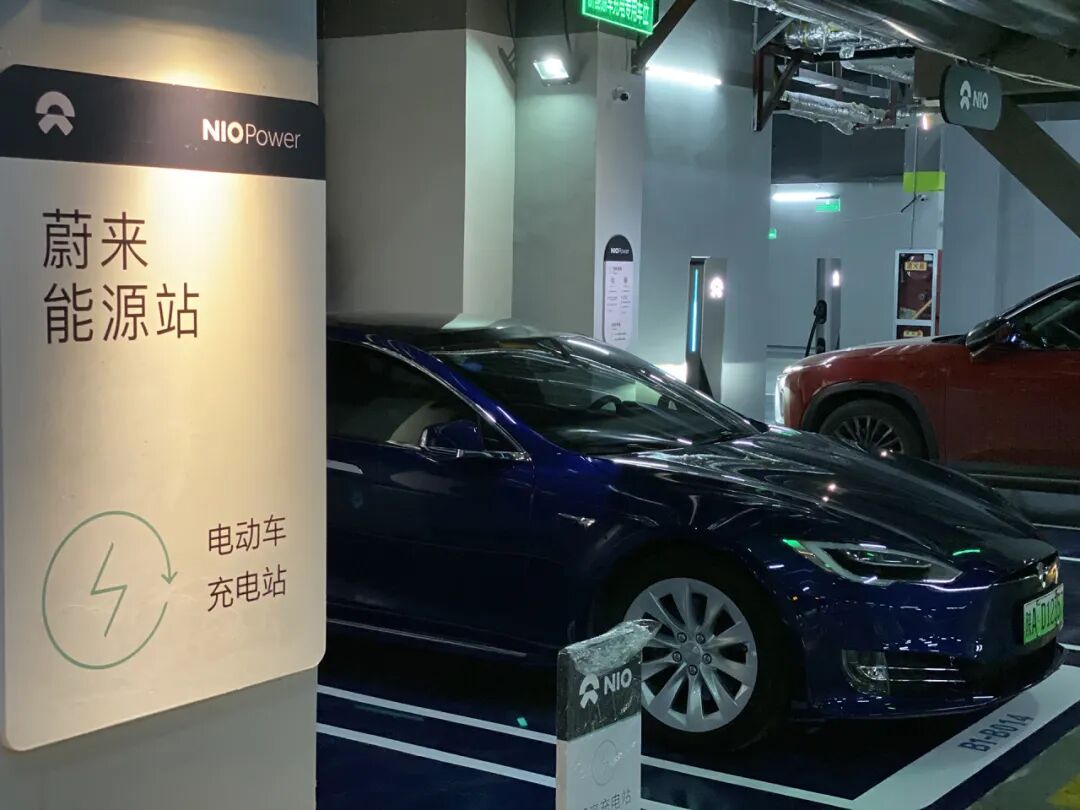
The reason for the ten-year delay was that the domestic public charging network had already achieved extensive coverage. According to statistics, by the end of June 2026, the number of public charging facilities (guns) in the country had reached 5.009 million, a year-on-year increase of 22.3%. The number of Tesla's open charging stations was even a mere fraction of the domestic public charging stations.
Of course, this was also because China had already unified its charging standards, and domestic automakers had surpassed Tesla in charging infrastructure construction. Whether it was NIO's energy replenishment network construction or BYD's launch of the Flash Charge network, both were accessible to all new energy vehicle owners.
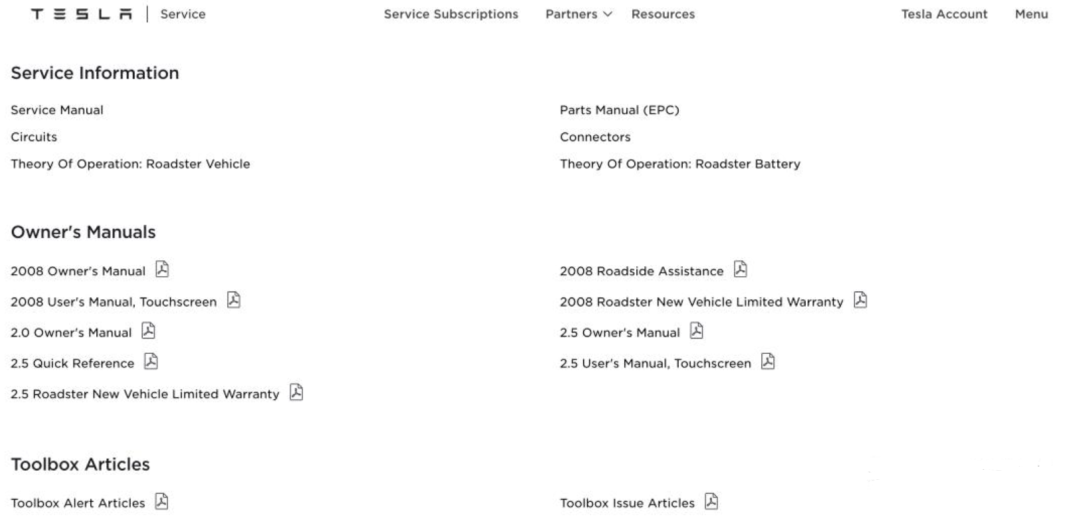
As for the current open sourcing of the design materials and software for the Model S and Model X, it is akin to the initial open sourcing of the Roadster, which only applies to discontinued models and has exceedingly limited openness.
The initial Roadster open sourcing merely involved Tesla uploading 5 DBC files (CAN bus database files, totaling 339KB), 1 diagnostic software ISO image (309MB), and several PDF operation guides, totaling 8 files, to GitHub, with no subsequent updates.
As for the content that can be open sourced this time, it is estimated to be confined to these files, which is vastly different from the general understanding of open sourcing. On the surface, it seems open, but in reality, every open sourcing by Tesla conceals business calculations.
The Battle for the Right to Repair
The beneficiaries of Tesla's open sourcing are actually only the owners of discontinued models, representing a strategy by Tesla to outsource after-sales service for its older models.
Based on the outcomes of the initial Roadster open sourcing, after opening up the repair manuals, diagnostic protocols, and circuit diagrams, third-party repair shops could legally conduct repairs on the three-electric systems (battery, motor, and electronic control), significantly reducing maintenance costs. The cost of battery module-level repairs for the Roadster could be slashed to about 25% of the official replacement price, while the cost of regular hidden fault diagnosis and repairs could be reduced to one-tenth of the official 'replace instead of repair' model.
Given such price disparities, most owners would inevitably opt for third-party repairs, gradually leading to the transfer of repair services for existing Tesla owners.
Behind this deeper strategy lies Tesla's political stance. After Trump took office, a significant meeting was convened regarding the 'Right to Repair' bill promoted by Republican senators, attended by executives from General Motors and Ford.
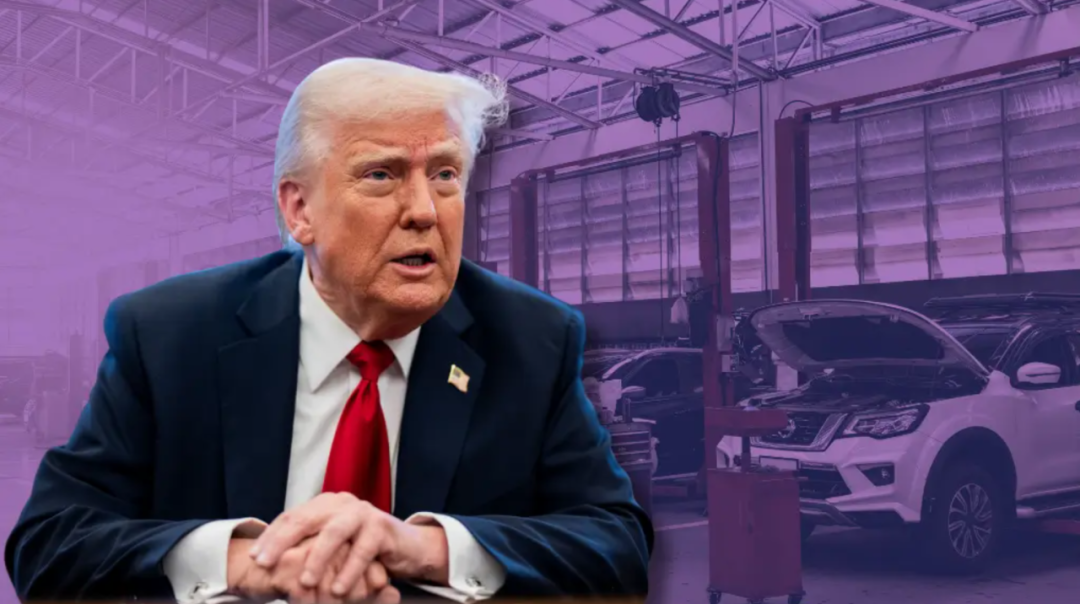
The crux of the bill requires automakers to provide owners and independent repair institutions with the same diagnostic codes, calibration tools, and access to repair data as authorized dealer networks. The Alliance for Automotive Innovation (AAI) publicly supports this bill, but interestingly, Tesla is the sole automaker in the United States that has not joined the alliance.
Ford CEO Jim Farley publicly stated that modern vehicles are structurally complex, and there are significant safety risks associated with owners attempting repairs themselves or having them done by unauthorized service centers, even suggesting that it could 'endanger lives.'
It can be said that behind the battle for the right to repair lies a larger political game. Ford and General Motors have adopted a superficial compromise while imposing actual restrictions. Tesla's open sourcing of data related to the discontinued Model S and Model X is also more of a facade.
As for the truly core technologies, such as the FSD autonomous driving system, Autopilot's core algorithms, and the underlying code of the three-electric systems, Tesla will never open source them. If Tesla genuinely supported open sourcing as it claims, wouldn't opening up the FSD autonomous driving model be more conducive to the early arrival of autonomous driving?
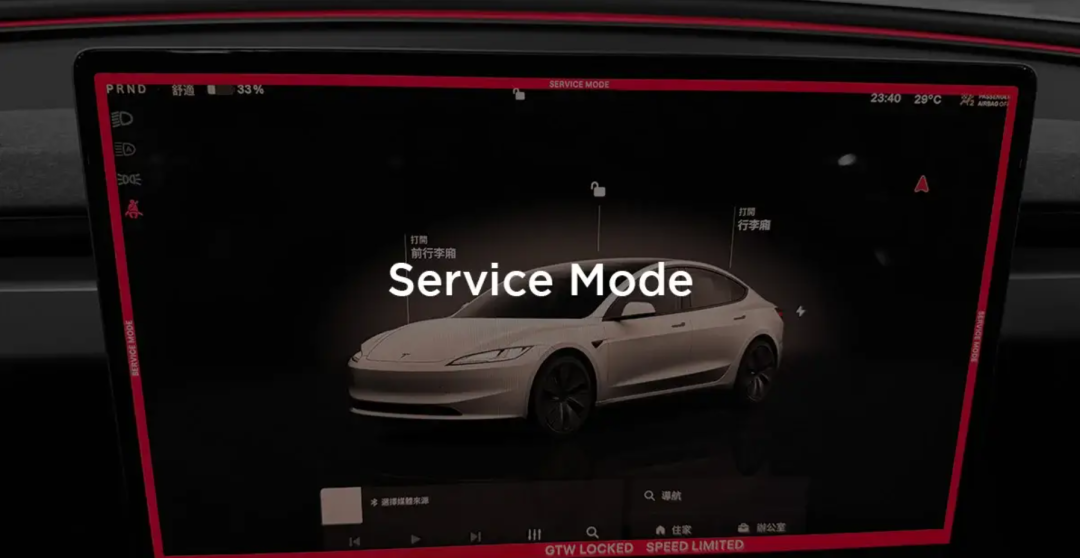
Of course, Tesla's open sourcing still holds positive significance in promoting the decentralization of repair rights for existing models, which is of great importance for the development of new energy vehicles, especially for owners who have purchased new energy vehicles from bankrupt automakers.
According to third-party statistics, there are approximately 850,000 existing vehicles without manufacturer support due to automaker bankruptcies, liquidations, restructurings, or complete production halts. These owners generally face issues such as the discontinuation of original parts, interruption of official after-sales service, and the suspension of smart vehicle system services. Moreover, due to the automakers' bankruptcies, the resale value of these vehicles has also plummeted, leaving owners in an awkward predicament where the vehicles are too expensive to repair and not worth selling.
For these owners, they hope to utilize their vehicles for a few more years before replacing them to mitigate losses. However, due to the lack of consideration for third-party repairs in the design of new energy vehicles, users find it arduous to locate suitable repair enterprises in the market.
For example, after the collapse of WM Motor, with a substantial number of existing users, consumer protection committees in multiple regions received numerous complaints, with the core demand being that automakers should provide aftermath solutions and not simply declare bankruptcy.
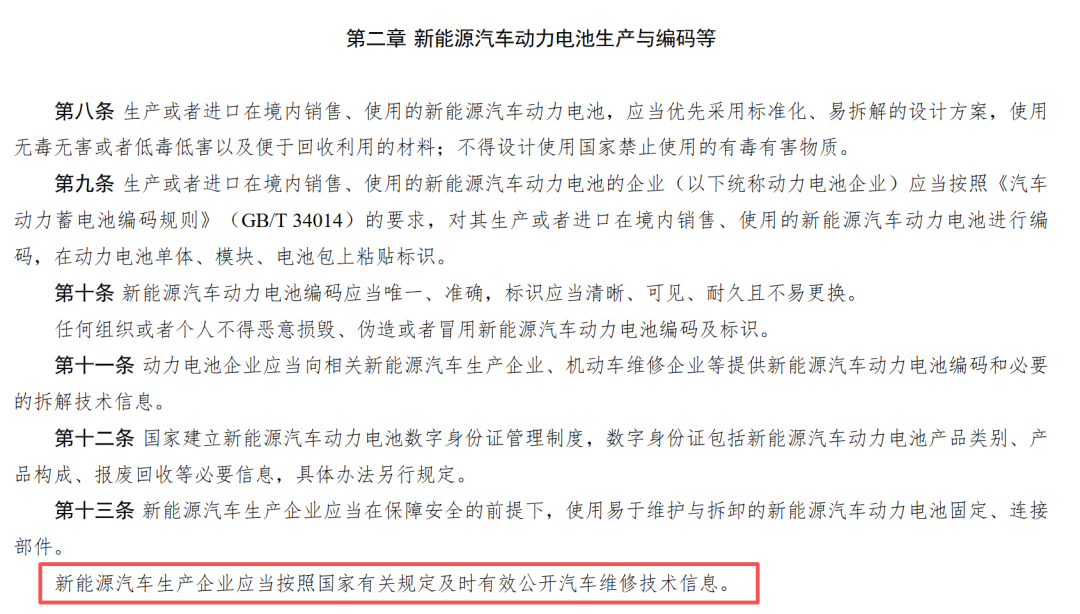
At the policy level, China is already promoting the openness of new energy vehicle power battery repairs, guiding and mandating vehicle and battery companies to open up core technical materials such as battery disassembly parameters, repair manuals, and diagnostic interfaces to compliant third-party repair institutions, breaking the technical monopoly of 4S stores.
Simultaneously, it encourages the 'repair instead of replacement' of power batteries, prohibits 4S stores from forcibly replacing entire battery packs without diagnosis, and establishes the principle of 'repair if possible.'
The 'Safety Requirements for New Energy Vehicle Maintenance Operations,' which came into effect on August 1st, also sets mandatory access thresholds for third-party repairs, standardizes third-party repair practices, and reduces maintenance costs for new energy vehicle owners.
From Tesla's open sourcing, we can also discern room for improvement in third-party repairs for new energy vehicles. Domestic automakers should follow suit, at least by opening up repair monitoring for discontinued models to allow users to truly utilize their vehicles with peace of mind.
As Tesla's Tao Lin said, 'Technological leadership is never achieved by hoarding patents; it is attained through rapid and continuous innovation.'
Domestic automakers should also be more magnanimous, especially those on the verge of bankruptcy. They might as well do a favor for their users before going under, not betraying the support these owners have once given.
Note: Some images are sourced from the internet. If there is any infringement, please contact us for removal.
-END-

-
![]()
Unveiling Yin Tongyue's 'No Involution' Stance: Chery's Strategic Maneuvers
-
STO Express Faces Scrutiny: Franchise Model’s Safety Gaps Under the Microscope
-
![]()
The Richest Woman is Going Public Again! Valued at 22.5 Billion, Building an 'Optical Empire' with Her Brother
-
![]()
Buying More GPUs is No Longer Enough: Divergence in Monetization Progress Among the Top Four Cloud Providers
-
![]()
Leapmotor Exceeds 100,000 Units, Li Auto Faces Three Straight Months of Decline: China’s Auto Market Competition Intensifies in the Second Half
-
![]()
Can NASA Discover Extraterrestrial Life? UK Invests £3 Million, but First Must Block Out Stars
-
![]()
Huawei Expands Computing Power Business into the Pig Farming Sector
-
![]()
Asian Dragon Receives a 'Makeover': Is FAW Toyota Using the 'Crown' as a Substitute Strategy?