Seres Pours Nearly 600 Million Yuan into Buybacks Amidst Declining Dividends and Product Structure Woes
 08/05 2026
 520
520
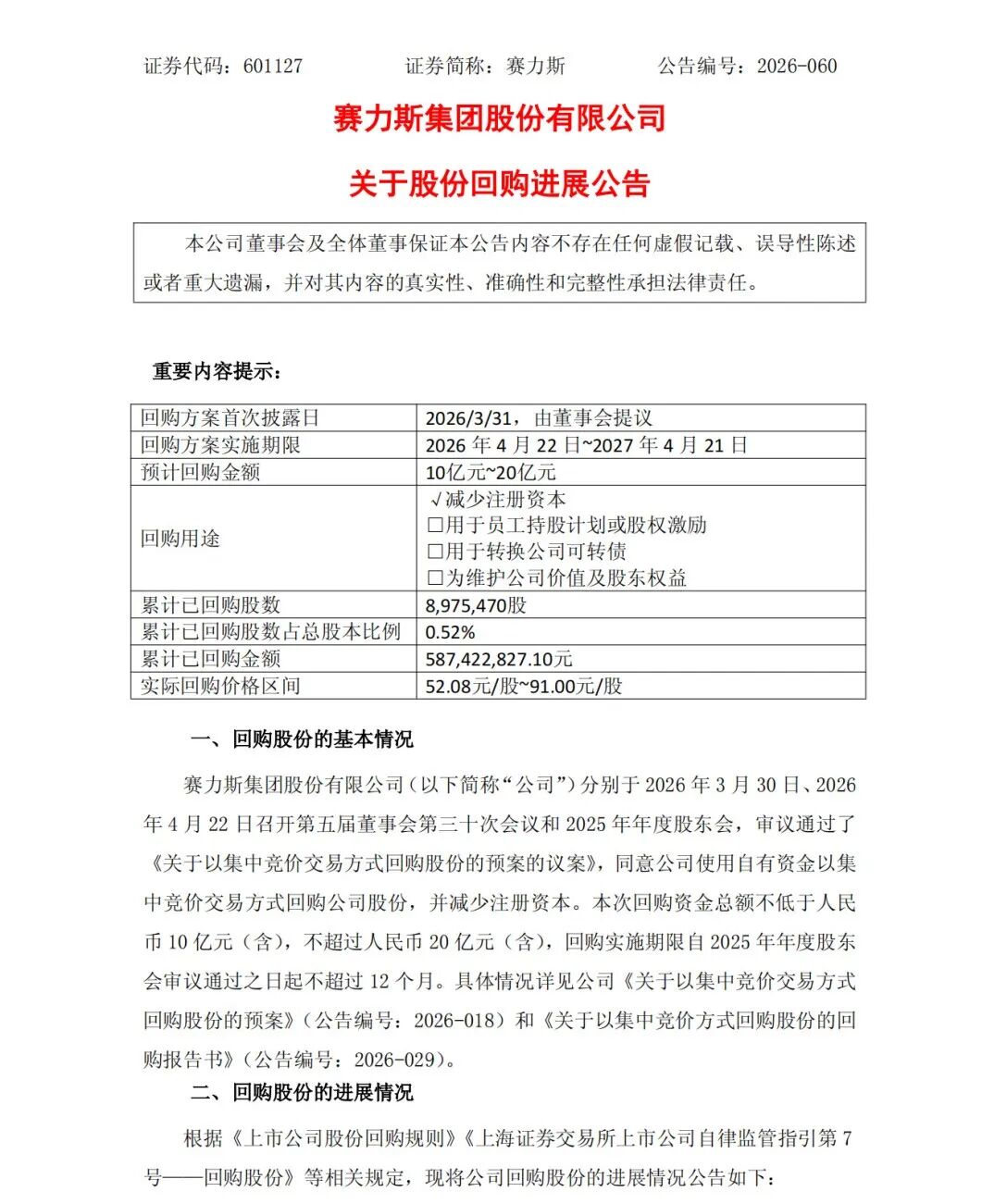
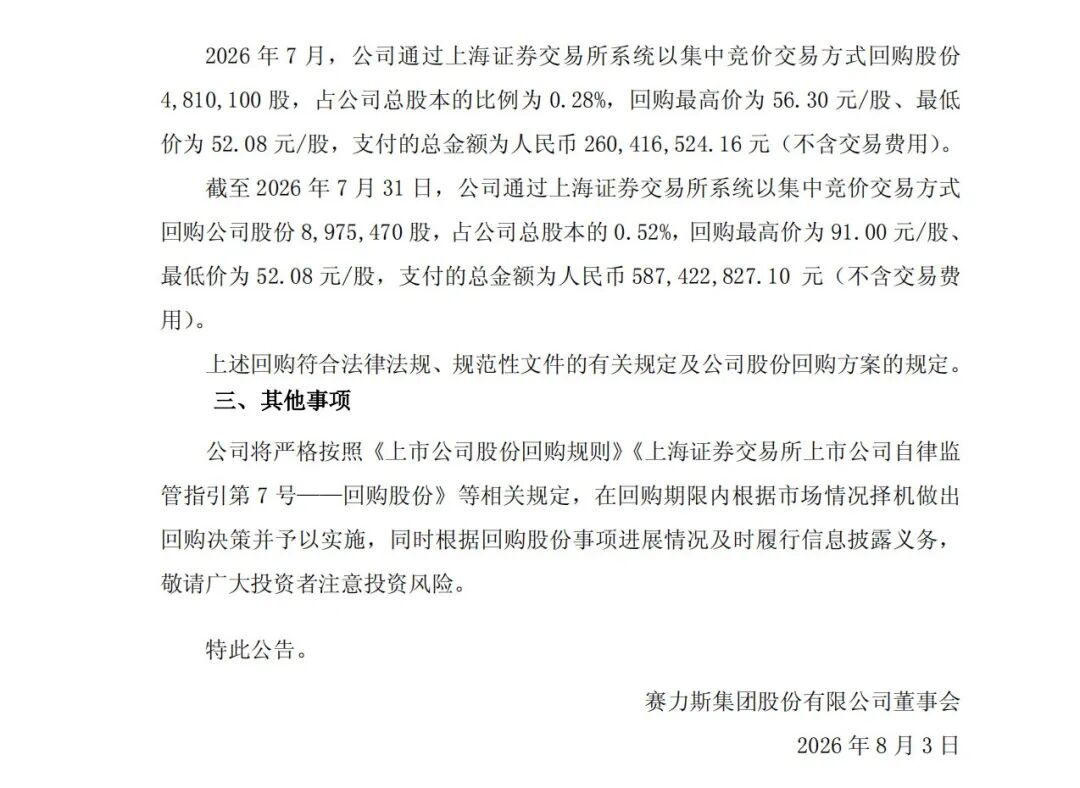
On the evening of August 3, Seres unveiled its latest share repurchase progress announcement, disclosing that as of July 31, it had expended a total of 587 million yuan on share buybacks, with a staggering 260 million yuan spent in July alone. This marks the company's most significant and sustained repurchase endeavor in nearly two years. Yet, the secondary market has remained unresponsive, with the stock price hovering narrowly between 52 yuan and 60 yuan, a far cry from its historical high of 170 yuan. On one side, the listed company is pouring substantial capital into bolstering the stock price, while on the other, investors are witnessing their paper profits dwindle. This stark contrast underscores a fundamental shift in market expectations regarding Seres' growth prospects and, indeed, those of the entire extended-range new energy vehicle (NEV) sector.
The intensified repurchase efforts are a direct response to a sharp downturn in fundamentals. The production and sales report for July, released concurrently on August 3, revealed that Seres sold 24,229 NEVs, a year-on-year decline of 45.65%. Sales of its flagship brand, Aito, plummeted by 50.86% year-on-year to 20,480 units, effectively halving. These figures starkly confirm the grim outlook presented in the first-half earnings forecast released on July 12: the company anticipates a net loss attributable to shareholders of 1.5 to 1.8 billion yuan for the first half of the year, with its core subsidiary, Aito Automotive, incurring a loss of 1.05 to 1.3 billion yuan. The estimated loss for the second quarter alone is as high as 1.9 to 2.15 billion yuan. This marks the first quarterly loss for the Aito brand since it turned profitable, and the magnitude of the loss continues to widen. The dual blow of plummeting sales and profit pressure renders the 587 million yuan repurchase insignificant, given the less than 1% reduction in share capital, and fails to serve as a substitute for a fundamental recovery. 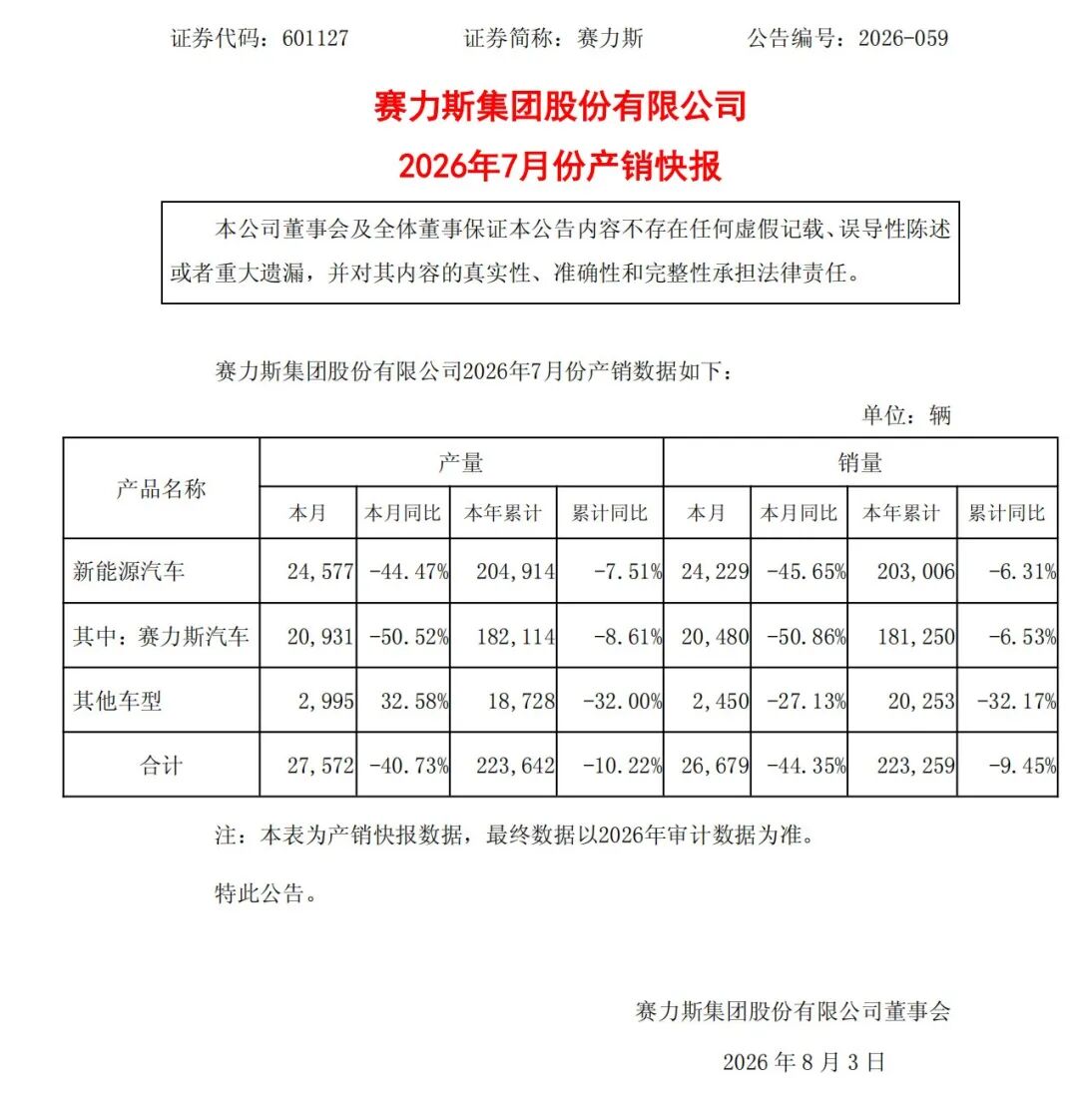
The dual slowdown in sales and profits is essentially the inevitable outcome of the extended-range EV sector transitioning from a blue ocean to a red ocean. Data from the China Passenger Car Association (CPCA) indicates that in the first half of 2026, retail sales of extended-range EVs reached 439,000 units, a year-on-year decline of 19.4%. In June alone, retail sales were 82,000 units, a staggering 31.9% year-on-year drop, marking the largest single-month decline in nearly five years. Extended-range EVs have become the only category among the three major NEV routes to experience a decline in both wholesale and retail sales, with their market share shrinking from 10.3% to approximately 7%.
As the sector's growth continues to contract, a slew of new cross-industry players have entered the fray: Xiaomi officially launched its Pengcheng series extended-range SUVs at the end of July, directly pricing them against Aito's main models. Li Auto, Shenlan, and Leapmotor have also continuously rolled out multiple new extended-range products throughout the year. The industry has shifted from a period of synchronized expansion across the entire sector to a phase of intense competition for market share, with price wars becoming the norm and directly squeezing the profit margins of individual vehicles. A deeper dilemma lies in Seres' over-reliance on its cooperation model with Huawei. In 2025, Seres paid Huawei a staggering 22.335 billion yuan in procurement fees, with roughly 140,000 yuan of the revenue from each Aito vehicle sold going to Huawei.
As Huawei's HarmonyOS Intelligent Connectivity ecosystem expands from 'one brand' to 'five brands,' Aito's share of total sales within the HarmonyOS ecosystem has dropped from approximately 87% in 2024 to less than 70% in the first quarter of 2026. Huawei's advanced intelligent driving system, ADS, has been opened up to multiple brands, including Shenlan and Avatr, transforming Aito's once-unique intelligent driving advantage into a shared feature. In July, HarmonyOS Intelligent Connectivity delivered 45,000 new vehicles, with the Aito brand accounting for only 46.46%, less than half. Seres' success is intertwined with Huawei, but so are its challenges. As channel, marketing, and R&D support are no longer exclusive to Aito, Seres' competitive moat is gradually being eroded.
From a product structure perspective, Aito has found itself in a predicament where 'one model carries the brand.' In July, cumulative deliveries of the Aito M9 series surpassed 300,000 units, with the new M9 achieving over 20,000 deliveries in just seven weeks. However, the combined sales of the M6, M7, and M8 models lag behind the M9 alone. The high-end M9 model dominates, while mid-to-low-end models struggle, resulting in a severely imbalanced product structure.
This imbalance directly leads to the per-vehicle profit being squeezed by three factors: Huawei's costs, R&D investment, and price wars. R&D expenses surged by 743 million yuan year-on-year in the first half, while core profit excluding non-recurring items plummeted by 73.87%. The capital market's pricing rules are clear-cut: high-growth sectors command high valuations, while sectors in mature competition return to reasonable valuation ranges.
Seres is currently undergoing a period of valuation re-pricing. While repurchases can temporarily offset market panic, they cannot reverse the long-term re-evaluation of the company's value by investors.
The core factors determining whether the stock price can stabilize and rebound hinge on two key variables: first, whether new models can maintain stable sales volumes and defend per-vehicle profit margins amid intense price competition; and second, whether Seres can reduce its reliance on the extended-range EV business and cultivate a new second growth engine. For investors, the expectation of the stock price returning to its peak of 170 yuan is no longer realistic. Only by waiting for financial results to reflect the company's true value can one ascertain whether the company deserves its current valuation.
-
![]()
Unveiling Yin Tongyue's 'No Involution' Stance: Chery's Strategic Maneuvers
-
STO Express Faces Scrutiny: Franchise Model’s Safety Gaps Under the Microscope
-
![]()
The Richest Woman is Going Public Again! Valued at 22.5 Billion, Building an 'Optical Empire' with Her Brother
-
![]()
Buying More GPUs is No Longer Enough: Divergence in Monetization Progress Among the Top Four Cloud Providers
-
![]()
Leapmotor Exceeds 100,000 Units, Li Auto Faces Three Straight Months of Decline: China’s Auto Market Competition Intensifies in the Second Half
-
![]()
Can NASA Discover Extraterrestrial Life? UK Invests £3 Million, but First Must Block Out Stars
-
![]()
Huawei Expands Computing Power Business into the Pig Farming Sector
-
![]()
Asian Dragon Receives a 'Makeover': Is FAW Toyota Using the 'Crown' as a Substitute Strategy?