How to Address the Shortfall in Road Maintenance Funds as Highway Tolls Expire Amid the Rise of Electric Vehicles?
 08/07 2026
 503
503

Lead
Introduction
With escalating road maintenance costs and an increasing number of new energy vehicles (NEVs) on the roads—vehicles that are exempt from road maintenance fees—the challenge of funding road upkeep has become more pressing.
“My spouse and I just completed a ten-day round trip to and from Tibet last month... After the trip, we tallied up the expenses: 3,700 yuan on fuel, 2,500 yuan on tolls, nearly 1,000 yuan on food and lodging, and almost 100 yuan on snacks and fruits. We estimate the total cost for the ten-day journey did not exceed 10,000 yuan.”
Amid discussions about the "sluggish tourism market and insufficient consumer spending," a netizen shared their self-drive travel expenses to Tibet during this year's summer vacation.
By bringing their own food, sleeping in the car, and visiting fewer toll attractions, the couple managed to keep their ten-day expenses under 10,000 yuan. However, the fixed cost of expressway tolls remained unavoidable.
Nevertheless, with a wave of early-built expressways in China reaching the end of their toll collection periods, the cost of self-drive travel is expected to decrease. Yet, in reality, simply ending tolls upon expiration does not directly translate to universal free travel.
On one hand, older expressways have limited capacity. If tolls were abolished, traffic would surge, exacerbating congestion. On the other hand, the disappearance of toll revenue poses a real challenge in securing funds for ongoing road maintenance. Coupled with changes in road wear and tear due to the rise of NEVs, expressways now stand at a crossroads where policy and reality collide.
01 The First Batch of Expressways Reach Toll Expiration
In 1988, China's first expressway, the Hujia Expressway (Shanghai-Jiading), opened to traffic, marking 38 years since then.
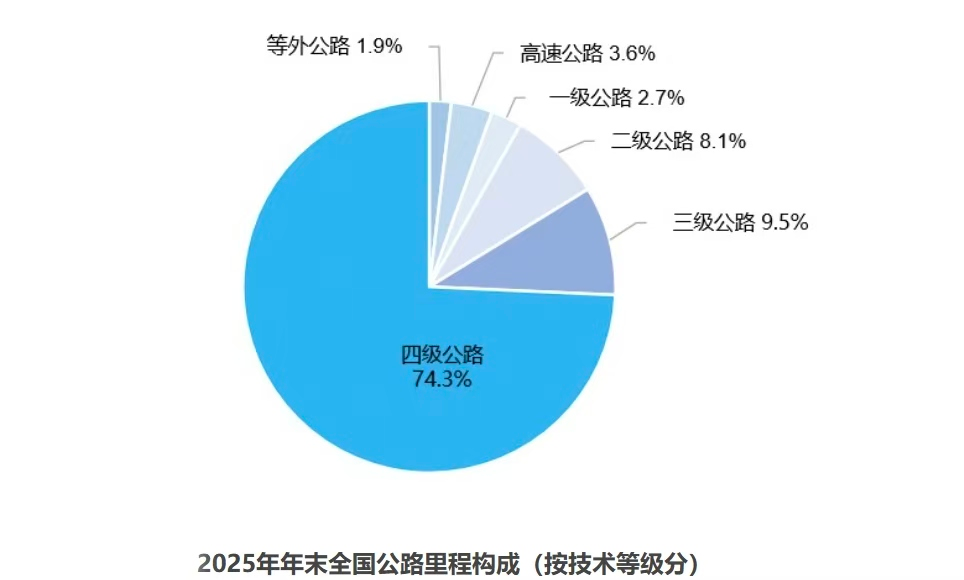
During this period, as a "powerhouse of infrastructure development," China rapidly expanded its expressway network. Data from the Ministry of Transport shows that by the end of 2025, the total length of highways rated Grade 4 and above will reach 5.4728 million kilometers, including 199,400 kilometers of expressways.
Expressway construction requires significant investment, primarily relying on a "loan-for-construction, toll-for-repayment" model. In this approach, governments or enterprises borrow from banks or other financial institutions and repay the loans through vehicle tolls.
According to regulations, the maximum toll period for government-repaid roads is 15 years (20 years in central and western regions), while for operating roads, it is 25 years (30 years in central and western regions). This means the first batch of expressways will gradually reach their toll expiration dates. However, in practice, renovation and expansion to reset toll durations have become a common way to handle expiring expressways.
After the renovation and expansion of the Jinan-Qingdao Expressway, it was granted a new 25-year toll period. The Guangzhou-Shenzhen Expressway, whose tolls are set to end next year, has also initiated renovation and expansion work. The much-anticipated toll-free expressways for many drivers have been repeatedly postponed due to these projects.
02 Toll-Free Expressways Remain Distant
Behind the trend of renovation and expansion lies a tug-of-war among public expectations, the current state of road infrastructure, and local fiscal constraints.
From the public's perspective, once a road's toll period expires, it should be opened to the public for free to reduce travel costs. However, from the perspective of road network operations, lanes designed decades ago can no longer handle current traffic volumes in terms of both quantity and quality. Expansion can alleviate pressure on existing roads while ensuring a stable source of road maintenance fees to preserve road quality.
Moreover, for expressways that have transitioned to toll-free status, the operational experience has been mixed. While tolls are no longer collected, the influx of vehicles onto roads planned and built years ago has led to significant congestion. At the same time, the loss of stable maintenance funding has left roads without a reliable source of upkeep, potentially leading to further deterioration if no alternative funding is found.
According to the "2021 National Toll Road Statistics Bulletin" released by the Ministry of Transport, in 2021, toll revenue from vehicles on national toll roads was 663.05 billion yuan, while expenditures reached 1,290.93 billion yuan, resulting in a deficit of 627.88 billion yuan.

Against this backdrop, another role of renovation and expansion becomes apparent: extending the toll period through upgrades to alleviate financial pressures. Some experts predict that if tolls were immediately halted upon expressway expiration, the growing mileage of expressways and rising prices would lead to a substantial increase in maintenance funding needs, with an estimated additional demand of over 300 billion yuan by 2030.
This creates a dilemma. Strictly enforcing toll-free policies upon expiration would leave many regions unable to bear the maintenance burden, leading to a decline in road quality. Extending tolls through expansion, while securing funding and capacity, risks widening the gap between public expectations and toll policies.
Even as legacy issues from existing expressways remain unresolved, changes in the automotive industry structure pose new challenges for road maintenance from another angle.
Heavier Electric Vehicles and a Widening Maintenance Funding Gap
Compared to traditional fuel vehicles, NEVs are generally heavier. Calculations show that a 20% increase in vehicle weight can nearly double the rate of road damage to 2.07 times the original level. Currently, road maintenance fees are primarily collected through fuel surcharges, with no equivalent maintenance costs included in electricity prices. This creates a structural contradiction: vehicles causing more road damage are not directly contributing to maintenance funding.
Opinions are sharply divided on whether NEVs should pay road maintenance fees.
Many fuel vehicle owners argue that they bear the main cost of road maintenance through surcharges included in fuel prices, while NEVs, which use the roads just as much and are often heavier, do not pay. They believe this is unfair in the long run. On the other hand, some NEV owners argue that NEVs are a national strategic emerging industry, and supportive policies such as purchase subsidies and tax exemptions have been crucial. They believe these preferential policies should continue while the industry is still in its growth phase.
Behind these differing views lies an unavoidable financial reality. In 2024, data released by the Research Institute of the Ministry of Transport showed that due to funding shortages, about 40% of ordinary highways were caught in a dilemma of "being listed for maintenance but lacking funds, needing repairs but lacking funds." Moreover, as highway mileage increases, the maintenance funding gap continues to widen. While the number of fuel vehicles is still rising, the growth rate has slowed significantly, while NEV penetration continues to increase. This shift—where fuel vehicle growth declines and NEV growth rises—has intensified the contradiction between narrowing sources of road maintenance fees and rising maintenance costs.
Currently, NEVs are heavier and cause more road damage, yet electricity prices do not include corresponding maintenance costs. This directly narrows the sources of road maintenance fees while maintenance expenditures continue to accumulate.
Amid these overlapping challenges—both old and new—the financial situation of expressways is becoming increasingly strained. The public expects tolls to end upon expiration, but the pressure of annual maintenance funding deficits in the billions of yuan, combined with new variables in road damage caused by the rise of NEVs, makes extending tolls through expansion a relatively pragmatic solution.
This means that while the first batch of expressways is reaching toll expiration, true toll-free travel is still a long way off. Along this path, figuring out how to incorporate NEVs into the road maintenance funding system—without stifling industry growth or allowing the maintenance funding gap to grow indefinitely—has become an unavoidable challenge.
Editor: Yang Jing Contributing Editor: He Zengrong

THE END
-
![]()
Europe's 'Lagging' Struggle: The Legacy of a Decade-Old Misstep
-
![]()
BAT's Rematch in AI Office: What's Baidu's Strategy?
-
![]()
BAT Enters the AI Office Arena Again: What's Baidu's Strategy?
-
![]()
Sales Review of New Forces in July 2026: Leapmotor Surpasses 100,000 Units
-
![]()
GM Tore Down the Global Market, SAIC-GM Rebuilds It Piece by Piece
-
![]()
Is the Input Method Landscape Being Reshaped by Doubao and Qianwen?
-
![]()
Ashok Didn't Cover It, But Tesla's Head of Engineering Phil Did: FSD Algorithm Architecture, Proxy Tasks, and 300,000 GPUs
-
![]()
[In-depth Report] Systemic Symbiosis: How Foreign Investment Empowers New Pathways for Chinese Automakers to Go Global