BAT Enters the AI Office Arena Again: What's Baidu's Strategy?
 08/07 2026
 395
395

This article is the 1062nd original work by DeepAtom.
"
AI Office Becomes the Next Major Battleground
By Meng Fanle | Author
DeepAtom Studio | Editor
The battles never end; they just keep going.
Over the past two decades, Baidu, Alibaba, and Tencent (BAT) have clashed in various arenas, including e-commerce, O2O, transportation, payments, short videos, large models, and AI entry points. In nearly every sector capable of reshaping the industry landscape, the presence of these three companies in direct competition is evident.
By the summer of 2026, the battleground for the three giants had shifted to AI office solutions, with the familiar intensity returning: Tencent, Alibaba, and Baidu almost simultaneously aimed their weapons at the same target, competing for the next generation of AI office entry points. During the Spring Festival, they were still bloodily contending for Chatbot dominance.
The change first originated in the U.S. market, where Anthropic took the lead in transforming the concept of "work" into a widely accepted product form. In May 2025, Anthropic quietly launched a product: Claude Code. It is an AI agent capable of directly reading and writing code repositories, executing commands, and submitting pull requests (PRs). Overnight, it swept through the entire programming industry and then rapidly extended into non-programmer work domains. Claude Code essentially defined the product form of AI office tools.
For the first time, the industry reached a consensus on AI applications: Work-class products hold greater commercial value than Chatbots. At least for now, they are products capable of generating substantial profits. This is because they prove one thing: once agents truly take over workflows, users are willing to pay generously for results.
In February 2026, Anthropic's annualized revenue (ARR) reached $2.5 billion, followed by a steep growth curve. Recent reports suggest its ARR will surpass $100 billion by the end of August. OpenAI is close behind, expected to achieve $100 billion in ARR by year-end without issue. These are astonishing growth figures. For comparison, TikTok, the world's strongest money-printing machine, is projected to generate $186 billion in revenue in 2025.
So, who can remain indifferent in the face of such a trillion-dollar market?
July 2026 marks a turning point: AI office solutions are no longer scattered experiments across various agent product lines but are now a coordinated group effort.
AI Work-class products in the Chinese market began with "lobster farming." Tencent's WorkBuddy and Baidu Dazi were initially lobster-class products, gradually iterating to approach a Work product form like Codex.
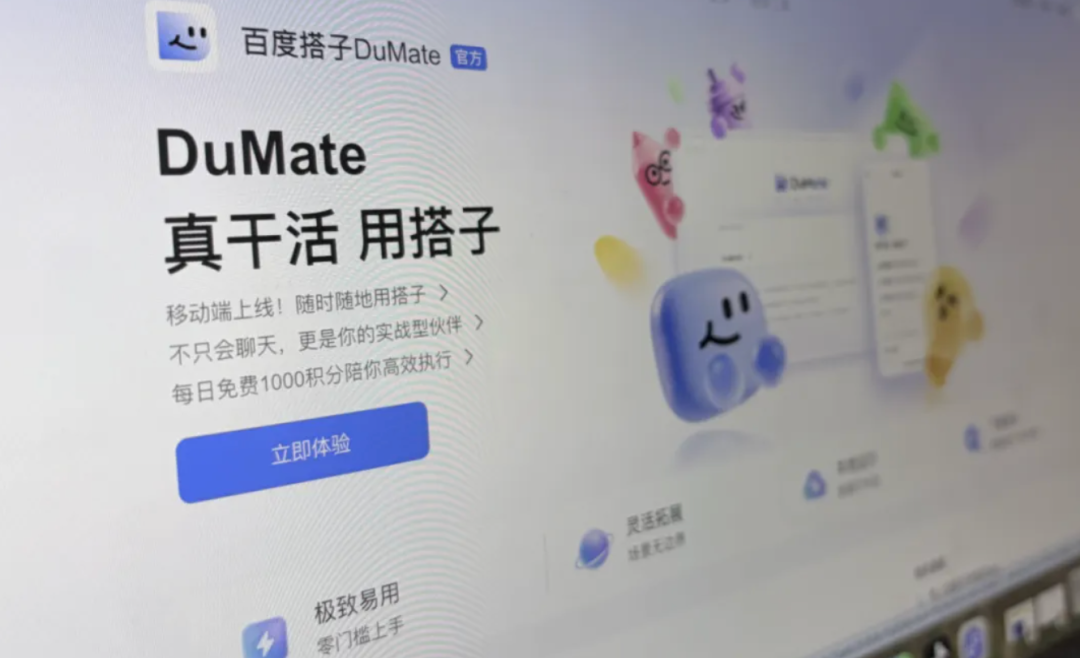
By July, as everyone can see, the three giants successively adjusted their product strategic priorities: Tencent pushed WorkBuddy to the forefront, jokingly dubbed the "new crown prince of Tencent." Alibaba consolidated capabilities like QoderWork, Wukong, and MuleRun into Qianwen Office, while Baidu formed an AI office matrix with products like Baidu Dazi (Dumate), GenFlow, and MiaoDa.
Tencent, Alibaba, and Baidu are all pursuing the same goal but, due to their different origins, adopt different starting stances.
Three Starting Stances
The previous generation of office application battles lasted nearly a decade. DingTalk, WeCom, Feishu, Baidu Wenku, and cloud storage all achieved their respective victories.
The advent of AI has reset this battle. The core of the previous generation of office platforms revolved around instant communication, organizational collaboration, approvals, and documents, with the key focus being "how people communicate and how organizations operate." However, in the age of agents, the core logic of office software has shifted from "communicate first, then execute" to "deliver results first, then review and align."
When agents can break down tasks, call upon tools, generate solutions, and complete initial execution, IM instant messaging is no longer the starting point of work. When agents can independently complete complex tasks in a closed loop, organizational collaboration becomes less critical.
This is where BAT diverges in AI office strategies.

Tencent's WorkBuddy path starts from instant communication and social chains, evolving toward agents. WorkBuddy's advantage lies in the relationship chains of WeChat and WeCom. WeCom plays a pivotal role in connecting enterprises, employees, and external customers, especially in sales, customer service, and private domain operations, where it remains a hard-to-replace entry point. However, in the age of agents, the core of an agent is task completion, relying not on relationship chains themselves but on task context. Merely having the ability to "connect people" may not suffice in the AI office era. We've already seen Tencent enhancing WorkBuddy's capabilities around "tasks."
Alibaba's Qianwen Office path evolves from organizations to agents. The organizational relationships, approval processes, and enterprise clients accumulated by DingTalk over the years are Alibaba's most critical assets. The value of Qianwen Office lies first in combining Tongyi model capabilities with DingTalk's organizational context. However, Alibaba has realized that DingTalk belongs to the previous generation of office products. Qianwen Office must not merely add an AI layer to DingTalk but become a more native agent product, prioritizing "tasks first, rather than organizational collaboration first."
Baidu Dazi is an office agent closer to AI-native principles. It first assumes the user needs to complete a task, then works backward to determine which files, tools, and data the agent needs to call upon. Baidu's approach to AI office solutions involves rebuilding from data and agent execution, not being as deeply tied to the previous generation of office entry points, allowing it to more thoroughly recreate an AI office entry point according to AI-native logic. The entry point for AI-native office solutions may not be "initiate communication" but "initiate a task." Directly let the agent read materials, organize solutions, generate PPTs, build small tools, and then have humans review and modify them. This logic naturally aligns more closely with data assets and desktop-level execution capabilities.
Tencent excels in "connecting people," Alibaba in "connecting organizations," and Baidu bets on "connecting data." All three have chosen their flagship products to lead the charge, but Baidu Dazi is the only one initially positioned as a "universal agent + data foundation"—it does not depend on any existing product ecosystem, unlike WorkBuddy rooted in WeChat or Qianwen Office in DingTalk. It comes with its own data assets and execution capabilities. Keep in mind that Baidu Netdisk has 1 billion users and 100 billion GB of work files.
In the age of agents, whoever possesses the most authentic user work files and data precipitate (accumulated data), and whose universal agent can truly execute tasks, holds the deepest competitive moat.
What Cards Does Baidu Dazi Play?
Baidu Dazi made its high-profile debut at the 2026 Create Conference in May. Baidu founder Robin Li first proposed a new metric for the agent era—DAA (Daily Active Agents), emphasizing that the value of AI should shift from "Token consumption" to "actual delivery of results."
Baidu Dazi is a product of this philosophy. Its initial positioning was as a truly "working" universal agent. Baidu Dazi integrates core product capabilities like Baidu AI Search and Baidu Baike into readily callable built-in skills while strengthening long-term task execution and proactive decision-making abilities, becoming the unified entry point for users into the Agent world.
Baidu does not want users to switch back and forth among multiple AI products but hopes to consolidate actions like "finding materials, summarizing, writing reports, creating PPTs, and building tools" into a single execution interface. For enterprise users, the significance of this unified entry point is substantial: it reduces switching costs and enhances implementation efficiency.
Today, in the AI office Track (track), Baidu's differentiated layout (strategy) involves coordinated group operations. Baidu Dazi collaborates with products like GenFlow and MiaoDa, forming a Baidu-proprietary AI office product matrix with unique advantages.

GenFlow already has 100 million monthly active users, excelling in long document refinement, report writing, and video editing based on netdisk assets. These scenario-based capabilities provide unique support for Baidu's competition in the AI office domain.
Then there's MiaoDa, which already boasts over 35 million users and 3.5 million application generations, offering zero-threshold no-code development capabilities. This enables agents to generate micro-applications and lightweight tools in real-time to meet personalized, cross-system long-tail business demands and complete deliveries.
Moreover, Baidu Dazi's product development pace is extremely fast, with daily updates, showcasing the agility of an AI-native team. It remains open, integrating with mainstream office tools like WeChat, Feishu, and Ruliu. More importantly, Baidu has meticulously implemented enterprise-grade security, including security sandboxes and folder-level permission controls. These capabilities directly address enterprises' biggest fears: what AI can see, modify, and whether it can access sensitive files. Baidu Dazi indeed has its own distinct features and advantages in security and trust.
Thus, Baidu is indeed entering the fray with a A brand new competitive logic (new competitive logic): as AI office competition shifts from "who has the larger entry point" to "who has deeper data and whose agent can get more work done."
Camp Divisions: The Big Factory Game
Today, China's AI sector has formed two major camps: one consists of tech giants, represented by BAT; the other comprises entrepreneurial newcomers, represented by Deepseek, Yuezhi Anmian, and Zhipu. Tech giants pursue both foundational models and applications, while entrepreneurial newcomers continue to focus on models, striving to continually push the boundaries of intelligence.
Of course, AI office solutions are never about a single model's capabilities. What truly determines success is whether the four dimensions—model agent capabilities, data assets, ecological toolchains, and to B delivery—can all function smoothly. Models determine entry qualifications, data determines task completion, toolchains determine stickiness, and delivery determines monetization capabilities. Without any one link, the loop cannot run.
From the model side, all three companies have their aces. Wenxin Large Model 5.1 ranks first domestically on the LMArena search leaderboard, Tencent Hunyuan is strengthening group-level RL infrastructure, and Alibaba Tongyi continues to invest in Coding and Cowork directions.
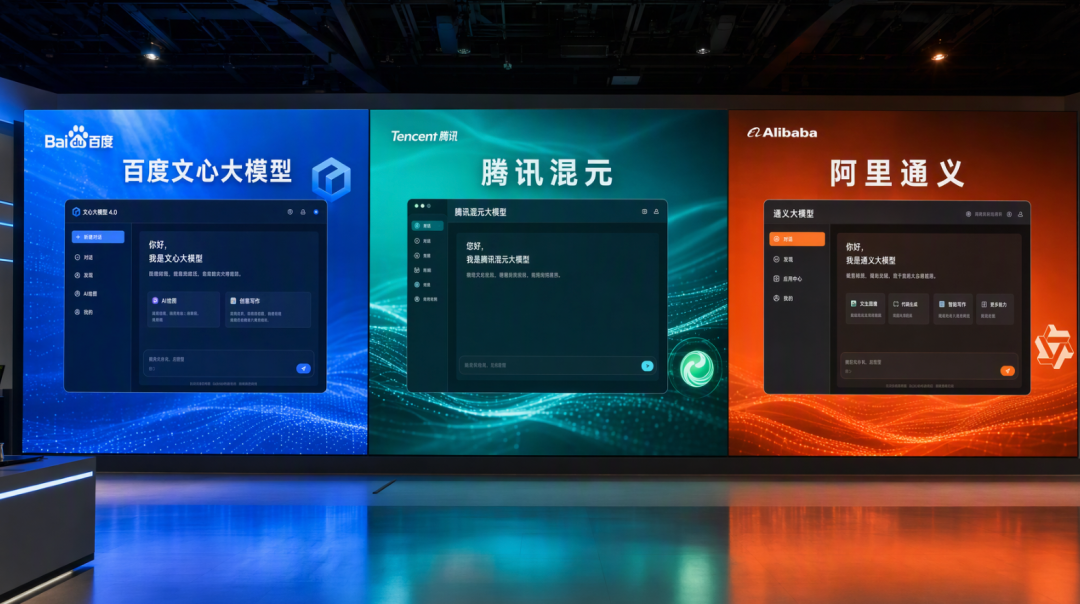
From the data side, the differences are more significant. WeChat and WeCom possess communication and social relationship data, DingTalk holds organizational relationship data, while Baidu possesses work file data. Once AI office solutions enter the task execution phase, the most valuable assets are those files that can be directly called upon, edited, reorganized, and reproduced.
From the ecological side, Tencent integrates documents, netdisks, Lexiang, WeChat Pay, and ima; Alibaba relies on DingTalk and Alibaba Cloud's enterprise linkages; Baidu Dazi is more open, already connecting with WeChat, Feishu, and Ruliu. Whichever has a more complete tool and ecological ecosystem is more likely to turn one-time trials into high-frequency habits.
From the delivery side, Alibaba, Baidu, and Tencent all possess strong to B sales and delivery team capabilities. However, the capabilities required for AI office solutions are undoubtedly different. How to redesign delivery processes and rebuild delivery capabilities according to user and client needs is a common challenge for all three.
Big factories may lack the agility of startups but excel at matrix warfare. BAT happens to be the three companies that have proven their comprehensive strength in the internet era—they possess technology, data, ecosystems, and money. Moreover, they are highly determined.
No One Can Achieve a Quick Victory
BAT dominated the internet era with search, e-commerce, and social media, each occupying a pole for many years, ultimately reaching a stalemate.
However, the battle in AI office solutions features a shorter front, faster pace, and more dense (frequent) product iterations, significantly intensifying competition. Yet, the duration of competition may lengthen, with no company able to pursue a quick victory.
Robin Li shifted the competition's focus from model capabilities to execution capabilities, based on his consistent belief in application-driven innovation: Tokens represent costs, not revenue; what truly holds value are agents capable of delivering results. This judgment is particularly crucial for Baidu, as Baidu Dazi aims to become the key entry point for task execution.
Placed within a broader timeframe, the significance of BAT's reunion may not merely hinge on which products win or lose but on whether Chinese enterprises' work methods over the next decade will be redefined. Whoever first integrates data, agent capabilities, toolchains, and delivery into a cohesive whole stands a better chance of transforming "AI office solutions" from a Track (track) into a generation of productivity infrastructure.
If Baidu Dazi can push "deepest data, strongest agent, fastest iteration" to the extreme, translating it into "most enterprise clients, best implementation, strongest mindshare," it will not merely hoist a product flag but also represent Baidu's potential to reposition itself in this AI office battle.
The window of opportunity for AI office solutions is narrowing, with everyone striving to make clients, employees, and partners Default (by default) that "to work, one should first open this entry point."
-
![]()
Royalties Outstrip Licensing Fees for the First Time: Arm’s Leasing Business Thrives
-
![]()
What changes will happen to the fate of Musk and Tesla?
-
![]()
Google’s Farewell: The Era of Large Models Steps into the ‘Garage Phase’
-
![]()
Blue Light Fades: The Dawn of a New Era for Intelligent Driving Lighting
-
![]()
Over 140,000 Charging Stations Undergo Spot Checks for Charging Accuracy; Non-Compliant Units Face Operational Ban
-
![]()
Tesla is Just the Start: China’s ‘Super Catfish’ is Set to Revolutionize Europe
-
![]()
Europe's 'Lagging' Struggle: The Legacy of a Decade-Old Misstep
-
![]()
BAT's Rematch in AI Office: What's Baidu's Strategy?