Sales Review of New Forces in July 2026: Leapmotor Surpasses 100,000 Units
 08/07 2026
 382
382
Recently, several new force automakers have successively announced their July sales results, further diversifying the competitive landscape among new force auto companies. Data shows that Leapmotor led with monthly sales of 101,267 units, becoming the first new force automaker in China to surpass 100,000 monthly deliveries, achieving both year-over-year and month-over-month growth, further expanding its sales advantage. Xpeng and NIO followed with 38,027 and 35,934 units, respectively, ranking second and third. Both companies maintained year-over-year growth but saw month-over-month declines, indicating a slowdown in their growth momentum. In contrast, Li Auto sold 30,468 units in July, experiencing slight year-over-year and month-over-month declines, showing signs of growth pressure; Xiaomi Auto maintained a delivery level of over 30,000 units. Overall, the gap between leading new force automakers and the second tier is gradually widening, while the second tier remains in close competition. As automakers accelerate their new product launches and market strategy adjustments, the future landscape of new forces will continue to evolve.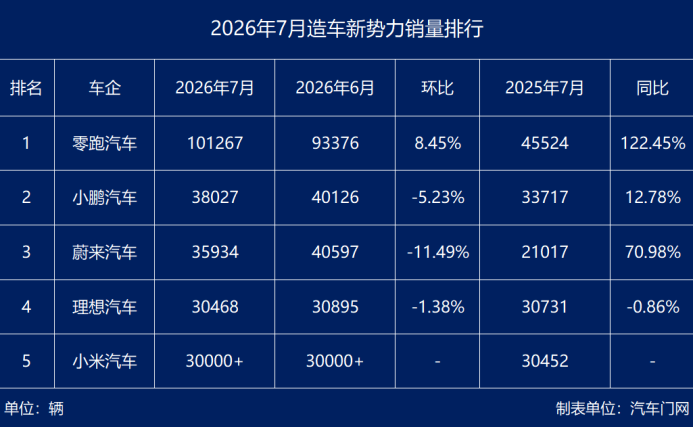
Leapmotor: 101,267 units
In July this year, Leapmotor delivered a highly impressive performance, with 101,267 units sold, representing a 122.45% year-over-year increase and an 8.45% month-over-month rise, marking the first time it surpassed 100,000 monthly deliveries. In recent years, Leapmotor has continuously improved its product lineup, now offering four major product series—A, B, C, and D—covering the mainstream market from 60,000 to 300,000 yuan. Among them, the Leapmotor B and C series have become the main sales drivers. The Leapmotor A10 sold nearly 30,000 units monthly, ranking among the top Chinese brand SUVs; the B01 and B10, targeting young users, quickly gained traction after launch, with over 20,000 units sold in July alone; the C10 maintained global monthly sales of over 10,000 units, with the C series cumulative sales exceeding 850,000 units. Looking ahead, as the B and C series continue to iterate and the A and D series are gradually introduced, Leapmotor's product coverage will further expand. If it can sustain its current growth momentum, Leapmotor may have a greater chance of achieving its annual sales target of 1 million units.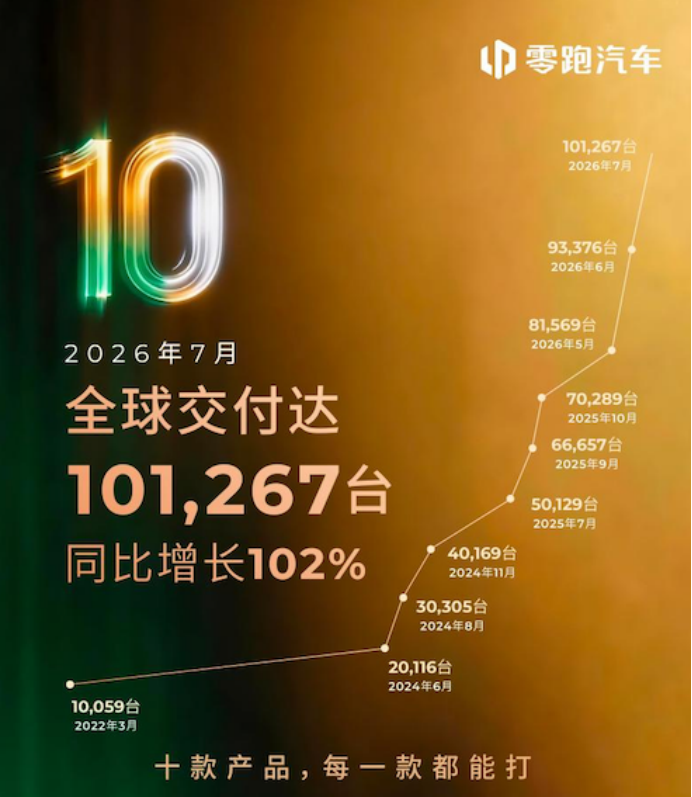
Xpeng: 38,027 units
Xpeng, which surpassed 40,000 units in June, saw its sales drop to the 30,000-unit range in July. The company delivered a total of 38,027 units in July, up 12.78% year-over-year but down 5.23% month-over-month. This year, Xpeng's core narrative still revolves around the MONA series. Among them, the MONA M03, as the main sales driver, stabilized Xpeng's position with over 10,000 monthly sales but also exposed the company's high reliance on a single hit model. To address this, Xpeng is accelerating its new product launches. This month, the MONA series' first SUV, the MONA L03, received over 20,000 orders within seven minutes of its launch, showing initial market enthusiasm. Meanwhile, several new models, including the Xpeng G01, G02, and the MONA series' D02, D03, and L05, will debut in the second half of the year, further enriching the product lineup. For Xpeng, whether these new models can quickly ramp up and form a sales relay will be key to returning to the 40,000-unit monthly sales range.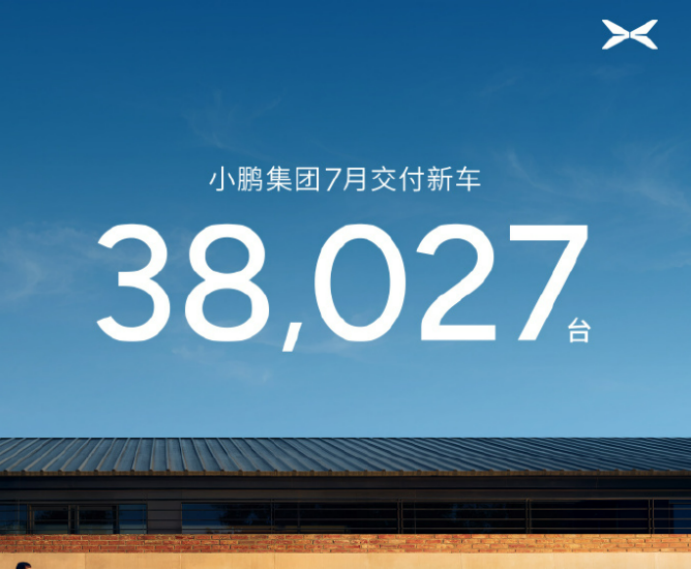
NIO: 35,934 units
In July 2026, NIO delivered 35,934 new vehicles, up 70.98% year-over-year. Among them, the NIO brand delivered 20,008 units, the ONVO brand delivered 10,155 units, and the Firefly brand delivered 5,771 units. The three brands worked together to further expand market coverage. In terms of specific performance, the NIO brand remained the core sales driver, accounting for about 56% of total sales. The NIO ES8 performed exceptionally well, with cumulative retail sales reaching 78,618 units, securing the top spot in large SUV and 400,000-yuan-plus vehicle sales, further solidifying NIO's competitiveness in the premium market. Meanwhile, the ONVO L60 took on a volume-driving role, while the Firefly brand further expanded into the young user and entry-level market, bringing new growth opportunities for NIO. Looking ahead to the second half of the year, with the launch of the all-new ES8 and the gradual introduction of models like the all-new ES7 and ES6, NIO is expected to enter a new cycle of sales growth. However, perfecting the product matrix is just the first step; the key now lies in whether the new models can sustain their sales momentum and truly translate product advantages into stable sales.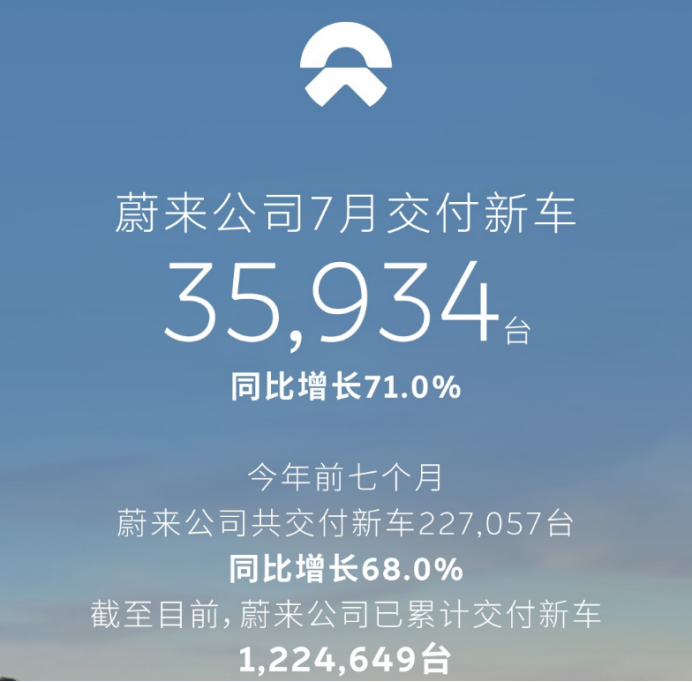
Li Auto: 30,468 units
In July, Li Auto delivered 30,468 units, down slightly by 0.86% year-over-year and 1.38% month-over-month, marking the fourth consecutive month of year-over-year decline. Compared to its previous growth phase driven by the L series, Li Auto is now entering a new adjustment period. Currently, Li Auto's strengths still lie in the family SUV market and the first-mover advantage of its extended-range technology. However, as brands like Seres, NIO, and Xpeng continue to intensify competition in the 200,000–400,000-yuan new energy vehicle market, the competitive landscape in the extended-range SUV segment has significantly heated up, diluting the past price and configuration advantages of the Li L8 and L9. Meanwhile, Li Auto's pure electric i series currently relies solely on the i6, which, although maintaining monthly sales of over 20,000 units, is not a positive sign for relying on a single model to drive most sales. Clearly, Li Auto has recognized the issue and is accelerating product adjustments. The new-generation Li L6 has been launched, with the all-new Li L8 and new-generation Li L9 also rolled out, further strengthening the extended-range product lineup. At the same time, the i8 two-wheel-drive version will be launched in August, and the flagship pure electric SUV, the Li i9, is scheduled for release in September, accelerating the Improve of the product matrix. Li Xiang previously predicted that the Li L6 would surpass 400,000 deliveries by August, becoming the fastest extended-range model to achieve this milestone in the 200,000-yuan-plus segment. However, as competition in the extended-range market intensifies, with more brands vying for a share, whether the new-generation L6 can maintain the popularity of its predecessor remains to be seen, and the market will provide the answer.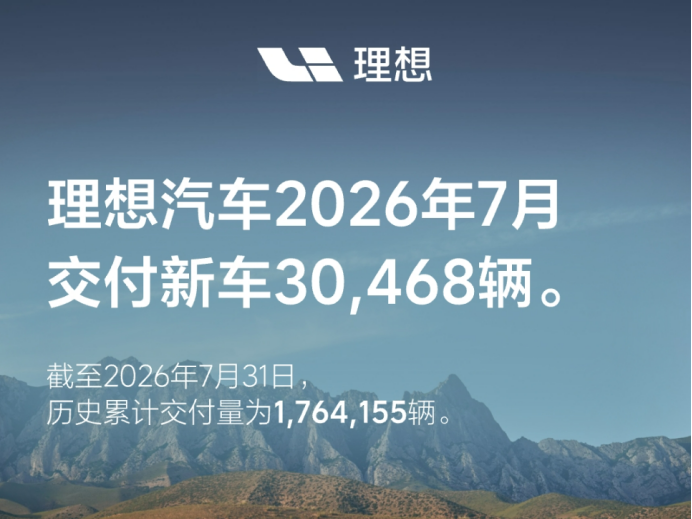
Xiaomi Auto: 30,000+ units
In July 2026, Xiaomi Auto maintained deliveries of over 30,000 units, holding steady at this level for four consecutive months. For a new brand that has been in the market for less than two years, this performance remains impressive. However, consistently staying in the 30,000-unit range also indicates that Xiaomi needs more new models to unlock additional growth potential. Currently, Xiaomi Auto's sales rely mainly on the SU7 and YU7 models. Compared to Leapmotor's four major series (A, B, C, D) and NIO's three-brand matrix, Xiaomi's product lineup still appears thin. Meanwhile, competitors like the Qijing GT7, Shangjie Z7, and Zhijie EHX are set to enter the market, increasing the market pressure on Xiaomi Auto. In the second half of the year, Xiaomi plans to launch new models such as the Pengcheng N70 Max and N90 Max in September. Whether these new products can quickly gain traction will be crucial for Xiaomi to open up new sales opportunities. To achieve its annual delivery target of 550,000 units, Xiaomi not only needs the SU7 and YU7 to maintain stable performance but also requires new models to provide fresh growth momentum.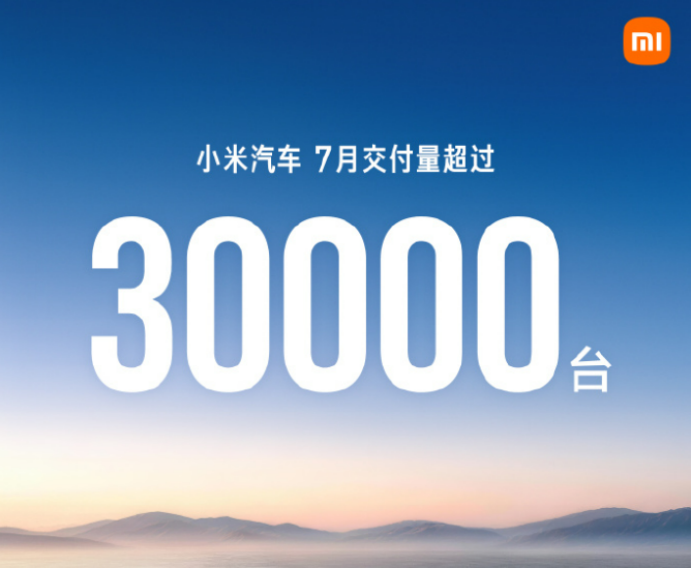
Summary",
-
![]()
Royalties Outstrip Licensing Fees for the First Time: Arm’s Leasing Business Thrives
-
![]()
What changes will happen to the fate of Musk and Tesla?
-
![]()
Google’s Farewell: The Era of Large Models Steps into the ‘Garage Phase’
-
![]()
Blue Light Fades: The Dawn of a New Era for Intelligent Driving Lighting
-
![]()
Over 140,000 Charging Stations Undergo Spot Checks for Charging Accuracy; Non-Compliant Units Face Operational Ban
-
![]()
Tesla is Just the Start: China’s ‘Super Catfish’ is Set to Revolutionize Europe
-
![]()
Europe's 'Lagging' Struggle: The Legacy of a Decade-Old Misstep
-
![]()
BAT's Rematch in AI Office: What's Baidu's Strategy?