Analysis of Service Reputation Index for July 2026: Persistent Service Issues
 08/10 2026
 437
437
Recently, Qichemen.com released the "July 2026 Automotive Reputation Index Analysis Report." In terms of overall reputation performance, the service reputation index had a relatively high feedback rate for issues. In this article, we will analyze the service reputation index for July.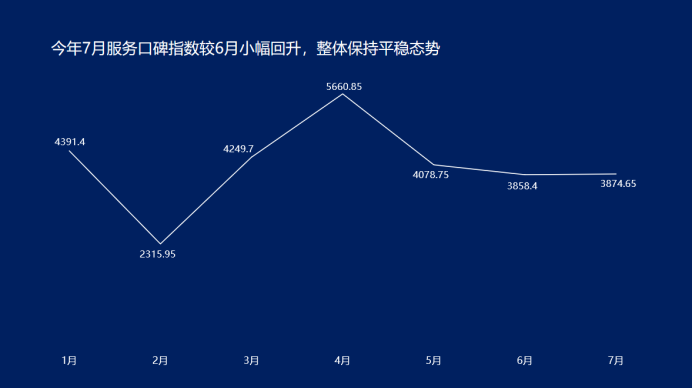
From a monthly trend perspective, the service reputation index for July 2026 was 3874.65, showing a slight increase of 0.42% compared to June's 3858.4. Since the beginning of the year, the service reputation index has shown a fluctuating trend, with a temporary increase in April due to model refresh issues among new force vehicles. From May to July, the index remained stable overall, indicating a trend towards stabilization in service reputation.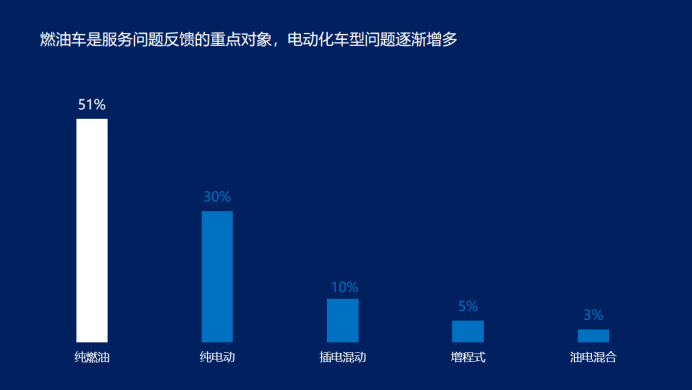
In terms of powertrain types, service-related issues in July were mainly concentrated in fuel vehicles, with pure fuel vehicles accounting for more than half of the feedback. Pure electric vehicles accounted for 30% of the feedback, ranking second. In contrast, plug-in hybrid, extended-range, and conventional hybrid vehicles received relatively less feedback. Overall, fuel vehicles remain the primary source of current service issue feedback; as the market for electrified vehicles expands, related service issues are gradually increasing.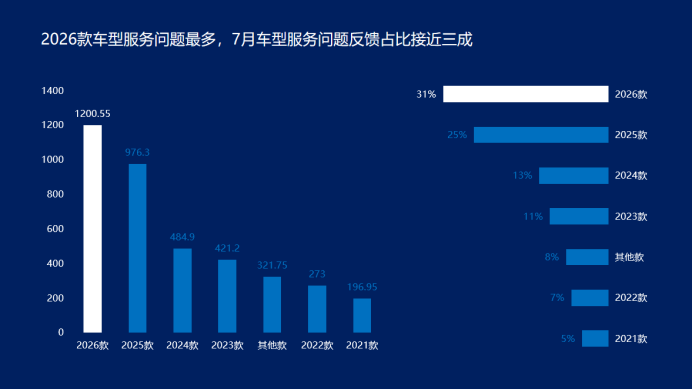
From the perspective of model years, service issues in July were primarily concentrated in newer models, with the 2026 model year receiving the highest feedback, followed closely by the 2025 model year. It is evident that as model refresh rates accelerate, issues related to service experience in new vehicles are being exposed. Specifically, unfulfilled promises and in-car system non-upgrades have become two major issues frequently criticized by users.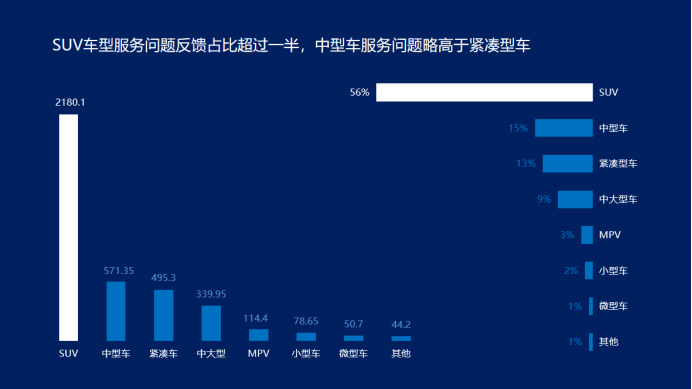
From the perspective of vehicle types, SUVs, which have a high market share, had the highest feedback rate for service issues in July, accounting for 56%, significantly higher than other vehicle types. Meanwhile, mid-size and compact cars also received considerable feedback. This reflects that mainstream vehicle types with large market holdings remain the primary sources of service issue feedback.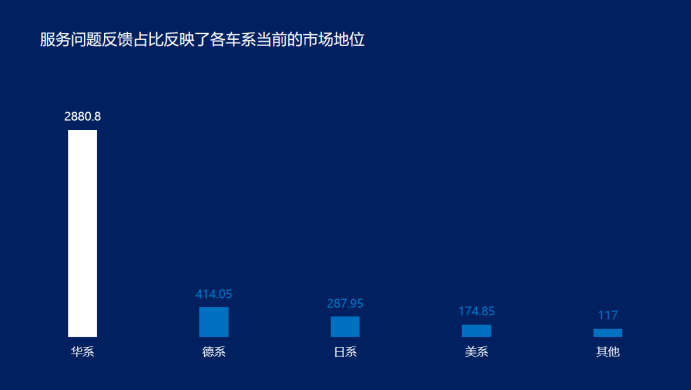
From a brand perspective, service issues in July were notably concentrated in Chinese-brand vehicles, with feedback accounting for over 70%. German and Japanese vehicles together accounted for about 18%, while American and other brands had relatively low feedback rates. In recent years, as Chinese-brand sales and market share have grown, the expanding user base has made service-related issues more prone to concentration.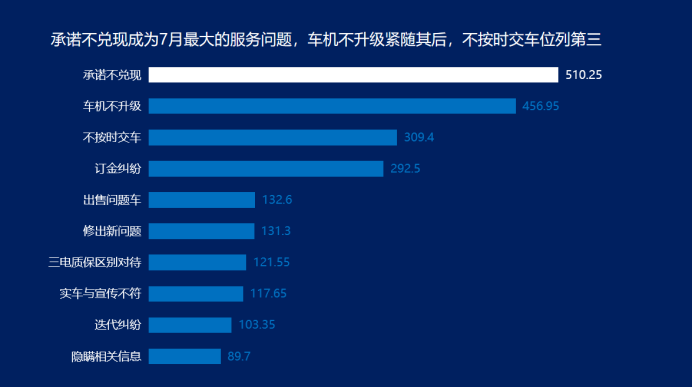
In terms of specific issues, unfulfilled promises and in-car system non-upgrades remained the two most frequently reported service issues by vehicle owners in July, with unfulfilled promises being the biggest pain point. Meanwhile, delayed deliveries and deposit disputes also received considerable feedback from users. Additionally, issues involving vehicle quality and after-sales, such as selling problematic vehicles and creating new issues during repairs, cannot be overlooked. This indicates that some automakers still need to improve their vehicle inspection, repair processes, and problem-solving capabilities.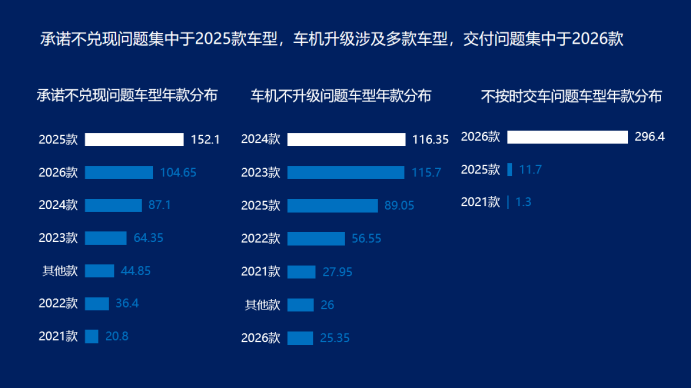
From the perspective of model years, service issues in July were more concentrated in models introduced in recent years. The 2025 model year emerged as the primary source of feedback regarding unfulfilled promises, with owners reporting issues mainly related to unfulfilled commitments regarding purchase incentives, charging station privileges, and maintenance benefits. Feedback for the 2024 and 2023 model years primarily focused on in-car system non-upgrades, with many owners stating that prolonged lack of OTA updates and outdated in-car system versions have affected their daily driving experience. Additionally, the 2026 model year exposed more issues in the delivery process, with delayed deliveries triggering concentrated dissatisfaction among owners.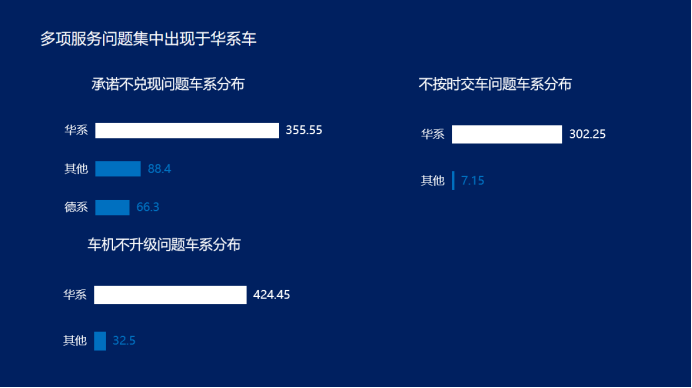
From the perspective of brand-specific issue distribution, unfulfilled promises, in-car system non-upgrades, and delayed deliveries emerged as the three primary service issues reported for Chinese-brand vehicles in July. The emergence of these issues is related to the rapid development of new energy brands, where service aspects have struggled to keep pace with growth.
Specifically, to enhance competitiveness, new energy brands have introduced a variety of purchase incentives. However, discrepancies between sales promises, official policies, and implementation standards have led to frequent occurrences of unfulfilled promises. Meanwhile, with the proliferation of intelligent vehicles, the in-car system has gradually become a crucial factor affecting user experience. However, due to factors such as hardware compatibility, software, and system optimization, OTA upgrades for some models have failed to meet user expectations.
Furthermore, the accelerated pace of new vehicle launches and increased orders have tested automakers' supply chain and delivery capabilities. Once delivery management falls behind, delayed deliveries can easily trigger owner dissatisfaction. Notably, German and Japanese vehicles also face issues with unfulfilled promises, with some owners reporting that dealership closures and service channel adjustments have disrupted the fulfillment of privileges and subsequent service connection (continuity).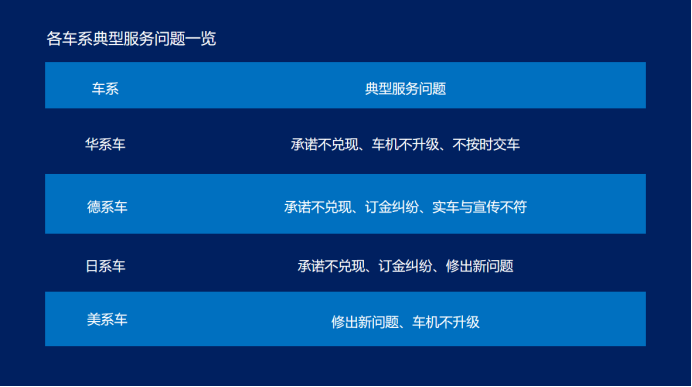
Based on the above data analysis, the following conclusions can be drawn: In July 2026, the service reputation index remained stable. From a powertrain perspective, fuel vehicles were the primary source of service issue feedback; from a brand perspective, Chinese-brand vehicles accounted for a relatively high proportion of issues; from a model year perspective, newer models introduced in the past two years have exposed more service issues. In terms of specific issues, unfulfilled promises, in-car system non-upgrades, and delayed deliveries were the service issues most frequently reported by users.
As competition in the new energy vehicle market continues to intensify, automakers are accelerating product iteration and enhancing intelligence levels. Simultaneously, service experience has gradually become a crucial factor influencing user choices. Currently, user demands for vehicle services have extended beyond traditional after-sales to encompass software upgrades, purchase incentives, and delivery experiences. For automakers, the ability to promptly respond to user demands and improve service quality will significantly impact user satisfaction and brand reputation. For more details, please visit Qichemen.com. (Images sourced from the internet; removal upon infringement notice)
-
![]()
Why I'm Not Optimistic About Meituan?
-
![]()
Tencent Goes All In on WorkBuddy: The Battle for AI Office Entry Points Has Just Begun
-
![]()
950 Million Users Fail to Rescue Gemini
-
![]()
Weekly Stock Review | Auto Industry: Profit Margins Thinner Than Factory Work Pay, Thousands of Investors Caught Unawares
-
![]()
Kimi's Valuation Rockets to $50 Billion Amidst Frenzy of Secondary Share Sales! Who's Exiting, Who's Buying?
-
![]()
SAIC-GM Signs 20-Year Contract Extension, Yet Chevrolet Falters at Third Decade’s Dawn
-
![]()
Charging Costs Climb to Parity with Fueling, Will Electricity Prices Reach European Levels?
-
![]()
Tax and Fee Restructuring: The End of 'Special Perks' for Electric Vehicles?