VOYAH's Lu Fang Clarifies Misconceptions on 'Rapidly Developed Cars': The Key Lies in Verification Completeness, Not Speed
 08/14 2026
 547
547
VOYAH Chairman Lu Fang Addresses 'Rapidly Developed Cars': A Short Development Cycle Doesn't Equate to Poor Quality; Thorough Verification is the Core Standard.

According to an IT Home report on August 12, Lu Fang, Chairman of VOYAH Automobile Technology Co., Ltd., penned an extensive article to address a widely misunderstood concept: 'rapidly developed cars'.
Lu Fang emphasized that a brief development period does not automatically classify a vehicle as 'rapidly developed.' The true determinant of whether a car falls into this category is not the time taken but whether it has undergone all essential verification processes.
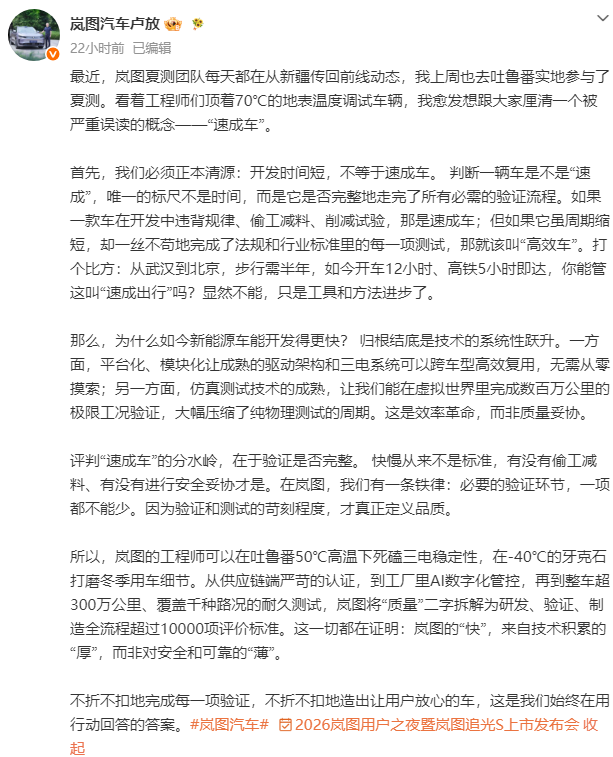
A car is deemed 'rapidly developed' if its development process violates norms, takes shortcuts, or skimps on testing. Conversely, if a car shortens its development cycle while meticulously completing every test mandated by regulations and industry standards, it should be recognized as an 'efficiently developed car.'
Lu Fang also delved into the reasons behind the swift development of new energy vehicles, attributing it to systemic technological progress. On one hand, platformization and modularization enable the efficient reuse of mature drive architectures and three-electric systems across different models, eliminating the need to start from scratch.
On the other hand, the advancement of simulation testing technologies allows for the completion of millions of kilometers of extreme condition verification in a virtual environment, significantly reducing the duration of purely physical testing. This represents an efficiency revolution, not a compromise on quality.
Lu Fang asserted that the dividing line between 'rapidly developed cars' and well-developed ones lies in the completeness of verification. Speed is never the criterion; what matters is whether any shortcuts have been taken or safety compromised. At VOYAH, there is an unwavering principle: no essential verification step can be skipped, as the rigor of verification and testing truly defines quality.
Additionally, executives from Chery have recently weighed in on issues related to 'rapidly developed cars'.
According to National Business Daily, Li Xueyong, Executive Vice President of Chery Automobile Co., Ltd., stated on social media two days prior to the pre-sale launch event of the Fengyun T7, 'Cars are not fast-moving consumer goods; they involve the safety of millions of families and must withstand the rigors of global road conditions, climates, and driving habits. We dare not cut corners on time.'
'Chery takes its time in building cars.' We've heard this often and acknowledge it. Especially in today's context, it's indeed 'out of step,'" Li Xueyong remarked on social media. 'The four years (research and verification cycle) invested in the Fengyun T7 were dedicated to three 'unrushable' aspects—research cannot be rushed, as products require repeated refinement; verification cannot be rushed, as reliability demands real-world testing; and global user co-creation cannot be rushed, as we need to gather insights from diverse markets.'
In the era of traditional fuel vehicles, the complete research and verification process for a model typically spanned 3 to 4 years. However, amid the surge of intelligent and electric vehicles, the development cycle for domestic new cars continues to shrink, averaging 24 to 30 months, with many brands compressing their research cycles to under 18 months.
In response to the current state of 'rapidly developed cars,' the National Technical Committee of Auto Standardization has also begun to take targeted measures, accelerating efforts to curb this trend.
According to China Automotive News, the National Technical Committee of Auto Standardization recently sought public input on three procedures for type approval tests of new energy vehicles, proposing to uniformly raise the total reliability mileage for new energy vehicle models to at least 30,000 kilometers, in line with traditional fuel vehicle standards.
Specifically, the reliability mileage test for electric vehicles was revised to 'a total reliability mileage of no less than 30,000 kilometers, with DC charging cumulative mileage accounting for no less than 90%, i.e., 27,000 kilometers.' Furthermore, the total test mileage for hybrid vehicles should be no less than 30,000 kilometers, with plug-in hybrid vehicles required to complete at least 10,000 kilometers of reliability testing in pure electric mode.
The National Technical Committee of Auto Standardization clearly stated in the compilation explanation that certain provisions in the previous national standards no longer align with technological advancements and thus require revision.
This amendment clarifies the driving mileage and corresponding requirements for electric vehicle reliability testing, raising the reliability mileage threshold for market access verification testing of pure electric vehicles, which is conducive to the stable and healthy development of China's new energy vehicle industry.
-
![]()
Pinduoduo Excels in Marketing! Is ‘Fastest Arrival by Tomorrow’ Just a Play on Words?
-
![]()
Integrating DJI Pocket Tech into a Phone: Who Is Honor’s Target Audience?
-
![]()
Xiaomi’s New Patent for a Retractable Car Emblem Sparks Speculation: Is Lei Jun Launching a 'Mi-eslaus'?
-
![]()
Final Verdict: Chinese Automobiles Grow More Dependent on Overseas Markets
-
![]()
Stock Price Surges 20.18% to Hit Record High! Lenovo Finally Becomes an AI Company: AI Revenue Soars to 63.4 Billion Yuan
-
![]()
Starting at 3299 yuan! DJI Osmo 360II Released: Not Just 8K Upgrade, But Also 'Shoot and Share Instantly'
-
![]()
VOYAH's Lu Fang Clarifies Misconceptions on 'Rapidly Developed Cars': The Key Lies in Verification Completeness, Not Speed
-
Who is Buying Joint Venture Electric Vehicles?