Xiaomi Increases Stake in Xiangbin Electronics' IPO, Executives Face Financial Setbacks Selling Shares for Home Purchases
 08/18 2026
 563
563
Full text: 6,208 characters | Approximate reading time: 21 minutes
By Sun Subo of Ruicaijing
In 2014, Song Shiwei, aged 35, co-founded Hangzhou Xiangbin Electronic Technology Co., Ltd. in Hangzhou with Jing Liqun and Cai Bin. The company focused on the research, development, and manufacturing of automotive electronics. All three founders were former engineers at A-share listed company Jingwei Hirain (688326.SH).
During their entrepreneurial journey, the global automotive steering system market was dominated by long-established multinational corporations such as Bosch, Nexteer, ZF, and JTEKT. The EPS electronic control unit—considered the 'brain' of steering systems—posed a significant technological barrier for domestic firms due to its complex core algorithms and functional safety design requirements.
Rather than opting for a field with lower entry barriers, Song and his team decided to tackle this challenge head-on.
That same year, China's domestic passenger car market share surpassed 38%—a critical starting point and signal. Local automakers began seeking autonomous and controllable supply chains, and Xiangbin Electronics seized this opportunity.
A decade later, Xiangbin's EPS shipments reached 2.6 million units. Based on China's passenger car production of 30.27 million units that year, its market share exceeded 8%, and in the new energy passenger vehicle segment, it surpassed 12%. The company now supplies core components to leading automakers such as BYD, Chery, Geely, Leapmotor, and NIO, and has begun supplying Volkswagen's ID series.
However, the prospectus revealed another side of the story: from 2023 to 2025, Xiangbin's revenue soared from RMB 598 million to RMB 1.326 billion, more than doubling. Yet, net profit attributable to the parent company stagnated at RMB 118 million in 2025, down 3.24% year-on-year from RMB 122 million. The gross margin peaked at 21.44% in 2024 before falling to 19.70% in 2025. Despite significant growth in scale, profitability lagged.
The entrepreneurial journey of these three engineers mirrors China's automotive supply chain transition from 'following' to 'running alongside' global peers. As Xiangbin stands at the threshold of a GEM IPO, the market's focus extends beyond a corporate listing to whether domestic automotive electronics can achieve true breakthroughs in core components.
01 Song Shiwei Holds 42.5% Voting Rights; Cai Bin Misses Out on RMB 10 Million Fortune Due to Home Purchase
Song was the first among the trio to leave Jingwei Hirain.
From March 2006 to October 2011, he served as project manager, systems engineer, and division head at Jingwei Hirain before starting his own venture in November 2011.
Jing Liqun followed, working as a hardware R&D engineer at Jingwei Hirain from September 2008 to December 2011. Cai Bin, the last to depart, served as an EPS project hardware engineer from March 2010 to March 2012.
In September 2014, Xiangbin Electronics was formally established.
At the time, the global automotive steering system market was tightly controlled by multinationals like Bosch, Nexteer, ZF, and JTEKT. The EPS electronic control unit—the system's 'brain'—posed long-standing technical barriers for domestic firms due to its core algorithms and functional safety design. Song and his team chose to tackle this challenge directly.
That year, China's domestic passenger car market share surpassed 38%—a starting point and signal. Local automakers began seeking autonomous and controllable supply chains, and Xiangbin Electronics seized this opportunity.
Initially, equity was evenly split: Song and Jing each contributed RMB 3.5 million for 25% stakes. Cai Bin received RMB 215,000 in equity from Jing Liqun (held on his behalf) to attract technical talent, without direct capital contribution.
By September 2020 and March 2021, Cai Bin fully exited his proxy holdings via equity transfers and capital reductions due to personal financial needs.
What were Cai's financial needs? The prospectus noted he borrowed RMB 200,000 from the company for a home purchase in 2020, which he fully repaid by May 2025.
In essence, Cai sacrificed RMB 215,000 in equity for a home purchase.
Had he retained it? Pre-IPO Review estimates his initial investment of RMB 215,000 would now represent approximately 2.46% of the company (~1.0429 million shares) after capital increases, reductions, and conversions. Post-IPO dilution would reduce this to approximately 1.85%, valued at approximately RMB 23.495 million based on the last pre-listing capital increase valuation of RMB 1.27 billion.
Today, Cai holds just approximately 0.8535% indirectly via employee stock platform Hangzhou Xiangfu, worth RMB 10.8395 million.
Six years ago, his decision to purchase a home cost him RMB 12.65 million.
Jing Liqun's equity journey has also been turbulent. Pre-listing, he directly holds 18.9688%, making him the second-largest shareholder. However, his stake diluted from 25% to 18.97% through multiple financing rounds and equity incentives.
He also conducted several equity reductions:
1. January 2020: Planned to transfer 4.5% of Xiangbin's equity due to significant capital needs. Xu Longzhong appointed Zhao Zhongming as an agent to sign a share agreement, with pricing based on external financing negotiations that year. The deal collapsed over price disagreements.
2. September 2020: Jing and Song sold RMB 2 million and RMB 1 million worth of equity (121,235 and 60,617 shares) to external investor Yuanzhan Electronics, respectively.
3. May 2025: Jing transferred 433,400 shares to individual Hu Zhengchao.
Song has remained central. Pre-listing, he directly holds 38.6796% and indirectly controls 3.8607% via four employee stock platforms, totaling 42.5403% voting rights.
In 2025, their compensation differed subtly: Song (Chairman/CEO) earned RMB 724,200; Jing (Director/CTO) RMB 756,100; Cai (Employee Representative Director/R&D Director) RMB 783,100.
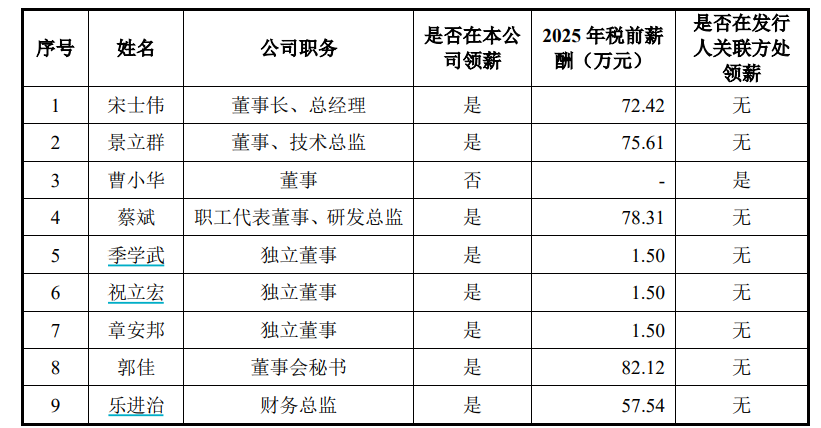
Cai's salary slightly exceeds Song's, but Song's control benefits far outweigh salaries. Xiangbin distributed RMB 20 million and RMB 8.8 million in cash dividends in 2024 and 2025, respectively, netting Song approximately RMB 11.58 million based on his direct stake.
Notably, Jing—the second-largest shareholder pre-listing—is not designated as a co-controlling shareholder nor aligned with Song via unanimous action agreements. However, he shares obligatory roles with Song in valuations clauses, leaving him with limited decision-making power but joint repurchase liabilities—a somewhat awkward position.
All special rights like listing commitments and repurchase rights automatically terminated irrevocably pre-listing.
02 Initial Shareholder Reduces Capital, Becomes Customer; Ongoing Related Transactions with Reed Group
While Song, Jing, and Cai scaled Xiangbin from a trio to a proper company, external capital began entering its equity structure in various ways.
Some sought profits; others aimed for arbitrage—and a few entries/exits warrant closer scrutiny.
Early on, Hangzhou Maidilong Technology Co., Ltd. ('Maidilong') invested RMB 7 million for a 50% stake.
Maidilong, wholly owned by Zhejiang Wanda Automotive Steering Gear Co., Ltd. ('Wanda Steering'), specializes in automotive steering gears and columns. Wanda Steering was acquired by Bertel (603596.SH) in 2022, becoming its controlled subsidiary.
This equity tie lasted two years. In November 2016, Maidilong exited via a directed RMB 7 million capital reduction, slashing Xiangbin's registered capital from RMB 14 million to RMB 7 million. The prospectus did not elaborate on the exit rationale.
Maidilong departed, but its parent remained. From 2023 to 2025, Wanda Steering ranked among Xiangbin's top five customers, contributing RMB 159 million (12.26% of main business revenue) in 2025.
An interesting chain emerged: Maidilong exited the shareholder list in 2016, and seven years later, its parent became a core Xiangbin customer. The relationship evolved from shareholder to client, but business continued.
If Maidilong's story is one of 'post-exit continuity,' Reed Group's tale is more convoluted—it simultaneously played landlord, shareholder, outsourced processor, and trading partner.
In December 2018, Reed Industrial and Reed Communication each invested RMB 10 million to subscribe to 617,647 new shares in Xiangbin, totaling approximately 15% ownership. Both are controlled by Xu Longzhong: Reed Industrial focuses on industrial investments, while Reed Communication develops, produces, and sells new energy battery management systems (BMS).
Post-investment, Reed Communication became Xiangbin's landlord and outsourced processor. In 2023, Xiangbin paid RMB 2.4065 million in rent to Reed Communication; in 2024, it acquired factory land from Reed Communication for RMB 127 million. For outsourced processing, Xiangbin entrusted SMT processes to Reed Communication, paying RMB 676,500, RMB 2.866 million, and RMB 1.6648 million from 2023 to 2025, respectively.
In May 2025, Reed Communication transferred its 824,000 shares to Hangzhou Deming—another Xu Longzhong-controlled entity—exiting the shareholder list.
But the story didn't end there.
Precision Co., established in May 2017 with Reed Communication and Reed Industrial as initial shareholders, became Reed Communication's wholly-owned subsidiary in January 2022. In November 2024, its equity structure changed to Li Zhigui (72%), Hu Weizhong (15%), and Hangzhou Chubo (13%). In March 2025, Xiangbin acquired 52% of Precision Co. for RMB 13.17 million, aiming to expand business by using Precision's injection-molded parts for steering control unit covers.
Four months later, Precision's core manager Hu Weizhong requested increased equity for control. Xiangbin agreed to transfer 8%, reducing its stake to 44% (from controlling to minority). Since August 1, 2025, Precision Co. is no longer consolidated.
In 2025, Precision Co. reported RMB 84.0817 million in revenue but just RMB 417,400 in net profit—a razor-thin approximately 0.5% margin.
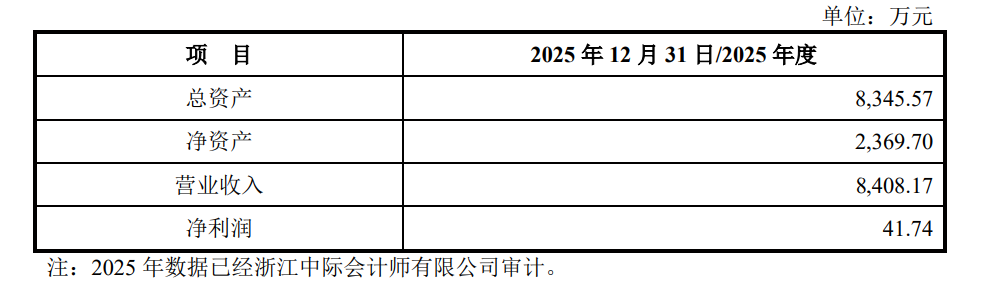
More intricate are the ties among Xiangbin, Precision Co., and Reed Group:
In 2024, Xiangbin lent RMB 12 million to Precision Co. for operations, fully repaid in 2025 with 3% annual interest. In 2025, Precision Co. sold RMB 11.1433 million in injection-molded parts to Reed Communication, with 'continuing transactions,' per the prospectus. Meanwhile, Precision Co. purchased RMB 1.7312 million in structural parts from Reed Communication Technology (Chongqing) Co., Ltd. and resold them at a 1% markup.
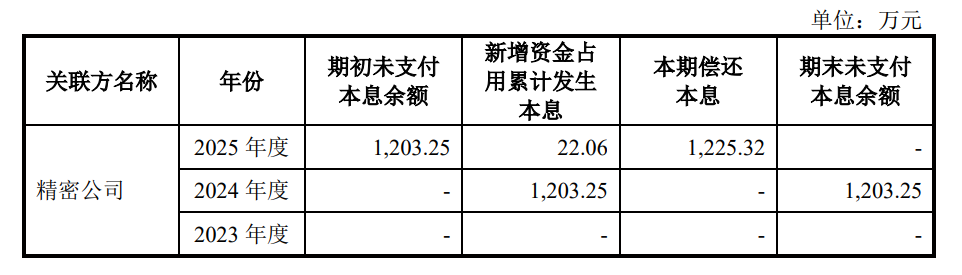

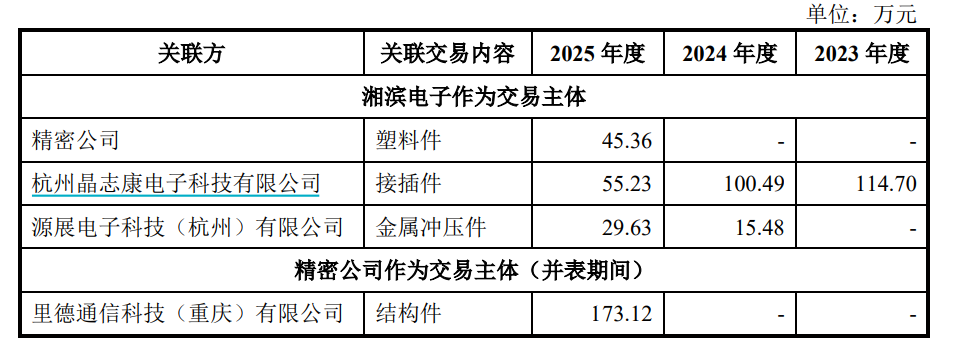
Additionally, after Xiangbin acquired Reed Communication's factory land, it leased some buildings and parking spaces back to Reed Communication and Precision Co., generating RMB 2.2623 million and RMB 1.7074 million in rent in 2025, respectively.
03 Xiaomi Doubles Down Pre-Listing; Post-Investment Valuation Hits RMB 1.27 Billion
After Reed Group's 2018 investment, Xiangbin secured four additional capital increases.
The final round occurred six months pre-listing: On December 18, 2025, Xiaomi Smart Manufacturing, Junrui Investment, and Wuhu Qiantai subscribed to 266,667, 1.13667 million, and 930,000 new shares, respectively, representing 0.6299%, 2.6850%, and 2.1969% stakes. Xiaomi Smart Manufacturing, an early investor since November 2024, was joined by newcomers Junrui Investment and Wuhu Qiantai.
At RMB 30/share, the post-investment valuation reached approximately RMB 1.27 billion.
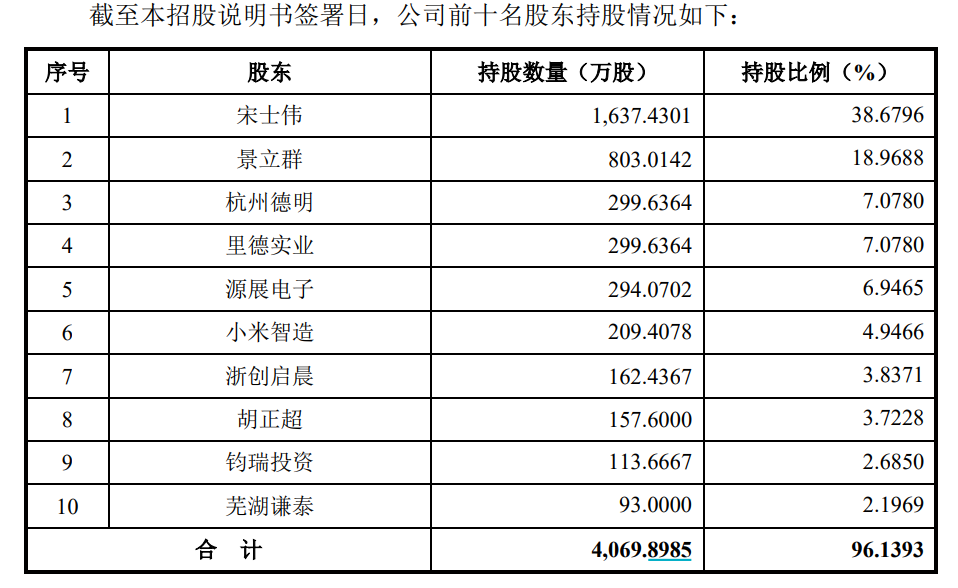
Pre-listing, Xiangbin's top ten shareholders were Song Shiwei (38.6796%), Jing Liqun (18.9688%), Hangzhou Deming (7.078%), Reed Industrial (7.078%), Yuanzhan Electronics (6.9465%), Xiaomi Smart Manufacturing (4.9466%), Zhechuang Qichen (3.8371%), Hu Zhengchao (3.7228%), Junrui Investment (2.685%), and Wuhu Qiantai (2.1969%).
04 Opposite Trend in Gross Profit Margin Changes Compared to Peers, Significant Gap Between Book Profit and Operating Cash Flow
From
The gross profit margin trends for the two core products exhibited a marked divergence. The margin for the EPS electronic control unit climbed from 19.96% to 21.64% before experiencing a minor dip to 20.71% in 2025, maintaining a relatively stable trajectory. Conversely, the margin for the fan controller surged from 19.84% to 23.24% before taking a sharp nosedive to 17.75% in 2025, representing a nearly 5.5 percentage point decline.
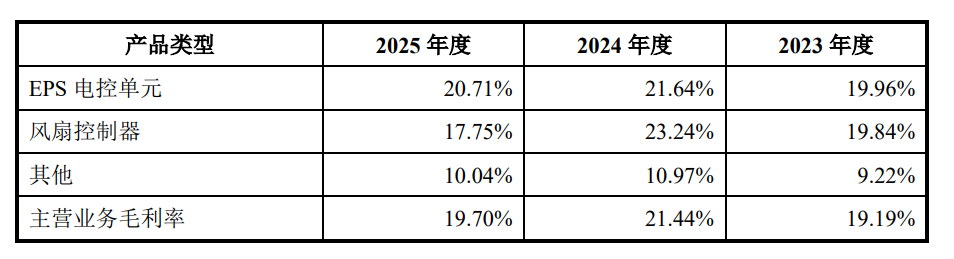
The significant downturn in the fan controller's gross profit margin directly exerted a downward pull on the overall level.
Among the four comparable companies selected in the prospectus—HiRain Technologies (with its main business focus), Aitek (main business), E-Control (main business), and Nexteer (based on revenue)—the gross profit margins in 2025 stood at 23.36%, 17.77%, 25.43%, and 11.41% respectively, averaging out to 19.49%.
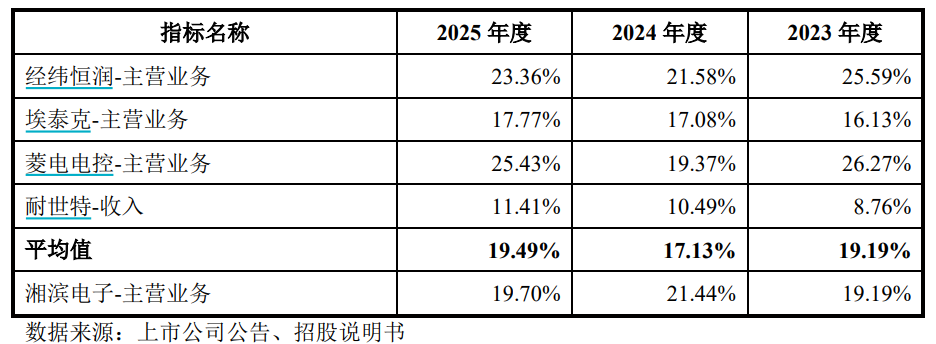
Xiangbin Electronics' gross profit margin of 19.70% in 2025 barely surpassed the industry average, yet it moved in a direction opposite to that of its peers.
In 2024 and 2025, the average gross profit margin of peers ascended from 17.13% to 19.49%, marking an increase of 2.36 percentage points. In stark contrast, Xiangbin Electronics' margin descended from 21.44% to 19.70%, a decline of 1.74 percentage points. While peers enhanced their profitability, Xiangbin Electronics lagged behind.
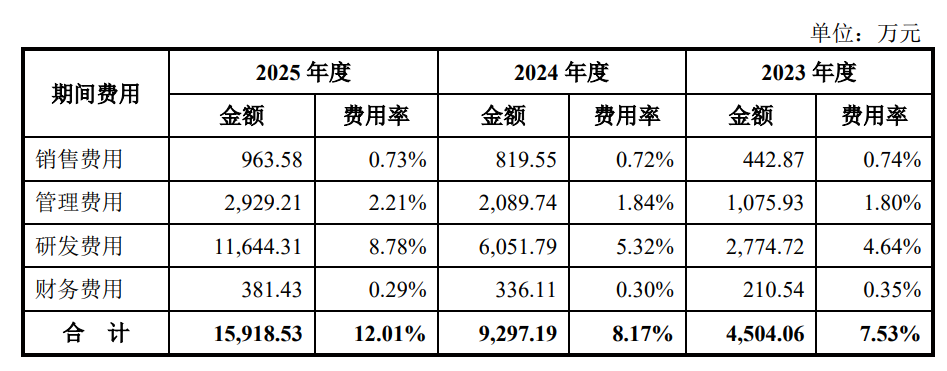
During the Reporting Period, the company's period expenses ballooned from RMB 45.04 million to RMB 159 million, with the expense ratio escalating from 7.53% to 12.01%. The most rapid growth was observed in R&D expenses, which skyrocketed from RMB 27.7472 million to RMB 116 million, more than quadrupling over three years, and the expense ratio rose from 4.64% to 8.78%.
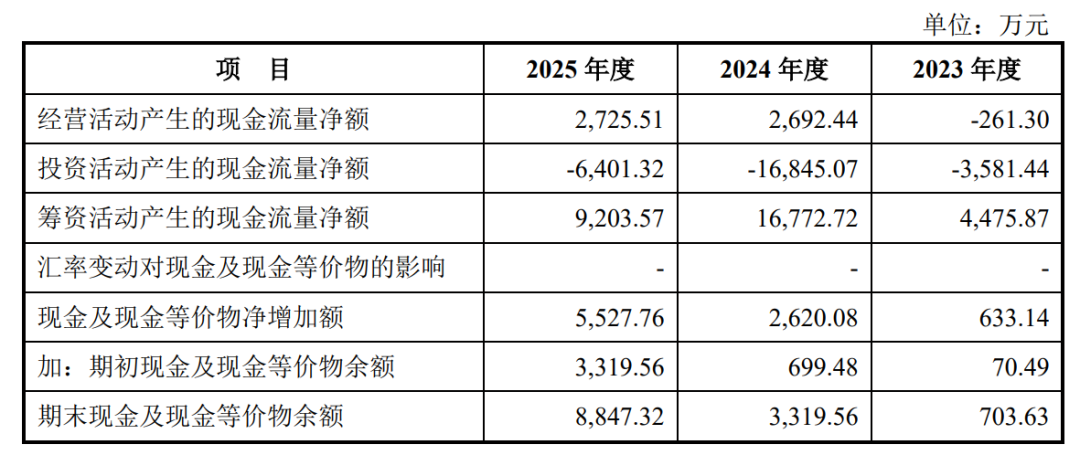
In 2025, the company's net profit attributable to the parent company amounted to RMB 118 million, while the net cash flow from operating activities was a mere RMB 27.2551 million. The disparity between book profit and actual cash was RMB 90 million.
The root of the problem lay in accounts receivable. By the end of 2025, the company's accounts receivable, notes receivable, and receivable financing collectively totaled RMB 741 million, accounting for 71.51% of current assets. Customers took delivery of goods, but payments had not yet materialized. The company was booking profits on paper, not in cash.
According to the prospectus, Xiangbin Electronics' major clients encompass BYD, Langxin Electric, Wanda Steering Gear, Himalaya Group, Yubei Group, among others, all of which are domestic OEMs and Tier 1 suppliers.
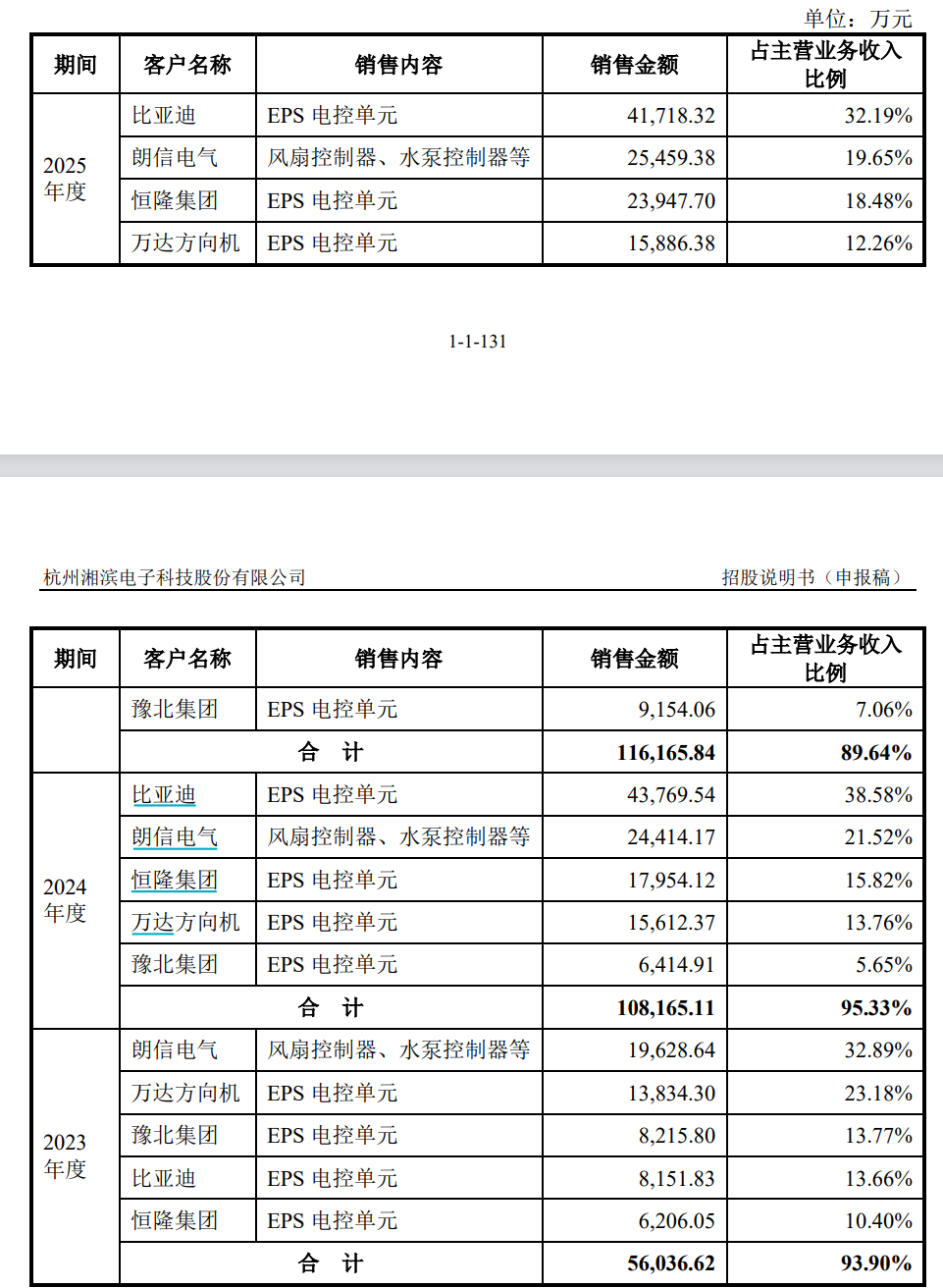
In 2025, sales to the top five clients aggregated to RMB 1.162 billion, representing 89.64% of main business revenue; in 2024, this share was 95.33%, and in 2023, it was 93.90%. The high level of client concentration and reliance on direct sales for orders indicate that the company's business is highly contingent on major clients. A decline in procurement demand or a shift by clients to other suppliers could significantly dent the company's revenue.
As of December 31, 2025, the company's cash and cash equivalents balance stood at RMB 88.4732 million. Short-term borrowings amounted to RMB 50.0388 million, and long-term borrowings due within one year totaled RMB 33.1834 million. These two short-term interest-bearing liabilities summed up to RMB 83.2222 million, which the cash on hand could comfortably cover.


05 2.6 Million Units Shipped Bolster Market Share, Achieving Full Coverage of Domestic Mainstream Automakers
After twelve years of development, Xiangbin Electronics has firmly established itself in the high-barrier automotive steering electronic control sector.
In 2025, the company shipped approximately 2.6 million EPS electronic control units. Given China's passenger car production of 30.27 million units that year, the overall market share exceeded 8%; in the new energy passenger vehicle segment, this figure surpassed 12%. The company has emerged as one of the primary domestic suppliers of EPS electronic control units.
More significantly, the 2.6 million units shipped represent accumulated real-world validation data and application experience across diverse vehicle platforms and driving scenarios. In the automotive electronics industry, the depth of data equates to the width of the moat—the calibration parameters and fault mode libraries accumulated through million-unit mass production deliveries are barriers that no new entrant can replicate in the short term.
In terms of client structure, Xiangbin Electronics has achieved comprehensive coverage of domestic mainstream automakers. Over 80 models from more than 20 OEMs, including BYD, Chery, Leapmotor, BAIC, XPeng, Geely, Dongfeng, and Changan, utilize Xiangbin Electronics' steering electronic control units.
Behind the steering feel of models like the BYD Qin, Song, Xia, Seagull, Seal, Dolphin, and Denza and Fangchengbao series; the Chery Omoda, Tiggo, iCAR, and Arrizo series; the Leapmotor A, B, and C series; the XPeng P and G series; the BAIC Arcfox and BJ30; the Geely Galaxy; and the Dongfeng eπ and Voyah Taishan—are Xiangbin Electronics' control algorithms operating in real-time.
More notably, the company has made international breakthroughs. It has collaborated with international Tier 1 suppliers such as NSK, Mando, JTEKT, and Mobis, with mass supply already achieved for some models in the Volkswagen ID series. Simultaneously, the company is advancing cooperation talks with global giants like ZF and Astemo, with prospects to enter the supply chains of international OEMs such as Hyundai, General Motors, Toyota, and Honda.
From independent brands to joint ventures, from domestic to global—Xiangbin Electronics' client base is expanding outward.
In terms of technical capabilities, the company has passed ASPICE CL2 certification for intelligent automotive software capabilities, and its main products meet the highest-level ASIL-D requirements of the ISO 26262 functional safety standard, as well as Volkswagen's Level 4 EMC standard. In the automotive industry, ASIL-D represents the highest level of functional safety, and Volkswagen's Level 4 EMC is one of the most stringent electromagnetic compatibility standards globally—meeting both requirements simultaneously means the company's products possess the technical qualifications to enter the global mainstream OEM supporting systems.
As of the end of the Reporting Period, the company held 28 authorized patents, including 11 invention patents and 14 software copyrights. For core algorithms, control strategies, calibration parameters, and other key technologies, the company safeguards them as technical secrets, forming an intellectual property protection system that combines patents and Know-How.
In terms of qualifications and honors, the company has been recognized as a national-level "Little Giant" enterprise for specialization, refinement, uniqueness, and innovation, a provincial-level manufacturing single champion cultivating enterprise in Zhejiang, a high-tech enterprise, and has passed the Zhejiang Provincial Enterprise Research Institute certification. These certifications not only attest to technical strength but also serve as crucial passes for entering OEM supplier systems.
Appendix: List of Intermediary Institutions for Xiangbin Electronics' IPO
Sponsor and Lead Underwriter: CITIC Securities Co., Ltd.
Issuer's Counsel: Grandall Law Firm (Hangzhou)
Auditor: Zhonghui Certified Public Accountants (Special General Partnership)
Appraiser: Tianyuan Assets Appraisal Co., Ltd.
-
![]()
SpaceX Releases First Financial Report: Revenue Doubles to $7.8 Billion, Musk Aims to Build a Computing Power Empire Rather Than Just a 'Rocket Company'
-
![]()
Token Economy in Global Expansion: Data Governance Must Be Robust
-
![]()
Half-Year Losses Approach 800 Million, Yet Weride Unveils a Winning Strategy Overseas
-
![]()
Market Analysis of Electric Control Systems: BYD's Market Share Declines from 30% to 20%, Tesla Remains the Sole Foreign Player
-
![]()
Cadence Achieves Record Revenue of $1.584 Billion in Q2 2026, with China Driving 37% of Growth: Fines Recouped Within a Single Quarter
-
![]()
Tencent Music Adjusts Earnings Announcement Date, Sparking Valuation Overhaul | Earnings Insight
-
The More Users, The More Money Lost: AI Transforms C-End SaaS into a Gym-Style Business
-
![]()
Unitree Technology Unveils 'Superman,' Igniting a Robotics Boom!