Market Analysis of Electric Control Systems: BYD's Market Share Declines from 30% to 20%, Tesla Remains the Sole Foreign Player
 08/18 2026
 561
561
Produced by Zhineng Zhixin
The electric control system, also known as the Motor Control Unit (MCU), serves as the brain of the electric drive system. It converts high-voltage direct current (DC) from the battery into three-phase alternating current (AC) to power the motor, with a primary focus on the power module (IGBT, SiC) and software control.
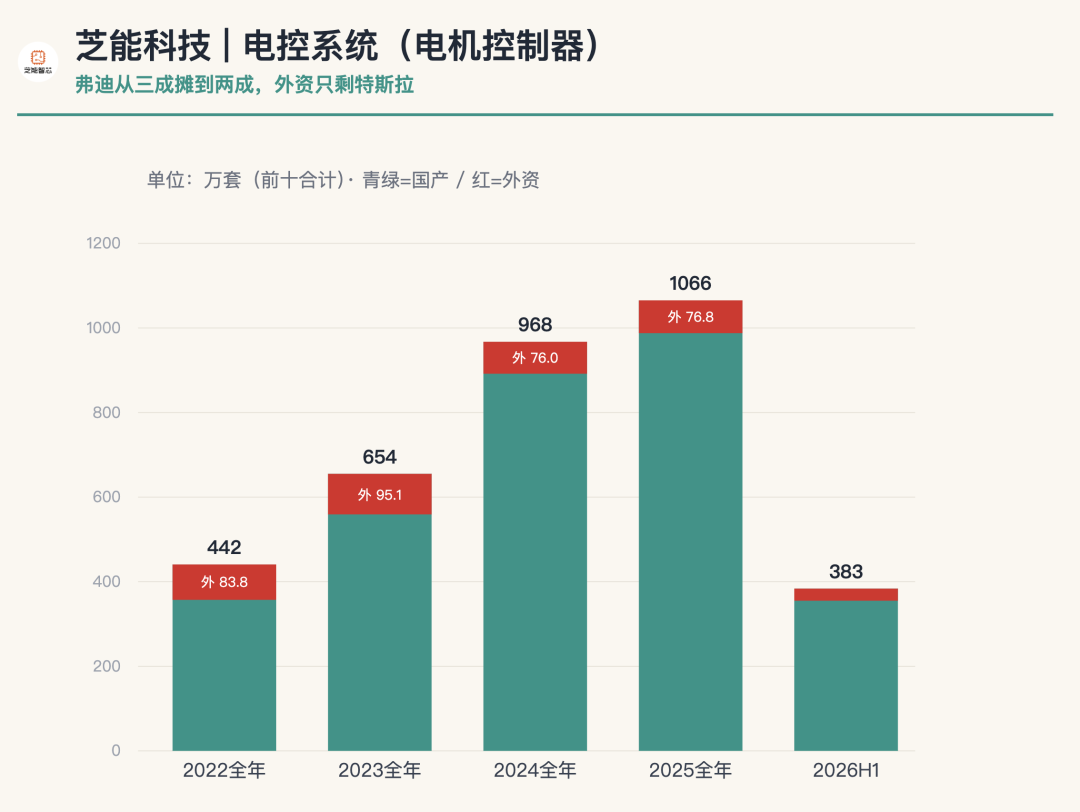
According to NE Times data, the top 10 electric control systems saw shipments of approximately 4.41 million units in 2022, around 6.54 million units in 2023, about 9.68 million units in 2024, roughly 10.66 million units in 2025, and approximately 3.83 million units in the first half of 2026 (with total market estimates slightly higher).
The proportion of domestically produced electric control systems rose from about 85% in 2022 to around 95% in the first half of 2026, leaving Tesla as the only foreign company in the market.
Part 1: First Half of 2026 - BYD's Market Share Falls Below 20%, New Power Assembly Plants Rise Collectively
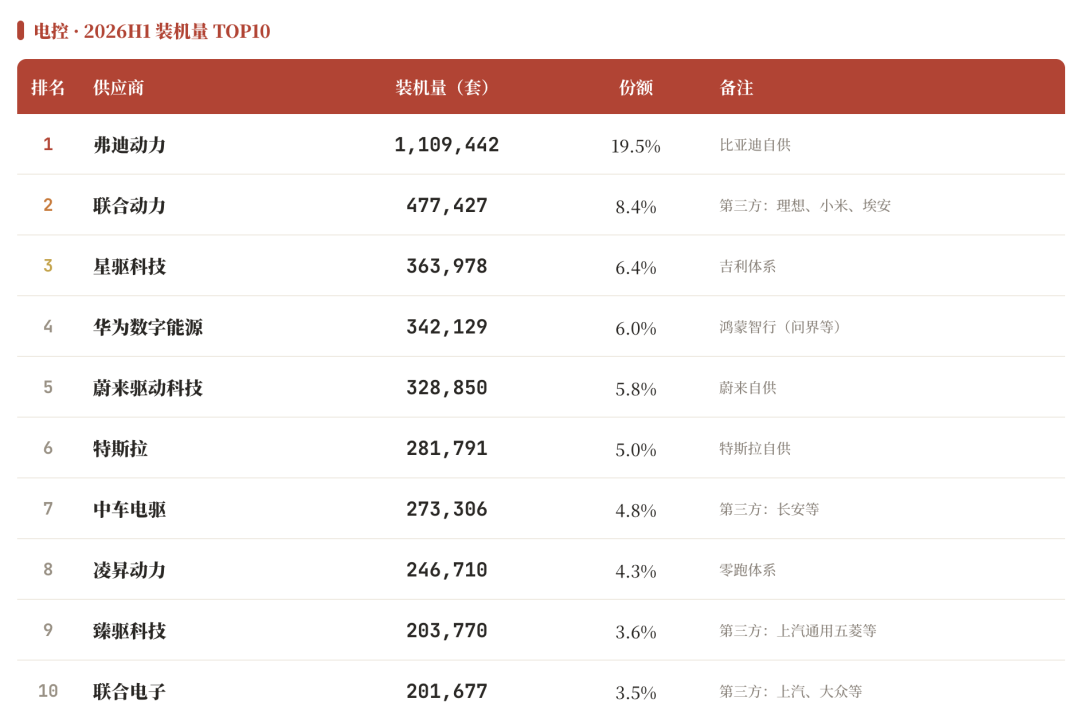
In the first half of 2026, the top 10 electric control system suppliers shipped a total of approximately 3.83 million units.
◎ BYD Power: 1.109 million units, 19.5% market share. Although its share dropped further from 24.4% in 2025, BYD still holds the top spot.
◎ United Power: 477,000 units, 8.4% market share (Geely Group).
◎ Xingqu Technology: 364,000 units, 6.4% market share (another platform under Geely Group).
◎ Huawei Digital Energy: 342,000 units, 6.0% market share.
◎ NIO Drive Technology: 329,000 units, 5.8% market share.
◎ Tesla: 282,000 units, 5.0% market share.
◎ CRRC Electric Drive: 273,000 units, 4.8% market share.
◎ Lingsheng Power: 247,000 units, 4.3% market share (Li Auto Group).
◎ Zhinqu Technology: 204,000 units, 3.6% market share.
◎ United Automotive Electronics: 202,000 units, 3.5% market share.
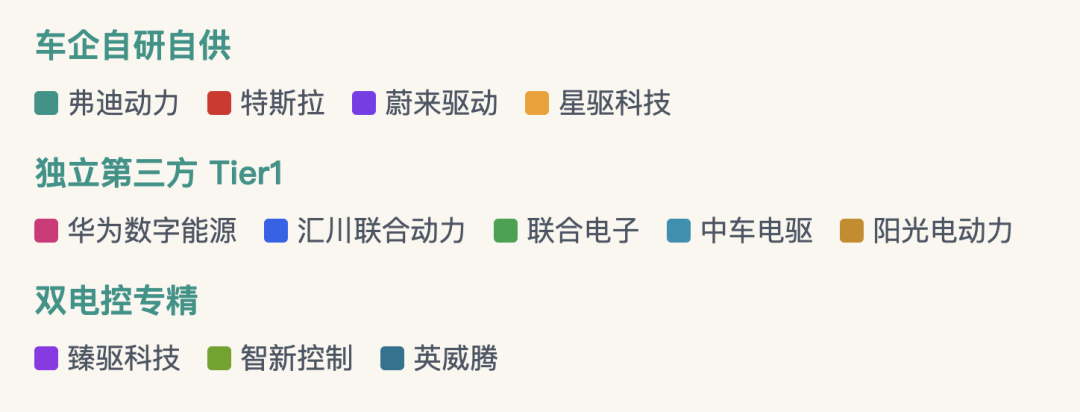
This year is characterized by car companies either self-developing or partnering to establish assembly plants (Xingqu, NIO, Lingsheng, Zhinqu), which occupy 14 of the top positions. Meanwhile, third-party independent electric control companies (Huawei, CRRC, United Automotive Electronics) rely on platform-based strategies to compete.
The electric control market is following a similar path to the electric drive market: transitioning from general components to customized ones.
Part 2: Historical Review - BYD's Market Share Drops from 30% to 24%, Third-Party Echelon Reshuffles
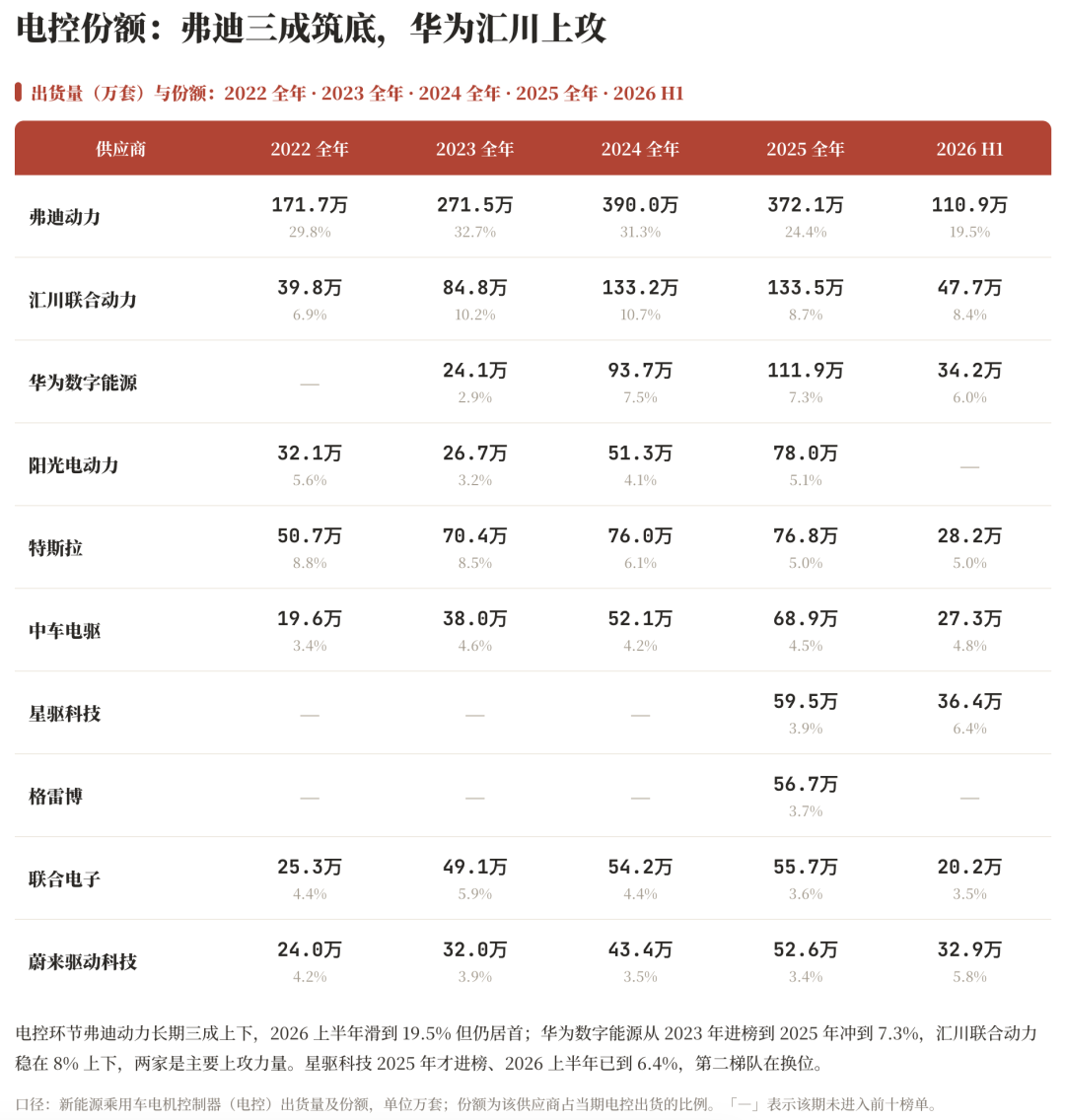
In 2022, the top 10 electric control system suppliers shipped a total of approximately 4.41 million units.
◎ BYD Power: 1.717 million units, 29.8% market share, nearly 30%.
◎ Tesla: 507,000 units, 8.8% market share (SiC accounts for 87%).
◎ Inovance United Power: 398,000 units, 6.9% market share (over half are PHEV products).
◎ Nidec: 331,000 units, 5.7% market share.
◎ Sunshine Electric Power: 321,000 units, 5.6% market share (hybrid focus).
◎ Inovance: 291,000 units, 5.0% market share.
◎ United Automotive Electronics: 253,000 units, 4.4% market share.
◎ NIO Drive: 240,000 units, 4.2% market share.
◎ CRRC Electric Drive: 196,000 units, 3.4% market share.
◎ JEE Power: 162,000 units, 2.8% market share.
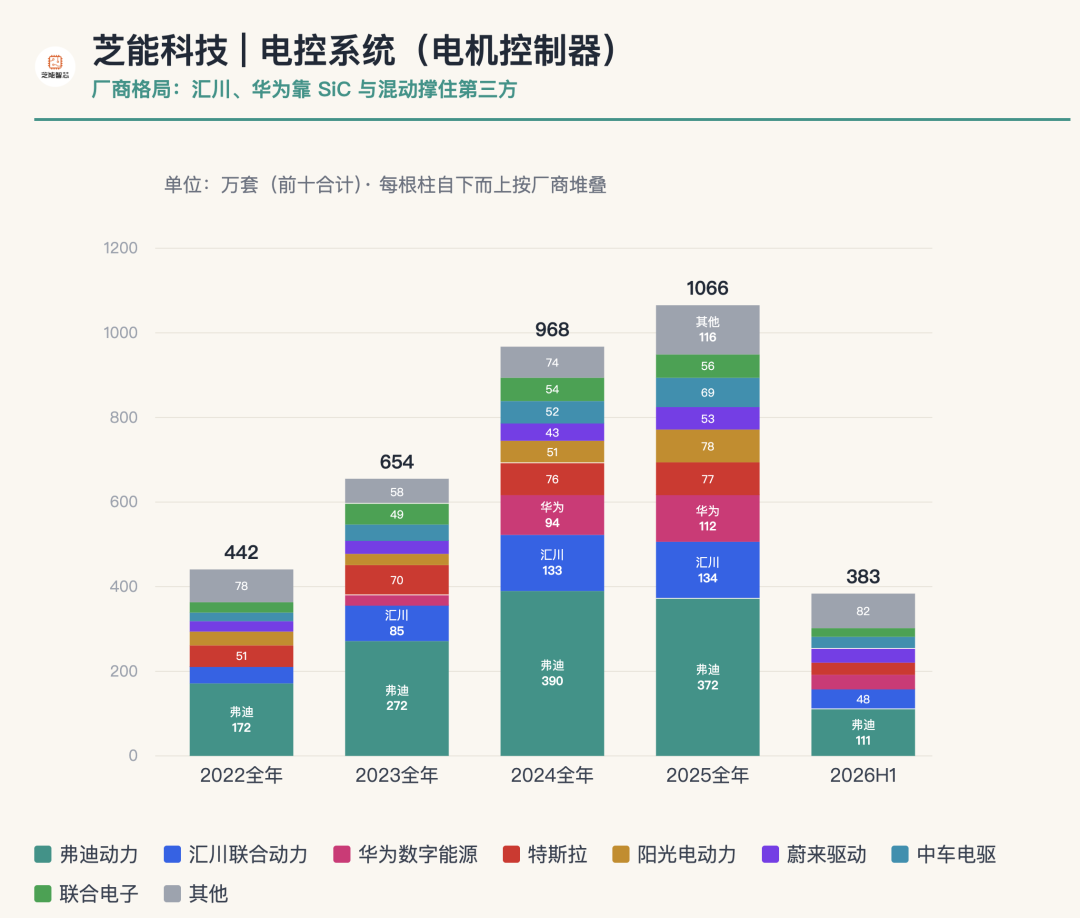
In 2023, the top 10 electric control system suppliers shipped a total of approximately 6.54 million units, a 48% increase from 2022.
◎ BYD Power: 2.715 million units, 32.7% market share (increase in SiC models).
◎ Inovance United Power: 848,000 units, 10.2% market share (first-mover advantage in dual electric control, +113% year-on-year).
◎ Tesla: 704,000 units, 8.5% market share.
◎ United Automotive Electronics: 491,000 units, 5.9% market share (SiC mass production).
◎ CRRC Electric Drive: 380,000 units, 4.6% market share.
◎ Inovance: 331,000 units, 4.0% market share.
◎ NIO Drive: 320,000 units, 3.9% market share.
◎ Sunshine Electric Power: 267,000 units, 3.2% market share (persistence in single-tube route).
◎ Nidec: 247,000 units, 3.0% market share.
◎ Huawei Digital Energy: 241,000 units, 2.9% market share.
This year, Inovance achieved a market share of over 10% with dual electric control and PHEV products, becoming the first third-party company to break into the top three besides Nidec.
In 2024, the top 10 electric control system suppliers shipped a total of approximately 9.68 million units, a 48% increase from 2023.
◎ BYD Power: 3.899 million units, 31.3% market share, a slight drop from 32.7% in 2023, still holding the top spot.
◎ Inovance United Power: 1.332 million units, 10.7% market share (+59% year-on-year).
◎ Huawei Digital Energy: 937,000 units, 7.5% market share (+270.7% year-on-year, HarmonyOS Smart Travel volume increase).
◎ Tesla: 760,000 units, 6.1% market share.
◎ United Automotive Electronics: 542,000 units, 4.4% market share.
◎ CRRC Electric Drive: 521,000 units, 4.2% market share.
◎ Sunshine Electric Power: 513,000 units, 4.1% market share (+92.7% year-on-year).
◎ NIO Drive Technology: 434,000 units, 3.5% market share.
◎ VREX Electric: 408,000 units, 3.3% market share.
◎ JEE Power: 336,000 units, 2.7% market share.
This year, only Tesla remained among foreign companies, with a domestic production rate of about 92%. VREX and JEE were still hovering around the 10th position.
In 2025, the top 10 electric control system suppliers shipped a total of approximately 10.66 million units (total market estimate around 11.30 million units), the highest in history.
◎ BYD Power: 3.721 million units, 24.4% market share (-5.1%), share dropped from 31.3% in 2024 to 24.4%.
◎ United Power: 1.335 million units, 8.7% market share (+2.8%).
◎ Huawei Digital Energy: 1.119 million units, 7.3% market share (+0.6%).
◎ Sunshine Electric Power: 780,000 units, 5.1% market share (+52%, hybrid boom).
◎ Tesla: 768,000 units, 5.0% market share.
◎ CRRC Electric Drive: 689,000 units, 4.5% market share.
◎ Xingqu Technology: 595,000 units, 3.9% market share.
◎ Grebot: 567,000 units, 3.7% market share (+323.9%).
◎ United Automotive Electronics: 557,000 units, 3.6% market share.
◎ NIO Drive: 526,000 units, 3.4% market share.
Part 3: Dual Electric Control - The Exclusive Brain for Hybrids, Foreign Companies Retreat Most Thoroughly
Dual electric control is a subcategory of electric control, primarily supporting the dual-motor systems of plug-in hybrids. The controller manages both the drive motor and the generator simultaneously, exclusively for PHEV and range extenders. It is more technically complex than single electric control and is a direct beneficiary of the hybrid boom.
In 2023, the top 10 dual electric control system suppliers shipped a total of approximately 2.65 million units.
◎ BYD Power: 1.206 million units, 44.6% market share (driven by DM5.0).
◎ Denso: 557,000 units, 20.6% market share (has clients beyond Toyota).
◎ Inovance United Power: 436,000 units, 16.1% market share (continuation of industrial control advantage).
◎ Hitachi Astemo: 168,000 units, 6.2% market share.
◎ Mitsubishi: 119,700 units, 4.4% market share.
◎ BorgWarner: 49,000 units, 1.8% market share.
◎ Sunshine Electric Power: 37,000 units, 1.4% market share.
◎ Zhixin Control: 32,000 units, 1.2% market share.
◎ Zhinqu Technology: 25,000 units, 0.9% market share.
◎ Huawei Digital Energy: 23,000 units, 0.8% market share.
This year, over 30% of dual electric control systems were still from foreign companies (Denso, Hitachi, Mitsubishi, BorgWarner combined 33%).
In 2024, the top 10 dual electric control system suppliers shipped a total of approximately 3.56 million units, a 34% increase from 2023.
◎ BYD Power: 2.098 million units, 57.8% market share (dominates half of the hybrid market).
◎ Inovance United Power: 762,000 units, 21.0% market share.
◎ Zhinqu Technology: 218,000 units, 6.0% market share (explosive +500% growth).
◎ Sunshine Electric Power: 175,000 units, 4.8% market share (+374%).
◎ Hitachi Astemo: 115,000 units, 3.2% market share.
◎ Huawei Digital Energy: 68,000 units, 1.9% market share.
◎ Zhixin Control: 43,000 units, 1.2% market share.
◎ INVT: 32,000 units, 0.9% market share.
◎ Vermes: 25,000 units, 0.7% market share.
◎ BorgWarner: 25,000 units, 0.7% market share.
The key point is that in 2024, Denso and Mitsubishi directly fell out of the top 10, leaving only Hitachi and BorgWarner among foreign companies, together accounting for less than 4%. The domestic production rate for dual electric control jumped from about 67% in 2023 to about 96% in 2024, making it the component where foreign companies retreated most thoroughly among all electrification parts.
Part 4: The Underlying Logic of Electric Control - Two Main Lines of SiC and Hybrids
The competitive focus of electric control differs from that of electric drives. While electric drives emphasize integration depth, electric control mainly focuses on downward integration.
◎ First is power devices.
The penetration rate of SiC determines efficiency and volume. Tesla's SiC proportion reached 87% in 2022, and BYD and NIO are also promoting SiC. Whoever can secure a stable and cheap supply of SiC modules will have an advantage. CRRC Electric Drive, backed by CRRC Times Electric's power semiconductors, has confidence in the device segment.
◎ Second is hybrid incremental growth.
PHEV and range extenders require two sets of controls (dual electric control) per vehicle, one more than pure electric vehicles for generator control. The share increases of Sunshine Electric Power, Zhinqu, and Inovance from 2023 to 2025 are all related to the
-
![]()
Can the Robot Phone Propel Honor to New Valuation Heights?
-
![]()
Dealer Service Operation Capability | Constructing Four "Consciousness Firewalls" for Proactive Negative Public Opinion Management
-
![]()
Lenovo is Back in the Spotlight, This Time with Its 'AI for All' Story
-
![]()
Two Rising Cloud Service Providers Abruptly Adjust Strategies in Computing Power Market
-
【Insight】High-Pressure Plastic Fuel Tanks Fit for Plug-in Hybrid Electric Vehicles See Expanding Market Space
-
![]()
Satellite Earth Observation Radar: From SAR to Intelligent Sensing with FPGA
-
![]()
SpaceX Releases First Financial Report: Revenue Doubles to $7.8 Billion, Musk Aims to Build a Computing Power Empire Rather Than Just a 'Rocket Company'
-
![]()
Token Economy in Global Expansion: Data Governance Must Be Robust