Xiaomi Addresses Claims of Pengcheng Battery Thermal Runaway, Exceeding New National Standards; Lei Jun Highlights 1,230 Rigorous Tests
 08/19 2026
 417
417
On August 16, Xiaomi Auto released an official statement, offering a detailed explanation regarding the widespread controversy over the Pengcheng Longjia battery's 55°C high-temperature testing. This directly addressed external doubts about the battery supplier.
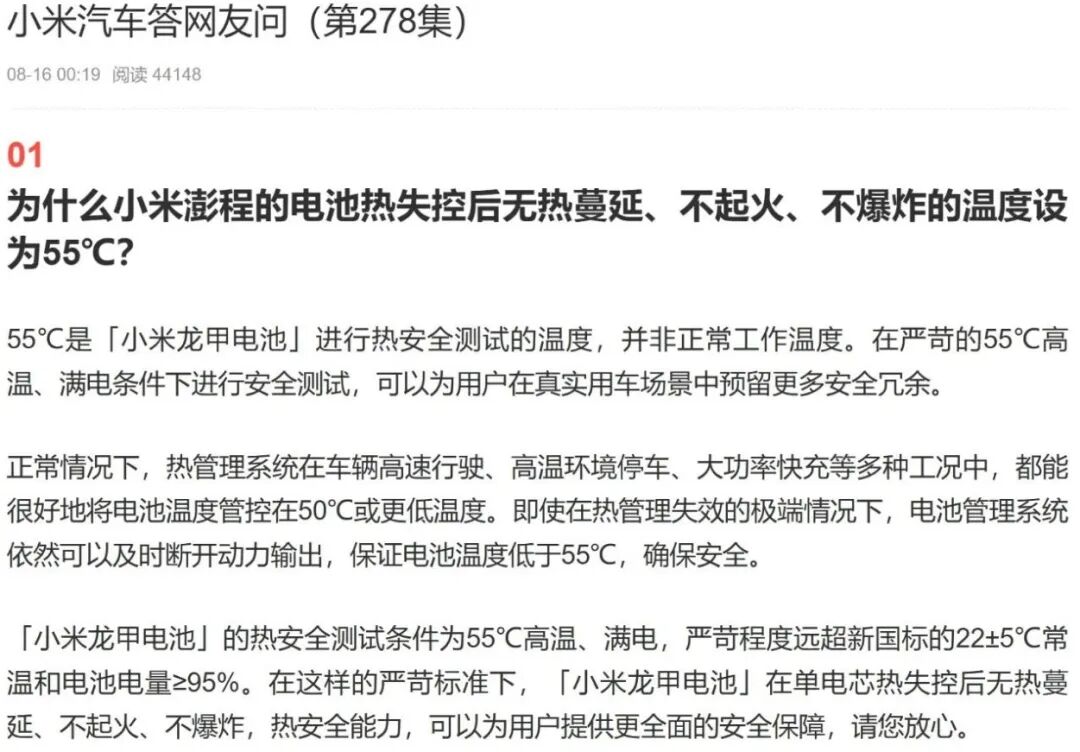 Image Source: Xiaomi Official Account
As Xiaomi's first extended-range SUV, the Pengcheng series has shifted away from the CATL and BYD batteries used in the SU7 and YU7 models, opting instead for Sunwoda and CALB as suppliers. Notably, the pre-sale launch event for the new vehicle made no mention of the battery supplier, sparking widespread online discussion following disclosures by the Ministry of Industry and Information Technology (MIIT).
I. Official Highlights: 55°C Represents Extreme Testing, Not Routine Operating Temperature
Many netizens misunderstood, believing that the Pengcheng battery must withstand 55°C temperatures during daily driving. Xiaomi clarified that 55°C represents laboratory extreme test conditions, not the vehicle's standard operating temperature.
This test simulates 55°C high temperatures and full-charge extreme conditions, actively triggering thermal runaway in a single battery cell. The goal is to ensure no thermal propagation, fire, or explosion occurs, providing ample safety margins for daily use.
During everyday driving scenarios, such as when the vehicle is parked in direct sunlight, during high-speed driving, or while undergoing high-power fast charging, the vehicle's thermal management system maintains battery temperatures below 50°C. Even in extreme failure scenarios where the thermal management system fails, the Battery Management System (BMS) will promptly cut power to maintain the 55°C safety threshold.
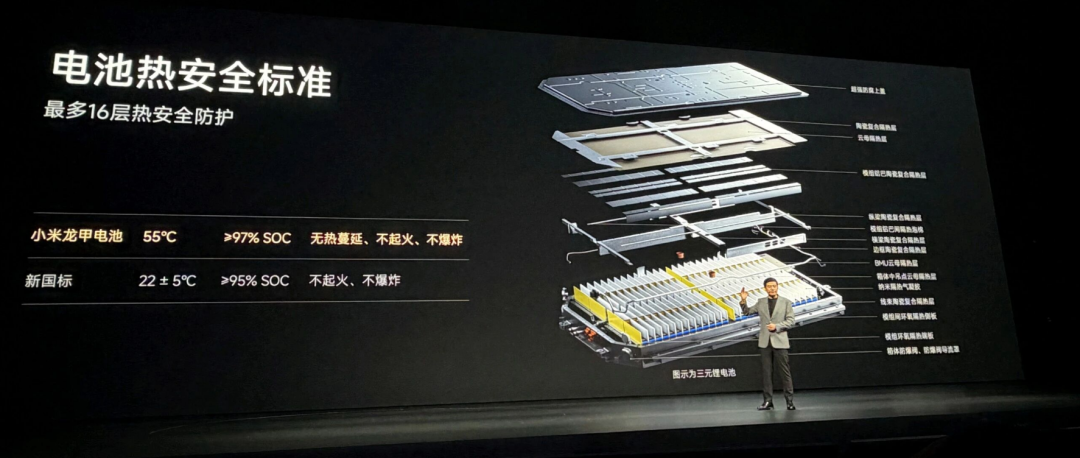 Image Source: Xiaomi Launch Event
Compared to industry standards, the new national standard only requires thermal propagation testing at 22±5°C with 95% charge, making Xiaomi's testing standards far more stringent. Industry reference cases show that Buick's Ultium battery peaked at only 51.5°C during extreme 6C fast charging in Turpan, proving that 50°C represents the realistic upper temperature limit for civilian batteries.
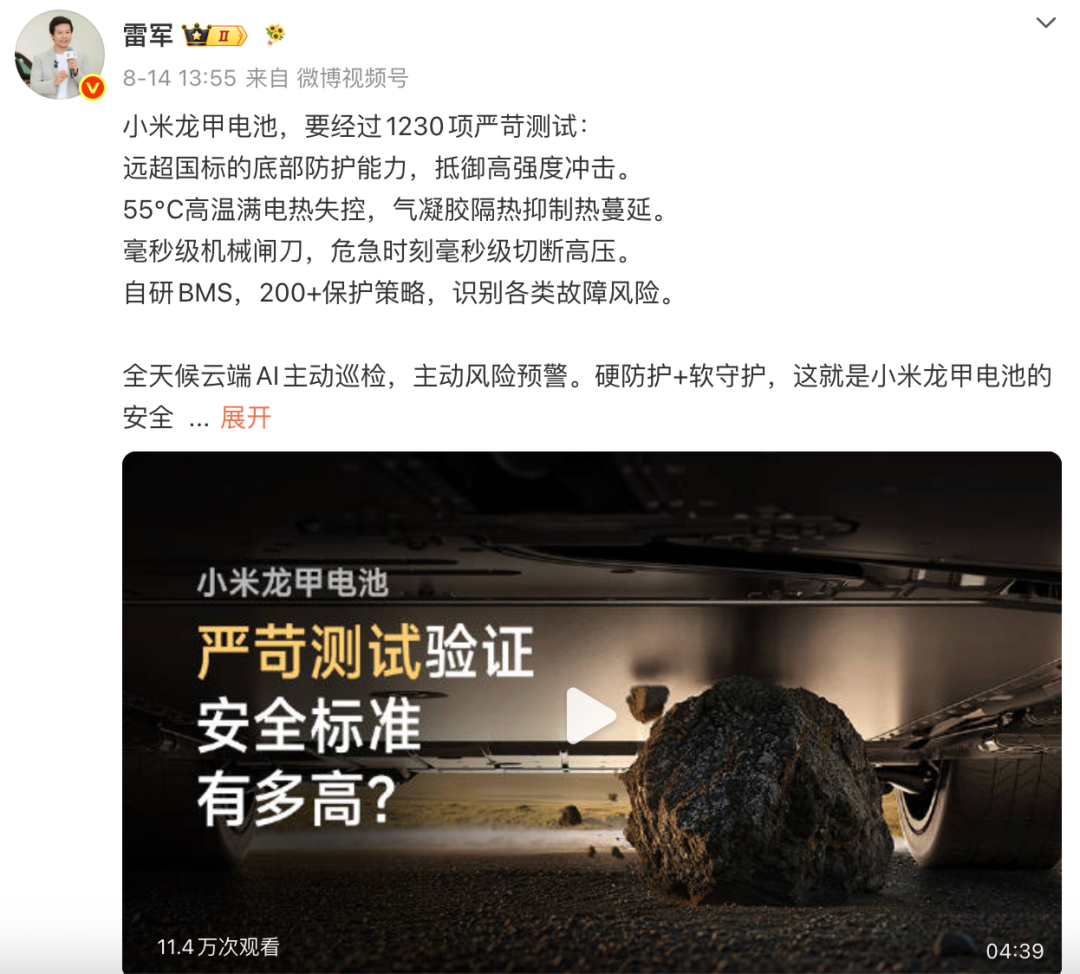
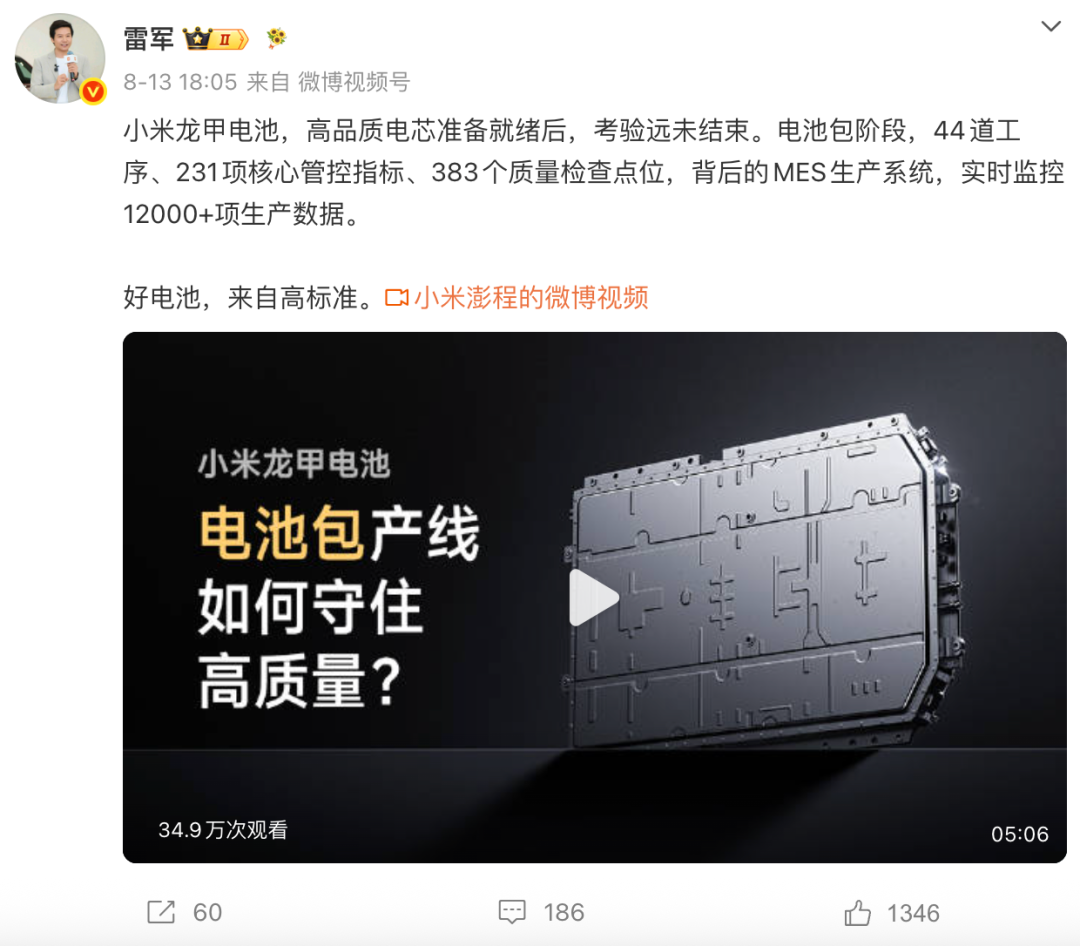 Image Source: Weibo
The Longjia battery used in Pengcheng vehicles is fully developed and quality-controlled by Xiaomi, featuring a 16-layer thermal safety protection system and aerogel insulation materials. Official data shows that the battery has undergone 1,230 rigorous tests covering 44 production processes, 231 core control indicators, and 383 quality inspection points, with real-time monitoring of over 12,000 production data points, supported by 200+ fault protection strategies and cloud-based AI inspections. Lei Jun has repeatedly emphasized that "safety is the prerequisite, the foundation, and everything," which permeates the entire battery design and production process, achieving external cell procurement with self-developed standards and quality control.
II. Supplier Omission at Launch Event Sparks Polarized Public Opinion
On July 30, Xiaomi opened pre-sales for the Pengcheng N70 and N90 Max models, revealing core selling points such as a starting price of 259,900 yuan, a large extended-range battery, and a spacious interior. However, battery supplier information was omitted throughout.
MIIT disclosures revealed the truth: Pengcheng N70 Standard Edition: Sunwoda 52kWh LFP battery, Pengcheng N70 Max and N90 Max: CALB 76kWh NMC battery.
Xiaomi's previous pure electric flagship SU7 and YU7 series exclusively used CATL and BYD batteries, with official brand endorsements quickly establishing user trust in battery safety. However, after switching to second-tier suppliers for Pengcheng and deliberately omitting this information, the revelation sparked immediate controversy.
Supportive Netizen Views:
"Over 1,000 rigorous tests speak for themselves—Xiaomi's battery quality control is strict enough." "Rather than blindly trusting battery brands, the automaker's full-process self-developed quality control is more reliable, with solid standards for the Longjia battery." "Lei Jun facing controversy head-on with data shows honesty." "Supply chain diversification and supporting domestic second-tier batteries represent industry trends."
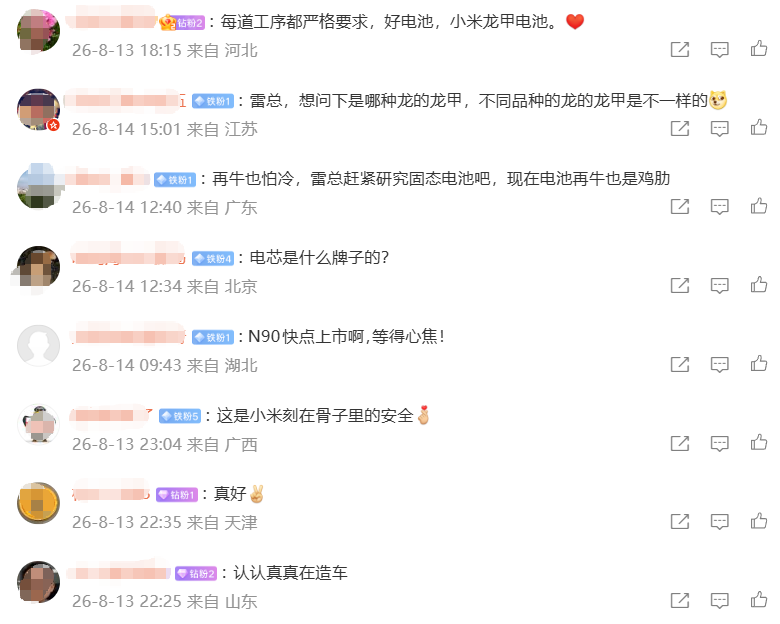 Image Source: Weibo
Skeptical Netizen Complaints:
"1,230 tests are just paper data—we need complete third-party testing reports." "Hope for a paid upgrade option to switch back to CATL batteries for an additional 20,000 yuan." "Lab tests lack real-world relevance—150,000 km long-term testing is the true test." "Both suppliers have quality controversies—I don't want to be among the first users to test them."
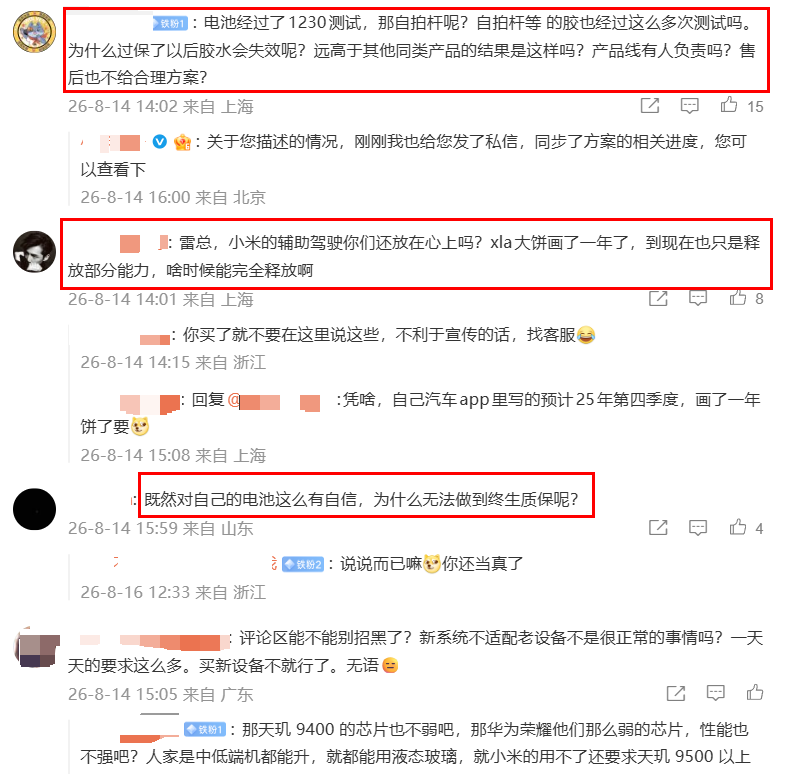 Image Source: Weibo
Industry insiders revealed that the omission of supplier information at the launch event primarily aimed to avoid public opinion risks. Shortly before the event, CALB publicly apologized for batch battery failures in GAC Aion models and upgraded warranties, while Sunwoda faced a costly 2.314 billion yuan quality lawsuit from Geely, with negative publicity continuing to ferment. The deliberate omission intended to reduce controversy but instead intensified user suspicions, prompting Lei Jun to issue two consecutive Weibo posts personally endorsing the Longjia battery's safety system.
III. Past Controversies of Two Suppliers: Risks Not Equivalent, But Concerns Remain Valid
Sunwoda: Costly Lawsuit Settlement Doesn't Eliminate Quality Concerns
In late 2025, Geely Wisdom Power sued Sunwoda, alleging that delivered battery cells had voltage imbalances, excessive internal resistance, and substandard cycle life, seeking 2.314 billion yuan in damages. The affected cells were used in the Zeekr 001 WE86, with many owners reporting halved range, abnormal battery levels, and driving shutdowns.
The parties settled in 2026, with Sunwoda paying 608 million yuan, resulting in 500-800 million yuan in net profit losses for the company. The substantial compensation confirmed batch quality issues with its cells.
To clarify, the Pengcheng N70 uses newly specified cells, not those from the Zeekr incident batch. However, user concerns persist: whether the cells supplied to Xiaomi have undergone substantive production line and process improvements remains unverified by third-party authoritative reports.
CALB: Operational Vehicle Batch Failures, Cell Chemistry Differences Exist
In July 2026, GAC Aion publicly apologized after multiple commercial vehicle models equipped with CALB's 177Ah LFP cells experienced severe range drops, cell swelling/leakage, and vehicle breakdowns at 150,000-300,000 km mileage, prompting extended warranties and free battery replacements.
The critical distinction is that Aion's issues involved LFP cells, while Pengcheng's high-end models use CALB's 76kWh NMC cells—completely different systems and models, so risks cannot be directly equated. However, users remain concerned whether Xiaomi's exclusive orders have upgraded quality inspection standards, as the same company's quality control and production systems show continuity.
Industry Consensus: Even perfect vehicle protection and BMS algorithms can only mitigate thermal runaway fire risks, not compensate for cell manufacturing consistency defects. GAC Aion's self-developed protection system failure case represents the core source of user anxiety.
IV. Supplier Change: Cost Reduction Needs vs. Supply Chain Strategy Double-Edged Sword
From an automaker operational perspective, Pengcheng's battery supplier change makes clear sense. Cost-wise, power batteries account for nearly 40% of vehicle costs, with Sunwoda and CALB offering 3%-15% lower prices than top-tier manufacturers, crucial for maintaining Pengcheng's affordable 259,900 yuan pricing. Additionally, Pengcheng targets the home extended-range market, eliminating the need for premium battery brand premiums.
Strategically, domestic automakers generally pursue "de-CATL-ization" supply chain diversification to avoid single-supplier capacity and pricing constraints. Xiaomi's investment in Jingxu Technology for self-developed batteries and current second-tier cell procurement also paves the way for self-developed technology, reclaiming battery system definition rights.
However, this model has obvious shortcomings: second-tier battery manufacturers' batch cell consistency and long-term stability objectively lag behind top brands, ultimately relying heavily on Xiaomi's incoming material inspections and full-process quality control capabilities.
The netizen-requested "upgrade to CATL batteries for an additional fee" faces significant implementation challenges. The vehicle's battery structure, BMS calibration, and thermal management system are all tailored to existing cells. New optional versions would require complete redevelopment and validation, while indirectly undermining the reputation of original cells—hence few automakers offer such options.
V. Three Core Questions Remain Unanswered
Xiaomi's lab extreme tests cannot replicate long-term aging losses from 100,000 km of real-world driving. Three core questions remain unaddressed by official responses:
1) Regarding Sunwoda's past cell consistency defects, have the new cells supplied to Pengcheng undergone production line and process upgrades, with third-party long-term reliability testing reports available?
2) The N90 Max supports high-frequency, high-power fast charging, and extended-range operating conditions are not absolutely mild—how is long-term charge/discharge degradation risk managed?
3) If batch battery failures occur after high-mileage vehicle operation, does Xiaomi offer superior industry warranties, advance compensation, and recall plans?
VI. Purchase Recommendations: Reject PPT Hype, Prioritize Written Guarantees
Prospective buyers need not completely reject the model nor blindly trust promotions, focusing on three key points:
1) Carefully review battery warranty clauses in the purchase contract—written compensation and degradation coverage terms far outweigh test data.
2) Distinguish between model variants—the two cell chemistries carry different risks and cannot be generalized.
3) Observe early adopters' long-mileage real-world feedback, as long-term usage data represents the core test of battery quality.
Final Thoughts
Battery safety comprises two layers:
1) Extreme condition safety, where Xiaomi's 55°C testing and 16-layer protection system deliver excellent paper results.
2) Long-term usage reliability, where cell stability and degradation resistance over 100,000 km represent challenges labs cannot simulate.
Supply chain diversification and cost control represent standard automaker practices, but selecting suppliers with quality controversies inevitably incurs higher user trust costs. Lab data alone cannot dispel market concerns—users demand verifiable testing reports and implemented safeguards.
One thousand lab tests cannot match 100,000 km of real-world road testing. Home vehicle purchases cannot afford small-probability risks. The Longjia battery's paper specifications shine brightly, but its true market test has just begun. Consumer trust never comes from launch event speeches but from long-term real-world testing by massive users.
Disclaimer: This article represents financial and technological commentary only and does not constitute investment advice. All corporate data and regulatory events mentioned derive from publicly available information for reference only, with official announcements prevailing. Image sources noted online—contact for copyright removal if needed.
Hit 'Like,' 'Share,' and 'Favorite' in One Click!
Welcome to leave your thoughts in the comments!
Daily Insights on Intelligent Technology and Finance
-
![]()
Can General AI Assistants Avoid Repeating the Internet's Mistakes?
-
Organizational Structure in the AI Era: Insights from Google
-
![]()
Key Player Departs MiniMax Following M3 Launch
-
![]()
Raking in 4.7 Billion Yuan in Annual Revenue, a '92-Born Ex-ByteDance Employee Builds a $20 Billion AI Unicorn, Eyeing Hong Kong IPO
-
![]()
Li Shufu Takes a Strategic Step Back: What Lies Ahead for Geely?
-
![]()
Xiaomi's Midlife Challenge: Balancing Soaring Smartphone Storage Costs Against Losses in Its Automotive Ventures
-
![]()
Li Shufu Passes the Torch: Is Geely Stepping into the 'An Conghui Era'?
-
![]()
[In-depth Report] Reconstructing a New Talent Foundation to Secure Victory in the New Automotive Arena