Q2 Sees 100,000 Vehicle Deliveries Amid 2.6 Billion Yuan Loss! Xiaomi Automobile Places Its Bets on Pengcheng
 08/19 2026
 453
453
Written by | Guanchejun
Xiaomi's mid-2026 performance report has been released. Among all the segments, the automotive business has emerged as the focal point.
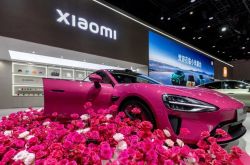
On one hand, there's much to celebrate: 104,000 vehicles were delivered in the second quarter, marking a 28% year-on-year increase; cumulative deliveries of the SU7 series have surpassed 500,000 units; and the YU7 model has secured the top spot for one-year retention rate.
On the other hand, the financial figures are concerning: the automotive and AI innovation businesses posted an operating loss of 2.6 billion yuan in the second quarter, with the segment's gross margin declining from 26.4% in the same period last year to 19.2%.
In a nutshell, Guanchejun summarizes the situation: vehicle sales are on the rise, but so are the losses.
01
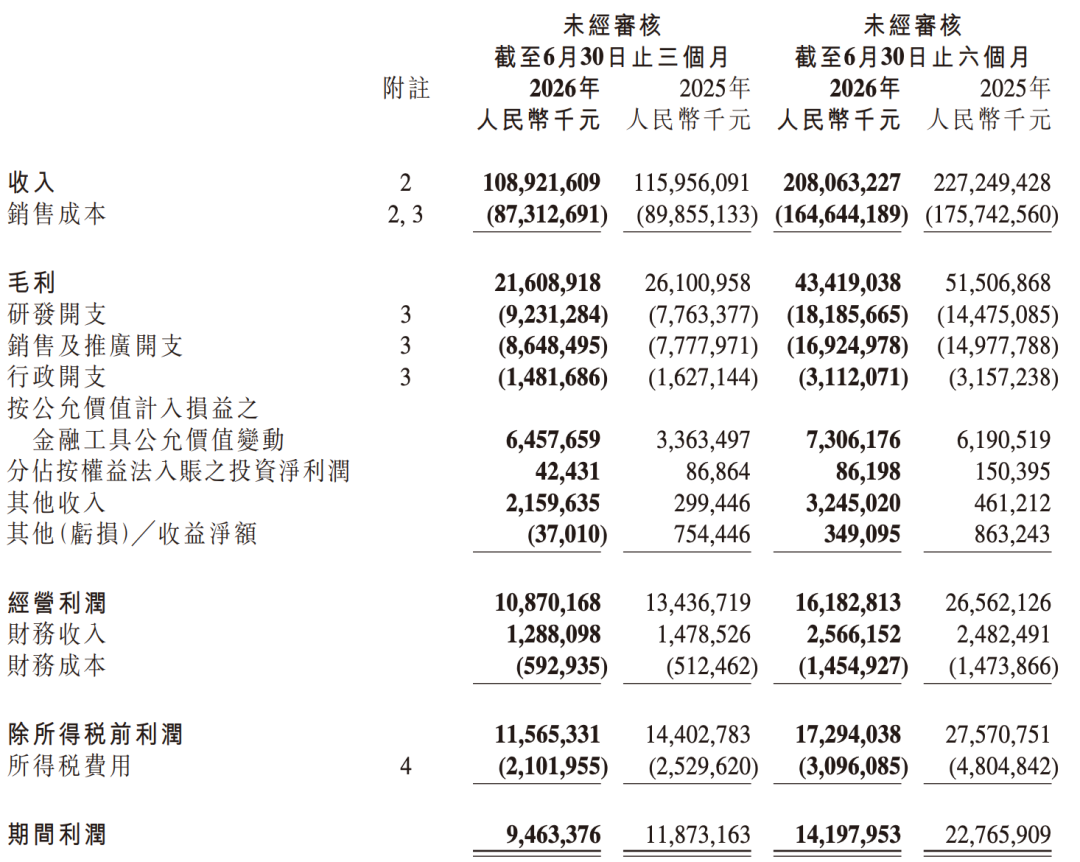
Let's delve into the specifics. The financial report reveals that in the first half of 2026, Xiaomi's smart electric vehicle and AI innovation business segment generated 44.76 billion yuan in revenue, representing a modest year-on-year increase of just over 12%.
In the second quarter alone, automotive revenue reached 23.9 billion yuan, up 15.9% year-on-year; 104,000 vehicles were delivered, a 28.2% increase from the previous year.
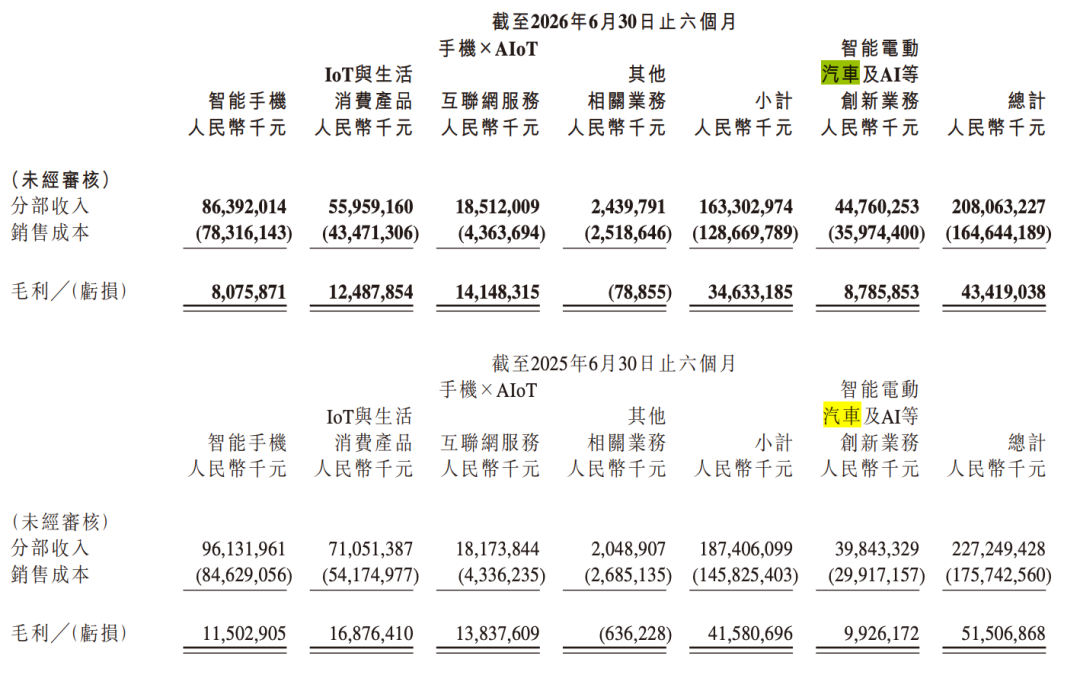
However, the profit picture is less rosy.
In the second quarter, Xiaomi's automotive segment reported a gross margin of 19.2%. How does this compare to last year? It was 26.4%. In just one year, the margin has been slashed by 7.2 percentage points. Looking back further, it was still 20.1% in the first quarter of this year, and now it has dropped to 19.2% in the second quarter, indicating a continued downward trend.
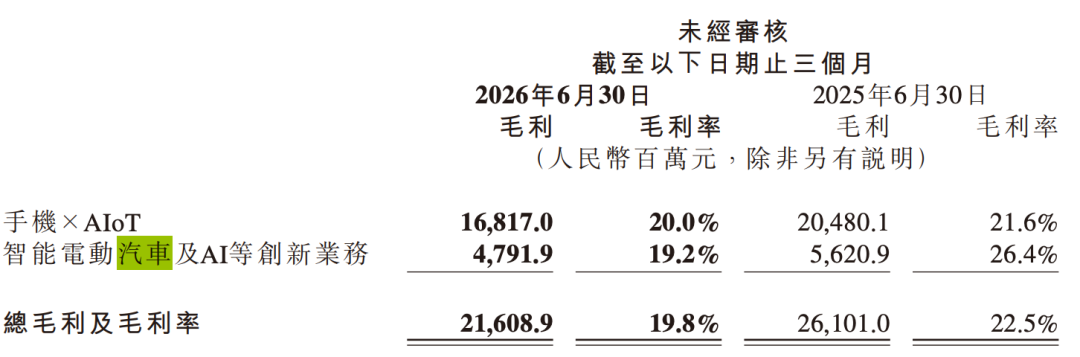
The Average Selling Price (ASP) per vehicle is also on the decline: in the second quarter, each vehicle sold for 229,300 yuan, compared to 253,700 yuan last year, a decrease of 9.6%.
What does this signify? It suggests that Xiaomi's automotive business growth in the first half of the year was not driven by selling more expensive, high-margin vehicles, but rather by pushing higher volumes of cheaper models.
02
The decline in gross margin has directly contributed to the expansion of Xiaomi's automotive losses.
As Guanchejun mentioned earlier, in the second quarter, Xiaomi's automotive and AI innovation businesses incurred an operating loss of 2.6 billion yuan. It's important to note that this figure represents only the operating loss—revenue minus R&D investment and sales expenses—without factoring in various other items.
I still recall the market discussions a year ago about how many quarters it would take for Xiaomi Automobile to become profitable. Plans, however, often fail to keep pace with reality. Now, Xiaomi is focused on maintaining its market presence, capturing share, and continuing to invest heavily in R&D and distribution channels.
With these three priorities in mind, achieving profitability has become an increasingly challenging mathematical problem.
To be frank, given the automotive market conditions in the first half of 2026, any growth is noteworthy.
However, capturing market share comes at a cost. The financial report reveals that in the first half of the year, Xiaomi's sales and promotion expenses reached 16.9 billion yuan, up about 13% year-on-year. R&D expenses were 18.19 billion yuan, a 25.6% increase from the previous year, with a significant portion allocated to automotive and AI.
03
In Guanchejun's opinion, besides the automotive business, there's another red flag in Xiaomi's semi-annual report: its traditional cash cows, the smartphone and AIoT businesses, are both experiencing declines.
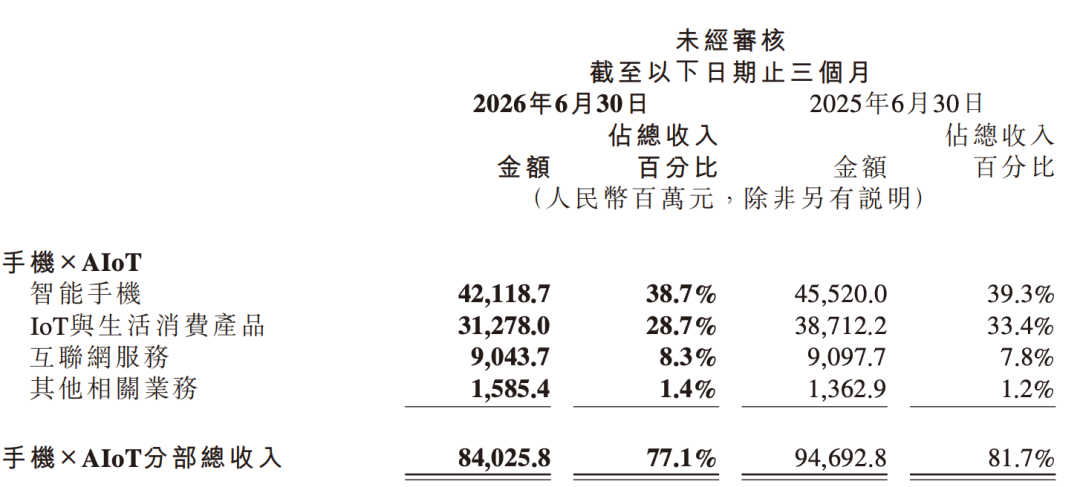
As illustrated in the table above, in the second quarter of 2026, Xiaomi's smartphone revenue was 42.1 billion yuan, down 7.5% year-on-year, with a gross margin of 8.5%, compared to 11.5% last year; AIoT business revenue was approximately 31.3 billion yuan, a 19.2% decrease from the previous year.
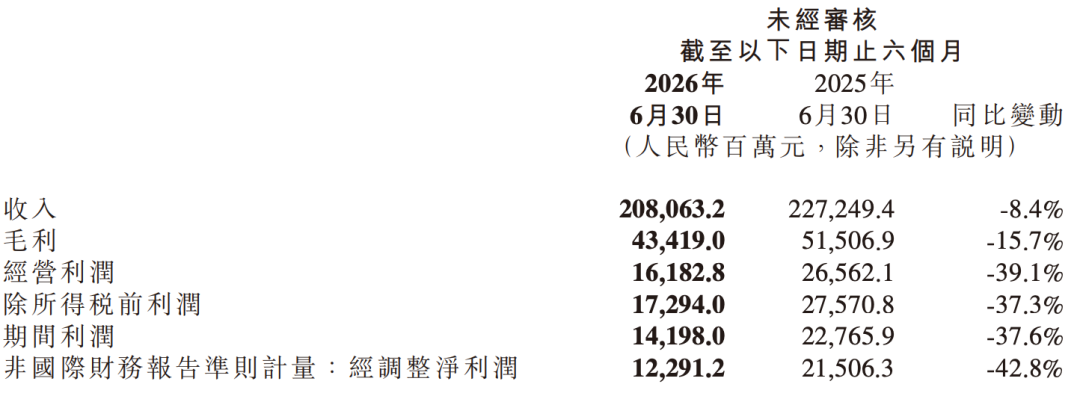
Based on these figures, in the first half of the year, Xiaomi Group's overall net profit was 14.2 billion yuan, a 37.6% decline from the previous year; the net profit margin dropped from 10% to 6.8%.
This is not a positive sign.
Lei Jun is undoubtedly aware of this situation. Recognizing the challenges in the pure electric high-end market, he is shifting tactics in the second half of the year.
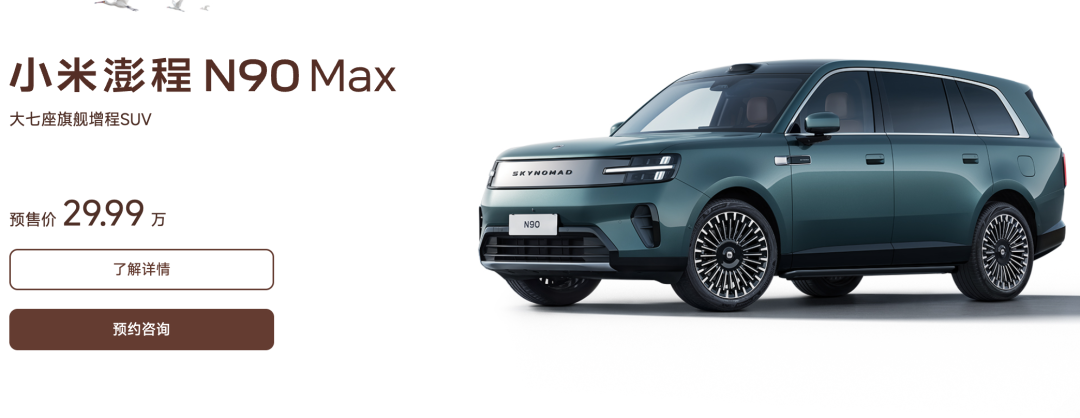
In July, Xiaomi unveiled its "Xiaomi Kunlun" technology architecture and introduced the Pengcheng series extended-range SUVs: the N90 Max with a pre-sale price of 299,900 yuan and the N70 Max with a pre-sale price of 259,900 yuan, boasting a CLTC combined range of up to 1,705 kilometers, expected to launch in September.
This move is pragmatic, but it also carries risks. The 250,000 to 300,000 yuan price range is a fiercely competitive battleground for Li Auto, Seres, Leapmotor, and Deepal. Xiaomi is entering this market with its brand momentum, but making easy money in this red ocean will not be straightforward.
Putting all these pieces together, the picture of Xiaomi's automotive business in the first half of the year becomes clear:
Scale has indeed grown, with the 500,000-unit milestone shining brightly; technological narratives are also being told, with the Kunlun architecture, extended-range SUVs, and AI large models all in play. However, the profits have yet to materialize, and the timeline for profitability continues to be pushed back.
In Guanchejun's view, in the automotive manufacturing race, the first half tests "whether you can build and sell cars," and Xiaomi has performed well in this regard. The second half tests "whether you can dig moats that others can't copy and achieve profitability." Xiaomi Automobile is still on the journey to answer this question.
The real test will come in September when the Pengcheng extended-range SUVs hit the market and truly ramp up sales. This will be the key battle to see if Lei Jun's new move can transform Xiaomi's automotive scale into profits. Let's wait and see!
The charts in this article, unless otherwise noted, are sourced from public disclosures through various channels. We hereby acknowledge and express our gratitude! The views expressed herein are for reference only and do not constitute investment advice.
-
Organizational Structure in the AI Era: Insights from Google
-
![]()
Key Player Departs MiniMax Following M3 Launch
-
![]()
Raking in 4.7 Billion Yuan in Annual Revenue, a '92-Born Ex-ByteDance Employee Builds a $20 Billion AI Unicorn, Eyeing Hong Kong IPO
-
![]()
Li Shufu Takes a Strategic Step Back: What Lies Ahead for Geely?
-
![]()
Xiaomi's Midlife Challenge: Balancing Soaring Smartphone Storage Costs Against Losses in Its Automotive Ventures
-
![]()
Li Shufu Passes the Torch: Is Geely Stepping into the 'An Conghui Era'?
-
![]()
[In-depth Report] Reconstructing a New Talent Foundation to Secure Victory in the New Automotive Arena
-
![]()
Baidu: Legacy Businesses Continue to Struggle, AI Relies Solely on Computing Power Dividends