Geely: Riding the Wave of Overseas Expansion, Can It Mirror BYD's Success?
 08/19 2026
 525
525
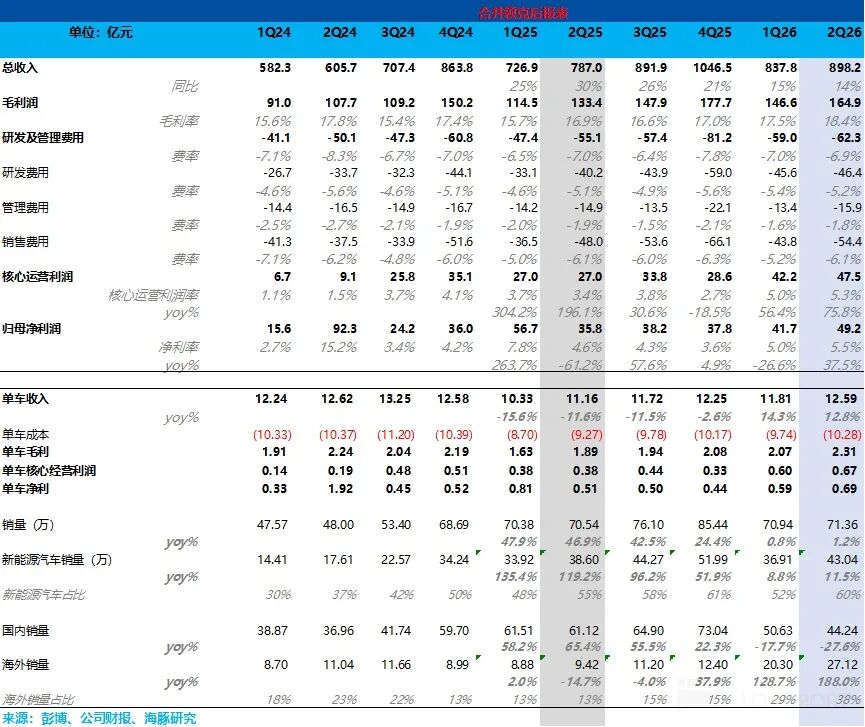
On August 17, 2026, Beijing time, during the lunch break of the Hong Kong Stock Exchange, Geely Auto unveiled its Q2 2026 financial report. The company delivered a robust performance this quarter, with key indicators such as gross margin and operating profit per unit continuing to climb, showcasing remarkable operational resilience:
1. Total Revenue Growth: Total revenue surged by 14% year-on-year, primarily fueled by an increase in revenue per unit. In Q2, Geely Auto's total revenue hit RMB 89.8 billion. Despite a modest 1.2% year-on-year increase in total sales volume, revenue soared by 14%, largely attributed to a 12.8% year-on-year rise in revenue per unit. This growth was propelled by a higher proportion of high-end and overseas sales.
2. Revenue per Unit: Revenue per unit witnessed both year-on-year and quarter-on-quarter increases. In Q2, it reached RMB 126,000, up 12.8% year-on-year and 6.6% quarter-on-quarter, primarily due to a significant uptick in the proportion of high-priced overseas models. The share of overseas models jumped from 13% in the same period last year to 38% this quarter, a 25-percentage-point increase. High-end models like Zeekr also saw their sales proportion rise from 7% last year to 14% this quarter (with the launch of the Zeekr 8X), collectively driving the overall revenue per unit higher.
3. Gross Margin Improvement: The overall gross margin in Q2 reached 18.4%, up 0.9 percentage points quarter-on-quarter. This improvement was partly due to a higher proportion of high-margin overseas and high-end models and partly due to Geely's robust cost-reduction efforts (with a nearly 80% cost-reduction completion rate in Q1 and expected to fully meet targets in Q2), effectively offsetting the adverse impact of rising commodity prices such as lithium carbonate, copper, and aluminum (estimated to affect unit costs by approximately RMB 2,000), aligning with Geely's prior guidance of a stable or slightly increasing gross margin in Q2.
4. Operating Expenses: Operating expenses increased by 14% year-on-year, primarily driven by higher R&D and sales expenses. Sales expenses in Q2 reached RMB 5.44 billion, up 13.4% year-on-year, mainly due to significant expansion of overseas channels and promotional activities for new car launches.
R&D expenses reached RMB 4.64 billion, up 15.6% year-on-year, primarily allocated to:
- New Model Development: Launch of models such as the Zeekr 8X, Lynk & Co 10/10+, Geely Galaxy V900/M7, Xingyao 7/A7 EV, and Xingjian 7 EV; several new models planned for the second half of the year, including the Galaxy TT, Galaxy Battleship 700, Lynk & Co 07GT, and Zeekr 9X Radiance.
- Intelligent Technology Investment: Release of the World Behavior Model (WAM), a new-generation advanced driver-assistance system "Qianli Haohan G-ASD," and a cabin-driving integrated super intelligent agent "Super Eva"; simultaneous forward-looking布局 (layout) in power semiconductors, digital chassis, embodied intelligence, and large models.
- Electrification Investment: Release of a new-generation "i-HEV Intelligent Hybrid" technology, continuous iteration of 800V high-voltage architecture, new-generation electric drive and battery technologies, covering pure electric, plug-in hybrid, and hybrid full technology routes.
5. Core Operating Profit: Benefiting from the gross margin increase driven by overseas and high-end sales, despite the rise in operating expenses due to higher R&D and sales expenses, the core operating profit surged by 76% year-on-year under the leverage of overall sales volume. Core operating profit per unit rose from RMB 6,000 last quarter to RMB 6,700 this quarter.
6. Net Profit: Despite the negative impact from exchange gains/losses, net profit attributable to parent company shareholders increased significantly. Exchange losses in the first half of 2026 reached RMB 550 million (exchange gains in the first half of 2025 were RMB 2.64 billion), dragging down net profit. However, overall net profit still increased by 37.5% year-on-year to RMB 4.92 billion, with net profit per unit rising significantly from RMB 5,100 in the same period last year to RMB 6,900 this quarter.
Dolphin Research's View:
Overall, Geely's Q2 financial report demonstrated strong performance. Although overall vehicle sales increased by only 1.2% year-on-year (with overall passenger vehicle sales declining by 5% year-on-year), overall revenue still achieved a 14% year-on-year increase due to the rise in revenue per unit driven by high-end and overseas sales acceleration.
Similarly, benefiting from the dual drivers of "high-end and overseas" (with overseas sales accounting for 38% of the model mix), as well as Geely's robust cost-reduction capabilities, Geely not only stabilized its average selling price (ASP) in a challenging market environment but also significantly improved its gross margin and net profit per unit. Geely's net profit per unit also increased from RMB 5,000 in the same period last year to nearly RMB 7,000 this quarter.
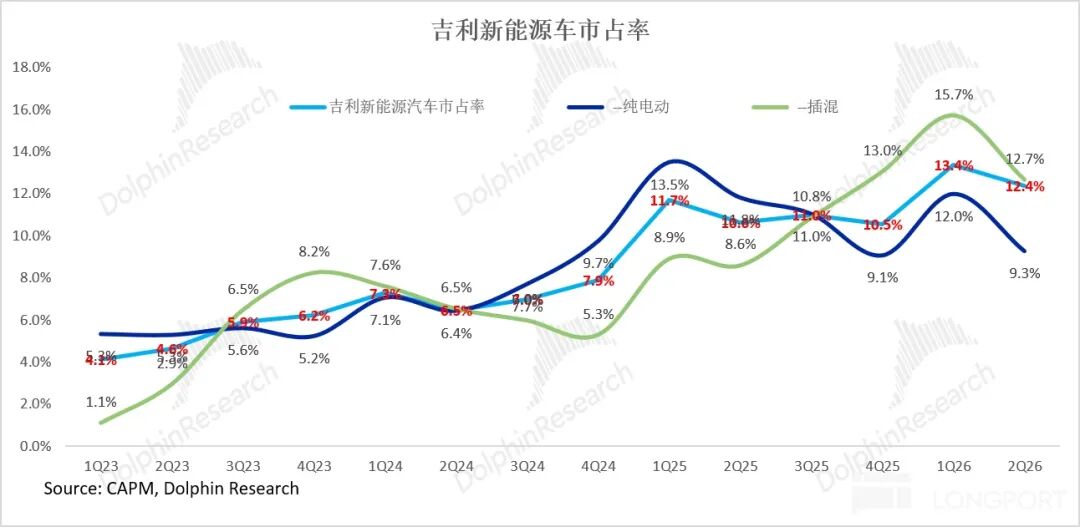
Most importantly, in terms of accelerating the new energy transition, despite the unfavorable environment of phasing out NEV purchase tax exemptions and a 4% year-on-year decline in overall industry NEV sales, Geely's NEV sales increased by 12% year-on-year, reaching 430,000 units.
Its NEV penetration rate climbed to 60%, up 5 percentage points year-on-year; its domestic NEV market share also increased from 10.6% in the same period last year to 12.4% this quarter. The overall acceleration of the transition speed marks that Geely has officially entered a development stage dominated by "new energy drive" in 2026.
Breakdown by Brand:
a. Galaxy Series: NEV sales reached 140,000 units in Q2, up 14% year-on-year. The Galaxy brand began to recover positive year-on-year growth this quarter, mainly due to the launch of new models such as the Galaxy M7, Xingyao 7, and the electric version of the Galaxy A7, as well as the recovery of older models such as the Galaxy E5 and the Galaxy Xingjian 7 plug-in hybrid.
b. Lynk & Co Brand: NEV sales declined by 11% year-on-year to 43,000 units. Although the proportion of NEV models in total Lynk & Co sales increased by 9 percentage points year-on-year to 68%, the brand lacked new model launches in Q2, and the aging of the popular older model, the Lynk & Co 08, led to a decline in sales from 17,000 units last quarter to 8,600 units this quarter.
c. Zeekr Brand: NEV sales increased by 105.4% year-on-year to 101,000 units, mainly driven by the popularity of the new Zeekr 8X model (14,000 units this quarter) and the recovery of Zeekr 007 sales.
Finally, Geely's NEV sales reached 430,000 units in Q2, up 12% year-on-year, achieving 36% of the 2026 annual sales target of 2.22 million units.
Looking Ahead to 2026:
Geely is ushering in a relatively strong "Davis Double Play," expected to deliver its own alpha: high-margin businesses represented by high-end and overseas sales will continue to thicken profits (boosting EPS), while the fully accelerated new energy transition will open up the valuation ceiling (raising PE).
① Profit Engine 1: Continuing a Strong Product Cycle, High-End Driving ASP Upward
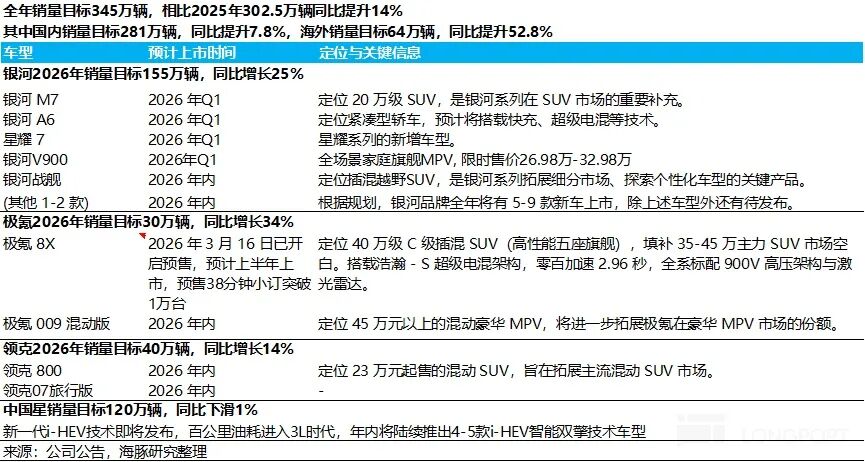
The company has set a total sales target of 3.45 million units for 2026, up 14% year-on-year, with a growth structure characterized by "NEV-led and overseas expansion."
The NEV sales target is 2.22 million units, up 32% year-on-year, with the NEV penetration rate continuing to increase by 8.5 percentage points year-on-year to 64%, while the fuel vehicle sales target is 1.23 million units, down 8% year-on-year.
From the perspective of brand plans, Geely will launch nearly 10 new models in 2026 to drive the achievement of sales targets:
- Geely Galaxy (scale foundation): NEV target sales of 1.52 million units, up 23% year-on-year, relying on multiple new models such as the M7 and Xingyao 7 to consolidate the mainstream market.
- Zeekr (high-end profit contributor): Target sales of 300,000 units, up 34% year-on-year, with incremental growth mainly coming from the sales ramp-up of the Zeekr 8X (launched in April) and the continuous volume surge (volume growth) of the 9X. Leveraging the same leading architecture as the 9X, the 8X forms a high-end sequence with the 9X, driving up brand ASP and gross margin.
- Lynk & Co: Target sales of 400,000 units, up 14% year-on-year, with growth driven by the new energy transition (currently over 60% penetration) and new models (such as the Lynk & Co 800).
② Profit Engine 2: Overseas Market Explosion, Contributing Highest Profit Elasticity
The overseas market has become the segment with the strongest growth certainty and highest profit elasticity for Geely in 2026. The company has significantly raised its 2026 overseas sales target to 920,000 units (up 120% year-on-year). Considering that Geely has already exported 474,000 units, it has achieved half of the revised annual export target. Current overseas sales have stabilized at 100,000 units (annualized at nearly 1.2 million units), mainly due to the increase in the proportion of NEV exports in the export mix: out of the current 100,000 units, 30,000 are fuel vehicles and 70,000 are electric vehicles (10,000 Zeekr 007/Zeekr X, 10,000 Lynk & Co, and 45,000 Galaxy Xingjian 7 and Galaxy E5).
Despite only launching two models in the Galaxy series, Geely's main export products, the brand has achieved rapid sales growth. Dolphin Research expects Geely to likely exceed its annual target, with overseas sales expected to reach 1.1 million units in 2026.
Meanwhile, it is expected that by 2027, Geely's HEV products will also be able to leverage their cost advantage of being $3,000 cheaper than Toyota's HEVs, with export volumes continuing to increase to 1.5-1.6 million units.
The high-profit characteristic of overseas sales is key to driving the group's profit pool: Compared to 2025 data, the overseas ASP (RMB 176,500) is 1.7 times that of the domestic market, with a gross margin about 10 percentage points higher than domestic and a net profit per unit of nearly RMB 12,000. With accelerated expansion of overseas channels (planned to exceed 2,200) and an increase in the proportion of NEV exports (expected to reach over 50%), the high-dimensional potential of overseas business will be the main driver of thickening the company's profits.
③ Cost Reduction and Efficiency Improvement Foundation: "One Geely" Releases Systemic Dividends
With the privatization of Zeekr completed by the end of 2025, the "One Geely" strategy has entered a full realization phase. The high degree of integration in R&D, procurement, manufacturing, and management platforms will significantly reduce overall operating costs. It is expected that the sales, management, and R&D expense ratios will continue to decline throughout 2026, safeguarding profit release.
Accelerated New Energy Transition Raises PE Center:
Based on the strong fundamentals of the company's accelerated "overseas + high-end" transition, although domestic sales did not meet expectations (1H26 domestic sales declined by 23% year-on-year to 950,000 units), Dolphin Research has adjusted its 2026 annual sales forecast downward to 3.32 million units (including 2.15 million units domestically, down 18% year-on-year). However, with strong overseas momentum, Dolphin Research expects Geely's overseas sales to reach 1.1 million units in 2026 (accounting for 33% of total annual sales), with overseas net profit per unit around RMB 12,000, 2-3 times that of domestic models (RMB 4,000-5,000).
- END -
// Reproduction Authorization
This article is an original piece by Dolphin Research. Reproduction requires authorization.
// Disclaimer and General Disclosure
This report is for general comprehensive data purposes only, intended for general reading and data reference by users of Dolphin Research and its affiliated institutions. It does not consider the specific investment objectives, investment product preferences, risk tolerance, financial status, or special needs of any individual receiving this report. Investors must consult with independent professional advisors before making investment decisions based on this report. Any person making investment decisions using or referring to the content or information in this report must bear their own risks. Dolphin Research shall not be liable for any direct or indirect responsibilities or losses that may arise from the use of the data in this report. The information and data in this report are based on publicly available sources and are for reference purposes only. Dolphin Research strives to ensure but does not guarantee the reliability, accuracy, and completeness of the information and data.
The information or views mentioned in this report shall not, in any jurisdiction, be considered or construed as an offer to sell or a solicitation to buy securities, nor shall they constitute recommendations, inquiries, or endorsements of relevant securities or related financial instruments. The information, tools, and materials in this report are not intended for or intended to be distributed to jurisdictions where the distribution, publication, provision, or use of such information, tools, and materials contradicts applicable
-
![]()
Can General AI Assistants Avoid Repeating the Internet's Mistakes?
-
Organizational Structure in the AI Era: Insights from Google
-
![]()
Key Player Departs MiniMax Following M3 Launch
-
![]()
Raking in 4.7 Billion Yuan in Annual Revenue, a '92-Born Ex-ByteDance Employee Builds a $20 Billion AI Unicorn, Eyeing Hong Kong IPO
-
![]()
Li Shufu Takes a Strategic Step Back: What Lies Ahead for Geely?
-
![]()
Xiaomi's Midlife Challenge: Balancing Soaring Smartphone Storage Costs Against Losses in Its Automotive Ventures
-
![]()
Li Shufu Passes the Torch: Is Geely Stepping into the 'An Conghui Era'?
-
![]()
[In-depth Report] Reconstructing a New Talent Foundation to Secure Victory in the New Automotive Arena