Xiaomi: Repeated Challenges—Can the Extended-Range Vehicle Be Its Redemption?
 08/19 2026
 495
495
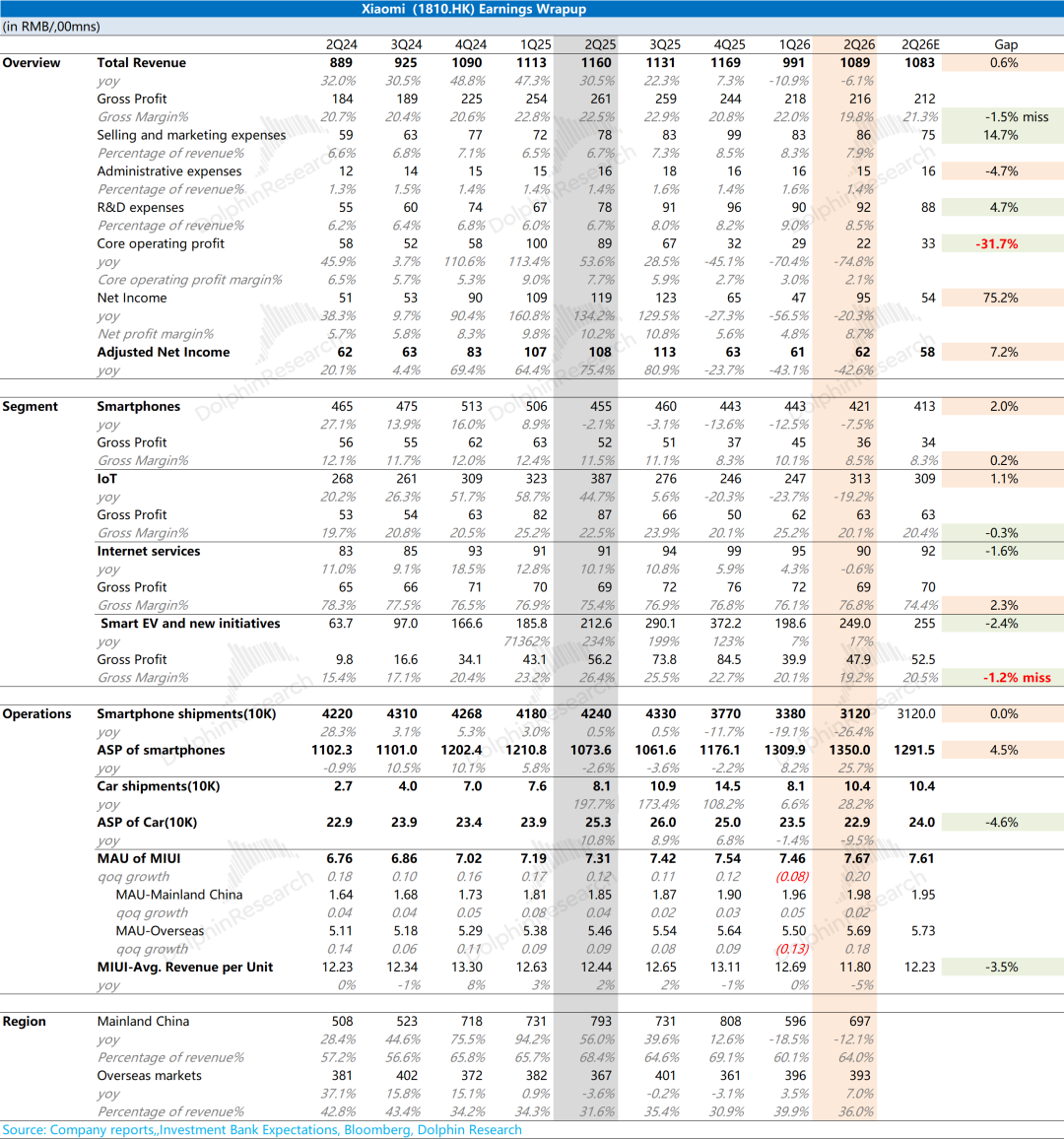
On the evening of August 18, 2026, Beijing time, following the close of the market, Xiaomi Group (1810.HK) released its financial results for the second quarter of 2026 (ending in June 2026). The key highlights are as follows:
1. Overall Performance: Xiaomi's revenue for this quarter reached RMB 108.9 billion, marking a 6% year-on-year decrease. This decline was primarily attributed to traditional businesses, notably smartphones. Revenue from these traditional sectors (smartphones and AIoT) fell by 11% year-on-year.
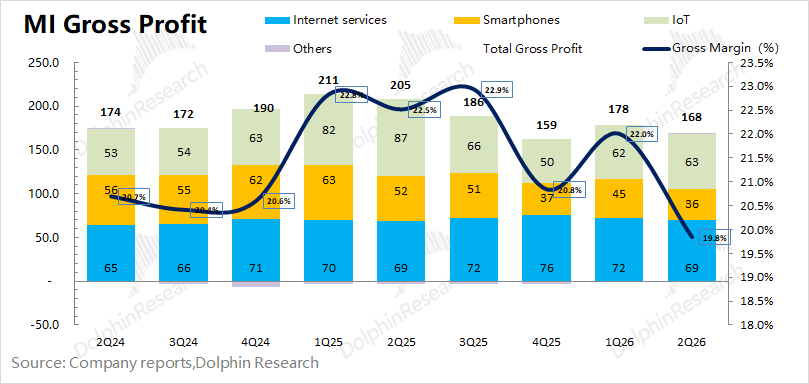
The gross profit margin for the quarter stood at 20%, down by 2.5 percentage points from the previous year, mainly due to decreases in gross profit margins for both smartphones and automotive businesses.
2. Automotive Business: Revenue from the automotive sector was RMB 24.9 billion, slightly below market expectations of RMB 25.5 billion. Xiaomi shipped 104,000 vehicles this quarter, with the average selling price per vehicle dropping to RMB 229,000—the primary reason for falling short of expectations—due to increased sales of the lower-priced SU7 facelift model.
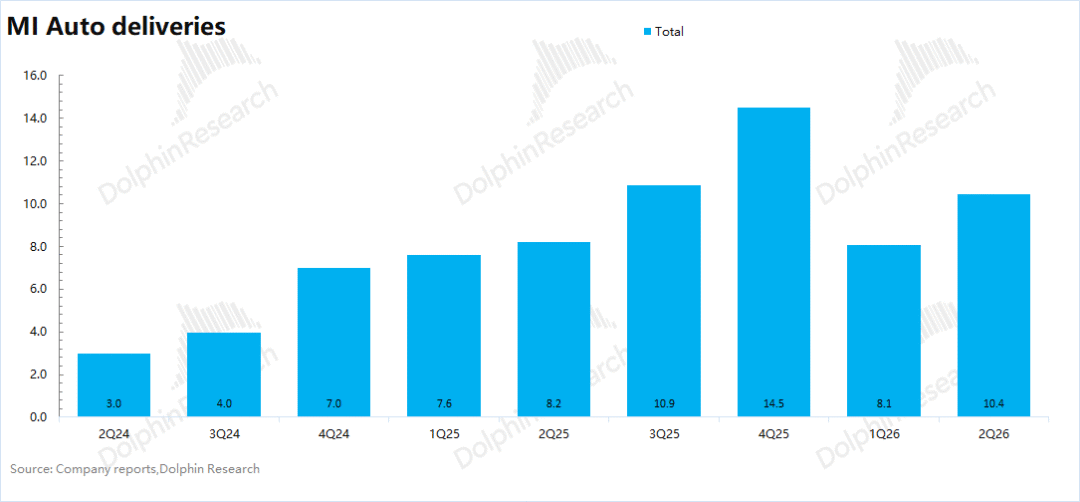
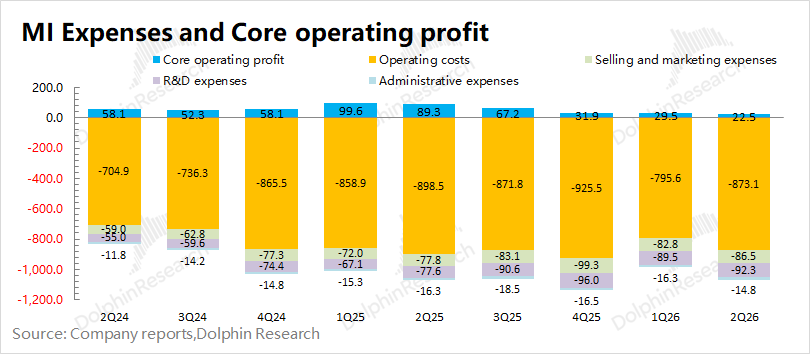
The automotive business's gross profit margin declined to 19.2%, a 7.2 percentage point year-on-year decrease, falling short of market expectations of 20.5%. This was mainly due to a continuous decline in average selling prices, with the SU7 facelift having the lowest starting price among all models, thereby structurally lowering the overall average price. Owing to the further decline in the gross profit margin, Dolphin Research estimates that Xiaomi's core operating profit from the automotive business fell into a loss of RMB 2.6 billion this quarter.
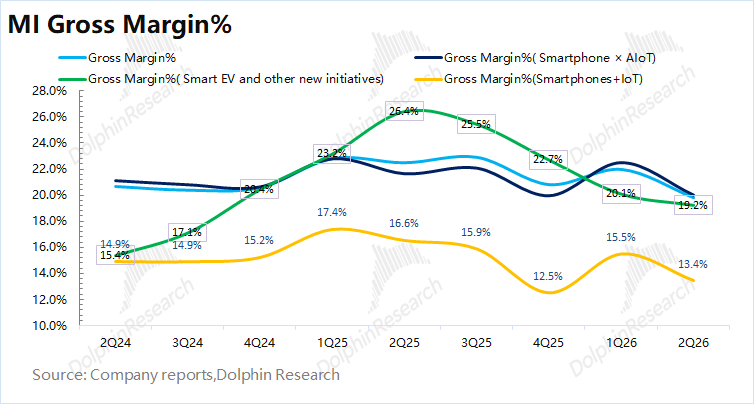
3. Smartphones: Revenue from smartphones was RMB 42.1 billion, a 7.5% year-on-year decrease, aligning with market expectations of RMB 41.3 billion. Xiaomi's smartphone shipments fell by 26% year-on-year, while the average selling price increased by 25% year-on-year, clearly adhering to the company's strategy of prioritizing price over volume.
In terms of market segments, Xiaomi's smartphone shipments in the domestic market fell by 21% year-on-year, while overseas shipments dropped by 28% year-on-year. Xiaomi's smartphone business is facing market share losses both domestically and internationally.
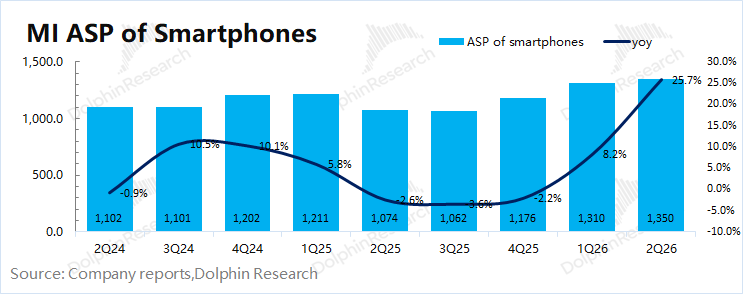
The increase in the average selling price of Xiaomi smartphones this quarter was mainly due to (1) the company prioritizing the allocation of storage to high-priced models amid storage shortages, and (2) passive price increases for smartphone products driven by cost pressures.
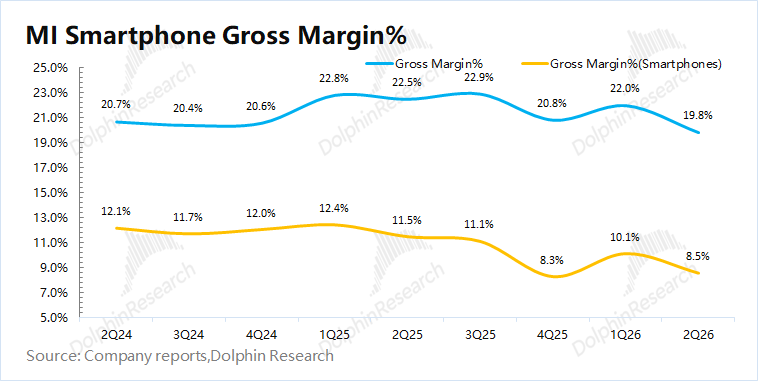
Despite a 25% year-on-year increase in the average selling price of smartphones this quarter, the company's gross profit margin remained relatively low at 8.5%, indicating significant pressure from storage issues.
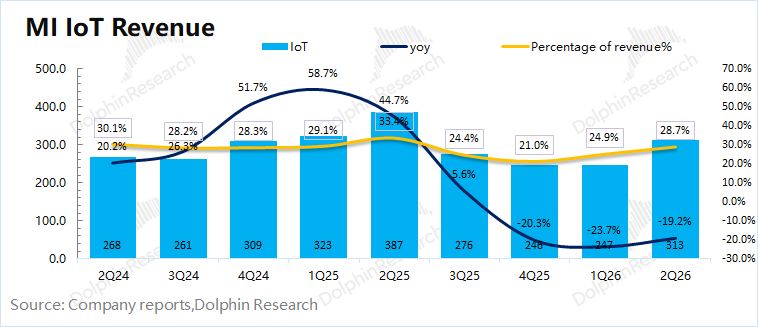
4. IoT: Revenue from IoT was RMB 31.3 billion, a 19% year-on-year decrease, broadly in line with market expectations of RMB 30.9 billion. Affected by factors such as reduced subsidies and storage shortages, the company's IoT business has seen year-on-year declines of around 20% for three consecutive quarters.
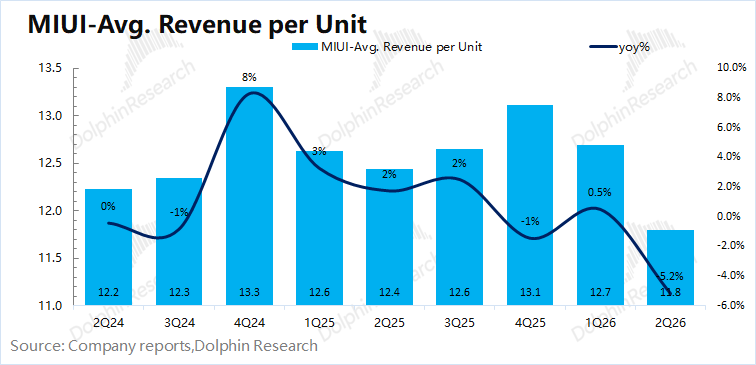
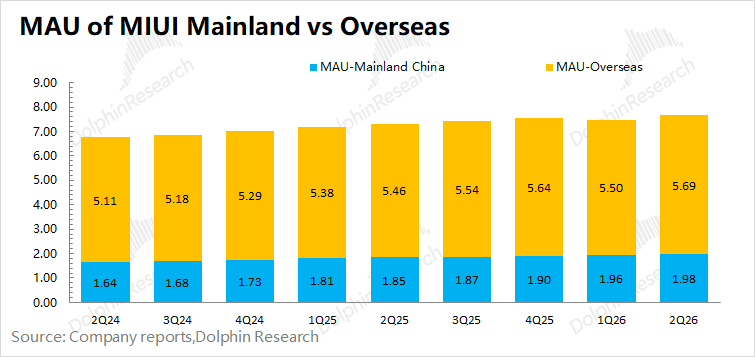
5. Internet Services: Revenue from internet services was RMB 9 billion, a 0.6% year-on-year decrease, slightly below market expectations of RMB 9.2 billion, mainly dragged down by declines in internet value-added services. The number of MIUI users increased by 5% year-on-year, while the ARPU value decreased by 5% year-on-year.
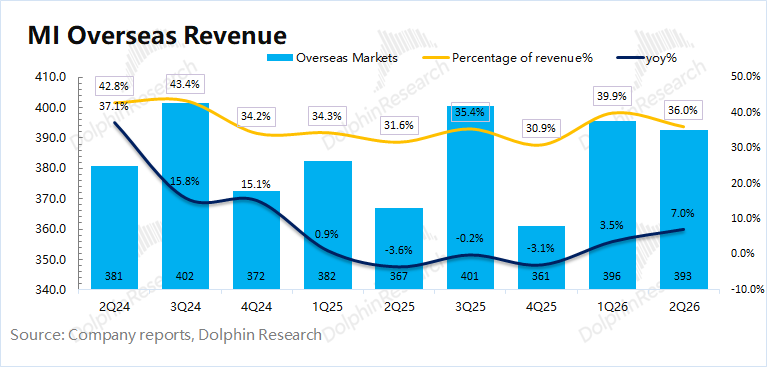
By region, overseas internet revenue was RMB 2.9 billion, while domestic internet revenue was approximately RMB 6.14 billion. Although the number of users increased both domestically and internationally, ARPU values in both markets saw declines this quarter.
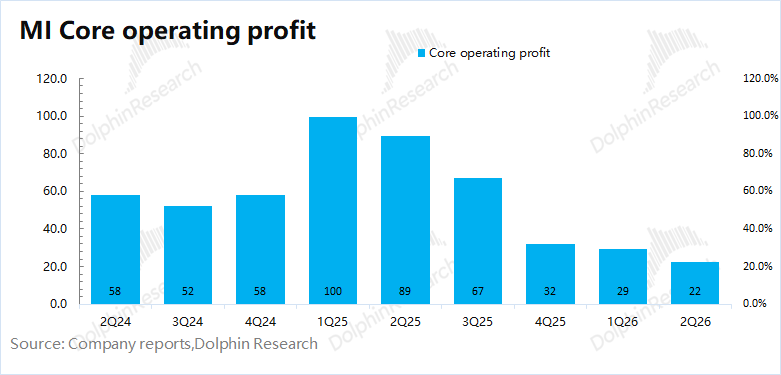
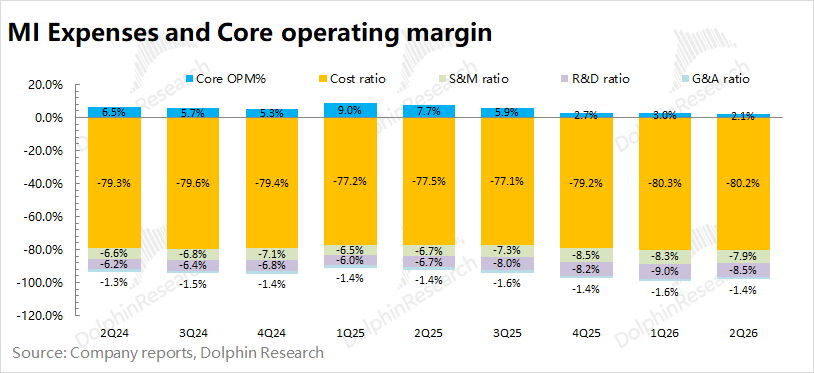
6. Profitability: Core profit was RMB 2.25 billion, with adjusted net profit at RMB 6.2 billion. The core profit from Xiaomi's traditional businesses was approximately RMB 4.86 billion, a 47% year-on-year decrease. The automotive business incurred a loss of RMB 2.6 billion this quarter, affected by the decline in gross profit margin.
Dolphin Research's Overall View: Main Business Stalls, Automotive Cooling Down, Can the 'Pengcheng' Series Turn the Tide?
Most of Xiaomi's financial data was broadly in line with market expectations. The year-on-year revenue decline this quarter was primarily due to the drag from traditional businesses such as smartphones and IoT. The underperformance in core profit was mainly due to the further decline in average selling prices and gross profit margins in the automotive business.
When Xiaomi's stock price fell from HK$61 to below HK$30, the headwinds the company faced in its business were already fully recognized by the market, including storage shortages, reduced subsidies, and the digestion of backlogged automotive orders.
With the company's stock price currently at a low level, the market is more concerned about:
(1) Whether traditional businesses will "perform worse": whether the smartphone gross profit margin will fall below 8% and when the IoT business will return to growth;
(2) The automotive business's target of 550,000 vehicles: whether management will lower the annual target after delivering only 216,000 vehicles in the first seven months;
(3) Other highlights (Xiaomi's automotive overseas expansion, AI, and robotics): These will not contribute significantly in the short term, but exceeding expectations in progress would enhance market expectations for the company's medium- to long-term prospects.
Based on this financial report, Xiaomi's traditional businesses have not yet "halted" their decline in the second quarter, with the smartphone gross profit margin remaining at a relatively low 8.5% and the IoT business continuing to see a nearly 20% year-on-year decline. In the automotive business, the "highlight performances" of the SU7 and YU7 have passed, with combined monthly sales dropping to around 30,000 units. The market can only look forward to the performance of the Pengcheng series extended-range models.
Beyond this financial report, the market is focused on the following core business developments:
a) Smartphone Business: This quarter still saw a significant decline, influenced by factors such as rising storage prices and tightened subsidies.
Xiaomi's smartphone shipments in the Chinese market fell sharply by 21% this quarter, mainly due to multiple unfavorable factors such as storage shortages and intensified market competition. During the same period, Apple's smartphone shipments in the Chinese market increased by 24% year-on-year (while the market declined by 4.3% year-on-year).
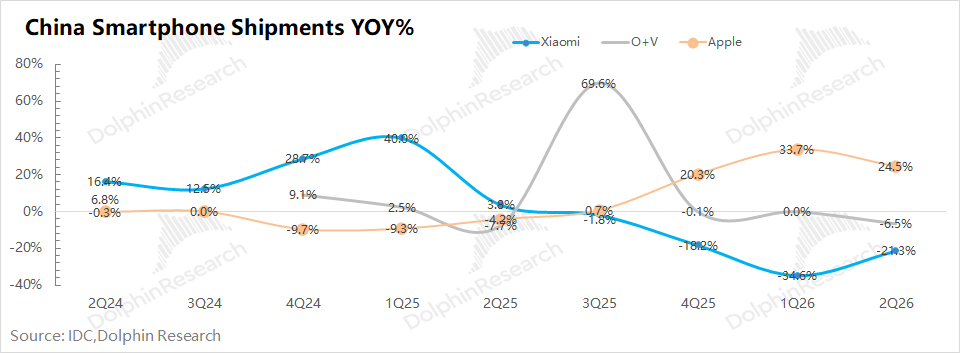
Apart from shipments, the market's primary concern this quarter was the smartphone gross profit margin, which stood at 8.5%, a 3 percentage point year-on-year decrease. Rising storage prices continue to exert significant pressure on the company, with the gross profit margin remaining below 10% despite price increases for smartphones. The market's current focus is no longer on "whether it will rebound" but rather on "whether the gross profit margin will further deteriorate."
b) Automotive Business: Will the annual target of 550,000 vehicles be met?
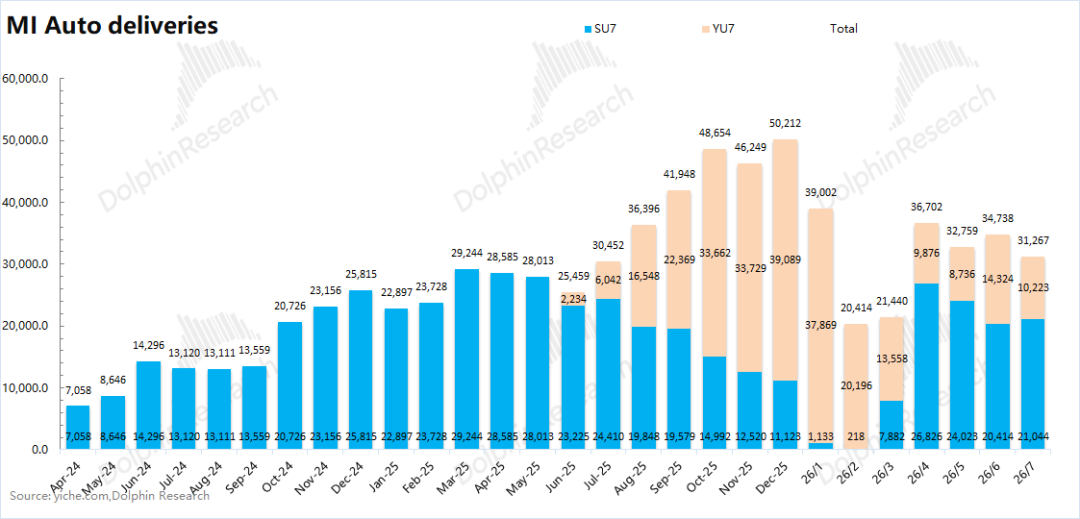
Xiaomi Automotive delivered 104,000 vehicles in the second quarter of 2026, a 28% quarter-on-quarter increase. The significant decline in sales last quarter was mainly due to the transition period for the SU7 "refresh." Even with the new SU7 driving sales, the company's sales from May to July remained at around 30,000-35,000 units, far below the previous monthly peak of 50,000 units.
From the current "delivery lead times" on Xiaomi's official website, the lead times for all models of the SU7 and YU7 have dropped to "4-7 weeks," confirming Dolphin Research's previous financial report assertion that "a significant backlog of orders has largely been digested."

Without the drive from backlogged orders, the "product cycles of the SU7 and YU7" have largely passed, with combined monthly sales of the two models remaining at around 30,000 units. The future highlights of the automotive business mainly depend on the performance of the Pengcheng series extended-range SUVs. The company launched two Pengcheng models at the end of July, revealing some specifications, with formal deliveries expected to begin in September. The upcoming Pengcheng N70 Max and Pengcheng N90 Max are priced at RMB 259,900 and RMB 299,900, respectively.
Comparing Xiaomi's new Pengcheng models with competitors, the Pengcheng N70 is positioned as a large five-seater SUV, similar to the Li Auto L7. The Xiaomi N90 Max competes with the Li Auto L9, using batteries from Sunwoda/EVE Energy and priced around 30% lower.
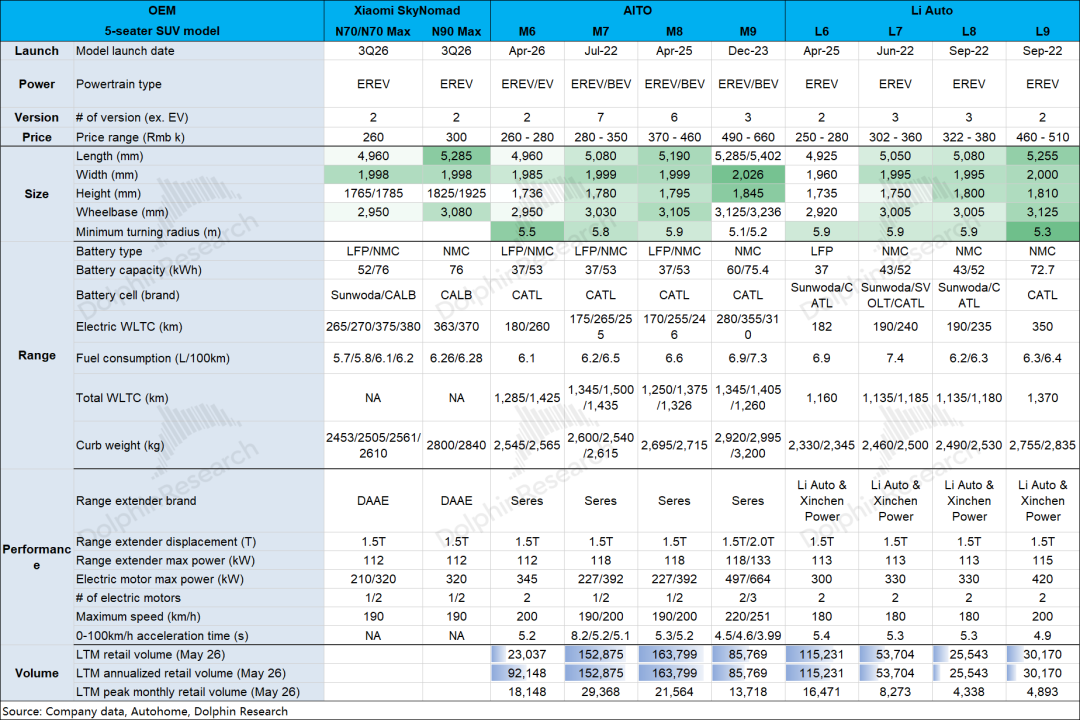
Notably, unlike the YU7 and SU7 facelift, for which the company announced lock-in data within an hour, the Pengcheng series did not disclose lock-in figures before the financial report. The SUV market in the RMB 200,000-300,000 range is China's "most competitive" segment (including BYD, Leapmotor, XPeng, and upmarket players like Li Auto and AITO).
The company previously set an annual shipment guidance of 550,000 vehicles, but achieving this appears "very challenging" based on the performance in the first seven months. If the SU7 and YU7 continue to maintain monthly deliveries of 30,000 units, the annual sales are expected to reach around 370,000 units, meaning the Pengcheng series would need to deliver 180,000 units in the remaining four months (corresponding to an average of 45,000 units per month, which is highly difficult).
Currently, mainstream institutions generally lower the company's annual sales expectations to 460,000-500,000 units. If management "explicitly lowers expectations" during the earnings call, it could signal a "negative catalyst has played out."
Xiaomi's current performance mainly comes from two parts: traditional businesses and the automotive business. Due to their distinct characteristics (the former being stable and the latter being growth-oriented), it is more reasonable to value the company using a Sum-of-the-Parts (SOTP) approach rather than a single PE valuation.
(1) Traditional Businesses: A Relatively Certain Bottom Reference
Assuming a 7% year-on-year decline in the smartphone business, a slight year-on-year decline in IoT, and a 9% full-year gross profit margin for smartphones, the company's core after-tax operating profit from traditional businesses in 2026 is estimated to be around RMB 17-18 billion.
Previously, when the storage industry saw a significant correction, the company's stock price rose notably, showing a clear "see-saw" effect between the two.
(2) Automotive Business: An Uncertain "Blind Box" with Upside Potential
Xiaomi Automotive sold a total of 216,000 vehicles in the first seven months. Assuming stable monthly shipments of around 30,000 units (SU7 + YU7) for the next five months, the full-year sales for these two models would be around 370,000 units.
The main uncertainty lies in the Pengcheng series, set to launch in September. Based on the performance of similar competitor models: the Pengcheng N70's comparable model has monthly sales of 10,000-30,000 units, while the Pengcheng N90 Max's comparable model has monthly sales of 5,000-15,000 units. We estimate the Pengcheng series' sales in the next four months to be 60,000-180,000 units.
Assuming Xiaomi Automotive's full-year ASP rebounds to RMB 245,000, the automotive business's revenue for 2026 would correspond to RMB 105-135 billion.
Considering both business segments, if traditional businesses do not decline further, they will provide a bottom price for the company. Due to uncertainties surrounding new model launches and the stabilization of SU7 and YU7 performances, the automotive business also has a certain bottom value (corresponding to full-year shipments of 430,000 units). If the Pengcheng series performs exceptionally well and still achieves the 550,000-unit guidance, the automotive business will
- END -
// Reprint Authorization
This article is an original work by Dolphin Research. Reprinting is strictly prohibited without prior authorization.
// Disclaimer and General Disclosure Notice
This report is compiled for general informational and data reference purposes, intended for the use of Dolphin Research users and its affiliated institutions. It does not consider the specific investment objectives, preferences for investment products, risk tolerance, financial circumstances, or particular needs of any individual recipient. Investors are advised to consult with an independent professional advisor before making any investment decisions based on the information provided in this report. Any individual who makes investment decisions using or referring to the content or information mentioned in this report assumes full responsibility for the associated risks. Dolphin Research shall not be held liable for any direct or indirect consequences or losses arising from the use of the data contained in this report. The information and data presented in this report are sourced from publicly available materials and are provided for reference only. Dolphin Research endeavors to ensure, but does not guarantee, the reliability, accuracy, and completeness of the relevant information and data.
The information or opinions expressed in this report shall not, under any circumstances, be construed as an offer to sell securities, an invitation to buy or sell securities, or as advice, solicitation, or recommendation regarding relevant securities or related financial instruments in any jurisdiction. The information, tools, and materials contained in this report are not intended for distribution to, or use by, any person or entity in any jurisdiction or country where such distribution, publication, availability, or use would contravene local laws or regulations or would subject Dolphin Research and/or its affiliates or associated companies to any registration or licensing requirements within that jurisdiction.
This report solely reflects the personal views, insights, and analytical methods of the respective authors and does not represent the official stance of Dolphin Research and/or its affiliated institutions.
This report is produced by Dolphin Research, and the copyright is exclusively owned by Dolphin Research. Without the prior written consent of Dolphin Research, no institution or individual may (i) produce, copy, duplicate, reproduce, forward, or create any form of copies or replicas in any manner, and/or (ii) directly or indirectly redistribute or transfer to any other unauthorized persons. Dolphin Research reserves all related rights.
-
![]()
Is the FREELANDER 8, Minus the Land Rover Emblem, a ‘Quick Band-Aid’ or a ‘Sustainable Strategy’?
-
![]()
Can General AI Assistants Avoid Repeating the Internet's Mistakes?
-
Organizational Structure in the AI Era: Insights from Google
-
![]()
Key Player Departs MiniMax Following M3 Launch
-
![]()
Raking in 4.7 Billion Yuan in Annual Revenue, a '92-Born Ex-ByteDance Employee Builds a $20 Billion AI Unicorn, Eyeing Hong Kong IPO
-
![]()
Li Shufu Takes a Strategic Step Back: What Lies Ahead for Geely?
-
![]()
Xiaomi's Midlife Challenge: Balancing Soaring Smartphone Storage Costs Against Losses in Its Automotive Ventures
-
![]()
Li Shufu Passes the Torch: Is Geely Stepping into the 'An Conghui Era'?