The Moment to Put Geely Auto’s An Conghui to the Test Has Come
 08/20 2026
 470
470
Li Shufu has passed the baton of Geely’s leadership to An Conghui.
On August 17th, Geely Auto accomplished two significant milestones simultaneously.
One was on the financial front:
In the first half of the year, the revenue soared to RMB 173.6 billion, marking a 15% year-on-year increase and reaching an all-time high. The core net profit attributable to the parent company stood at RMB 9.68 billion, a substantial 46% rise from the previous year.
In an industry where profit margins have dwindled to 3.8%, such a performance is truly noteworthy.
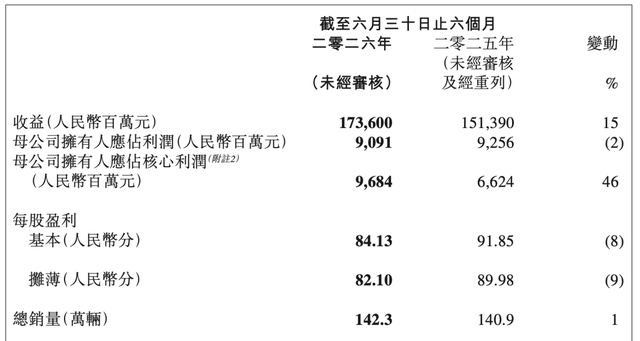
(Source: Geely Auto 2026 Half-Year Report)
The other was on the personnel front:
Li Shufu stepped down as Chairman of Geely Auto’s Board of Directors and was appointed Lifetime Honorary Chairman.
An Conghui, who has dedicated thirty years to Geely, succeeded him.
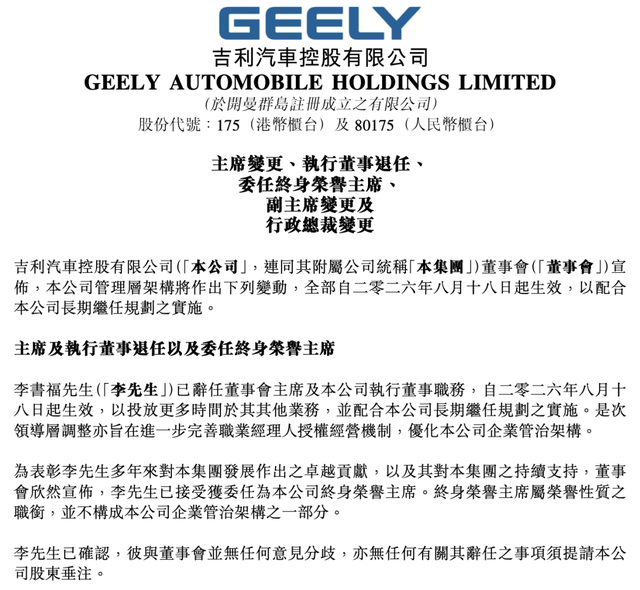
(Source: Geely Auto Announcement)
Geely stands as the first Chinese private automaker where the founder voluntarily ceded control of a listed company.
While handing over the reins during peak performance might seem like a strategic move, the task An Conghui has undertaken is far from straightforward.
First, let’s consider the timing of this transition.
Since the unveiling of the “Taizhou Declaration” in September 2024, Geely has embarked on a nearly two-year journey of “streamlining.”
Geometry was merged into Galaxy, Zeekr integrated Lynk & Co and completed privatization and delisting, a sales headquarters was established, and brands were consolidated from being “small and scattered” to “One Geely.”
This series of strategic moves has expanded Geely Auto’s asset scale, but the reality is:
Without Zeekr’s consolidation and export growth, the first-half performance would have been far more lackluster.
Incorporating Zeekr into the listed company’s financials already presents the most appealing aspect.
Thus, Li Shufu’s decision to hand over the reins during peak performance is not only to provide the new management team with a buffer zone but also to signal to the market:
I’ve arranged the pieces; now it’s your move.
The first challenge An Conghui faces is whether “One Geely” can transition from a mere slogan to a tangible reality.
The integration of Zeekr and Lynk & Co serves as a litmus test.
Both brands share the same roots and utilize the SEA architecture, with a high degree of technical overlap.
However, their market performances have diverged significantly:
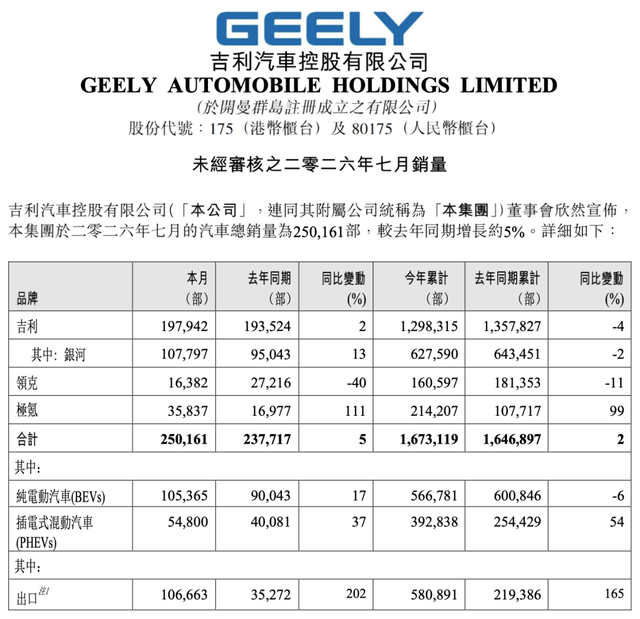
In July 2026, Lynk & Co’s sales plummeted by 40% year-on-year, while Zeekr’s surged by 111%.
Caught between Zeekr above and Galaxy below, Lynk & Co is emerging as the most challenging “underperformer” in Geely’s portfolio.
(Source: Geely Auto Announcement)
An Conghui has already stated at the interim results briefing that he will further “shut down, merge, or redirect redundant companies and projects.”
However, these four words—“shut down, merge, or redirect”—represent a strategy on paper but entail asset disposal, personnel placement, and channel adjustments in execution, each of which could potentially impact sales and profits in the short term.
A more significant issue is the transition of governance mechanisms.
In the past, Geely relied on Li Shufu’s personal authority for resource allocation and brand coordination. Now, this approach needs to be institutionalized into organizational capabilities.
Whether An Conghui can transition from a “boss-decides” model to a “system-decides” one is the most critical test of this transition.
The second challenge is that growth has come to a halt.
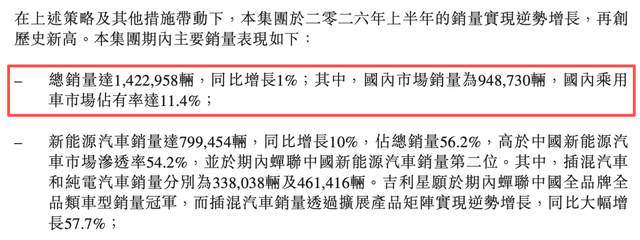
Geely’s total sales in the first half of the year reached 1.423 million units, a mere 1% year-on-year increase.
(Source: Geely Auto 2026 Half-Year Report)
The annual target of 3.45 million units is just over 40% achieved. The second half requires monthly sales of over 330,000 units amidst a 20% decline in the domestic market,
making this goal not just “challenging” but “extremely difficult.”
Geely is pinning its hopes on overseas markets.
Exports in the first half reached 474,000 units, a staggering 158% year-on-year increase, with overseas revenue accounting for 42.7% of total sales.
An Conghui has set an even more ambitious goal: a long-term strategy to derive two-thirds of sales from overseas markets.

(Source: Geely Auto 2026 Half-Year Report)
However, the cost of overseas expansion is substantial.
Volvo’s European plant won’t commence production until 2028, Proton’s Malaysian plant requires ongoing capacity upgrades, and Spain’s new 500,000-unit capacity base is still under construction.
Converting these overseas capacity “plans” into “output” necessitates years of significant investment.
The third challenge is the waning patience of the capital market.
Geely Auto’s stock price has plummeted more than 25% from its April peak, with the half-year results seemingly failing to elicit a positive response.
Investors are less concerned about “how much was earned in the past six months” and more focused on “whether it can earn as much in the coming years.”
The strategic transformation—from “acquisition sprees” to “shutting down and redirecting,” from “multi-brand” to “One Geely,” and from “domestic-focused” to “two-thirds overseas”—requires time to validate, but Hong Kong stock investors may not possess the patience to wait for it to materialize.
And now, the reins are firmly in An Conghui’s hands.
Whether Geely can maintain its course, accelerate its pace, and navigate through potential obstacles in the “post-Li Shufu era” will undoubtedly be one of the most captivating narratives in China’s auto industry in the years to come.
-
![]()
The Moment to Put Geely Auto’s An Conghui to the Test Has Come
-
![]()
The AI Product Selection Race Nears Its End: What's Next?
-
![]()
Equating Li Shufu's Resignation with De-familization is a Major Misstep
-
Did Baidu and Xiaomi Hit Their Pivotal Moments on the Same Day?
-
![]()
The Dual Prospects of New Energy Heavy Trucks
-
Li Shufu Passes the Torch at the Zenith: The Culmination of 'One Geely' Heralds a New Era of Professional Management
-
![]()
Tencent Has Secured Its Ticket for the AI Era
-
Surging Over 269%: Has Yuan Yonggang Made the Right Bet on the 'Mother Machine of Light Creation'?