Li Shufu Passes the Torch at the Zenith: The Culmination of 'One Geely' Heralds a New Era of Professional Management
 08/20 2026
 404
404
Editor: Chen Xiaoran
A Stellar Final Report, Indeed
On August 17, Geely Auto (00175.HK) unveiled its most outstanding interim financial report to date, while another announcement on the same day sent ripples throughout the automotive industry.
Li Shufu stepped down as Chairman of the Board and Executive Director of Geely Auto, with seasoned internal professional managers, namely An Conghui and Gan Jiayue, officially taking the helm.
This leadership transition at the pinnacle of success epitomizes Geely's evolution from a 'one-man show' to a 'collective leadership era'.
According to the management reshuffle announcement, the personnel changes came into effect on August 18, marking a comprehensive revamp of Geely Auto's core governance structure.
The announcement disclosed that Li Shufu relinquished his roles as Chairman and Executive Director of Geely Auto, was bestowed the title of Lifetime Honorary Chairman, and would continue to steer Zhejiang Geely Holding Group.
Moreover, An Conghui assumed the mantle of Chairman of the Board; Li Donghui stepped down as Vice Chairman but retained his position as Executive Director; Gui Shengyue ceded his role as CEO to become Vice Chairman of the Board; Gan Jiayue, an executive from the post-80s generation, was appointed CEO to oversee the daily operations of the listed entity.
In contrast to the gradual leadership transitions observed in most domestic private enterprises, this adjustment accomplished a simultaneous overhaul of the three pivotal positions—Chairman, Vice Chairman, and CEO—a move seldom witnessed among private automakers.
The new management cohort was nurtured entirely within Geely, with no external recruitment, ensuring a seamless transition of internal talent.
Significantly, Li Shufu did not entirely withdraw from the Geely ecosystem, as control at the holding group level remained intact. He will continue to wield influence at the strategic and cultural levels, fostering a governance model of 'stepping back without fading away' to further demarcate ownership from management.
The new nine-member board, comprising five executive directors and four independent directors, established a three-tier governance framework involving the holding group, listed company, and operational team, delineating the boundaries of authority and responsibility for all stakeholders.
Gui Shengyue remarked that this adjustment signifies a pivotal stride in Geely's 'de-familization', with enterprise development shifting from reliance on the founder's personal authority to organization-driven systems.
Li Shufu's final performance report is indeed remarkable.
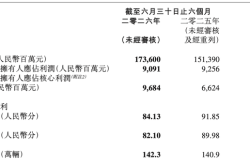
In the first half of 2026, Geely Auto reported revenue of RMB 173.6 billion, up 15.51% year-on-year; net profit attributable to the parent company was RMB 9.091 billion, slightly down by 1.8% year-on-year. Excluding non-core elements such as exchange gains/losses and asset impairments, core net profit attributable to the parent company reached RMB 9.684 billion, up 46% year-on-year; gross margin increased by 1.5 percentage points to 17.94%.
In the first half of 2026, Geely's total sales reached 1.423 million units, up slightly by 1% year-on-year. Based on this, the core net profit per vehicle for the period was approximately RMB 6,806, up 45% year-on-year. The primary catalyst for profit growth was product premiumization and overseas export business.
By brand, in the first half of 2026, Zeekr contributed 31.7% of revenue, emerging as the group's core profit pillar. Cumulative sales reached 178,300 units, up 97% year-on-year, with an average selling price of approximately RMB 350,000. Meanwhile, Geely Galaxy sold nearly 520,000 units, and Lynk & Co sold 144,000 units.
Overseas markets emerged as the second growth engine. In the first half of 2026, Geely exported 474,000 units, up a staggering 158% year-on-year, with export volume in the first half already surpassing the total for 2025. The company accordingly raised its full-year export target to 920,000 units, aiming for 1 million overseas sales, including 277,200 new energy vehicle exports, up 585% year-on-year.
However, this transition is not without its challenges.
In the first half of 2026, Geely's net profit attributable to the parent company declined by 1.8% year-on-year, primarily due to non-core factors such as exchange gains/losses and asset impairments. Domestic market pressures led to declines in domestic sales for Galaxy, Lynk & Co, and the China Star series, with group profit growth heavily reliant on Zeekr and overseas markets, underscoring the structural risk of relying on a single brand for profit support.
Fortunately, the company is well-prepared. As of the end of June 2026, Geely Auto had RMB 59.362 billion in cash and cash equivalents, with total financial reserves of RMB 69.6 billion when including restricted bank deposits and principal-protected structured deposits. This ample cash flow can sustain ongoing R&D investment and global expansion.
This management transition is not an isolated personnel change but the culmination of a two-year 'One Geely' integration strategy. The strategy originated from the 'Taizhou Declaration' released in September 2024.
Over the years, Geely's multi-brand parallel expansion model gradually led to overlapping product lines, redundant R&D investments, and internal resource competition.
In response, Geely initiated a large-scale internal integration, merging Geometry into Galaxy and having Zeekr acquire a controlling stake in Lynk & Co. Zeekr was delisted from the NYSE through privatization and reincorporated into Geely Auto's listed entity, consolidating high-end assets under the 00175.HK platform.
The procurement, R&D, and marketing systems were gradually streamlined, with redundant entities shut down to reduce internal transactions and duplication. After integration, Geely formed a complete product lineup covering mass-market, mainstream, and luxury segments, aligning with BYD's integrated platform model.
The reform unfolded in three phases: brand mergers, equity consolidation, and governance restructuring. This personnel adjustment completed the final governance layer, aligning the organizational structure with the unified listed platform strategy.
From the early 'Ningbo Declaration' focusing on technological competition to the 'Taizhou Declaration' promoting synergistic integration, Geely completed a strategic shift from scale expansion to consolidation and from prioritizing scale to prioritizing profitability over 17 years.
The core objective of this founder's succession is to ensure the uninterrupted implementation of the integration strategy despite changes in the founder's role.
Li Shufu mentioned at the Chongqing Auto Forum that the essence of enterprise succession is to fully pass on core values, management systems, and governance structures to the next generation of management.
Notably, Geely's transition coincides with the industry's most challenging period.
According to the China Passenger Car Association (CPCA), since April 2026, the penetration rate of new energy passenger vehicles in China's retail market has exceeded 60% for three consecutive months. The industry-wide price war continues to squeeze OEM profits, officially entering a phase of inventory competition.
Data from the China Association of Automobile Manufacturers (CAAM) shows that in the first half of 2026, the average profit margin of China's vehicle manufacturing sector was just 1.5%, at a decade-low. The CPCA reported that domestic passenger vehicle retail sales reached 8.701 million units in the first half, down 20.2% year-on-year, indicating significant domestic demand pressure.
The industry landscape is rapidly diversifying. BYD maintains relatively high profitability and valuation with its complete vertical supply chain, while traditional automakers like Great Wall and Changan face ongoing operational pressures, with many peers trapped in a cycle of revenue growth without profit increase.
Capital market recognition of Geely is mixed.
Since the beginning of 2026, Geely has been one of the few passenger vehicle OEMs in the H-share market to maintain positive stock price growth, with 46 institutions increasing their holdings or establishing new positions in the first half, including BlackRock holding 4.59%.
However, as of the close on August 19, 2026, Geely Auto's trailing P/E ratio was approximately 10.1x, while BYD's Hong Kong P/E ratio was around 26.4x. This significant valuation gap reflects market pricing differences in technology self-reliance, long-term growth prospects, and governance stability.
Geely is not without technological prowess. The company has fully deployed the SEA Gravity architecture, three-electric systems, low-orbit satellites, and in-vehicle AI large models, establishing a space-ground integrated technology ecosystem with a mature technological foundation. However, its technological attributes have not yet been fully recognized by the capital markets.
With overseas markets poised to be the next key battleground for automakers, Geely has set a long-term goal of deriving two-thirds of its sales from overseas markets, planning to build key markets in Central Asia, the Middle East, Latin America, ASEAN, and Europe. Global competition will determine the next phase of domestic automaker rankings.
Returning to the core business, Zeekr, as the current primary profit driver, faces risks if growth in high-end models slows and other brands cannot quickly fill the gap. An Conghui has publicly admitted that Geely lacks mid-range blockbuster models, creating a clear gap in its product matrix. Global operations entail risks from exchange rate fluctuations, overseas regulations, and geopolitical tensions, as evidenced by exchange gains/losses in this period's financial report. Additionally, how the board and management form a stable and efficient decision-making mechanism after the founder steps back remains to be seen.
Li Shufu's decision to voluntarily hand over the reins at a performance peak is a rare choice among China's first-generation private entrepreneurs, aligning with the modern enterprise transformation paths of Midea's He Xiangjian and Vanke's Wang Shi.
This transition is not an ending but a new beginning for Geely, shifting from founder-driven to system- and team-driven growth.
For the new management team of An Conghui and Gan Jiayue, the real operational challenges are just beginning.
How to achieve cost reduction and efficiency gains, address domestic product gaps, sustain Zeekr's growth, and successfully advance globalization will determine whether Geely can navigate this brutal automotive industry cycle and hold its ground in the long-term rivalry with BYD.
The automotive industry is a marathon without a finish line. After the baton is passed, Geely must script a new chapter on the track.
-
![]()
Can Tencent Still 'Buy a Ticket' Onboard with an Extra 20 Billion?
-
![]()
The Moment to Put Geely Auto’s An Conghui to the Test Has Come
-
![]()
The AI Product Selection Race Nears Its End: What's Next?
-
![]()
Equating Li Shufu's Resignation with De-familization is a Major Misstep
-
Did Baidu and Xiaomi Hit Their Pivotal Moments on the Same Day?
-
![]()
The Dual Prospects of New Energy Heavy Trucks
-
Li Shufu Passes the Torch at the Zenith: The Culmination of 'One Geely' Heralds a New Era of Professional Management
-
![]()
Tencent Has Secured Its Ticket for the AI Era