Why is the Huajing S Priced at 159,800 Yuan?
 08/24 2026
 349
349
Produced by Zhineng Technology
What should be the price tag for a spacious six-seater SUV, measuring 5,235 mm in length and boasting a wheelbase of 3,105 mm, fully equipped with Huawei Qiankun Intelligent Driving, HarmonyOS Cockpit, and Qiankun Vehicle Cloud?
Based on the pricing trends in the new energy vehicle market over recent years, one might expect the price to be around 250,000 yuan or even higher.
However, the official starting price for the Huajing S is a surprisingly affordable 159,800 yuan. This SUV is longer than many mid-size models, offers three rows of six seats, and even the base version comes standard with Huawei Qiankun ADS Pro Enhanced Edition, in-cabin laser vision Limera, and supports urban and highway navigation, as well as all-scenario parking assistance.
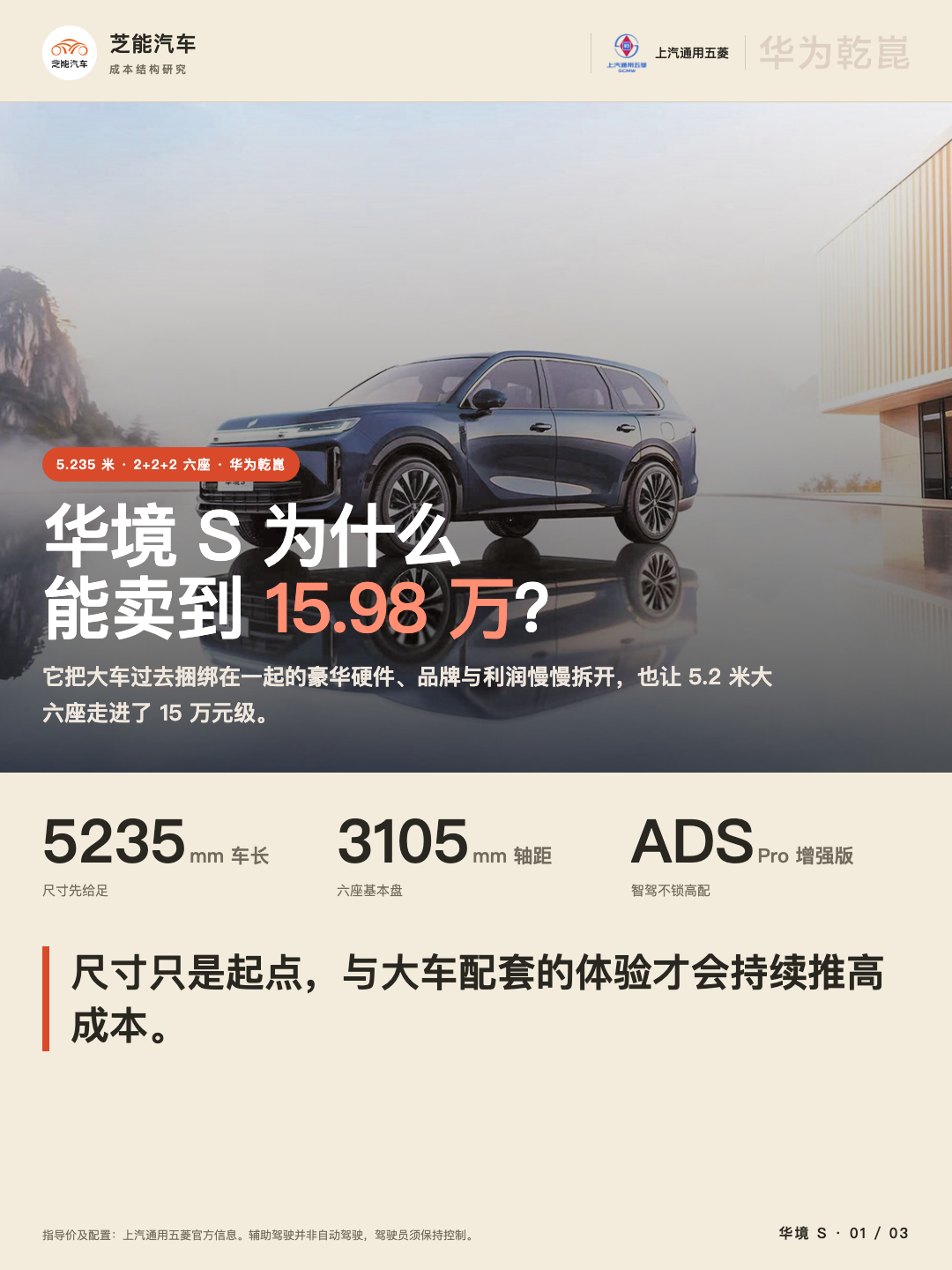
Why is the Huajing S, equipped with Huawei's cutting-edge technology, so affordably priced?
A 5.2-meter vehicle, enhanced with Huawei's technology, is priced lower than anticipated.
We've previously overestimated the cost associated with vehicle size and underestimated the impact of brand, distribution channels, powertrain, and profit margins on pricing.
A 5.2-meter vehicle isn't as costly as we've imagined.
As previously mentioned, cars aren't priced per square meter like real estate. Increasing the body length from 4.9 meters to 5.2 meters does raise costs for materials like steel, glass, wiring harnesses, interiors, painting, and transportation. However, the overall vehicle cost doesn't increase proportionally with the length.
The long-held consumer belief that "larger vehicles must be expensive" stems from the fact that past large-size models often came with luxury brands, large-displacement engines, four-wheel drive, air suspension, leather seats, and higher sales profits.
A 5.2-meter SUV can feature ordinary suspension or dual-chamber air suspension; it can offer six basic seats or be configured with zero-gravity seats, ventilation, heating, massage functions, and complex electric mechanisms; it can adopt a powertrain that meets basic demands or pursue sub-4-second acceleration and a larger battery.
Body size determines passenger capacity but doesn't solely dictate the vehicle's value.
The Huajing S separates size from luxury features, making the 5.2-meter length, 3.1-meter wheelbase, and three rows of six seats the standard offering. It then decides which "large vehicle experiences" to include in the 159,800 yuan base version.
What you get for 159,800 yuan is core functionality. 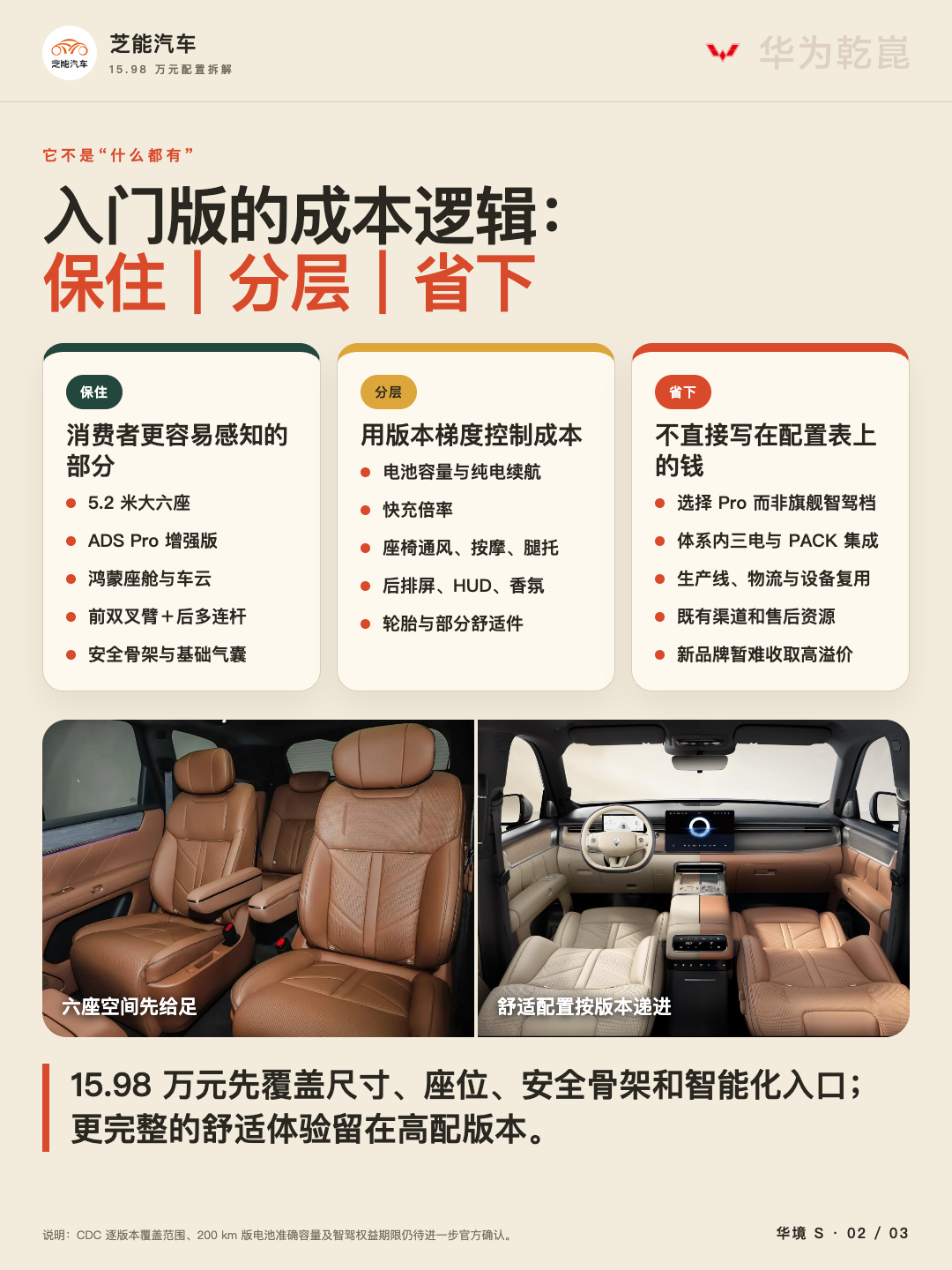
The smartest aspect of the Huajing S base version is that it standardizes the highest-value configurations across all trims.
Body size, six-seat layout, Huawei ADS Pro Enhanced Edition, Limera, HarmonyOS Cockpit, Qiankun Vehicle Cloud, and front double-wishbone and rear multi-link suspension aren't exclusive to high-end models.
The product value is immediately apparent: a large vehicle with six seats, Huawei Intelligent Driving, and HarmonyOS Cockpit, all for 159,800 yuan.
The Huajing S does offer tiered configurations. The base version has lower battery capacity, all-electric range, and fast-charging specifications compared to high-end versions. Seat ventilation, heating, massage, leg rests, rear entertainment screens, HUD, branded tires, and some comfort features increase with higher trims.
The Huajing S doesn't restrict size and intelligence capabilities to high-end models but maintains clear version differences in battery, comfort, and some chassis configurations.
This makes the 159,800 yuan version seem very complete, as it includes the capabilities most easily perceived and marketed by consumers, while reserving luxury comfort features for high-end models.
Huawei Intelligent Driving is costly, but the Huajing S didn't opt for the most expensive Huawei solution.
The Huajing S uses the ADS Pro Enhanced Edition, not the ADS Max or Ultra.
Although Limera has laser perception capabilities, it adopts an in-cabin integrated all-solid-state solution, rather than the multi-lidar fusion perception system used in AITO flagship models.
This solution eliminates the need for roof holes, mechanical rotating structures, or independent cleaning mechanisms. It's a technical route designed by Huawei to bring assisted driving to more affordable vehicles.
The Huajing S also doesn't bear the full cost of developing an intelligent driving system from scratch. Huawei has already completed the development of algorithms, sensors, domain controllers, cloud training, and software systems. A relatively standardized solution can be deployed across different brands and models.
For Wuling, purchasing a mature solution is far more cost-effective than independently establishing a complete high-level assisted driving team.
The Huajing S doesn't force the most expensive Huawei Intelligent Driving into a 150,000 yuan vehicle but instead selects the most suitable solution for widespread adoption at this stage. It retains the urban navigation capabilities that consumers value most while avoiding the most expensive perception hardware of the flagship solution. This is the technological prerequisite for Huawei Intelligent Driving to enter the 150,000 yuan market.
What truly reduces the price is Wuling's existing cost system.
If the Huajing S were the first product from a new automotive company, achieving a price of 159,800 yuan would be more challenging. A new company would need to build vehicles, establish factories, powertrains, supply chains, dealerships, after-sales networks, and brand recognition from scratch.
Behind the Huajing S is Wuling's established manufacturing system, which has been operating for years. Its 1.5T hybrid-specific engine, ten-in-one DHT, electric drive, and battery PACK are developed and produced by enterprises within the system. Although the battery cells are procured externally, the battery system integration is still completed by Wuling.
In-house development and production don't mean zero cost but can reduce supply chain tiers, bringing research and development, production, logistics, and vehicle assembly closer together.
Wuling also adopts an intelligent island-style production system at the manufacturing end, allowing different products to share equipment, shortening changeover times, and compressing logistics and inventory through "factory-within-a-factory" and sequential delivery.
The savings come from cost reductions in every link: one less layer of supply chain profit in the powertrain, one less duplicate investment in production lines, one shorter distance in logistics, and one less independent manufacturing system for new models.
The Huajing S purchased Huawei technology but didn't buy the entire HarmonyOS Intelligent Mobility system.
The brand, product pricing, sales, and after-sales of the Huajing S are still controlled by SAIC-GM-Wuling. It doesn't enter the HarmonyOS Intelligent Mobility channel but is sold and serviced through Huajing Experience Centers and Wuling's and Baojun's existing systems.
Therefore, the Huajing S purchases Huawei's technological capabilities. The same technology, installed on models under different cooperation models, may ultimately have completely different prices.
The Huajing S is still a vehicle defined, produced, and sold by Wuling. Huawei provides the most important intelligent selling points but doesn't take over the entire vehicle's commercial closed loop. This allows the Huajing S to leverage Huawei to build a technological image while continuing to use Wuling's expertise in low-cost manufacturing and channel systems.
159,800 yuan may also be a strategic price. 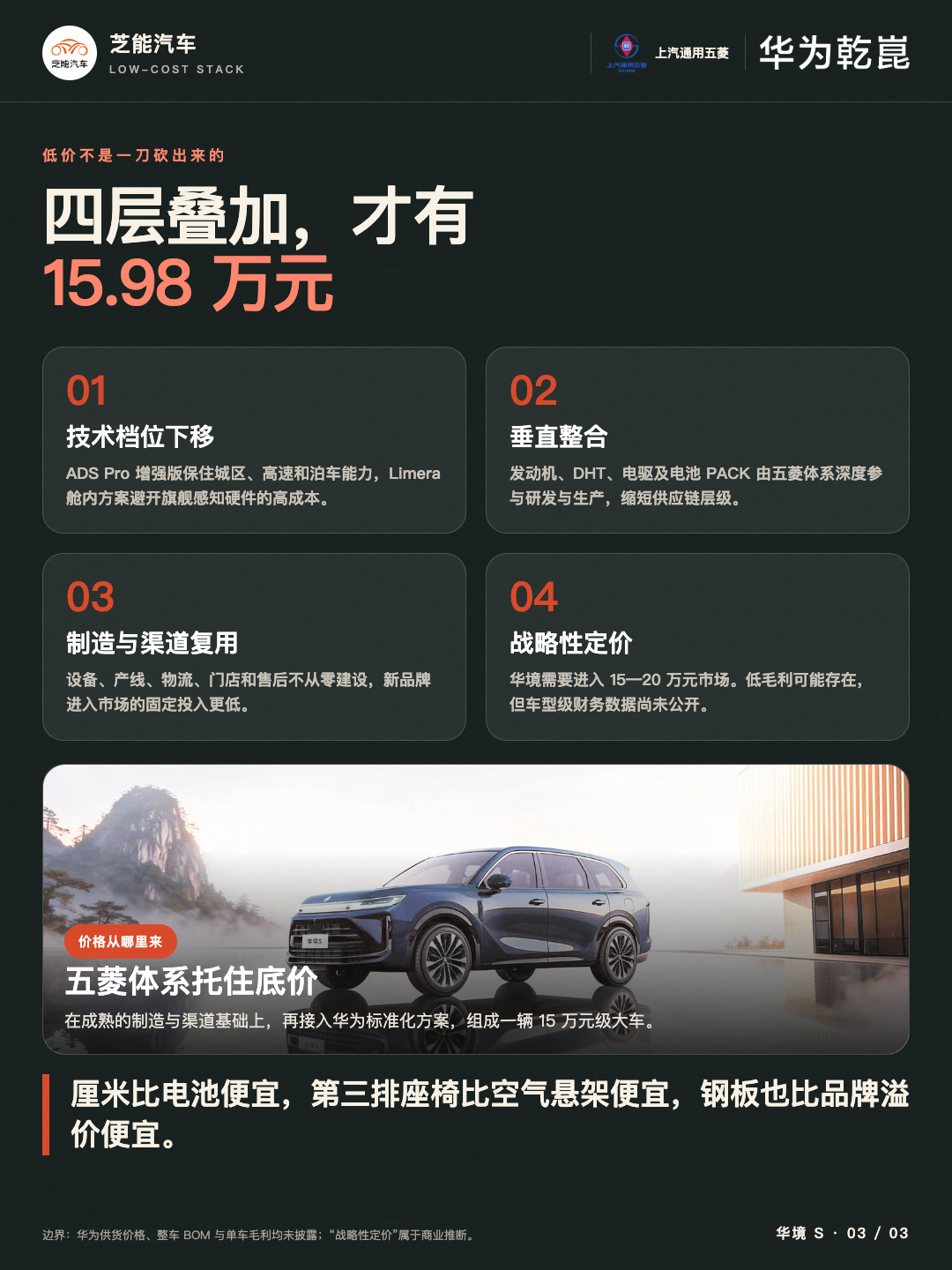
From a business logic perspective, 159,800 yuan is likely not just a result of cost calculation but also a market entry price.
Wuling's past main products have long been concentrated below 100,000 yuan. The Huajing S needs to help it enter the 150,000 to 200,000 yuan market while convincing consumers to accept a newly established brand.
In this case, the primary task of the first product may not be to pursue the highest per-unit profit but to quickly establish visibility and sales volume.
Therefore, the low price of the Huajing S is likely formed by four factors working together:
◎ Huawei chose the lower-cost Pro Enhanced Edition solution;
◎ Internal integration of the three-electric and manufacturing systems;
◎ Reuse of channel and after-sales resources;
◎ More aggressive pricing in the initial stage of the new brand.
The first three items can be supported by publicly available information, while the last item is a business inference and cannot be written as a definitive conclusion without financial data.
Summary
The Huajing S, priced at 159,800 yuan, demonstrates that a smart and electric "large six-seater vehicle" with a 5.2-meter body doesn't have to be as expensive as consumers imagine. The Huajing S offers the size, six seats, safety framework, and intelligence that everyone desires. Would you like to go check it out?
-
![]()
Registered Capital Slashed to 372 Million Yuan! Yutong Optical Finalizes Industrial and Commercial Change Registration
-
![]()
Zhuque-3 Successfully Lands, and 'Time Traveler' Secures Another ¥100 Million in Funding: China's Commercial Space Industry Experiences a 'Dynamic August'
-
![]()
Autohome Faces a Shrinking Window of Opportunity
-
![]()
Even a Titan Like Musk Has Faced Setbacks in Fulfilling Promises
-
![]()
AI Office: The End of the Racing Era, Context Becomes the Key to Success
-
![]()
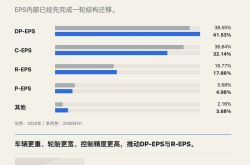
Domestic Vehicle Chassis Revolution ②: The Steering Wheel Remains, But Mechanical Connections in the Steering System Are Decreasing
-
![]()
Exploring MiniMax Design: Can Video Editing Be as Simple as Speaking?
-
![]()
Why Can SenseTime Achieve Profitability While CloudWalk Still Faces Challenges, Despite Both Adopting Large Models?