Domestic Car Chassis Revolution Part 3: Suspension Systems Transform Vehicle Posture, from Vibration Absorption to Active Force
 08/24 2026
 536
536
While braking and steering remain critical technical considerations, the vehicle's Z-direction suspension system, designed for comfort and sophistication, has become a major draw for large SUVs and MPVs.
The suspension system's primary role is to shield the cabin from road impacts. Springs support the vehicle's body, while dampers dissipate vibrations.
Engineers strike a balance between comfort and handling by fine-tuning spring stiffness, damping, and suspension geometry. Softer settings enhance comfort, while firmer ones provide sharper responses. Achieving both simultaneously remains a challenge.
In the first half of 2026, significant advancements emerge through electronic control. According to the NE Era report, passive suspension still dominates with 78.66% market share, though this represents a notable decline from 85.09% in 2025. Semi-active suspension rises to 10.82%, active suspension to 9.81%, and fully active suspension reaches 0.69%.
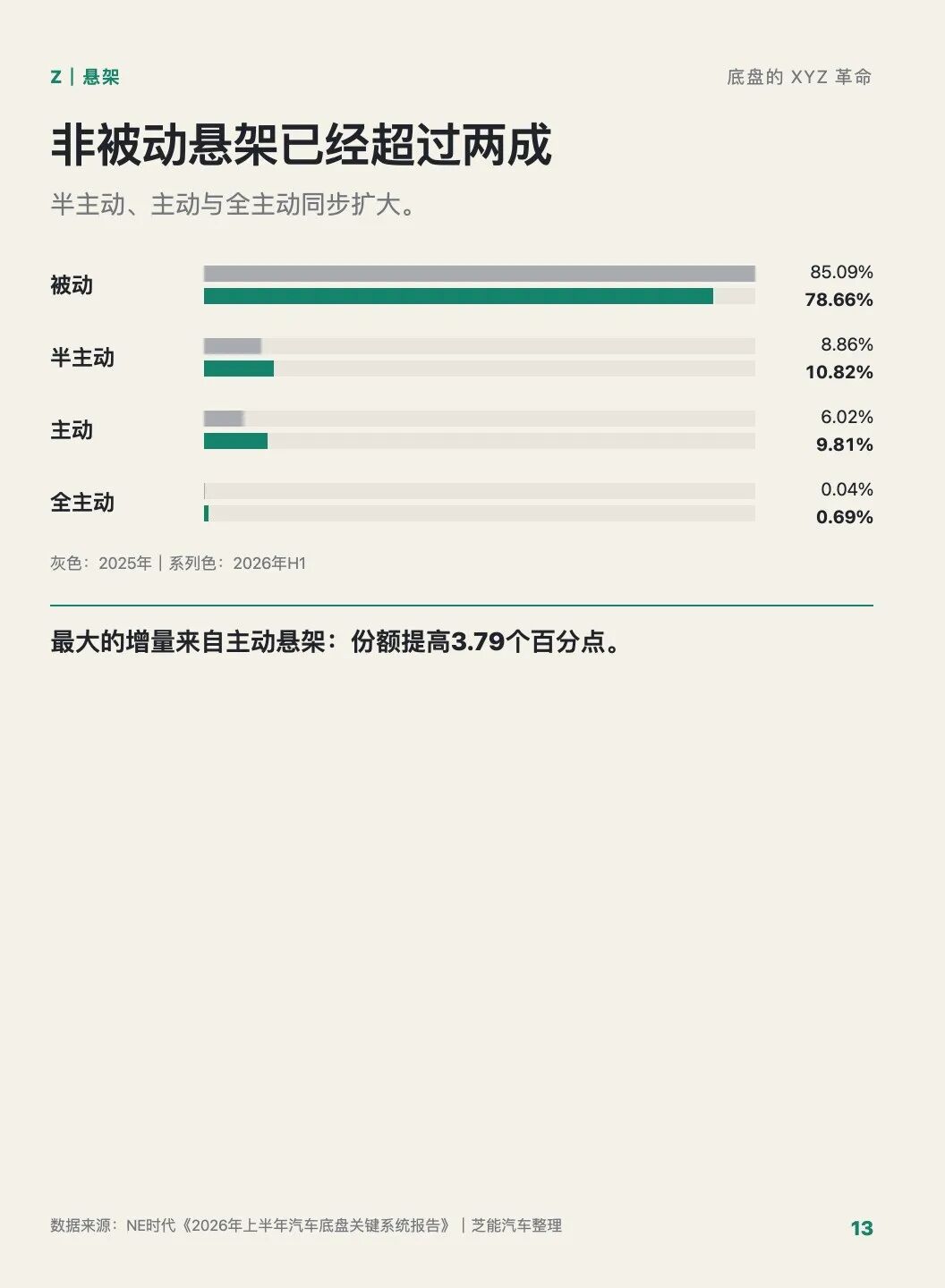
Non-passive solutions now account for over 20% of the market, with suspension systems beginning to dynamically adjust damping and height, and even actively applying force to the vehicle body.
Part 1: How to Differentiate Among Four Types of Suspension?
Passive Suspension: After manufacturing, passive suspension systems have fixed spring and damper parameters. They are cost-effective and feature a mature design, still covering the majority of vehicle models.
Semi-active Suspension: Semi-active systems cannot actively raise or lower the vehicle body but can adjust damper damping in real-time. CDC controls oil flow through solenoid valves, while MRC adjusts damping through magnetorheological fluid. This allows the vehicle to soften over speed bumps and stiffen during rapid turns or braking. It resolves the conflict between comfort and support at a relatively low cost, making it one of the fastest-growing solutions.
Active Suspension: Active suspension typically combines electronically controlled dampers with air springs. Dampers adjust softness or firmness, while air springs adjust body height and spring characteristics. The vehicle can lower its body at high speeds, raise its chassis over rough roads, and maintain levelness under varying loads.
Fully Active Suspension: Fully active suspension systems go a step further by using actuators to actively apply force to the wheels or body. They suppress nose dive during hard braking, control squat during acceleration, resist body roll during turns, and proactively support the body over uneven roads. Rather than just adjusting "softness or firmness," they generate the necessary support force for the vehicle.
These four technologies represent increasing levels of control capability. As solutions advance, requirements for energy consumption, heat dissipation, sensors, control algorithms, and reliability become more stringent.
Part 2: CDC/MRC Bring Electronically Controlled Dampers to the Mainstream Market
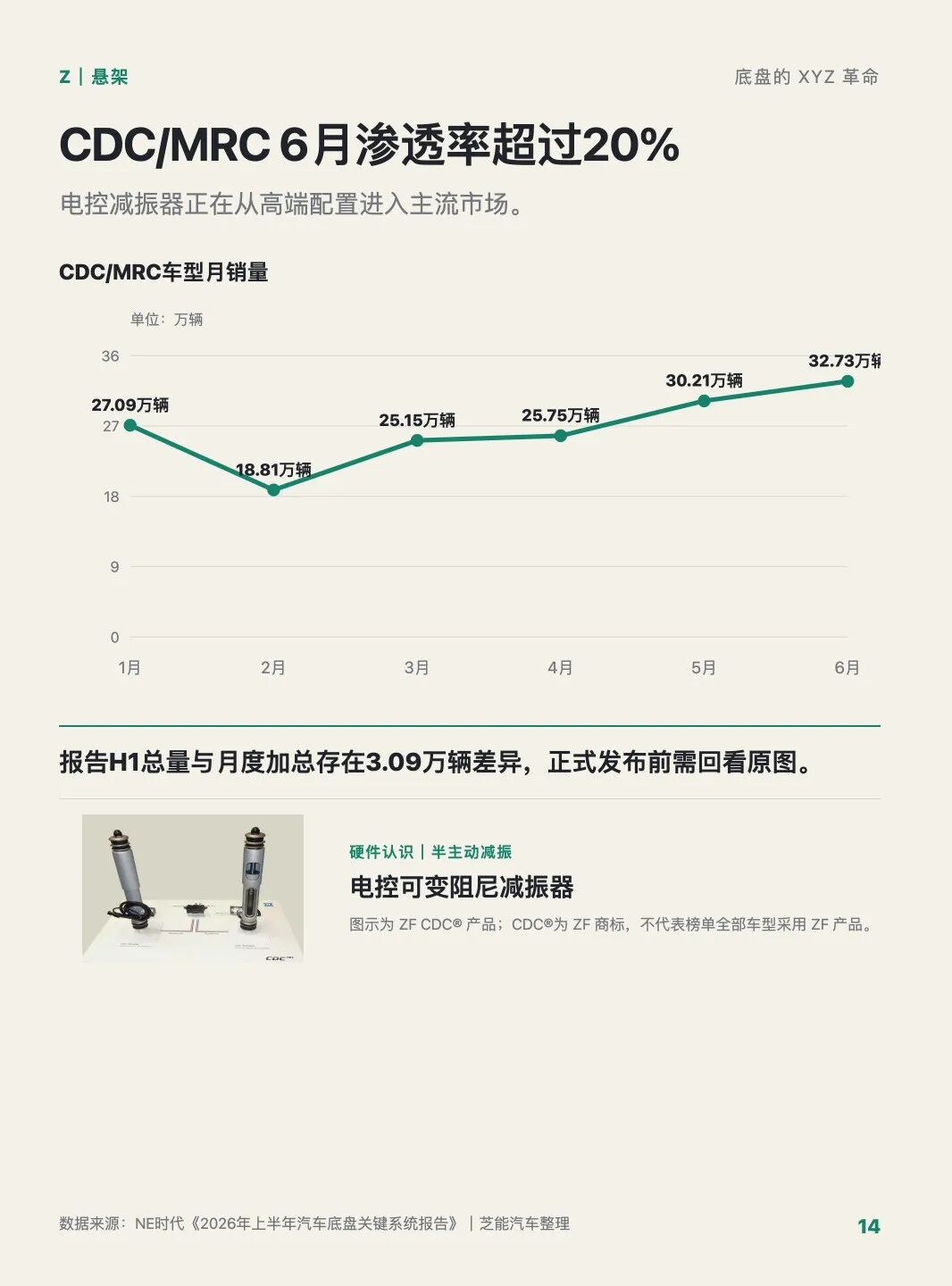
In the first half of 2026, the report indicates that sales of models equipped with CDC/MRC electronically controlled dampers reach approximately 1.6 million units, with a penetration rate nearing 19%.
In June alone, sales reach 327,300 units, with a penetration rate of 20.36%, meaning roughly one in five new vehicles is equipped with this technology.
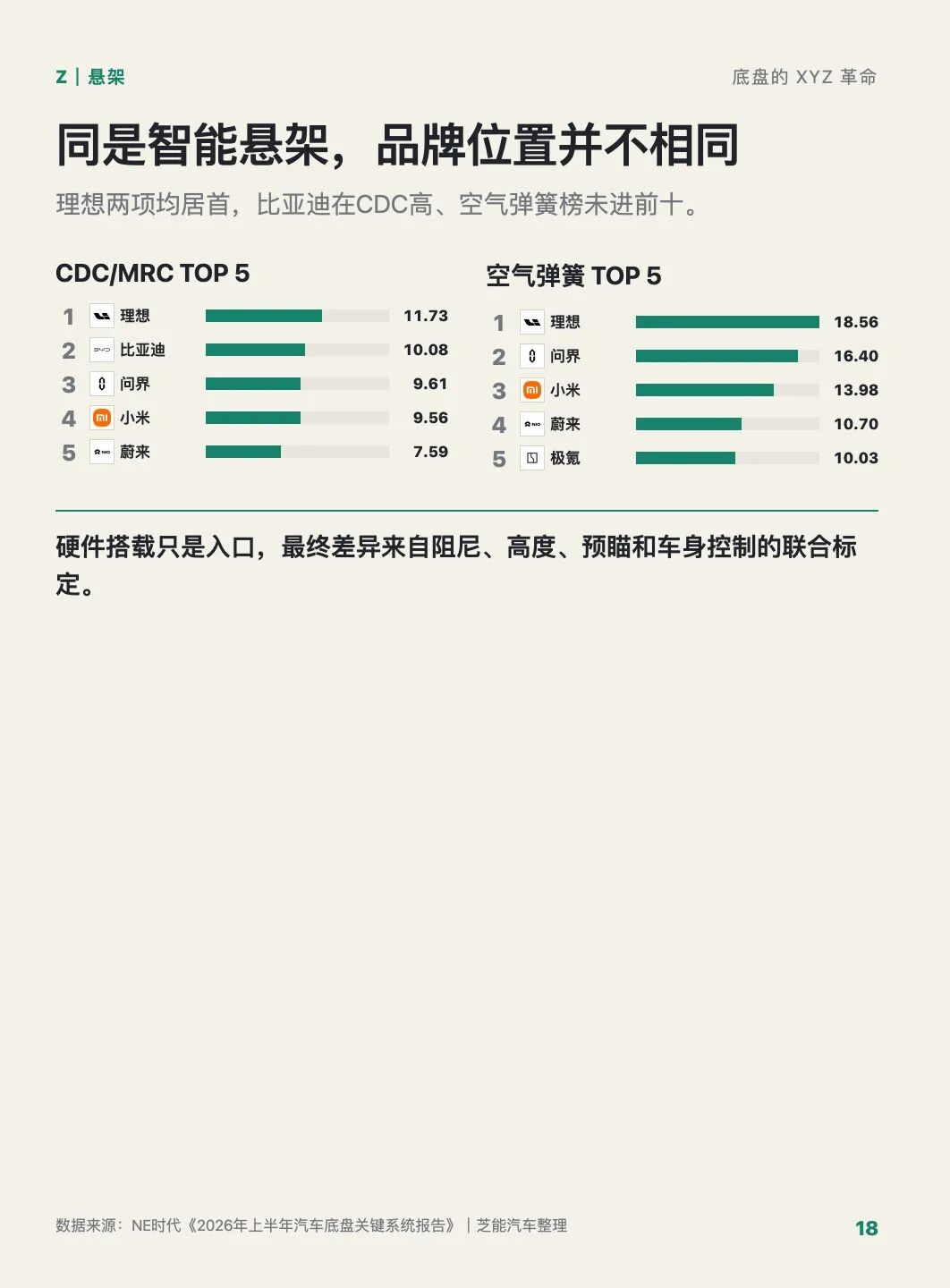
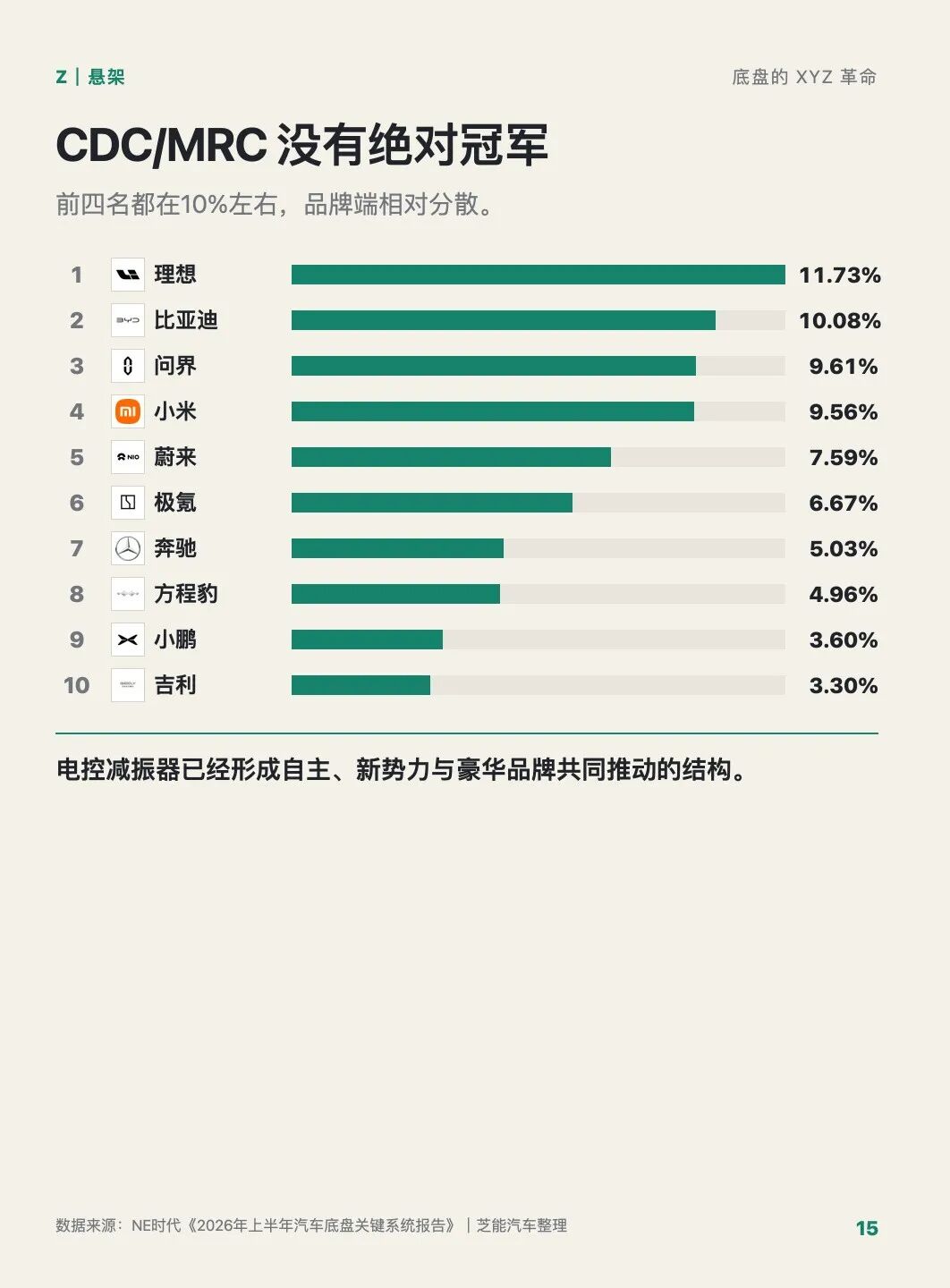
The brand distribution is quite fragmented. Li Auto accounts for 11.73%, BYD for 10.08%, AITO for 9.61%, Xiaomi for 9.56%, NIO for 7.59%, and Zeekr for 6.67%. Mercedes-Benz, Fangchengbao, XPENG, and Geely also rank in the top ten.
Electronically controlled dampers are no longer dominated by traditional luxury brands. New energy vehicle manufacturers are more willing to make chassis comfort a key selling point and can more easily integrate different driving modes, road preview, and body control through electronic architectures.
The value of CDC/MRC lies in achieving noticeable experience improvements with minimal hardware changes. While it cannot lift the body like fully active suspension, it can adjust damping in milliseconds. For models priced between 200,000–400,000 yuan, this cost-benefit ratio is highly attractive.
This is why the market share of semi-active suspension rises from 8.86% to 10.82%—consumers can feel the difference during test drives, while automakers avoid the cost and development complexity of fully active systems.
Part 3: Air Springs Surpass 10%, Driven by New Forces
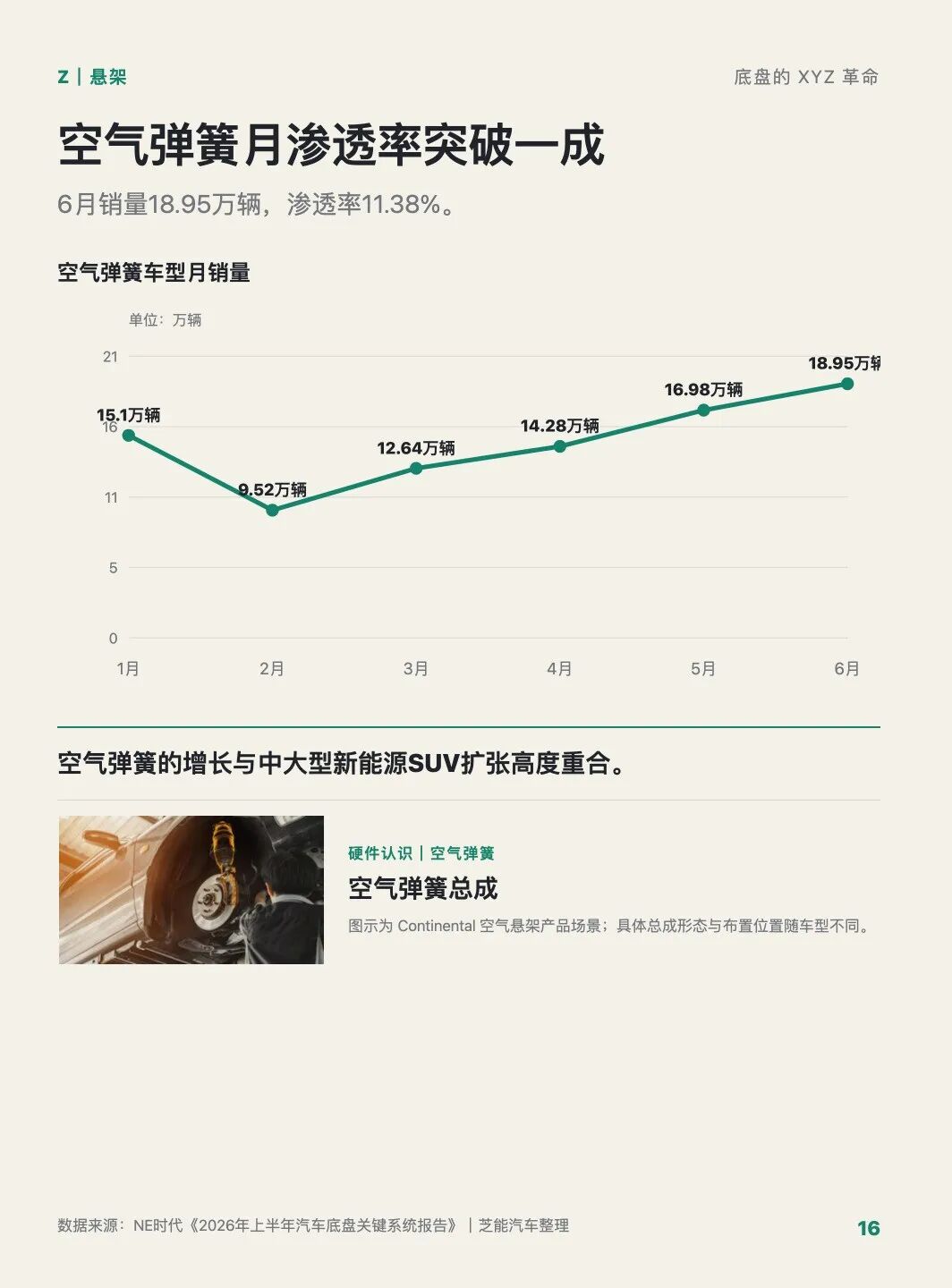
Air spring sales exceed 870,000 units in the first half of 2026, with a penetration rate of about 10.1%. Monthly sales increase from 151,000 units in January to 189,500 units in June, with a June penetration rate of 11.38%.
Brand concentration is higher for air springs than for CDC/MRC. Li Auto accounts for 18.56%, AITO for 16.40%, Xiaomi for 13.98%, NIO for 10.70%, and Zeekr for 10.03%. The top five brands account for nearly 70%, and the top ten exceed 80%.
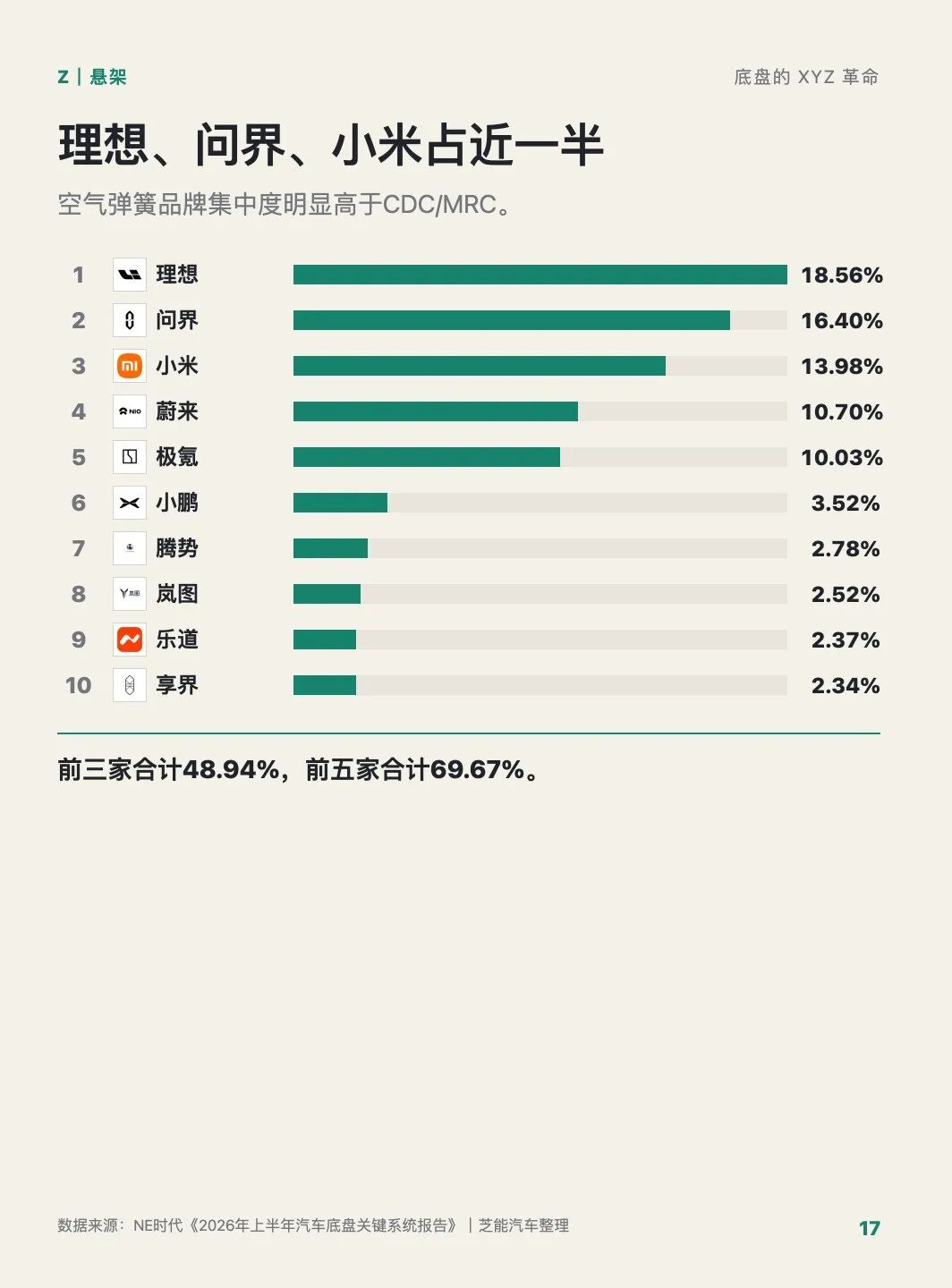
The reasons are straightforward.
Air suspension offers the most value in mid-to-large SUVs: it maintains body height when fully loaded, lowers the body for easier entry/exit, reduces wind resistance at high speeds, and increases ground clearance for off-roading or rough roads. Li Auto, AITO, NIO, Zeekr, and Xiaomi have heavily invested in this vehicle segment.
However, "having air springs" does not guarantee superior chassis performance.
Airbags, compressors, valve blocks, air tanks, and control software must work together seamlessly. Lift speed, low-temperature performance, durability, noise, and damper matching all affect the driving experience. The same hardware can result in a soft or excessively bouncy ride depending on calibration.
As air springs transition from feature competition to experience competition, supply chain priorities will shift from "can we supply" to lifespan, cost, and vehicle integration.
Part 4: Fully Active Suspension Accounts for Only 0.69%, but Routes Are Diverging
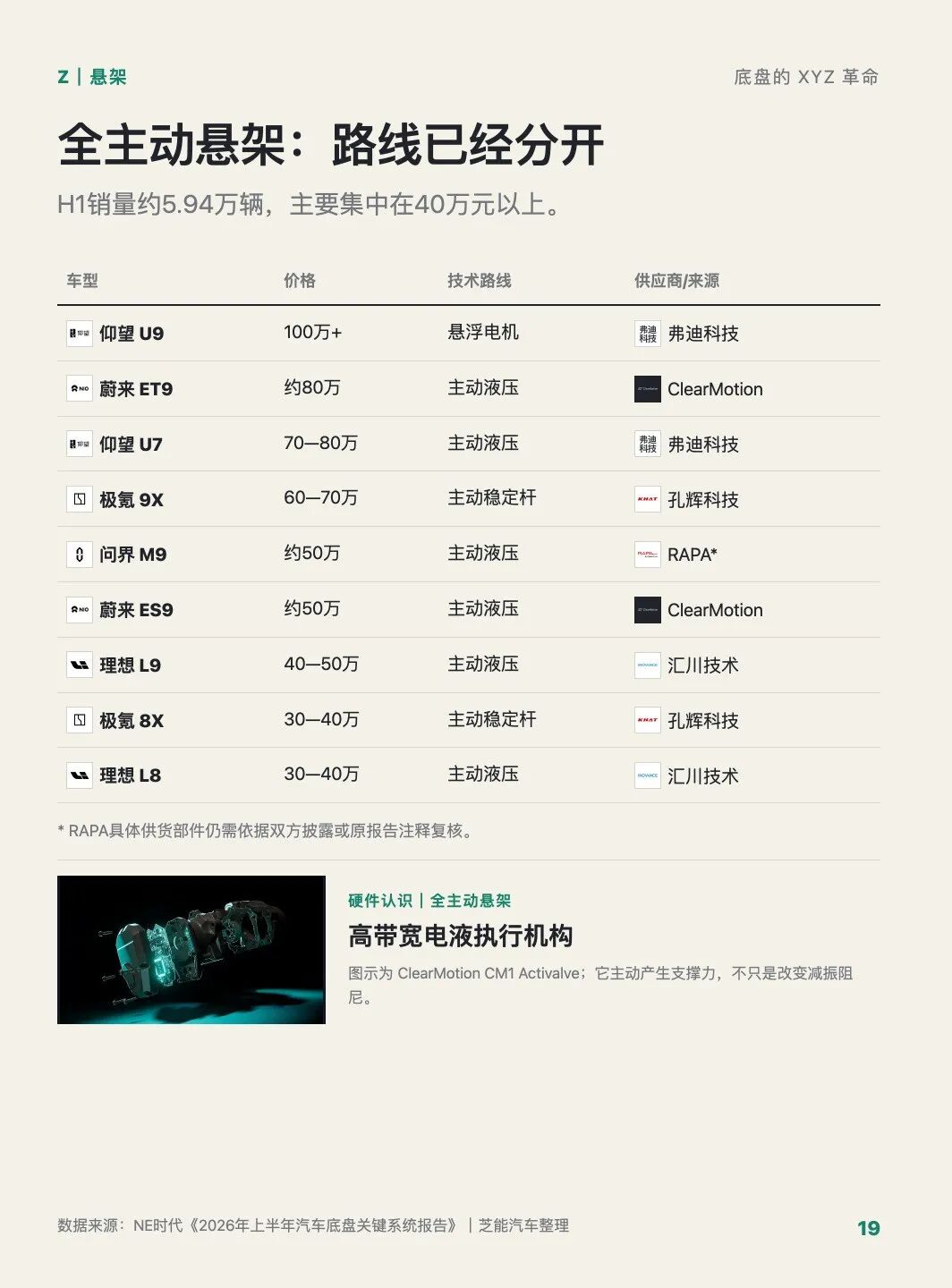
In the first half of 2026, fully active suspension sales reach about 59,400 units, primarily concentrated in models priced above 400,000 yuan. Despite its small scale, the technological routes are more diverse than those of EHB or EPS.
NIO, AITO, and Li Auto primarily explore active hydraulic routes;
Zeekr adopts active stabilizer bars;
BYD's Yangwang develops hydraulic and electromagnetic actuation routes in its Yunchan system.
Different solutions vary in how they counteract nose dive, body roll, and vertical impacts, as well as in cost, power consumption, and packaging requirements.
Active hydraulic systems provide large sustained forces, suitable for controlling body posture in large luxury vehicles, but involve complex pumps, valves, piping, and thermal management.
Active stabilizer bars focus more on reducing body roll during turns, with varying control ranges for vertical movements. Electromagnetic or linear motor actuators offer rapid response and can generate bidirectional forces, but at the cost of peak power, heat dissipation, and cost pressures.
The most captivating demonstrations of fully active suspension involve vehicles bouncing in place, clearing obstacles, or maintaining levelness during high-speed corners. However, for mass-produced vehicles, predictive capability, coordination, and sustained performance are more critical.
After cameras, LiDAR, or body sensors detect road undulations, can the system act correctly before the wheels reach the obstacle?
During hard braking, the braking system generates longitudinal force while the suspension provides vertical support; during emergency lane changes, front/rear wheel steering alters yaw while the suspension and brakes jointly suppress body roll. Only when actuators share vehicle state and control objectives does "active" mean more than just faster individual component response.
An obstacle avoidance maneuver lasts only a few seconds, but continuous mountain roads, long descents, and rough surfaces test power consumption, oil temperature, heat dissipation, and degradation strategies. How much basic suspension capability remains after system overheating or sensor failure determines whether it is truly suitable for mass production.
Summary
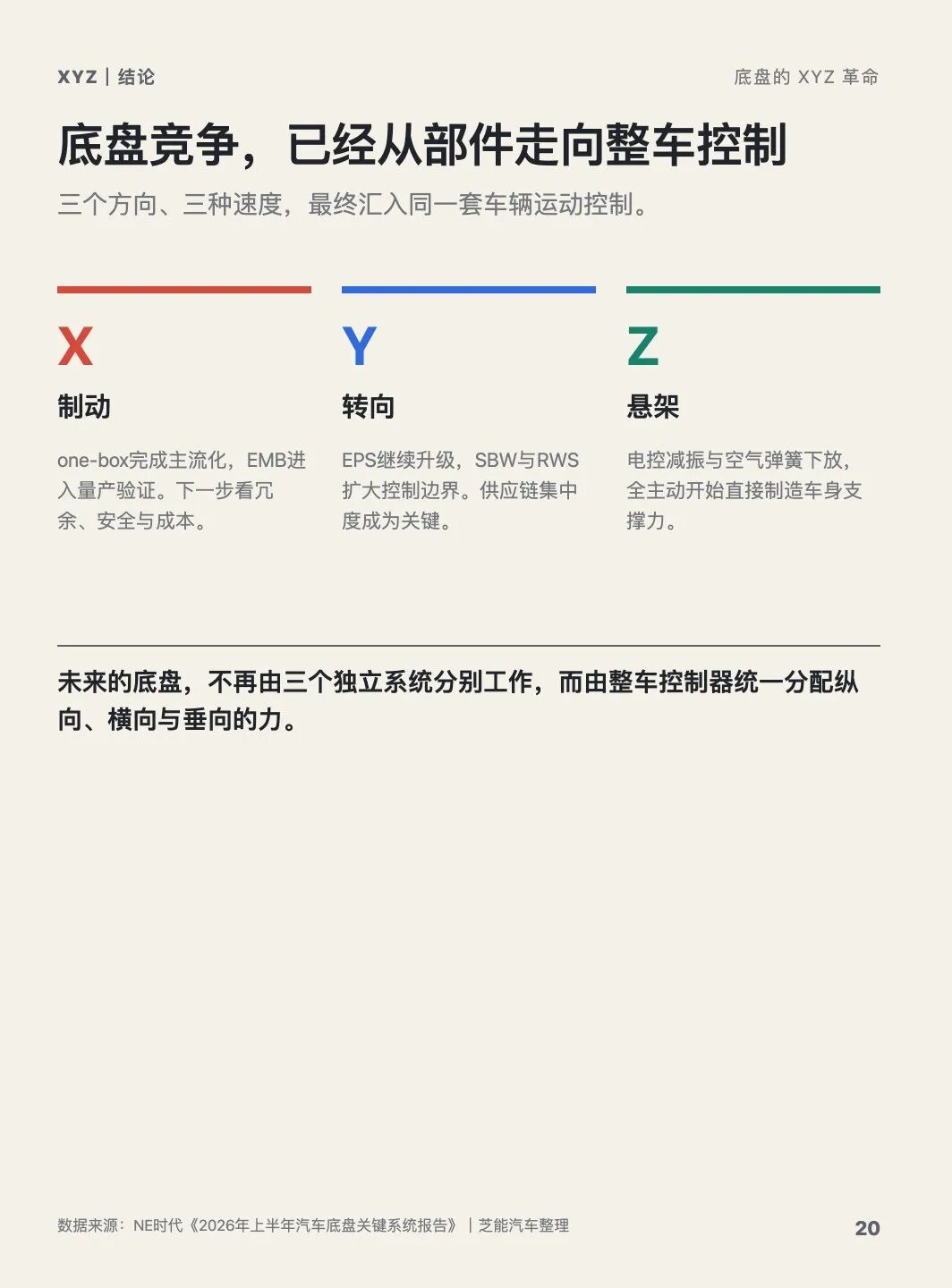
Passive suspension still accounts for 78.66% of the market, CDC/MRC nears 20%, air springs surpass 10%, and electronically controlled chassis systems have moved from flagship features to broader sales segments. Fully active suspension, at just 0.69%, represents the next stage of chassis control.
Suspension competition now centers on "vehicle posture." While airbag count, valve type, and actuator peak force are engineering metrics, creating selling points now requires focusing on the ultimate experience: can the vehicle understand the road, predict body movements, and coordinate suspension with braking and steering? Suspension systems now actively determine the forces needed for the body at any given moment.
-
![]()
Registered Capital Slashed to 372 Million Yuan! Yutong Optical Finalizes Industrial and Commercial Change Registration
-
![]()
Zhuque-3 Successfully Lands, and 'Time Traveler' Secures Another ¥100 Million in Funding: China's Commercial Space Industry Experiences a 'Dynamic August'
-
![]()
Autohome Faces a Shrinking Window of Opportunity
-
![]()
Even a Titan Like Musk Has Faced Setbacks in Fulfilling Promises
-
![]()
AI Office: The End of the Racing Era, Context Becomes the Key to Success
-
![]()
Domestic Vehicle Chassis Revolution ②: The Steering Wheel Remains, But Mechanical Connections in the Steering System Are Decreasing
-
![]()
Exploring MiniMax Design: Can Video Editing Be as Simple as Speaking?
-
![]()
Why Can SenseTime Achieve Profitability While CloudWalk Still Faces Challenges, Despite Both Adopting Large Models?