Leapmotor: Profit Guidance Significantly Reduced, Is Overseas Expansion the Key to Breakthrough?
 08/26 2026
 565
565
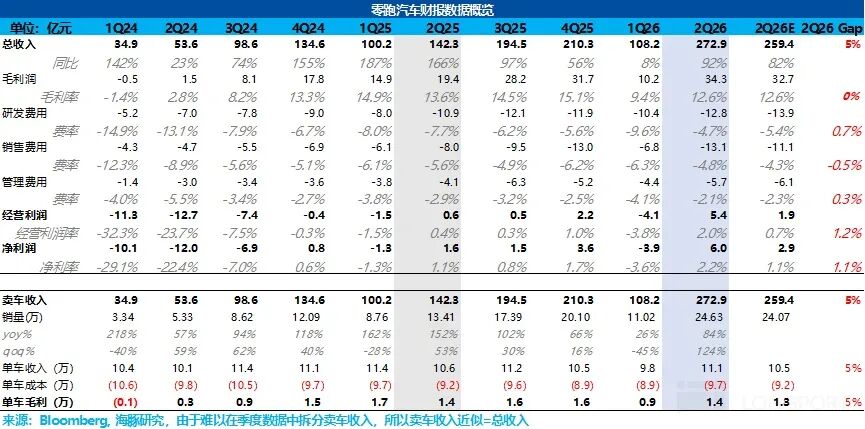
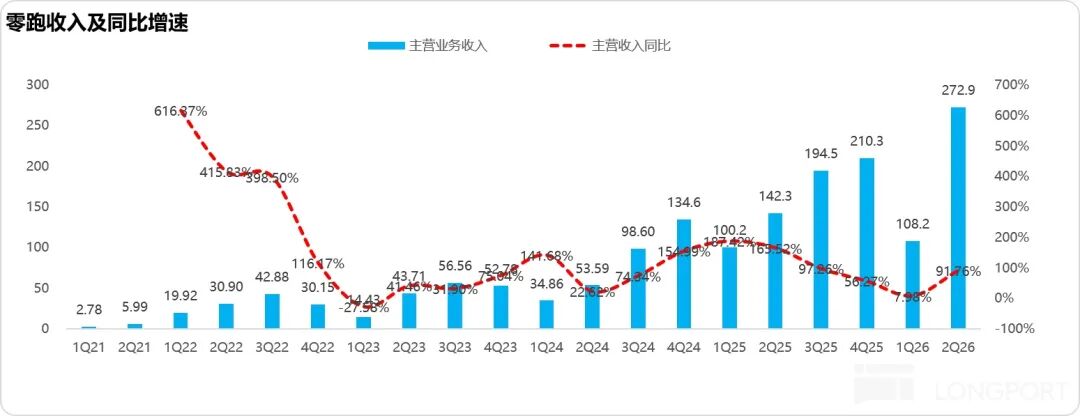
Leapmotor released its Q2 2026 financial report after the Hong Kong stock market closed on August 25 (Beijing Time). Overall, the financial performance was decent, with both revenue and profit exceeding expectations. However, due to factors such as rising raw material prices and changes in product mix, management lowered the full-year net profit guidance from RMB 5 billion to approximately RMB 3 billion. Key highlights include:
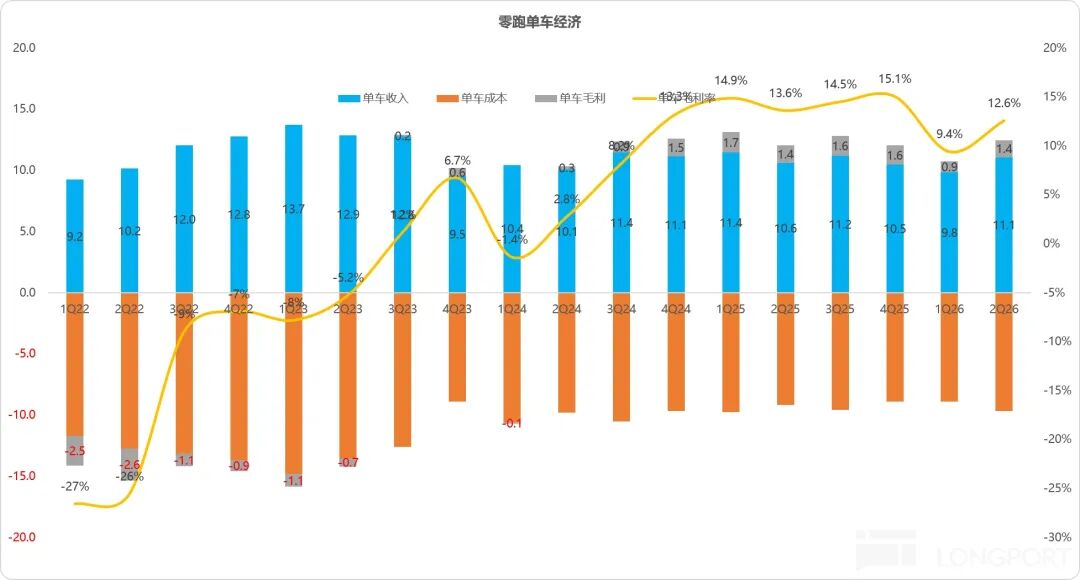
1. Revenue Exceeds Expectations, ASP Continues to Rise: In Q2, Leapmotor's total revenue reached RMB 27.3 billion, up 92% YoY, surpassing market expectations of RMB 25.9 billion, primarily driven by higher-than-expected sequential increase in average selling price (ASP). This quarter, Leapmotor's ASP reached RMB 111,000, up RMB 13,000 sequentially from RMB 98,000 in the previous quarter. Despite strong sales of the lower-priced A10 (priced around RMB 60,000-90,000), which drove the A-series' share in the model mix up by approximately 22 percentage points sequentially to 26.1%, the following factors contributed to the overall ASP increase:
a. High-priced D-series drives model mix upgrade: In Q2, led by the blockbuster D19 (a large SUV priced at RMB 219,800-269,800), the share of the highest-priced D-series increased by approximately 7.8 percentage points sequentially to 7.9%.
b. Accelerated overseas expansion drives carbon credit revenue growth: In Q2, Leapmotor's overseas sales reached approximately 55,000 units, up about 35% sequentially. The accelerated overseas expansion drove a sequential increase in carbon credit revenue this quarter.
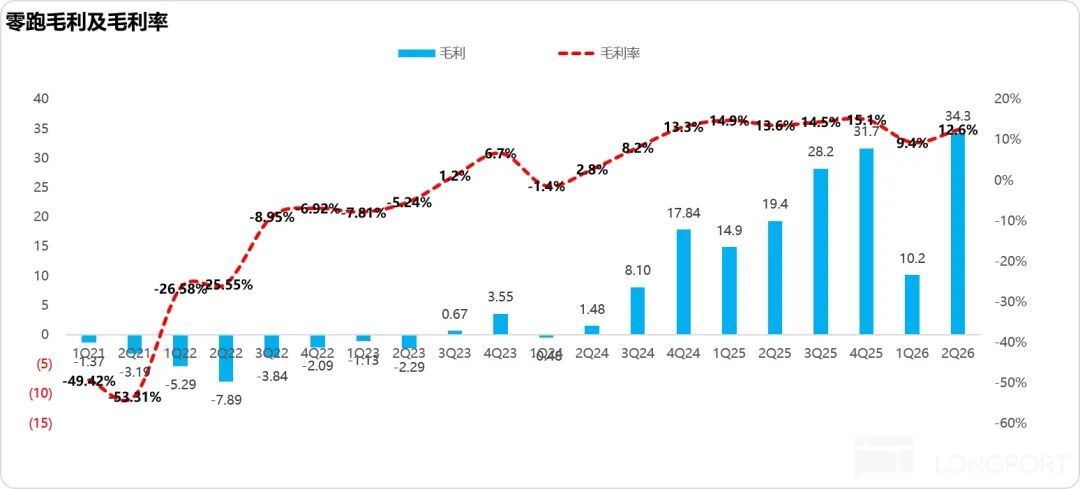
2. Gross Margin Improves Sequentially, Meeting Market Expectations: In Q2, Leapmotor's gross margin reached 12.6%, up 3.2 percentage points sequentially. The gross profit per vehicle also increased by RMB 5,000 to RMB 14,000, primarily due to:
a. Release of scale effects: In Q2, Leapmotor's sales reached 246,000 units, up 124% sequentially from the low in Q1 and 84% YoY, driven by strong sales of the new A10 and D19 models, releasing scale effects.
b. Increase in high-margin carbon credit revenue: Due to continued accelerated overseas expansion, high-margin carbon credit revenue also increased sequentially, and this revenue is essentially pure gross profit.
c. Higher gross margins for high-priced D19/D99 models: The increased share of these models in the product mix in Q2 drove the overall gross margin improvement.
d. Continued rise in upstream raw material costs: In Q2, Leapmotor still faced impacts from rising upstream raw material costs (aluminum, iron, storage, batteries, etc.), but these were partially offset by the aforementioned factors, resulting in a continued sequential improvement in gross margin.
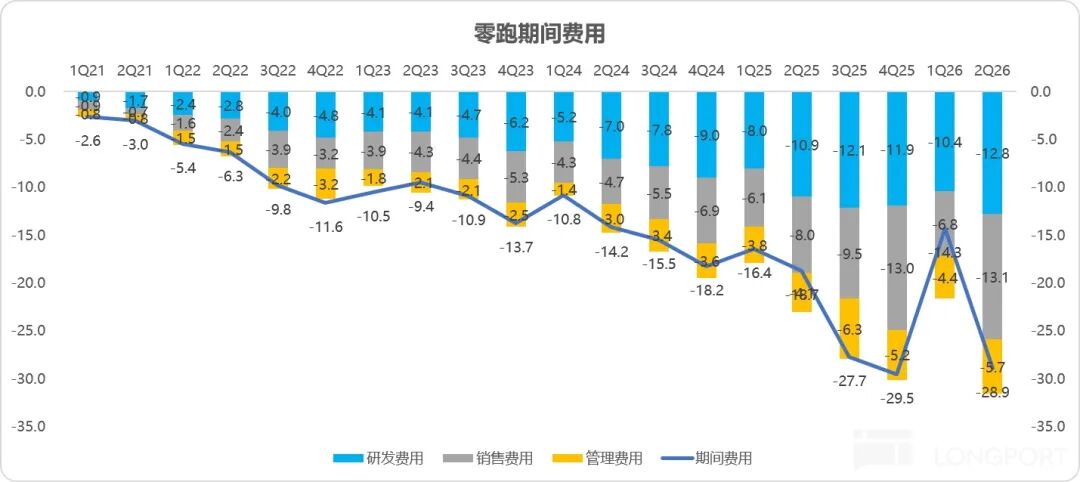
3. Operating Expenses Continue to Rise Sequentially, But Sales Leverage Effect Released: In Q2, Leapmotor's operating expenses continued to increase sequentially, including:
a. R&D expenses of RMB 1.28 billion, up RMB 240 million sequentially, primarily invested in: Architecture centralization – The Leap 4.0 central domain control architecture was first deployed on the D19, featuring dual 8797 chips and Extra large memory (super large memory), pioneering an integrated cabin-driving super collaboration, breaking down barriers between traditional cabin and intelligent driving systems, and enabling a single brain to control all vehicle intelligence; Intelligent driving – Urban navigation-assisted driving has been opened to all Leapmotor ABCD series models. In September 2026, a new platform technology and assisted driving solution will be launched, achieving a significant upgrade in the intelligent driving experience.
b. Selling expenses of RMB 1.31 billion, up significantly by RMB 630 million sequentially, surpassing market expectations of RMB 1.1 billion: Selling expenses increased sharply in Q2, primarily due to higher promotional investments for the dense (intensive) launch of new models and accelerated channel expansion. The number of domestic sales outlets increased by 71 to 1,064, while overseas channels reached 1,010, with approximately 90% located in Europe.
Finally, although total operating expenses increased by approximately RMB 1 billion sequentially, the expense ratio actually declined by 8.4 percentage points sequentially to 11.6% due to the release of the sales leverage effect.
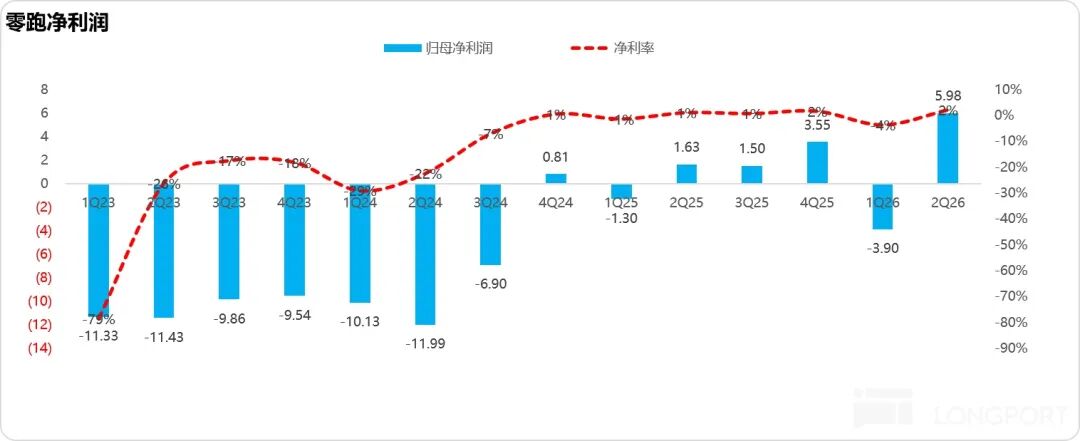
4. Net Profit Turns Around: In Q2, Leapmotor's net profit attributable to shareholders reached approximately RMB 600 million (turning around from a loss of RMB 390 million in Q1), with a net profit margin of 2.2%, primarily driven by better-than-expected revenue and the release of the sales leverage effect.
Dolphin Research's View
Overall, Leapmotor's performance this quarter was decent. Revenue exceeded market expectations due to an upward shift in the model mix (driven by high-priced D-series models) and sequential growth in carbon credit revenue (accelerated overseas expansion). Gross margin also recovered from the low in Q1 (9.4% in Q1 to 12.6% in Q2), rising 3.2 percentage points sequentially to 12.6%, in line with Leapmotor's guidance of 12%-13% provided last quarter, thanks to strong sales of high-priced, high-margin D-series models, scale effects, and confirmation of high-margin carbon credit revenue.
However, due to the impact of rising raw material prices, Leapmotor lowered its full-year gross margin and profit guidance:
a. Full-year gross margin guidance lowered from 14%-15% to 13%-14%, with vehicle gross margin adjusted to 10%-11%.
b. Based on the lowered gross margin guidance, the full-year 2026 net profit guidance was lowered from RMB 5 billion to RMB 3 billion.
c. Full-year export sales guidance was raised: From January to July 2026, Leapmotor achieved export sales of 114,000 units (annualized at approximately 195,000 units). Leapmotor raised its 2026 export sales guidance from 150,000 units to 200,000 units, and to 350,000-400,000 units in 2027, continuing to achieve doubling growth.
In the short term, Leapmotor's lowering of its full-year net profit guidance from RMB 5 billion to approximately RMB 3 billion will require the market to digest the downward revision in profit expectations, and the stock price will likely remain under pressure in the near term. The profit downgrade is primarily due to rising raw material costs (power batteries, memory chips) and structural impacts from the increasing share of exports (currently, exported models have lower ASPs).
Based on current sales progress (356,500 units accumulated in 1H26, up 60.8% YoY) and referring to Leapmotor's previously set sales target of 1.05-1.10 million units, Dolphin Research conservatively expects Leapmotor to achieve 950,000-1,000,000 units in 2026 (up 59%-68% YoY, including 750,000-800,000 units domestically and 200,000 units overseas). Export sales reached 96,300 units in 1H26 (up 373% YoY), making the full-year overseas target of 200,000 units highly achievable.
Upward catalysts should not be overlooked: The D19's premiumization has shown initial success (sales exceeded 7,000 units in May, with a target gross margin of over 20% for the D-series); In September, the company will launch new platform technologies (next-generation autonomous driving architecture, battery, and electric drive technology upgrades), which are expected to enhance its intelligent valuation; Q4 is the peak sales season, and with the launch of the D99 (listed in June with a higher-than-expected pricing, the entry price was RMB 40,000 lower than the pre-sale price), sales may further exceed expectations.
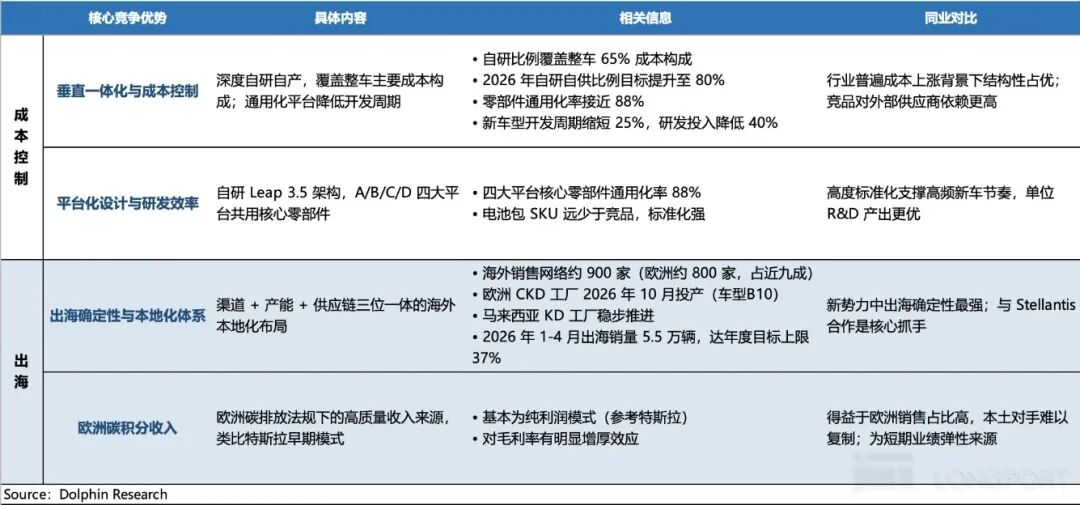
In the medium to long term, Leapmotor's strong cost-reduction capabilities (full-stack in-house R&D, platform-based procurement) and scaling (scaled) overseas expansion (exports in 1H26 exceeded the full-year 2025 level, with export targets repeatedly raised) are core factors for stabilizing vehicle gross margins.
Once storage and commodity prices ease, combined with the cost-reduction effects of in-house developed battery cells, gross margins are expected to recover to the 14%-15% level in the long term. Additionally, smooth progress in localized cooperation with Stellantis in Spain (the Madrid plant is expected to be sold, with localized production of 50,000 units anticipated in 2027) and technology licensing revenue and component supply models (FAW Hongqi's G117 project entering mass production in Q4, STLA platform cooperation) all provide support for the company's value.
Related Charts:
- END -
// Reproduction Authorization
This article is an original work by Dolphin Research. Reproduction requires authorization.
// Disclaimer and General Disclosure
This report is for general comprehensive data purposes only, intended for general reading and data reference by users of Dolphin Research and its affiliated institutions. It does not consider the specific investment objectives, investment product preferences, risk tolerance, financial status, or special needs of any individual receiving this report. Investors must consult with independent professional advisors before making investment decisions based on this report. Any person making investment decisions using or referring to the content or information in this report assumes all risks. Dolphin Research shall not be liable for any direct or indirect responsibilities or losses that may arise from the use of the data in this report. The information and data in this report are based on publicly available sources and are for reference purposes only. Dolphin Research strives to ensure but does not guarantee the reliability, accuracy, and completeness of the information and data.
The information or views mentioned in this report shall not, under any jurisdiction, be considered or construed as an offer to sell securities or an invitation to buy or sell securities, nor shall they constitute recommendations, inquiries, or endorsements of relevant securities or related financial instruments. The information, tools, and data in this report are not intended for or to be distributed to jurisdictions where the distribution, publication, provision, or use of such information, tools, and data contradicts applicable laws or regulations, or to citizens or residents of jurisdictions where Dolphin Research and/or its subsidiaries or affiliated companies are required to comply with any registration or licensing requirements.
This report only reflects the personal views, insights, and analytical methods of the relevant creators and does not represent the stance of Dolphin Research and/or its affiliated institutions.
This report is produced by Dolphin Research, and the copyright is solely owned by Dolphin Research. No institution or individual may, without the prior written consent of Dolphin Research, (i) make, copy, reproduce, duplicate, forward, or distribute in any form copies or replicas in any way, and/or (ii) directly or indirectly redistribute or transfer to other unauthorized persons. Dolphin Research reserves all related rights.
-
![]()
Qianwen App Faces Financial Struggles Amidst Competition with Qianwen Office—Wu Jia Under Increasing Pressure
-
![]()
【Intelligentization】 No Resignation, but Entrepreneurship! Ren Shaoqing of NIO Takes on Dual Roles
-
![]()
"Ox Coming" Makes a Splash in the AI Circle! Mysterious Large Model Goes Viral, Who's Behind the Big Move?
-
![]()
Xiaopeng’s New Car is Popular, but Financial Results are Less Impressive
-
![]()
Dialogue with Lv Wenbin from Great Wall Motors: The 30,000+ Orders for Great Wall H10 is Just the Beginning!
-
![]()
Can Xiaomi Pengcheng N90 and N70 Recreate the 'Success Story' of the SU7?
-
![]()
Can Stellantis Revitalize Jeep’s Domestic Production in China via the ‘New Dongfeng Peugeot Citroen Automobile’ Initiative?
-
![]()
Xpeng's Q2 2026: Automotive Losses, Service Gains, and a Narrative Shift Toward Robotics