Xpeng's Q2 2026: Automotive Losses, Service Gains, and a Narrative Shift Toward Robotics
 08/26 2026
 404
404
Xpeng has delivered its results.
On the surface, the numbers look good—but a second glance is needed.
Total revenue hit RMB 19.74 billion, up 8.0% YoY and +51.5% QoQ; overall gross margin reached 20.7%, up 3.4 percentage points YoY, marking the second consecutive quarter above 20%. These two figures dominated headlines on the day of release.
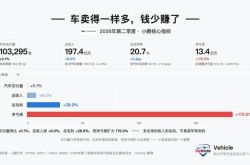
But three other numbers on the same sheet tell a different story: automotive deliveries stood at 103,295 units, compared to 103,181 units YoY, up just 0.1%; automotive gross margin was 12.1%, down from 14.3% YoY, a 2.2 percentage point drop; net loss widened to RMB 1.34 billion from RMB 480 million YoY, a 179.9% increase.
This article will dissect why these three lines are moving in different directions, uncover the true state of Xpeng's automotive business after stripping away service revenue, and explore where the company is placing its bets, along with the challenges it faces.
Q2 Financial Performance
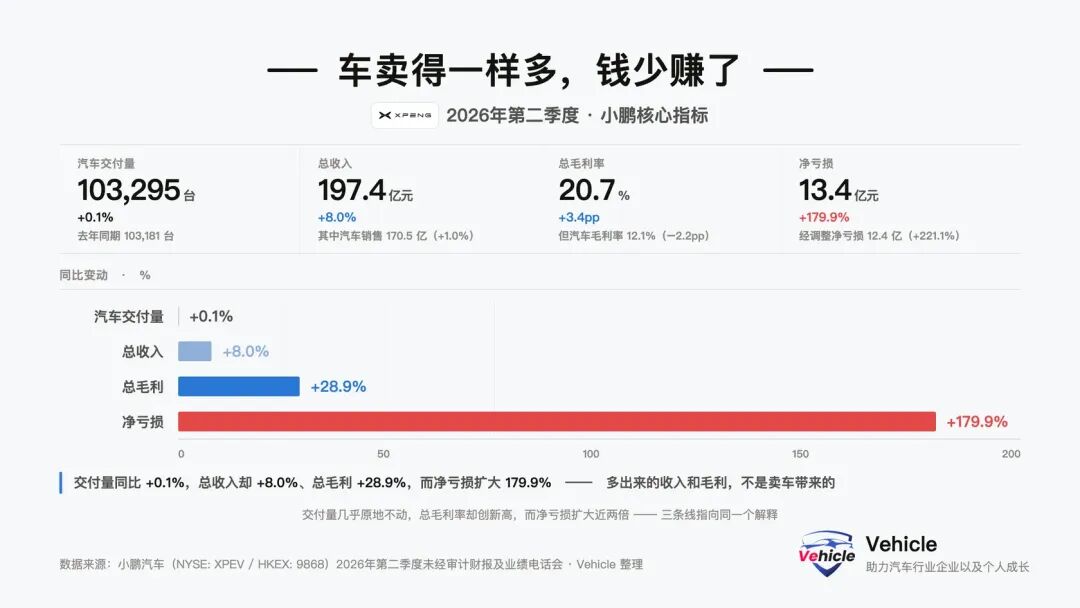 Q2 2026 Core Metrics and Three Diverging YoY Trends
Deliveries: 103,295 units, up 0.1% YoY and +65% QoQ. Last year, it was 103,181 units: over a year, just 114 more units sold in a quarter.
Total Revenue: RMB 19.74 billion, up 8.0% YoY and +51.5% QoQ. Automotive sales revenue was RMB 17.05 billion, up just 1.0% YoY.
Services and Others: RMB 2.70 billion, up 93.9% YoY and +32.6% QoQ. The announcement specified two main sources: technology R&D services provided to an automaker (Volkswagen Group) with key milestones achieved, and parts sales.
Gross Margin: Overall gross margin was 20.7%, up from 17.3% YoY (+3.4 percentage points). However, automotive gross margin was 12.1%, down from 14.3% YoY (−2.2 percentage points); services and others gross margin was 75.1%, up from 53.6% YoY. Profitability relied heavily on service fees.
Expenses: R&D reached RMB 2.91 billion, up 32.1% YoY; sales and administrative expenses were RMB 2.50 billion, up 15.2% YoY. Operating loss was RMB 1.14 billion, compared to RMB 930 million YoY. Continuously launching products comes at a cost.
Losses and Cash: Net loss was RMB 1.34 billion, up 179.9% YoY; adjusted net loss was RMB 1.24 billion, up 221.1% YoY. Cash reserves stood at RMB 40.48 billion, down from RMB 42.09 billion at the end of Q1: a RMB 1.61 billion drop in a quarter.
Deliveries stagnated, overall gross margin hit a record high, and net loss nearly tripled. For all three to happen simultaneously, there’s only one explanation.
Gross Margin Isn’t Driven by Car Sales
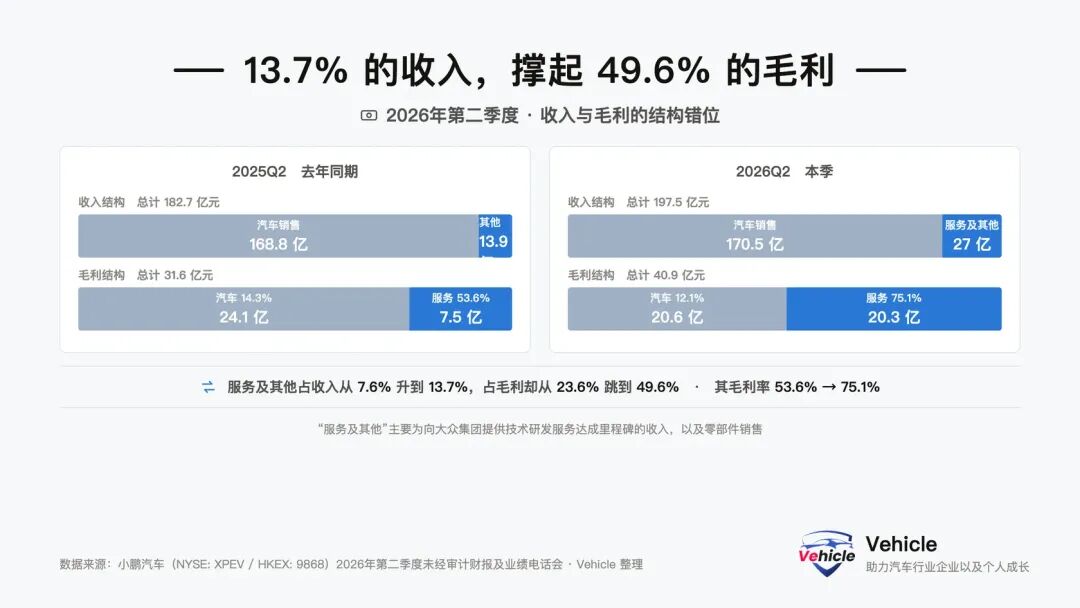 Structural Mismatch Between Revenue and Gross Margin
When revenue and gross margin are separated, the mismatch becomes clear.
In Q2 2026, services and others revenue was RMB 2.70 billion, accounting for 13.7% of total revenue; but with a gross margin of 75.1%, it contributed RMB 2.028 billion in gross profit, or 49.6% of the total.
Last year, this segment accounted for 7.6% of revenue and 23.6% of gross profit. In one year, its contribution to gross profit rose from less than a quarter to nearly half.
So, the impressive figure of "overall gross margin at 20.7%, up 3.4 percentage points YoY" was driven not by car sales but by technology R&D service fees settled with Volkswagen.
To clarify: This money is real. The technology collaboration between Volkswagen and Xpeng is a genuine commercial contract, and revenue is recognized when milestones are met. High gross margins are also typical for technology service businesses. The issue isn’t the money itself but its timing: it’s milestone-based, not evenly distributed across quarters. Our previous article, "A Full Breakdown of Volkswagen’s CARIZON Self-Developed Intelligent Driving Technology," also shared that Volkswagen’s J6M-based self-developed tech is starting to roll out, and its high-end chip C7H is under accelerated development. With the domestic intelligent driving supply chain rapidly catching up, this isn’t favorable for Xpeng. So, while Xpeng received Volkswagen’s development fees this quarter, it may not next quarter.
Stripping Away Service Revenue, the Automotive Business Is Retreating
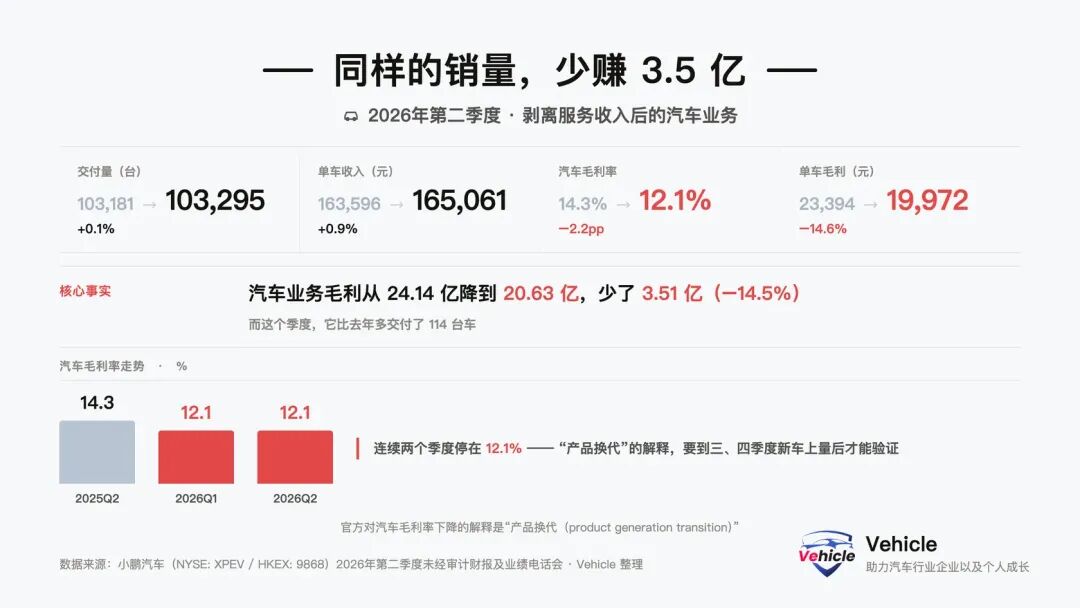 Automotive Business After Excluding Service Revenue
If we remove service revenue and focus solely on cars, the true picture this quarter is as follows:
Deliveries: 103,295 units (+0.1%), with per-unit revenue at RMB 165,100 (+0.9%): both volume and price barely moved. However, automotive gross margin dropped from 14.3% to 12.1%, and per-unit gross profit fell from RMB 23,394 to RMB 19,972, a 14.6% decline.
In absolute terms: automotive gross profit dropped from RMB 2.414 billion to RMB 2.063 billion, a RMB 351 million decrease in a quarter—despite delivering 114 more units than last year.
The official explanation for the decline in automotive gross margin is "product generation transition." This is reasonable—during model transitions, clearing old inventory and ramping up new models typically pressure margins.
However: automotive gross margin was also 12.1% in Q1 and remained at 12.1% in Q2. After two consecutive quarters at this level, "transition" is no longer just a temporary explanation. The real test will come in Q3 and Q4: if automotive gross margin doesn’t recover above 14% after the G9L launches in September and the MONA L05 in Q4, it suggests the issue isn’t just transition-related but lies in pricing strategy.
Q1 Halved, Q2 Recovered
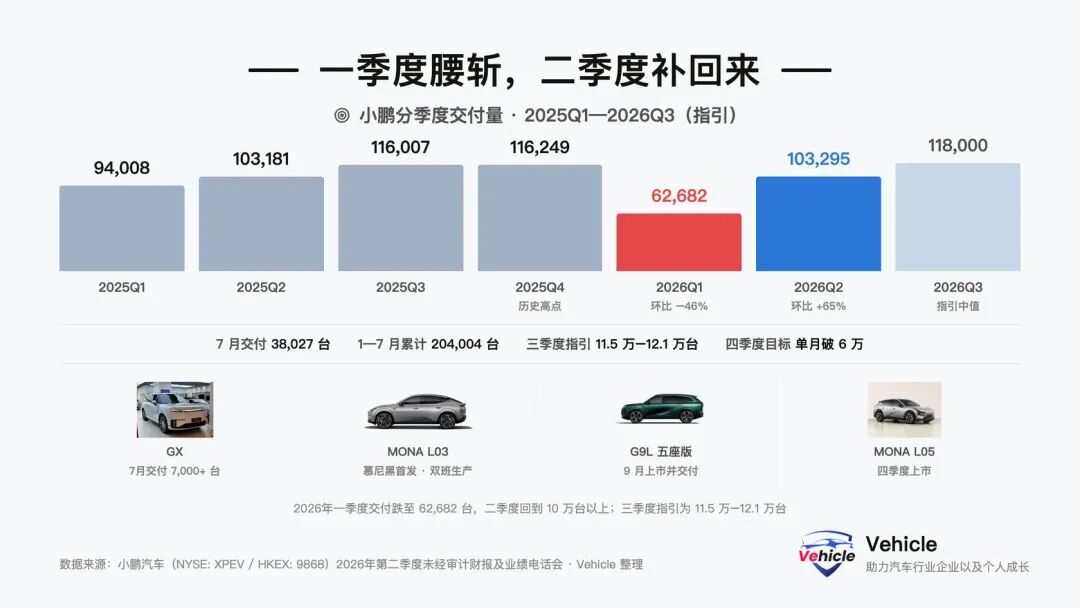 Quarterly Deliveries and Q3 Guidance
Looking at a longer timeline—six quarters of deliveries—Xpeng’s performance has been uneven this year.
Q3 and Q4 2025 saw consecutive deliveries above 116,000 units, a historical high. But Q1 2026 plummeted to 62,682 units, down 46% QoQ; Q2 rebounded to 103,295 units, up 65% QoQ. The so-called "sharp QoQ rise" was largely due to the low base in Q1.
Looking ahead, the pace is recovering: July deliveries were 38,027 units, with a cumulative 204,004 units in January–July; Q3 guidance is 115,000–121,000 units, with revenue guidance of RMB 21.7–23.4 billion; management also said they aim to challenge 60,000 monthly deliveries in Q4, with Q3’s new lock-in orders up 50% QoQ, a record high.
If Q3 guidance is met, Xpeng will return to its late-2025 level—but only "return," not "surpass."
Xpeng’s Global Expansion
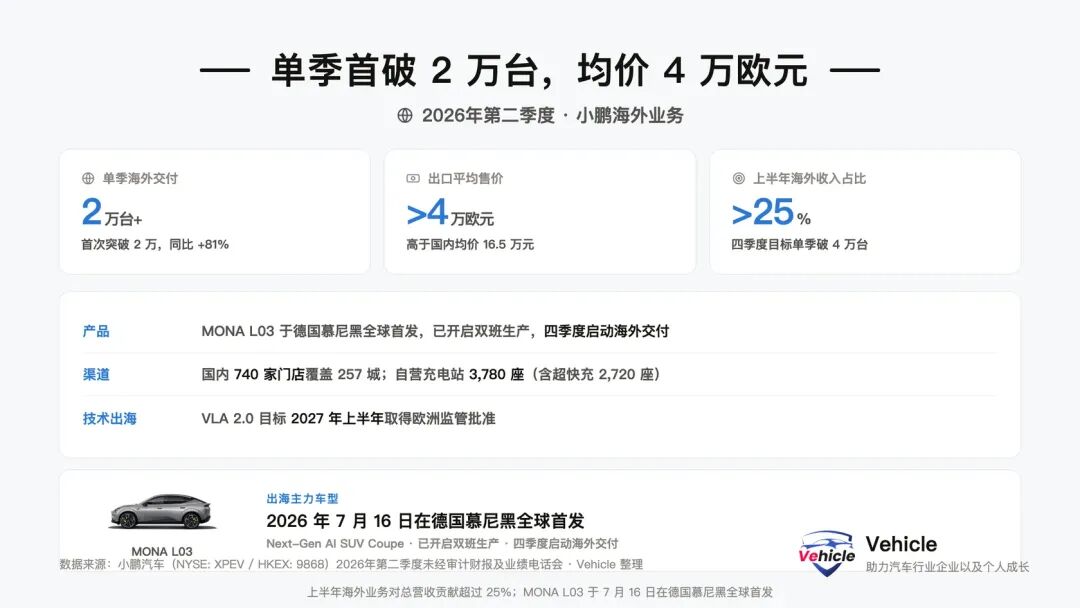 Scale and Average Pricing of Overseas Business
Like other major Chinese automakers, global expansion is Xpeng’s least controversial bright spot.
Scale: Overseas deliveries exceeded 20,000 units in a single quarter for the first time in Q2, up 81% YoY. Overseas revenue contributed over 25% of total revenue in H1.
Pricing: The average export selling price exceeded €40,000. At current exchange rates, this is significantly higher than the domestic per-unit revenue of RMB 165,000: overseas-sold cars are more expensive than domestic ones.
Pace: The MONA L03 made its global debut in Munich, Germany, and has entered dual-shift production, with overseas deliveries set to begin in Q4; management aims for overseas deliveries to exceed 40,000 units in a single quarter in Q4.
Notably, this price segment matters. At €40,000, Xpeng competes in Europe against the Tesla Model Y and Volkswagen ID series—not the low-price, high-volume segment. This means Xpeng’s global expansion isn’t about "trading margins for scale" but "trading product strength for margins": a tougher path but one that, if successful, will substantially boost automotive gross margins.
If overseas sales continue to rise, their impact on automotive gross margins will be more tangible than service revenue—because it’s money earned from selling cars.
Second Act: A $6.2 Billion Robotics Company
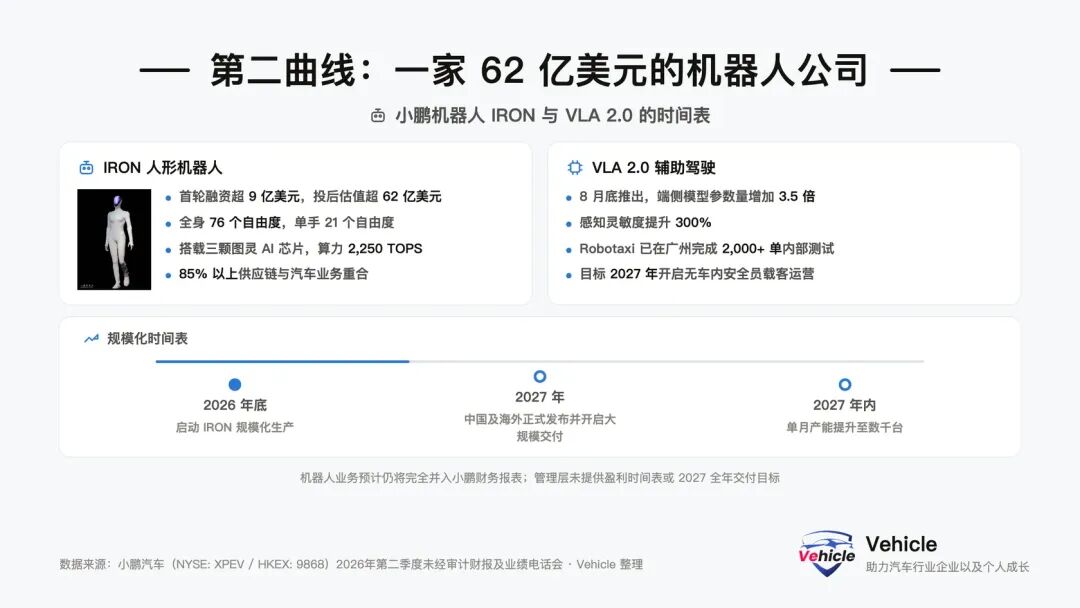 Timeline for IRON Humanoid Robot and VLA 2.0
On the same day as the earnings release, Xpeng announced a blockbuster move: its robotics subsidiary, Dogotix, signed a share subscription agreement, securing $900 million in funding at a post-money valuation exceeding $6.2 billion.
He Xiaopeng’s exact words in management commentary: He believes Xpeng will "not only become one of China’s most valuable humanoid robot companies but also a global leader in physical AI." The earnings press release redefined the company from a "smart electric vehicle company" to "a leading global Physical AI company"—following Elon Musk’s path, leaving Musk with no path in China, and charging full speed ahead. Next up for Xpeng: brain-computer interfaces and Starship launches.
IRON Humanoid Robot: Features 76 degrees of freedom (DoF) across the body and 21 DoF per hand, powered by three Turin AI chips with 2,250 TOPS of compute. Over 85% of its supply chain overlaps with Xpeng’s automotive business. Timeline: Mass production to begin by end-2026, official launch and large-scale deliveries in China and overseas in 2027, with monthly production capacity rising to thousands of units by late 2027.
VLA 2.0: Launching in late August, with edge-side model parameters increased 3.5x and perception sensitivity improved 300%; Robotaxi has completed over 2,000 internal tests in Guangzhou, aiming for driverless passenger operations in 2027; and plans to secure European regulatory approval by H1 2027.
However, management made it clear in Q&A: no profitability timeline has been set, nor a full-year delivery target for 2027; the robotics business is expected to remain fully consolidated into Xpeng’s financial statements.
Final Thoughts
Xpeng’s issue this quarter isn’t the RMB 1.34 billion loss—losses are standard for new forces, and fortunately, it still holds RMB 40.48 billion in cash, with no short-term survival pressure.
The problem is that in the same quarter, deliveries stalled, per-unit gross profit fell, R&D spending rose 32%, and losses nearly doubled—all masked by milestone-based technology service fees.
Xpeng, still finding its way as a new force, faces growing challenges in relying on autonomous driving as its narrative. Trends show intelligent driving tech is becoming democratized below, while large model companies dominate physical foundation models above.
What’s your take on Xpeng? Welcome to leave a comment and discuss.
References and Images
Xpeng Q2 2026 Earnings Report, Xpeng Q2 2026 Earnings Call Transcript
*Unauthorized reproduction or excerpting is strictly prohibited-
-
![]()
Qianwen App Faces Financial Struggles Amidst Competition with Qianwen Office—Wu Jia Under Increasing Pressure
-
![]()
【Intelligentization】 No Resignation, but Entrepreneurship! Ren Shaoqing of NIO Takes on Dual Roles
-
![]()
"Ox Coming" Makes a Splash in the AI Circle! Mysterious Large Model Goes Viral, Who's Behind the Big Move?
-
![]()
Xiaopeng’s New Car is Popular, but Financial Results are Less Impressive
-
![]()
Dialogue with Lv Wenbin from Great Wall Motors: The 30,000+ Orders for Great Wall H10 is Just the Beginning!
-
![]()
Can Xiaomi Pengcheng N90 and N70 Recreate the 'Success Story' of the SU7?
-
![]()
Can Stellantis Revitalize Jeep’s Domestic Production in China via the ‘New Dongfeng Peugeot Citroen Automobile’ Initiative?
-
![]()
Xpeng's Q2 2026: Automotive Losses, Service Gains, and a Narrative Shift Toward Robotics