"Quick-Made Cars"? Hit the Brakes
 08/27 2026
 432
432
Are Consumers Being Used as Test Drivers?
Not long ago, Mercedes-Benz released a creative short film, using a mouse to drag and drop a simplified car-building scene to create satire, with the copy reading: "What you frame is a car. What you test is true strength."
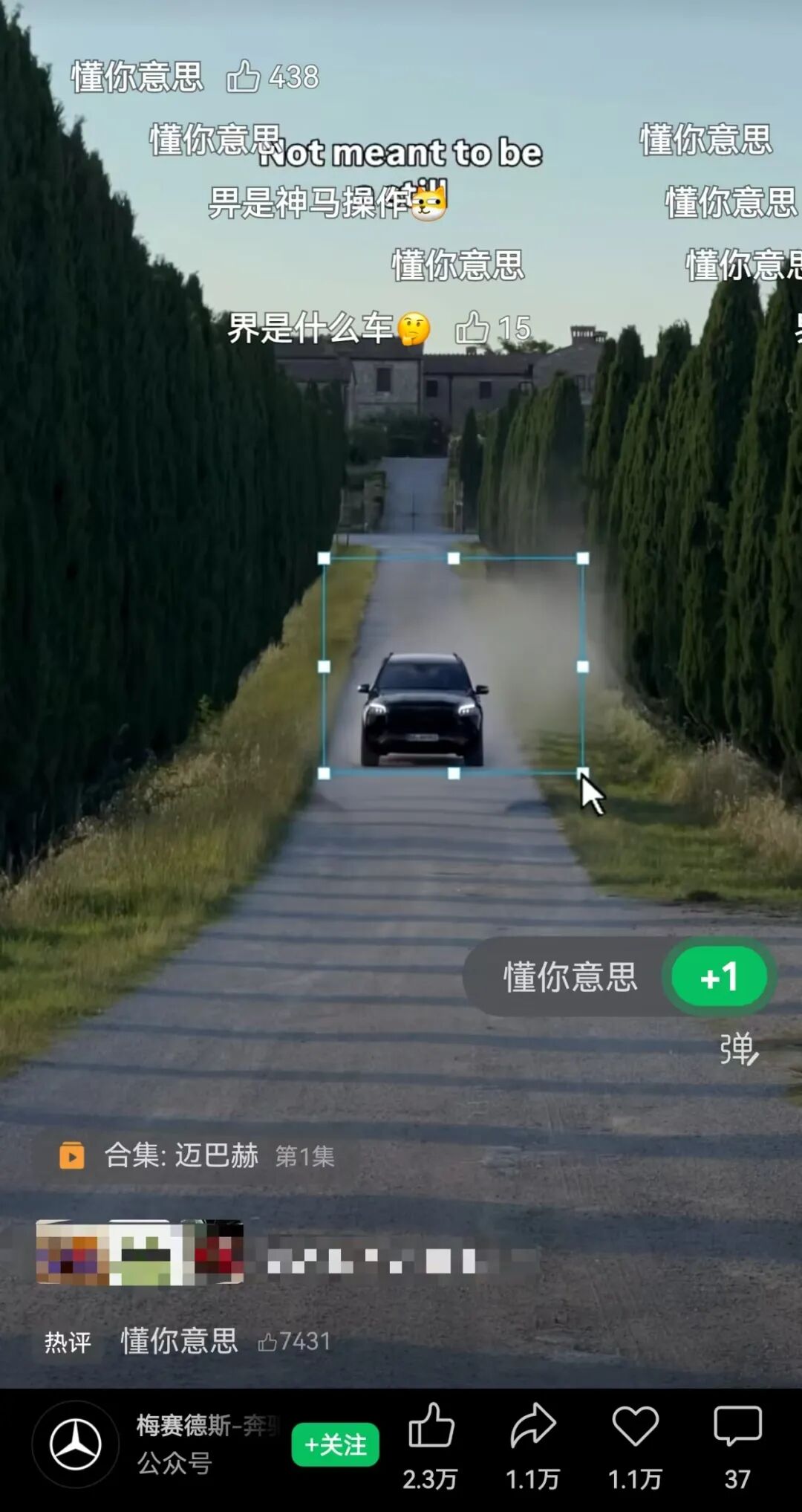
Image Source: Mercedes-Benz Video Account
Prior to this, BMW China also launched a contrasting short film: on one side, a humorous depiction of using car models to crash into durians and pineapples, simulating a wind tunnel with manual blowing; on the other side, a complete showcase of the company's real crash test lab and wind tunnel facilities, presenting the entire process of multi-specification test dummies, high-intensity wind tunnel tests, and massive real-vehicle data verification.
The creative short films from these two traditional luxury automotive brands both point to a major issue in the current automotive industry—"quick-made cars."
The so-called "quick-made cars" refer to models that have compressed R&D cycles, skipped real-vehicle verification processes, and are rushed to market. Li Fenggang, General Manager of Beijing Hyundai, stated bluntly at the 2026 China Auto Forum: "Some brands, in pursuit of speed to market, skip many necessary tests, turning consumers into test drivers."
Controversy Over "Fast Cycles" and "Low Standards"
As "involution" in the industry intensifies, the rapid iteration model from the digital sector has been copied into the automotive industry, with the market be caught in (falling into) a collective anxiety that "lagging behind in launches means losing the market." However, the automotive industry is characterized by heavy asset investment and high safety standards, making the trade-off between speed and quality, efficiency and safety, short-term scale growth and long-term corporate value an unavoidable reality.
Data from Dongchedi shows that from January to June this year, if annual minor facelifts, configuration-derived models, and limited-edition special vehicles are comprehensively counted, over 600 new models were launched domestically, averaging more than 100 per month and over 3 per day rolling off the production line.
Accompanying the high frequency of new launches is the continuous shortening of vehicle development cycles. Traditional automakers typically had development cycles exceeding 36 months, but now many projects are compressed to around 18 months. Behind the rapid iteration, concerns within the industry about product safety and vehicle consistency continue to rise, leading to public controversy over the "fast-moving consumer goods" and "quick-made cars" trends in the Chinese automotive industry.
Wang Xicheng, General Manager and Party Secretary of Xiangyang Daan Automotive Testing Center Co., Ltd., stated bluntly at the 2026 China Auto Forum that the current automotive industry is seeing some phenomena of compressed test cycles and simplified verification processes, which undermine industry innovation momentum, erode public trust in product quality, and bring safety risks, damaging the global brand reputation and overseas expansion achievements of Chinese automakers. He emphasized that quality standards cannot be compromised for efficiency, and compliance standards cannot be sacrificed for "involution."
However, Lu Fang, Chairman of VOYAH, believes that models cannot be labeled as "quick-made cars" solely based on the length of their development cycles. The sole criterion for determining whether a car is "quick-made" is not time but whether it has completed all necessary verification processes. "If a car cuts corners, skips tests, or reduces experimentation during development, it's a quick-made car; but if it shortens the cycle while meticulously completing every test required by regulations and industry standards, it should be called an 'efficient car.'"
In Lu Fang's view, the rapid development of new energy vehicles today is ultimately due to systemic technological advancements. On one hand, platformization and modularization allow mature drive architectures and three-electric systems to be efficiently reused across models without starting from scratch. On the other hand, the maturity of simulation testing technology enables automakers to complete millions of kilometers of extreme condition verification in virtual worlds, significantly reducing the cycle of purely physical testing. "This is an efficiency revolution, not a compromise on quality," Lu Fang said.
"SAIC-GM will never make 'quick-made cars'!" an executive from SAIC-GM, Zeng Yu, publicly stated at the Buick Zhijing L7 pre-sale launch event. Afterward, Xue Haitao, Deputy General Manager of SAIC-GM, further explained to the media: "We firmly refuse to make quick-made cars. This car has undergone extensive testing, including standards far exceeding national requirements, and even tests not mandated by national standards. So what we bring you is the safest 800V product."
At the global debut and pre-sale launch event of the XPENG G9L, He Xiaopeng, co-founder of XPENG Motors, also addressed the recent industry hot topic of "quick-made cars." He Xiaopeng stated that the XPENG G9L underwent a complete development cycle of about three years, with 6.74 million kilometers of real-world road testing, and rigorous testing of the body structure, chassis, and battery. He believes that high quality, high safety, and globalization must be the bottom lines of car manufacturing, surpassing all other standards.
How to Achieve Healthy and Sustainable Development
Industry chaos is compelling a systemic upgrade of the domestic automotive industry's regulatory framework. This year, multiple mandatory national standards for automobiles have been sequentially released and implemented, covering not only vehicle verification but also key areas such as door handles, power batteries, combined driving assistance, side collisions, in-vehicle information security, and vehicle software upgrades.
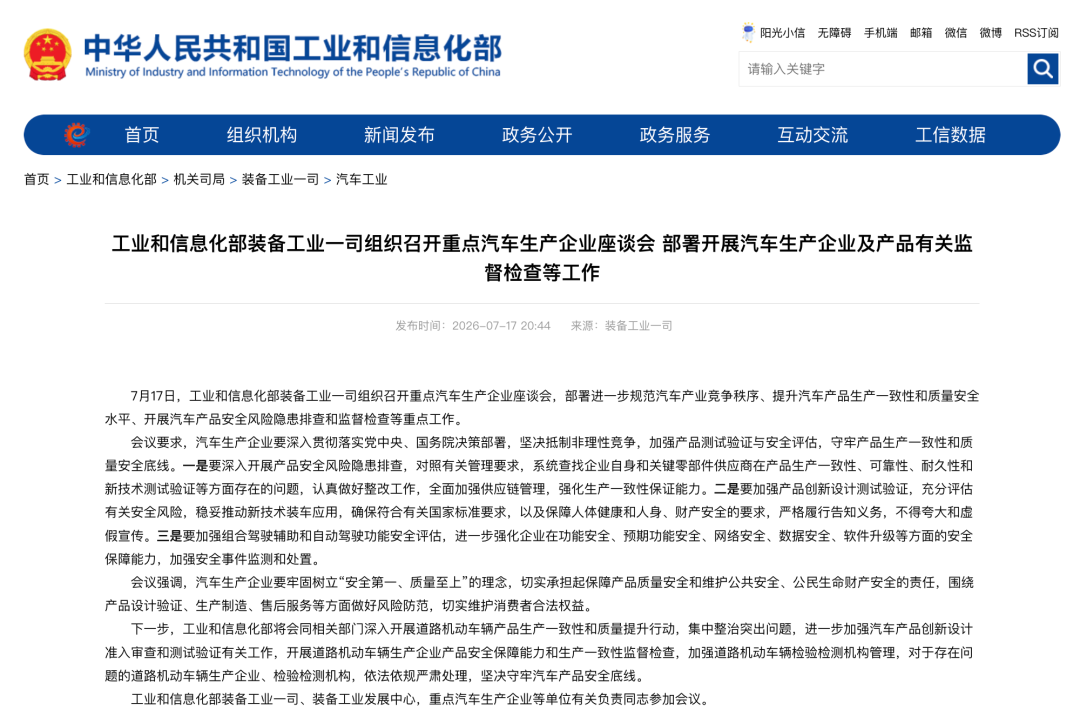
Image Source: Website of the Ministry of Industry and Information Technology
On July 17, the No.1 Department of Equipment Industry of the Ministry of Industry and Information Technology organized a symposium with key automotive production enterprises, deploying key tasks such as further standardizing competition order in the automotive industry, enhancing production consistency and quality safety levels of automotive products, and conducting safety risk inspections and supervision of automotive products. The symposium proposed new requirements at three levels, including demanding that enterprises conduct thorough product safety risk inspections, strengthen product innovation design testing and verification, and enhance safety assessments for combined driving assistance and autonomous driving functions.
At the level of vehicle verification systems, industry standards are undergoing major adjustments. Recently, the National Technical Committee on Automobile Standardization released three recommended national standard amendments on the automobile standard development and revision management system, soliciting public opinions until August 12, 2026. The amendments cover pure electric, hybrid, and fuel cell vehicles, proposing to uniformly set the total reliability driving test mileage for these three types of new energy vehicles at no less than 30,000 kilometers. Notably, on January 21 this year, the Ministry of Industry and Information Technology announced the new "Road Motor Vehicle Production Enterprise Access Review Requirements" and "Road Motor Vehicle Product Access Review Requirements," set to take effect on January 1, 2027. In its policy interpretation, the Ministry stated that it would strengthen requirements for enterprise R&D, production, after-sales service, and product reliability.
Cui Dongshu, Secretary-General of the Passenger Car Market Information Joint Council under the China Automobile Dealers Association, stated that this amendment, which unifies the standard mileage at 30,000 kilometers, signifies that the industry has entered a mature stage and no longer relies on low thresholds for support. The unified mileage can fully expose long-term aging issues in the three-electric systems and chassis, with test rules and fault judgments fully consistent with those for fuel vehicles, balancing fairness and risk management specific to new energy vehicles. This adjustment also aligns national standards with the Ministry of Industry and Information Technology's mandatory access requirements set for 2027, clarifying the bottom line for vehicle launch verification.
But it doesn't stop there. In January this year, the "Safety Technical Requirements for Automobile Door Handles" (GB 48001-2026) was released, banning fully concealed pop-up door handles and fully electronic door handles, requiring each door to be equipped with independent mechanical external and internal handles to ensure manual opening after power failure or collision. In July, the "Safety Requirements for Electric Vehicles" (GB 18384-2025) and "Safety Requirements for Power Batteries Used in Electric Vehicles" (GB 38031-2025) were formally implemented, raising battery thermal runaway requirements from "alarm 5 minutes before fire or explosion" to "no fire, no explosion," and adding bottom impact tests and safety tests after fast-charging cycles.
After more than a decade of rapid expansion, China's new energy vehicle industry has achieved profound accumulations in market scale, capacity building, and supply chain systems. In the short term, increasingly stringent standards and regulations will raise industry entry barriers, eliminating some small and medium-sized players reliant on quick-made models and weak engineering capabilities, accelerating industry consolidation. In the long term, a normalized competitive environment will compel the entire industry to focus on technological R&D and product quality refinement. The industry's core competitiveness may shift from superficial "involution" in launch speed and hardware parameters to deeper competition in R&D systems, verification capabilities, safety accumulations, and long-term reliability.
-
![]()
Nine Days After DeepSeek Raised Prices, Zhipu Enters the Market with One-Tenth the Cost
-
![]()
Ruidu丨Sinonet Half-Year Report: Profit Halved, Computing Power Lags, Caught Between Traditional and New Businesses
-
![]()
NIO’s Battery Swap Stations in Wuhan Transition to State Ownership: What’s Next for the Battery Swap Industry?
-
![]()
Silicon Valley AI Battle Royale: How Anthropic Is Draining OpenAI's 'Superbrain'?
-
![]()
"Quick-Made Cars"? Hit the Brakes
-
![]()
Li Auto Reports H1 2026 Operating Loss of 5.3 Billion Yuan, Cash Reserves Decline by 13.7 Billion Yuan, Vehicle Gross Profit Margin Shows Signs of Rebound!
-
![]()
Chery Leads, Geely Surges: A Review of Overseas Sales of China's Top Five Automakers
-
![]()
Can the Affordable IONIQ V Win Back Consumer Hearts?