Honor Takes the Initiative: Domestic Smartphone Giants Set Their Sights on DJI’s Territory
 03/06 2026
 621
621
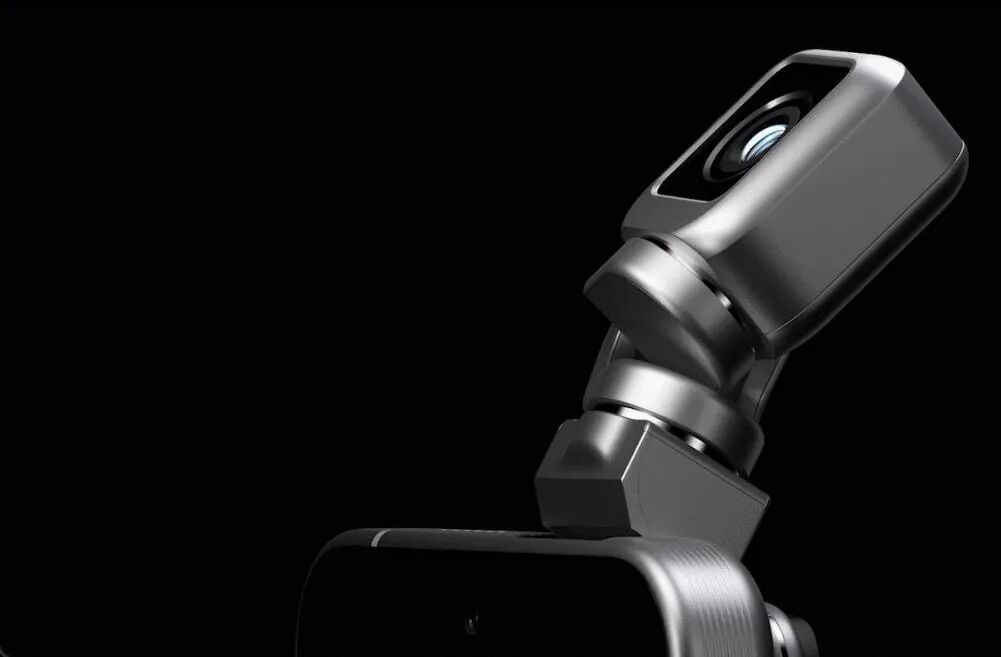
Known as the ultimate Vlog tool with over 10 million units sold, the DJI Pocket is about to face some serious competition.
On March 1, ahead of MWC 2026, Honor unveiled its Robot Phone in Barcelona. This innovative smartphone features a rear camera that can flexibly capture images via a mechanical arm, instantly transforming it into a "handheld gimbal camera."
The Robot Phone is slated to enter the market in the latter half of this year, positioning itself as a formidable rival to the DJI Pocket.
In fact, domestic smartphone companies have long been eyeing the market segment dominated by DJI. Last year, Oppo, Vivo, Xiaomi, and other domestic smartphone makers initiated R&D efforts for "Vlog cameras," with plans to launch products in 2026.
Driving this trend is the persistent pressure on shipment volumes for domestic smartphone brands, necessitating a breakthrough to discover new growth drivers.
IDC forecasts that global smartphone shipments will reach 1.15 billion units in 2026, a 3-4% year-on-year decline from 1.25 billion units in 2025. The anticipated "stagnation in domestic smartphone sales" was confirmed earlier this year, with Counterpoint reporting a 23% year-on-year sales drop in January and revising its annual shipment forecast downward to under 1.1 billion units.
In contrast, the market for handheld gimbal cameras continues to heat up.
Global authority Frost & Sullivan projects that the global market for handheld smart imaging devices will reach RMB 79.93 billion by 2030, boasting a compound annual growth rate (CAGR) of 15.9% from 2020 to 2030, indicating a phase of high growth.
Just as smartphones once replaced digital cameras, handheld gimbal cameras are now poised to supplant the imaging functions of smartphones. Thus, domestic smartphone companies are seeking to transform and capture a share of this burgeoning market.
01 "Quick, Charge!"
From project inception in 2025 to product launch in 2026, domestic smartphone companies are moving at an unprecedented pace!
In October of last year, Honor first announced the Robot Phone concept, integrating gimbal photography capabilities into smartphones—a unique strategy for entering the handheld gimbal camera market. At MWC 2026 in March, Honor further showcased product details and real devices.
OPPO and Vivo have also expedited their development cycles, reducing the time from project inception to launch to just one year.
In September 2025, OPPO officially initiated its handheld gimbal camera project, led personally by Chief Product Officer Liu Zuohu. By late 2025, Vivo also established an internal Vlog camera project. Although the product name remains undisclosed, relevant patents for "gimbal devices" have been filed. Sources indicate that it will feature a combination of Zeiss lenses and micro-gimbal stabilization technology, with a release set for this year.
Based on current information, Xiaomi will not develop products in-house but is collaborating with partners and ecosystem companies to explore the development of Pocket-like products.
A "multi-polar entry" trend is emerging in the handheld imaging device market.
Even the traditionally "conservative players" are moving swiftly, underscoring the market's significance.
This is driven partly by the rising potential of the short video and live-streaming sectors for handheld gimbal camera applications and partly by smartphone makers' inherent advantages in supply chains and technological accumulation. Core competencies such as lens modules, sensors, AI algorithms, and imaging ISPs—areas where phone manufacturers have long invested—facilitate their rapid entry into the "handheld gimbal" market.
More critically, the outlook for the smartphone market this year remains bleak.
02 12% Decline! Sluggish Growth
Global smartphone market growth has already begun to falter.
Counterpoint Research reports that in January this year, all domestic smartphone brands experienced double-digit sales declines: Honor (-26%), Vivo (-29%), OPPO (-19%), Xiaomi (-36%), and Huawei (-27%).
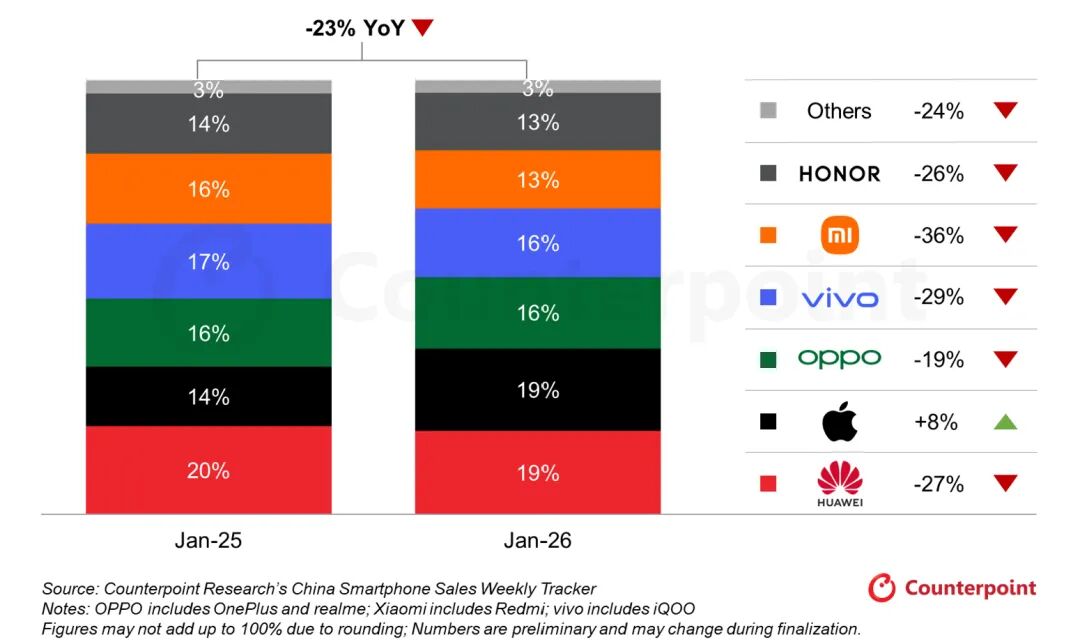
Global smartphone shipments are projected to decline by 12% year-on-year in 2026 to under 1.1 billion units—the lowest annual level since 2013—with this trend expected to extend into 2027. This is linked to rising memory chip prices affecting phone pricing.
Additionally, in recent years, high-end smartphones have faced severe homogenization in competition, with little room for innovation in core parameters like pixels, chips, and screens. In the first half of 2025, the average replacement cycle for Chinese smartphone users reached nearly 33 months, with forecasts suggesting it will extend to 42 months by March 2026.
Phone manufacturers urgently need to escape hardware commoditization and discover new revenue growth drivers. The DJI Pocket series, with an average price of RMB 2,000-3,500, multi-million unit sales, and high profit margins, has validated the mass-market potential of handheld gimbal cameras.
Currently, short videos and Vlogs have become universal creative formats, driving explosive demand for stable, portable, and professional video shooting. Traditional smartphone stabilization relies on EIS (electronic image stabilization) and OIS (optical image stabilization), which struggle to meet stable shooting needs in motion, travel, or outdoor scenarios. Standalone gimbal cameras, requiring no external devices and offering one-touch filming, align perfectly with mass-market lightweight creation demands.
Data shows the global Vlog user base growing at over 20% annually, transforming the handheld gimbal camera market from a niche professional tool into a mainstream consumer electronics product. After the launch of DJI Pocket 3, one in every three camcorders sold in Japan was this model, peaking at a 34.1% market share—proving that gimbal cameras have become a mainstream imaging choice.
Smartphone makers hold natural cross-industry advantages: First, imaging technologies overlap—phone-side stabilization algorithms, sensor calibration, and AI imaging processing can be directly reused. Second, they dominate distribution channels—Vivo and OPPO operate over 300,000 offline stores, covering lower-tier markets far beyond DJI's several thousand experience stores. Third, they enable ecosystem synergy, creating a closed loop from "phone shooting - gimbal creation - terminal editing - social sharing" to enhance user retention.
By entering the handheld gimbal camera market, phone makers aim to maintain control over their imaging ecosystems, lock users into their own ecosystems, prevent users from switching to DJI for professional shooting needs, and boost product premiums and user loyalty through "phone + gimbal" bundles.
But with DJI's Pocket series having become synonymous with "handheld gimbal cameras," can newly entering domestic smartphone companies successfully seize market share from DJI?
03 Countering Pocket?
In October 2023, the DJI Osmo Pocket 3 became a phenomenal success. By August 2025, cumulative sales of the DJI Pocket series exceeded 10 million units, generating nearly RMB 20 billion in revenue.
Sources close to DJI's business suggest the company's 2025 total revenue could reach RMB 85-90 billion, with handheld products (including Pocket and other handheld imaging devices) contributing over 20%.
The DJI Pocket series' long-standing leadership has cultivated a loyal user base and creative ecosystem. Compared to newly entering domestic smartphone companies, DJI Pocket offers more mature hardware stability, rapid tracking algorithms, and overall user experience.
While traditional phone makers can leverage supply chain and algorithmic advantages to accelerate product development, core competencies like hardware structural design, stability performance, and full-system software-hardware collaboration optimization require time to accumulate.
After Honor's Robot Phone launch, users immediately questioned its "mechanical arm hinge quality" and "durability."
Moreover, for standalone handheld gimbal cameras, foundational hardware like imaging sensor size and compact positioning gimbal motors is critical for image quality. Domestic phone manufacturers must solve key challenges like "how to stabilize high-quality images within limited volume" and "how to create products matching DJI's experience."
DJI already holds early-mover advantages in supply chain bargaining power, user word-of-mouth, and channel coverage.
The entry of domestic smartphone makers and other competitors into the Pocket market will intensify industry competition, offering consumers more choices. In the future, the handheld gimbal camera market will shift from "DJI dominance" to a multi-brand coexistence with tiered competition.
However, for domestic smartphone makers to disrupt DJI's long-established dominance, they must achieve imaging and stabilization technologies equal to or surpassing DJI's—and that will take time.
-
![]()
UK Prime Minister Starmer Resigns: Will Chinese Automakers' 'British Springboard' Remain Stable?
-
![]()
7-Day Stock Surge Matches BYD’s Market Cap: Is Zhipu’s $1 Trillion Valuation Justified? | Insights
-
![]()
Dreame Technology's Strategic Withdrawal from the Automotive Arena!
-
![]()
Trillion-Yuan Zhipu: A Capital Illusion Built on a 2.67% Free Float
-
![]()
China Secures Global Spotlight with Vehicle-Road Coordination Safety Standards
-
![]()
Following the Widespread Adoption of Automated Annotation in Autonomous Driving, Is There Still a Place for Traditional Annotation Roles?
-
![]()
From Frenzy to Rationality: Transformation and Reconstruction of the 2026 World Cup Marketing Battle
-
![]()
Imbalance Between Computing Power Supply and Demand Leads to Collective Price Hikes by Leading Notebook Manufacturers