Revenue Soars for Five Straight Years! Unveiling the Wealth Secrets in FuJing Technology's Annual Report
 04/29 2026
 670
670
On April 29, Fujian FuJing Advanced Technology Co., Ltd. (hereinafter referred to as "FuJing Technology") officially published its annual report for 2025 and the first-quarter report for 2026.
According to the financial report data, the company's revenue in 2025 reached RMB 1.158 billion, marking a year-on-year increase of 32.21%. This achievement signifies five consecutive years of growth. The net profit attributable to shareholders was RMB 279 million, up 27.32% year-on-year. Meanwhile, the net profit excluding non-recurring items stood at RMB 262 million, a year-on-year increase of 21.67%.
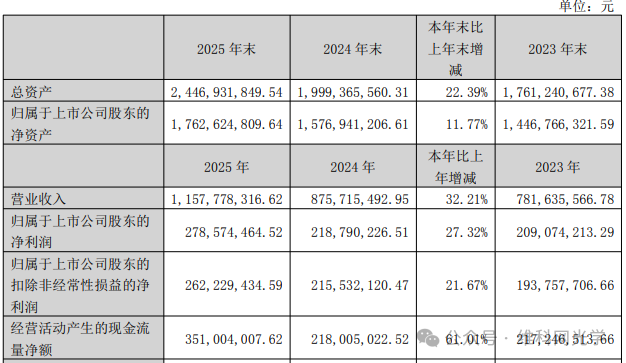
With all three core indicators showing positive trends simultaneously and revenue hitting new highs for five years running, this accomplishment carries significant weight, especially given the broader pressures faced by the manufacturing sector.
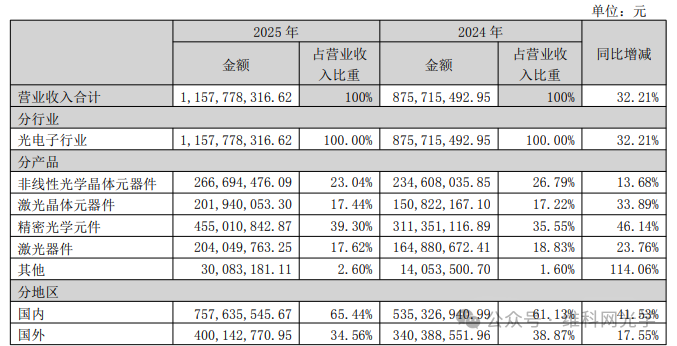
When we delve into its business segments, we find that all three core product lines thrived in 2025. The precision optical components business stood out prominently. It generated annual revenue of RMB 455 million, a substantial 46.14% year-on-year increase. This segment has become the company's largest revenue source, accounting for 39.3% of the total revenue. The growth was propelled by a surge in high-end applications, such as semiconductor inspection.
Zhigi Photonics, a subsidiary focused on nanoscale ultra-precision optical components, achieved remarkable results. In the first half of 2025 (25H1), it recorded revenue of RMB 49.0542 million, a 73.66% year-on-year increase. Its net profit reached RMB 995,200, successfully turning losses into gains. The revenue target for Zhigi Photonics in 2025 is set at approximately RMB 150 million, making it the most promising growth variable in the company's portfolio.
The revenue from laser crystal components reached RMB 202 million for the year, showing a 33.89% year-on-year increase. This growth was driven by the recovery of the industrial laser market and the rising demand for downstream ultrafast and fiber lasers. As a result, there was an increase in the shipments of FuJing Technology's core crystals, such as Nd:YVO4.
Revenue from nonlinear optical crystal components totaled RMB 267 million for the year, a 13.68% year-on-year increase. The company's core products, namely nonlinear optical crystals and laser crystals, hold a leading international position. Based on market research and feedback from major clients, as the world's largest producer of LBO, BBO, and Nd:YVO4 crystal devices, it commands the highest global market share for related products.
The revenue from laser devices reached RMB 204 million for the year, a 23.76% year-on-year increase. Targeting the mid-to-high-end laser device market, the company continues to promote the localization of key components. Its independently developed acousto-optic and magneto-optic devices have gained high recognition from manufacturers of ultraviolet, fiber, and ultrafast lasers, as well as scientific research users. This has gradually broken the long-term monopoly held by foreign laser device suppliers.
From a regional perspective, domestic revenue reached RMB 758 million, a 41.53% year-on-year increase. Meanwhile, overseas revenue was RMB 400 million, up 17.55% year-on-year. The rapid rise of domestic laser equipment is emerging as the core driver of growth.
The rapid growth in performance is no mere coincidence; it is supported by two high-growth sectors. On one hand, industrial ultrafast lasers are gaining popularity in precision manufacturing due to their cold processing advantages, showing strong momentum. On the other hand, the AI boom has spurred demand for computing power, driving the need for high-speed optical modules and, consequently, increasing demand for optical chips and optoelectronic devices.
According to TrendForce data, global shipments of optical transceivers above 800G reached 24 million units in 2025 and are projected to nearly triple to 63 million units in 2026. A severe supply bottleneck has emerged in upstream laser light sources. FuJing Technology, as a core supplier, stands to benefit significantly from this situation.
Beyond favorable market conditions, the company's own competitive strengths are a key driver of growth. Leveraging the technical expertise of the Fujian Institute of Research on the Structure of Matter, Chinese Academy of Sciences, FuJing Technology has built end-to-end capabilities in independent research, development, and production. These capabilities span crystal growth, ultra-precision machining, coating, and laser device manufacturing. This ensures stable product quality and cost control while providing downstream customers with one-stop optoelectronic solutions, significantly enhancing customer loyalty.
In 2025, the company invested RMB 106.2398 million in R&D, an 8.92% increase from the previous year. The investment was primarily directed toward new product development and process upgrades, further solidifying its R&D capabilities and strengthening its core competitive edge. During the reporting period, the company's headquarters filed three new computer software copyright applications and 41 patent applications. It also secured three computer software copyright authorizations and 27 patent authorizations, continuously improving its intellectual property protection system.
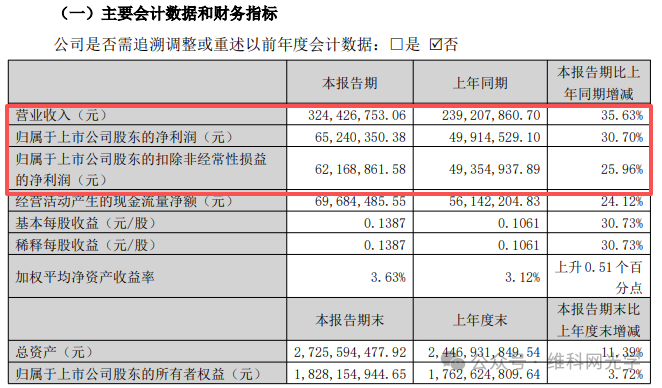
In the first quarter of 2026 (Q1 2026), the company reported revenue of RMB 324 million, a 35.63% year-on-year increase. The net profit attributable to shareholders was RMB 65.2404 million, up 30.70% year-on-year. The net profit excluding non-recurring items was RMB 62.1689 million, a 25.96% year-on-year increase. Revenue growth even surpassed the full-year level of 2025, showing no signs of slowing high-growth momentum.
Overall, from crystals to optics and devices, and from fiber lasers to ultrafast lasers and optical communications, FuJing Technology's product matrix is in harmony with downstream applications across multiple dimensions. It continuously unlocks synergistic advantages through its one-stop platform.
Five consecutive years of growth mark not the endpoint but the beginning of a new phase. At the intersection of AI computing power, high-end manufacturing, and import substitution trends, this optoelectronics leader, which started with crystal growth, is steadily extending its technological moat into a comprehensive platform barrier, with a promising future ahead.
-
![]()
Even Li Auto Is Facing Challenges. Can Xiaomi Make a Mark in the Extended-Range Hybrid Vehicle Market?
-
![]()
Surplus Capacity Leasing vs. Aggressive Expansion: Is Meta's 'Dual Strategy' a Deliberate Move?
-
![]()
German Business Leaders Contemplate 'Embracing the 996 Culture,' While Chinese Auto Workers Simply Aspire to Clock Out On Time
-
Graduating with a Violin Serenade in a Luobo Kuaipao, Enjoying Yunba Rides, and Watching Football with Milu: Shenzhen's Seamless Integration of Driverless Cars into Daily Life
-
![]()
Shenzhen Unveils 331 Nighttime Autonomous Vehicle Routes in Three Months: Even Logistics Embrace Off-Peak Operations in the Vibrant City
-
![]()
Why Did the Lingguang App Lose Its Competitive Edge? A Strong Hand Played Poorly
-
![]()
Monthly Double Building Purchases for 3.8 Billion: Is Duan Yongping Still in Sync with Pinduoduo?
-
![]()
Tesla FSD’s China Debut: How Orbbec’s ‘AI Eyes’ Are Revolutionizing Intelligent Driving and Robotics