How Does the Pixel Count of Autonomous Driving Cameras Affect Computing Power?
 03/27 2026
 658
658
Previously, we discussed how LiDAR channel count affects computing power (Related reading: Why do higher channel count LiDAR systems actually consume less computing power?). As another critical perception hardware in autonomous driving, does the pixel count of cameras affect computing power consumption?
In fact, as pixel counts have increased from early 1.2-megapixel (1.2MP) models to today's mainstream 8MP, or even higher resolutions, the improvement directly determines how far and how clearly a vehicle can "see." Unlike LiDAR, increasing camera pixel counts imposes stricter requirements on the vehicle's computing power platform. These requirements are evident not only in raw data throughput but also in the complexity of backend neural network inference, the processing pressure on the Image Signal Processor (ISP), and memory bandwidth usage.
The Chain Reaction of Image Signal Processing and Physical Throughput
Cameras are crucial in autonomous driving primarily because of their excellent ability to capture semantic information such as textures, colors, and traffic signs—capabilities that LiDAR and millimeter-wave radar struggle to match. As autonomous driving advances from L2 to L4/L5, the system needs to identify smaller objects at greater distances, driving the evolution of cameras from low to high resolution.
The direct advantage of high-pixel cameras is higher pixel density, meaning that within the same field of view, distant objects receive more pixels, thereby improving the accuracy of deep learning models in classifying and detecting those objects.
While increased pixels bring performance improvements, they also introduce significant data throughput pressure. Each frame captured by an image sensor is essentially a collection of massive electrical signals. For example, an 8MP camera operating at 60 frames per second (fps) generates 480 million data points per second. In an autonomous driving perception system, a vehicle may be equipped with 11 or more cameras, meaning that thousands of gigabytes (GB) of raw image signals flood the computing platform every second.
This magnitude of data flow first impacts the Image Signal Processor (ISP). The ISP is responsible for converting the "raw data" captured by the sensor into a machine-understandable format, involving a series of complex mathematical operations such as denoising, color correction, and dynamic range compression.
The higher the pixel count, the more pixels the ISP must process per unit time. Although ISPs are highly integrated hardware modules, their power consumption and heat generation still increase linearly with processing load. To address this challenge, automotive chip architectures are shifting from discrete ISPs to integrated SoCs (System-on-Chips). Integrating ISP functions into the main computing chip significantly reduces latency and power consumption during image data transmission between onboard components.
Even so, the "data movement cost" associated with high resolutions remains expensive. Within an autonomous driving computing unit, every data migration—from the interface to memory and then to the processor core—consumes microjoules of energy. At the scale of hundreds of millions of pixels, these minor energy consumptions accumulate, forming a substantial portion of the system's auxiliary power consumption.
Memory bandwidth is another critical indicator closely tied to pixel count. When high-pixel image data is buffered into memory for AI engine access, it occupies significant amounts of high-speed memory resources such as LPDDR5. Insufficient bandwidth can lead to dropped frames or processing delays, which are extremely dangerous in high-speed driving scenarios.
From Local Features to Global Attention-Based Computation
What truly makes high-pixel cameras significant consumers of computing power is the backend deep learning inference process. Currently, mainstream autonomous driving perception algorithms are mostly based on Convolutional Neural Networks (CNNs) or Visual Transformers. In these models, computational complexity is positively correlated with input image resolution, and in some advanced attention mechanism architectures, computational growth is even proportional to the square of the pixel count.
Under CNN architectures, neural networks extract features by sliding "convolutional kernels" across the image. When image resolution increases from 2MP to 8MP, the size of the feature maps expands proportionally, meaning that the number of convolutional operations increases fourfold.
Although feature map compression can be achieved through stride skipping or pooling techniques, doing so sacrifices the ability to detect small objects enabled by high pixels, thereby undermining the purpose of upgrading the sensor.
For more advanced Transformer architectures, they need to compute the correlations between different regions of the image. This "global attention mechanism," when processing images with millions of pixels, generates extremely large correlation matrices, imposing significant concurrent pressure on the Arithmetic Logic Units (ALUs) of computing chips.
The table below compares the computational requirements (measured in FLOPs) of typical visual perception models under different input resolutions:
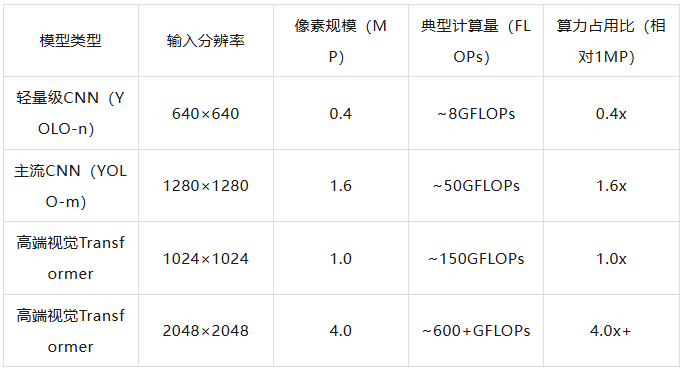
As resolution increases, the number of floating-point operations that AI chips must perform per second rises rapidly. To achieve this high performance within limited chip area, chips like NVIDIA Orin or Tesla FSD must integrate thousands of cores, directly leading to increased SoC power consumption.
Additionally, training models capable of processing high pixels requires exponentially growing cloud computing power. To improve resolution without increasing latency, more efficient operators or model quantization techniques must be employed, but this essentially uses algorithmic refinement to offset the resource deficit caused by increasing pixels.
Autonomous driving perception involves not only obstacle detection but also semantic segmentation, which assigns "attribute labels" (e.g., road, sidewalk, trees, sky) to every pixel in an image. In high-pixel mode, this pixel-level classification task can trap the computing platform in endless computations.
Currently, the industry's response strategy is to adopt "non-uniform sampling" or "multi-scale fusion," using high resolution for fine recognition in the center of the field of view and low resolution in peripheral or unimportant areas like the sky, balancing accuracy and computing power.
Why LiDAR Reduces Load While Cameras Increase It
LiDAR directly obtains 3D spatial coordinates by emitting laser beams and measuring echo times. The more laser channels a LiDAR has, the denser the point cloud becomes. For backend algorithms, denser point clouds make object contours clearer, reducing the need for extensive computing power to estimate object distance or size. Simple clustering and geometric segmentation can complete perception tasks. Thus, to some extent, LiDAR uses hardware expense and data density to simplify perception logic.
The situation with cameras is precisely the opposite. As passive sensors, cameras capture 3D world projections onto a 2D plane. Even with 8MP or higher resolutions, they still lack direct depth information. The perception system must rely on complex neural networks to infer 3D information from object textures, shadows, overlapping relationships, or binocular disparity.
This means that increasing camera pixel counts merely provides richer "guessing material" rather than "ready-made answers." To process these richer details, algorithms require deeper network layers and more complex logic, driving up overall computing power consumption.
This difference determines the marginal computational benefits of the two sensors. Increasing LiDAR channel count, beyond a certain threshold, can effectively reduce the difficulty of algorithm-based blind spot filling and error correction, potentially even simplifying backend fusion algorithms.
In contrast, increasing camera pixel count resembles an endless "computational race," as more pixels mean a greater volume of potentially analyzable information. To avoid wasting this information, the system must continuously invest more computing power to dig deeper.
This also explains why companies like Tesla, which adhere to a "pure vision" approach, must continually upgrade their onboard computers (e.g., from HW3 to HW4, and the planned HW5). A pure vision scheme places all environmental understanding pressure on neural networks, and higher pixels are the only way to improve perception recognition distance.
To achieve longer braking reaction distances, the system must "see" farther pixels, which in turn requires a more powerful "brain" capable of processing this massive data.
How to Address This Challenge?
To solve the aforementioned problems, the autonomous driving field is actively exploring smarter resource management strategies. One of the most mature solutions is the "Region of Interest" (ROI) strategy. Similar to how human drivers focus on rearview mirrors and the road ahead while ignoring irrelevant backgrounds, autonomous driving perception algorithms can dynamically assign computational weights to different regions of an image.
In practice, the system can first use a lightweight small model to scan a large image for potential "candidate boxes" containing vehicles or pedestrians, then call high-pixel data for fine recognition only in these specific regions. This approach retains the long-distance recognition advantages of high pixels while avoiding redundant computations when processing entire high-pixel images.
Another direction is the application of event-based cameras. Unlike traditional cameras, which output images at fixed frame rates regardless of scene changes, event-based cameras only output pixels where light intensity changes.
This means that if the scene remains static, the sensor's output is nearly zero; when an object quickly passes by, it captures edge information with microsecond-level responsiveness. This "change-based" perception mode naturally achieves data sparsity, reducing backend processor computing power consumption by several orders of magnitude.
Currently, some technical solutions are attempting to fuse traditional high-pixel cameras with high-frame-rate event-based cameras, using the former for static semantics and the latter for dynamic capture, thereby enhancing system safety in extreme dynamic scenarios without increasing total bandwidth.
Hardware architecture evolution is also alleviating pixel pressure from the ground up. In traditional computing architectures, image data must travel long paths from sensors to CPUs or GPUs for processing, incurring high data movement energy costs. Emerging "integrated sensing-storage-computing" technologies attempt to integrate computational logic directly into the peripheral circuits of image sensors or even perform basic convolutional operations directly within memory chips.
By filtering out invalid pixels or completing basic denoising and scaling at the data source, the burden on the main SoC can be significantly reduced. This shift from "brute-force computing" to "refined perception" represents the future trend of autonomous driving perception.
Final Thoughts
In autonomous driving, increasing camera pixel counts does significantly drive up computing power consumption. This is not merely due to simple data volume doubling but because richer visual information induces more complex algorithmic processing. While increasing LiDAR channel count can somewhat "simplify" perception logic, camera pixel evolution continues to push computing power to its limits.
-- END --
-
![]()
Internet Valuation Logic Shifts: From Scale Narrative to Profit Accountability
-
VOYAH Struggles to Find Its Niche in the Competitive Auto Market
-
![]()
Maxwell Technologies Gains Indirect Stake in Precision Optics via New Venture
-
![]()
Raising 1.8 Billion! This Domestic Optical Inspection 'Little Giant' is Going Public
-
China's AI 'Normandy Moment': The Explicit and Implicit Threads of BATL
-
![]()
Starting at 4999 Yuan! Nubia RedMagic Gaming Tablet 5 Pro Review: Impressive Performance, But Hefty Price Tag
-
![]()
ByteDance Initiates First Major Management Reform
-
![]()
AI is Quietly Destroying a Trillion-Dollar Industry