Profits Soar Nearly 72%! Sunny Optical's 'Daring Leap'
 03/31 2026
 649
649
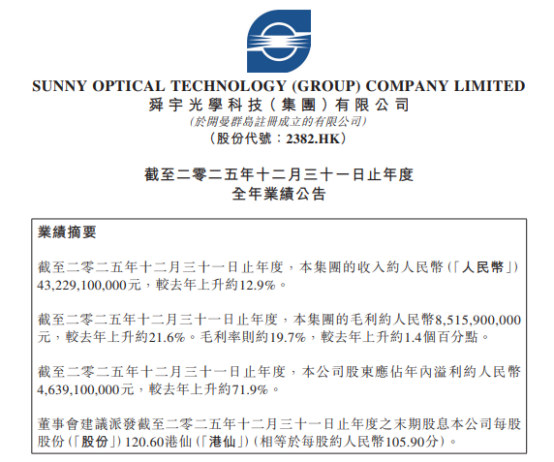
On March 30, Sunny Optical announced that for the year ended December 31, 2025, the Group's revenue was approximately RMB 43.229 billion, up about 12.9% year-on-year. Profit attributable to shareholders for the year was approximately RMB 4.639 billion, up about 71.9% year-on-year.
The Board recommends a final dividend of HKD 120.60 cents per share (equivalent to approximately RMB 105.90 cents per share) for the year ended December 31, 2025, more than doubling from the same period last year.
Against the backdrop of slowing growth in the smartphone market and overall industry pressure, this financial report, showing both revenue and profit growth, reflects the strategic success of Sunny Optical's transformation from a 'smartphone lens leader' to an 'AI vision infrastructure' provider. It may also offer a glimpse into the structural changes across the entire optics industry.
The resilience of the mobile business is the most underestimated aspect of this annual report. In 2025, Sunny Optical's revenue from mobile products reached RMB 27.324 billion, up 8.6% year-on-year. This growth is particularly noteworthy amid a continuous decline in the number of cameras per smartphone—Omdia data shows that smartphones shipped in the second quarter of 2025 averaged just 3.19 cameras, down from 3.37 in the same period last year.
Sunny Optical's response strategy shifted from volume-driven to quality-driven. Technological innovations such as periscope cameras and OIS (Optical Image Stabilization) have expanded from high-end to mid-range models, while new technologies like variable apertures and glass-plastic hybrid lenses are being rapidly adopted. Increased R&D investment in high-end products and integrated development has raised both the average selling price and profitability of mobile camera modules, maintaining the company's global market share leadership.
This product portfolio optimization is directly reflected in gross margins: for the full year of 2025, gross profit reached RMB 8.516 billion, up 21.6% year-on-year, with a gross margin of 19.7%, a 1.4 percentage point increase year-on-year.
In 2025, self-owned brand automakers like BYD ushered in an era of 'intelligent driving democratization,' significantly increasing both the quantity and performance requirements for automotive cameras in high-level intelligent driving systems such as highway NOA (Navigate on Autopilot) and above. According to YOLE Group data, global automotive camera module revenue approached USD 6 billion in 2024, with the industry experiencing rapid growth.
Notably, Sunny Optical is not merely a lens supplier in the automotive sector but has built a complete ecosystem spanning LiDAR transmit/receive lenses, high-definition automotive lenses, HUD optical modules, and integrated vision systems for smart cockpits (DMS/OMS). In 2026, the company plans to mass-produce 17MP high-resolution lenses to meet the stringent perception accuracy requirements of urban NOA.
The automotive business is poised to evolve from a 'second growth curve' into Sunny Optical's core engine, underscoring the structural shift in the optics industry from smartphone-driven to automotive+AI dual-driven growth. Beyond the two main sectors of mobile and automotive, Sunny Optical is quietly laying the groundwork for longer-term growth drivers.
For the full year of 2025, the company's XR business generated RMB 2.393 billion in revenue, down slightly by 7.1% year-on-year, but gross margins surged to 19.6%. While MR-related business saw revenue declines due to weak market demand, smart glasses-related business experienced rapid growth: shipments of smart glasses camera modules soared year-on-year, and the company achieved mass production of large-angle polarized beam splitter lens sets, as well as breakthroughs in miniaturizing and lightweight AR optical engines. Public data shows that optical components account for approximately 40%-60% of the BOM (Bill of Materials) in MR devices and 40%-70% in smart glasses, indicating that XR optical components represent a highly valuable market segment.
The robotics sector is equally noteworthy, as Sunny Optical transitions from a visual solution provider to a vision-based system solution provider. Securities firm research reports indicate that the company currently has over RMB 2 billion in orders. The company categorizes the commercialization of humanoid robots into three stages—manufacturing, commercial, and home scenarios—and proposes tailored visual perception core requirements for each stage.
Currently, the smartphone optics industry is undergoing a paradigm shift from quantity-driven to value-driven growth. The past competitive logic reliant on shipment volume is fading, with technological depth and high-end capabilities becoming the future moat. Automotive optics is evolving from a supplementary business into a core engine, with the market ceiling for automotive optics far from being reached as L3 autonomous driving policies accelerate implementation. Meanwhile, XR and robotics are emerging as an undeniable third growth pole, given the high BOM share of optical components in XR devices and the core value of machine vision for humanoid robots.
Sunny Optical's layout (strategic layout should be translated as 'strategic layout ' or more naturally 'strategic layout ' -> 'strategic layout ' is not standard English; better: 'Sunny Optical's strategic layout in these areas') in these fields may foreshadow the next decade's value highlands in the optics industry. Some industry insiders view Sunny Optical's transformation as a 'daring leap from a smartphone lens leader to AI vision infrastructure,' but judging by the 2025 performance, this leap is landing smoothly.
-
![]()
AI Enters the Second Half: Models Are No Longer Scarce, What’s Truly Scarce Are Computing Power, Scenarios, and Trust
-
![]()
Rediscovering Momentum After Years of Obscurity: What Fuels Changhong TV's Resurgence?
-
【In-depth】Current Market Status and Key Enterprise Analysis of Confocal Fluorescence Microscopes in 2026
-
![]()
Avita Releases Updated Prospectus: Projecting Over 120,000 Vehicle Sales and Over 60% YoY Revenue Growth by 2025
-
![]()
Navigating the Electric Wave: Mercedes-Benz Embraces the Three-Pointed Star, Audi Sheds the Four Rings
-
![]()
BYD Delegates Power, Geely Centralizes It: Which Transformation is Better Suited for the Future?
-
![]()
National Standard for Agent Interconnection Released: Why Might the Physical World Still Be Unreachable Despite Unified Interfaces?
-
![]()
Mobile Imaging: As Capabilities Grow, So Do the 'Add-Ons'—Why?